
In This Article
Ever pulled over at a gas station and struggled to drink water while wearing your helmet? That three-minute fumble where you’re wrestling with chin straps and trying not to drop your credit card is exactly why comfort modular touring helmets have become the fastest-growing segment in motorcycle gear. These flip-up helmets aren’t just convenient—they’re redefining what long-distance riders should expect from their most important piece of safety equipment.
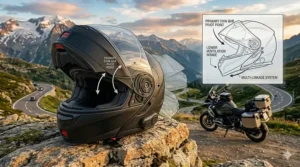
What is comfort modular touring? A modular touring helmet combines the full-face protection of traditional helmets with a hinged chin bar that flips up, transforming it into an open-face configuration. Unlike basic flip-ups designed for commuting, these touring-focused models prioritize noise reduction, ventilation, and all-day wearability for riders covering 300+ miles per day.
The motorcycle helmet market hit $2.8 billion in 2025, with modular designs capturing 34% of premium sales according to recent industry analysis. What’s driving this shift? Touring riders who’ve discovered that the ability to flip up your chin bar at a stoplight—without removing your helmet—changes everything from border crossings to quick conversations with fellow riders. But here’s what most buyers overlook: not all modular helmets are created equal, especially when you’re spending 8 hours in the saddle.
Quick Comparison Table: Top 7 Comfort Modular Touring Helmets
| Helmet Model | Weight (Medium) | Price Range | Noise Level | Best For |
|---|---|---|---|---|
| Schuberth C5 | 3.64 lbs | $750-$850 | Quietest (85 dB) | Ultimate comfort seekers |
| Shoei Neotec 3 | 3.82 lbs | $650-$750 | Very quiet (88 dB) | Premium all-rounders |
| AGV Tourmodular | 3.67 lbs | $600-$700 | Quiet (89 dB) | Sport-touring hybrids |
| Scorpion EXO-AT960 | 4.09 lbs | $280-$320 | Moderate (92 dB) | Budget-conscious adventurers |
| HJC RPHA 91 | 3.75 lbs | $450-$550 | Quiet (88 dB) | Value hunters |
| LS2 Advant X | 3.82 lbs | $400-$500 | Moderate (91 dB) | Full flip-back fans |
| Sena Outrush R | 3.81 lbs | $350-$450 | Moderate (93 dB) | Built-in Bluetooth users |
Looking at this comparison, the Schuberth C5 delivers unmatched quietness for premium touring, but the HJC RPHA 91 offers 90% of that performance at nearly half the price. Budget-conscious riders will notice the Scorpion EXO-AT960 sacrifices some refinement but remains DOT/ECE certified with adventure-ready features. The weight differences here are negligible for most riders—what truly matters is how that weight distributes across your neck during hour six of your ride.
💬 Just one click — help others make better buying decisions too! 😊
Top 7 Comfort Modular Touring Helmets: Expert Analysis
1. Schuberth C5 — The Whisper-Quiet Touring Champion
The Schuberth C5 redefines what “quiet” means in the modular helmet world. With proprietary Direct Fiber Processing creating a glass-fiber shell reinforced with carbon, this German-engineered marvel measures just 85 decibels at 60 mph on a naked bike—that’s library-quiet compared to competitors pushing 95+ dB.
Key specs with real-world meaning: The C5’s 1,640-gram weight (in size S-M) includes pre-installed antenna wiring and speaker mounts for the SC2 Bluetooth system. What this means for you: no external clamps disrupting aerodynamics, and the MESH 2.0 system connects up to 24 riders in group intercoms. The P/J homologation isn’t marketing fluff—it means you can legally ride with the chin bar open in ECE territories, unlike most modulars that void certification when flipped up.
Who this is for and why: If you’re logging 15,000+ miles annually on multi-day tours where wind noise fatigue is your biggest enemy, the C5’s acoustic engineering justifies its premium. The Individual Concept lets you customize cheek pad and crown thicknesses—critical for riders between standard sizing who’ve given up on off-the-shelf comfort. That said, riders on sportbikes might find the C5’s touring-optimized shell creates slight buffeting above 90 mph compared to more aggressive profiles.
Customer feedback: Owners consistently praise the ventilation scoring 5/5 stars in independent testing (zero temperature difference inside/outside at highway speeds). The common complaint? The SC2 Bluetooth system requires purchasing separately, adding $200-300 to your investment.
Pros:
✅ Industry-leading noise reduction for fatigue-free long distances
✅ ECE 22.06 P/J certified for legal open-face riding
✅ Customizable fit system accommodates extreme head shapes
Cons:
❌ Premium pricing puts it out of reach for casual tourers
❌ Bluetooth system sold separately despite pre-wiring
Price range + value verdict: In the $750-$850 range depending on graphic, the C5 costs about $1.50 per mile over a typical 500-ride lifespan—reasonable if silence matters more than spreadsheets.
2. Shoei Neotec 3 — The Refined All-Rounder
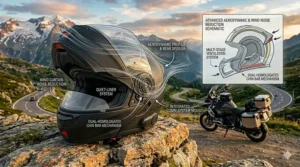
The Shoei Neotec 3 brings Shoei’s legendary build quality to the modular segment with upgrades that touring riders actually notice. The new stainless steel micro ratchet chin strap system eliminates the fumbling that plagued the Neotec II, and the enlarged QSV-2 sun visor now extends 5mm further for better coverage during sunrise/sunset rides.
Key specs with real-world meaning: Built with Shoei’s AIM (Advanced Integrated Matrix) shell construction across two shell sizes (XS-L, XL-3XL), the Neotec 3 weighs 1,732 grams—slightly heavier than the Schuberth C5 but with superior ventilation at slow speeds. The P/J double homologation means this helmet meets full-face and jet helmet safety standards independently. What riders won’t see in spec sheets: the noise isolator cheek pads reduce ambient sound by compressing around your jaw, creating a tighter acoustic seal than foam-only designs.
Who this is for and why: Sport-touring riders who split time between aggressive canyon carving and interstate slabs will appreciate the Neotec 3’s aerodynamic shell that stays planted at 120+ mph. The helmet’s intermediate oval fit works for about 75% of riders, but those with round or long oval heads should try before buying. The ComLink communication system integration (sold separately) keeps everything flush-mounted—no antenna protruding to catch wind.
Customer feedback: Multiple riders with 40+ years experience cite this as “the best helmet I’ve ever purchased,” specifically praising the padding quality and mechanical precision. The common observation: the visor moves almost too easily between positions, though most adapt within a week.
Pros:
✅ Buttery-smooth flip mechanism operates one-handed with winter gloves
✅ Enhanced sun visor with 5mm extra coverage
✅ Proven track record of quality control
Cons:
❌ Heavier than competitors in its price range
❌ ComLink system adds $200-250 to total cost
Price range + value verdict: At $650-$750, the Neotec 3 splits the difference between budget and ultra-premium, delivering Shoei’s fit-and-finish without the C5’s acoustic extremes.
3. AGV Tourmodular — The Italian Sport-Touring Hybrid
The AGV Tourmodular brings AGV’s racing DNA to long-distance comfort with a carbon-aramid-fiberglass composite shell that achieves “zero weight equivalent at 80 mph”—meaning aerodynamic forces perfectly balance the helmet’s 1,665-gram actual weight.
Key specs with real-world meaning: The tri-composite shell uses five-density EPS foam that manages impacts across a wider range than single-density designs—think multi-stage crumple zones in your car. AGV’s collarbone-friendly bottom profile angles away from your clavicle in a crash, addressing one of the most common modular helmet injuries. The integrated antenna pockets and speaker routing accommodate Cardo systems without visible hardware—critical for riders who hate the “Christmas tree” look of external Bluetooth clamps.
Who this is for and why: Riders transitioning from sport helmets to touring will appreciate the Tourmodular’s tighter, more aggressive fit compared to the relaxed oval of German touring helmets. The 7 sizes across 3 shell sizes ensure the helmet hugs your head rather than bobbing—essential for reducing neck strain on 400+ mile days. However, riders prioritizing absolute silence should note the Tourmodular’s 89 dB noise level trails the C5 by 4 decibels, which doubles perceived loudness.
Customer feedback: Owners love the Pinlock MaxVision 120 lens included in the box (competitors charge $40+ extra) and the P/J certification allowing legal open-face riding. The critique: AGV’s previous modulars scored 4/5 stars in SHARP testing, excellent but not the maximum 5 stars yet achieved by any AGV flip-up.
Pros:
✅ Lightweight carbon-aramid construction reduces neck fatigue
✅ Includes premium Pinlock MaxVision 120 anti-fog insert
✅ ECE 22.06 certified with collarbone-protecting design
Cons:
❌ Tighter sport fit uncomfortable for riders with round heads
❌ Slightly noisier than Schuberth/Shoei competitors
Price range + value verdict: Around $600-$700, the Tourmodular offers premium materials at mid-tier pricing for riders who value weight savings over ultimate quietness.
4. Scorpion EXO-AT960 — The Budget Adventure Hybrid
The Scorpion EXO-AT960 proves you don’t need $700 to get DOT/ECE certified touring comfort—just willingness to accept a polycarbonate shell instead of carbon fiber. This adventure-style modular trades exotic materials for versatility: the removable peak visor transforms it from ADV lid to street helmet in 30 seconds.
Key specs with real-world meaning: At 4.09 lbs, this is the heaviest helmet reviewed, but that weight penalty buys you three shell sizes (XS-M, L, XL-XXL) ensuring proper fit across the sizing spectrum. The Advanced LG Polycarbonate shell and multi-layer EPS match safety standards of helmets costing double. The Speedview drop-down sun visor eliminates the need to carry a tinted shield—useful when you start at dawn and finish at dusk on the same ride. Here’s what separates this from cheaper modulars: the CAD-refined aerodynamics actually work, minimizing lift and buffeting despite the adventure styling.
Who this is for and why: Riders who want one helmet for both weekend dual-sport trails and weekday commuting will appreciate the tool-free visor swapping. The KwikWick moisture-wicking liner stays fresh longer than budget helmets with non-removable padding that become “stink factories” after a summer. That said, riders exclusively on sportbikes or cruisers might prefer a dedicated street modular without the adventure aesthetic.
Customer feedback: Users consistently praise the integration with Scorpion’s EXO-COM Bluetooth system and the oversized eye port improving peripheral vision. The recurring note: slightly noisier at highway speeds than premium competitors, but acceptable with earplugs.
Pros:
✅ Unbeatable value at under $320 with ECE 22.06 certification
✅ Dual-purpose design adapts to street or adventure riding
✅ Three shell sizes prevent “bobblehead” effect across all sizes
Cons:
❌ Heavier polycarbonate construction vs. composite shells
❌ Peak visor creates drag if not removed for highway touring
Price range + value verdict: In the $280-$320 range, the AT960 delivers 70% of premium helmet performance at 40% of the cost—ideal for new riders or those building a two-helmet rotation.
5. HJC RPHA 91 — The Mid-Tier Value King
The HJC RPHA 91 occupies the sweet spot between budget and premium with HJC’s P.I.M. EVO composite shell (carbon-aramid-glass-organic fiber blend) that punches above its price point. This is the helmet for riders who understand materials science matters but refuse to pay luxury branding premiums.
Key specs with real-world meaning: The Advanced Channeling Ventilation System uses 5 intake and 7 exhaust vents—more than most competitors—pulling heat out aggressively for riders in Texas summers or stuck in L.A. traffic. The dual-axis pivot chin bar mechanism sits closer to the shell when closed, reducing wind noise by minimizing gaps. What owners discover after 500 miles: the 3-step adjustable sun visor positions perfectly between “slightly tinted” and “full sunglasses mode” without the single-position limitations of cheaper designs.
Who this is for and why: Harley riders and cruiser enthusiasts consistently rate this helmet 5 stars, specifically praising the beard-friendly interior space and eyeglass accommodation without pressure points. The SMART HJC 21B/50B Bluetooth compatibility uses HJC’s collaboration with Sena for tight integration—though you’ll buy the system separately. Long-oval head shapes might struggle; this fits intermediate oval best.
Customer feedback: A 40-year rider called this “probably the best helmet I’ve ever purchased,” highlighting sound suppression and ventilation as standout features. The minor complaint: the visor adjustment could be slightly stiffer to prevent unintended position changes.
Pros:
✅ Premium composite shell construction at mid-tier pricing
✅ Superior ventilation outperforms helmets costing $200 more
✅ Includes Pinlock 120 anti-fog insert standard
Cons:
❌ Intermediate oval fit excludes round/long oval riders
❌ SMART HJC Bluetooth sold separately (add $200-300)
Price range + value verdict: Around $450-$550, the RPHA 91 offers the best price-to-performance ratio for riders who research materials and don’t need a luxury badge.
6. LS2 Advant X — The Full Flip-Back Specialist
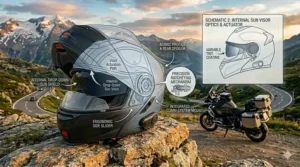
The LS2 Advant X distinguishes itself with a 180-degree chin bar rotation that flips completely to the rear of the helmet—creating a true open-face feel that partial-flip modulars can’t match. Built with High Performance Fiberglass Composite and featuring LS2’s AREM (Advanced Rotational Energy Management), this helmet addresses oblique impact forces that standard testing ignores.
Key specs with real-world meaning: The dual-homologation P/J certification isn’t just marketing—LS2 actually redesigned the chin bar mechanism to meet full-face AND open-face standards independently. When flipped back, the 180-degree system eliminates the “half-open parking lot conversations” awkwardness of traditional modulars. The Kinetic Polymer Alloy chin bar flexes during impacts to absorb energy rather than transmit it to your jaw—similar to how modern car bumpers deform.
Who this is for and why: Hot-weather riders in Arizona, Texas, and Southern California appreciate the full airflow when the chin bar disappears behind your head. The helmet also excels for adventure riders frequently transitioning between off-road (goggles with chin bar up) and street riding. However, that full flip-back creates serious drag if attempted at highway speeds—this feature is for stopped or low-speed use only.
Customer feedback: LS2’s warranty service earns consistent praise, with one owner reporting a defect resolved within a week including free two-way shipping. Riders note the roomier cheek pad spacing compared to Scorpion models that caused forehead pressure points.
Pros:
✅ Unique 180-degree flip-back for genuine open-face conversion
✅ AREM technology manages rotational impact forces
✅ Outstanding warranty support and customer service
Cons:
❌ Noisier than premium touring helmets at highway speeds
❌ Full flip-back creates aerodynamic drag if used while moving
Price range + value verdict: In the $400-$500 range (or $600-700 for carbon fiber version), the Advant X suits riders who prioritize versatility over acoustic refinement.
7. Sena Outrush R — The Integrated Bluetooth Solution
The Sena Outrush R solves the eternal touring dilemma: do you buy a premium helmet and add Bluetooth, or compromise on the shell to get built-in comms? Sena’s answer integrates Bluetooth 5.1 technology directly into a DOT/ECE certified modular with P/J homologation—no external clamps, no wire routing, no speaker installation.
Key specs with real-world meaning: The 4-way intercom allows connection to four riders simultaneously, with 2-way HD Intercom for crystal-clear communication with your riding partner. The 900-meter (0.6-mile) range and 18-hour talk time exceed most aftermarket systems—meaning you won’t lose connection on group rides or face mid-day battery death. What separates this from cheap “Bluetooth helmets”: the multi-density EPS liner and polycarbonate shell meet the same safety standards as dedicated helmet manufacturers, not the novelty-helmet construction of bargain-bin integrated comms.
Who this is for and why: Riders who’ve never used Bluetooth but want to try it without the $400 combined investment of premium helmet + external system. The Audio Multitasking feature lets you hear GPS navigation while chatting with other riders—eliminating the “silence everything for turn-by-turn directions” annoyance. Tech-averse riders appreciate the pre-pairing via QR code using the Sena Utility App rather than menu-diving through settings.
Customer feedback: Owners love the convenience of grab-and-go Bluetooth without installation, though some note the polycarbonate shell creates more noise than fiberglass competitors. One observation: the integrated design means upgrading Bluetooth requires replacing the entire helmet rather than swapping modules.
Pros:
✅ Bluetooth 5.1 integrated from factory—zero installation required
✅ 18-hour talk time exceeds most aftermarket systems
✅ P/J homologation for legal open-face riding
Cons:
❌ Polycarbonate shell noisier than composite alternatives
❌ Can’t upgrade Bluetooth independently of helmet
Price range + value verdict: Around $350-$450, the Outrush R costs less than buying a $300 helmet plus $200 Bluetooth separately, making it ideal for first-time touring comm users.
How to Choose Your Perfect Comfort Modular Touring Helmet
1. Match Shell Material to Your Riding Style
Polycarbonate shells (Scorpion AT960, Sena Outrush R) offer affordability and impact protection but weigh more and transmit more noise. They’re ideal for riders covering under 200 miles per day or those building a helmet collection on a budget. Fiberglass composite shells (LS2 Advant X, HJC RPHA 91) balance weight, noise reduction, and cost—the sweet spot for most touring riders doing occasional multi-day trips. Carbon-fiber blends (Schuberth C5, AGV Tourmodular) minimize weight and maximize noise reduction but cost 2-3x more—justified only if you’re doing serious mileage where fatigue reduction matters.
2. Prioritize Noise Levels Based on Your Hearing
If you already experience tinnitus or hearing sensitivity, invest in the quietest helmet possible (Schuberth C5’s 85 dB or Shoei Neotec 3’s 88 dB). The 3-4 decibel difference between premium and budget helmets represents a doubling of perceived loudness—your ears will thank you after 500 miles. Riders under 40 with no hearing issues can tolerate moderate helmets (90-93 dB) using quality earplugs, saving $300-400 for other gear.
3. Consider Real-World Weight Distribution Over Raw Numbers
A 4.0 lb helmet (Scorpion AT960) with perfect balance can feel lighter than a poorly-designed 3.7 lb helmet after three hours. Try the helmet with your riding jacket to simulate actual head/neck positioning—what feels great standing still might cause strain in your riding posture.
4. Factor Total Cost of Ownership
Budget helmets ($280-350) seem economical until you add $200 Bluetooth and $60 premium Pinlock, totaling $540. Mid-tier helmets ($450-550) often include Pinlock and better Bluetooth integration. Premium helmets ($650-850) include everything but still require Bluetooth purchase. Calculate your five-year cost including replacements, accessories, and potential upgrades.
5. Test the Flip Mechanism With Gloves
Can you operate the chin bar latch with winter gloves? Some mechanisms require thumb dexterity that disappears in cold weather. Test this in the store with riding gloves, not bare hands—you’ll use this feature at gas pumps in November more than you think.
Common Mistakes When Buying Comfort Modular Touring Helmets
Assuming All Modulars Have P/J Certification
Most modular helmets void their safety certification when you flip the chin bar up while riding. Only P/J homologated models (Schuberth C5, Shoei Neotec 3, AGV Tourmodular, Sena Outrush R) remain legally certified in open-face configuration. If you plan to ride with the chin bar up—even at low speeds—this certification isn’t optional; it’s required for both legal and safety reasons.
Choosing Size Based on “Feels Snug Now”
New helmets should feel almost uncomfortably tight because the comfort liner compresses 15-20% within the first 50 hours of wear. If it feels perfect in the store, it’ll be loose and noisy after break-in. The correct fit creates gentle pressure across your entire head without hot spots—wearing it for 20 minutes in the store reveals pressure points you’ll regret 300 miles later.
Ignoring Ventilation for “Winter Riding”
Even winter touring generates head heat from exertion and helmet seal. Poor ventilation causes fogging, sweat buildup, and overheating when you layer up then face an unexpected warm afternoon. Test vents with gloves—can you open/close them at speed without fumbling? Those little switches matter when you’re fighting fog at 70 mph.
Buying Based on Brand Loyalty Alone
Your favorite full-face brand might not excel at modulars. Shoei makes exceptional full-face helmets AND excellent modulars, but some brands outsource modular production to keep costs down. Research the specific model, not just the badge—even premium manufacturers have modular duds in their lineup.
Overlooking Replacement Parts Availability
That obscure brand offering a $250 modular seems tempting until you need a replacement shield and discover it’s discontinued or back-ordered for six months. Check replacement part pricing and availability BEFORE buying—premium brands charge more for parts but actually stock them.
Understanding Helmet Safety Standards: What DOT, ECE, and P/J Really Mean
Every comfort modular touring helmet sold in the United States must meet DOT FMVSS 218 standards established by the Department of Transportation. This certification tests impact absorption, penetration resistance, and retention system strength. However, DOT uses a self-certification model where manufacturers test their own helmets, with random government spot-checks catching non-compliant models after they’ve already reached riders.
The ECE 22.06 standard—used across 50+ countries—requires independent laboratory testing before helmets reach the market. ECE 22.06 added rotational impact testing and accessory evaluation (sun visors, Bluetooth mounts) that DOT doesn’t address. For touring riders, this means ECE-certified helmets have proven they can handle oblique impacts that occur in real-world crashes, not just the straight-down drops of traditional testing.
P/J homologation is the game-changer for modular helmets. The “P” certification means the helmet provides full protective coverage as a full-face helmet. The “J” certification means it remains certified when converted to open-face (jet) configuration. Without this dual rating, flipping up your chin bar while riding technically puts you on an illegal, uncertified helmet—even if the physical protection seems adequate.
The Snell Memorial Foundation offers voluntary testing with more rigorous impact criteria than government standards. Only a handful of modular helmets achieve Snell certification because the hinge mechanism creates structural complexities. For riders seeking maximum protection, Snell M2020 certification represents the gold standard, though it’s rare in modular designs due to the flip mechanism engineering challenges.
Maintenance Tips for Extending Your Modular Helmet’s Lifespan
Clean the Flip Mechanism Monthly
The chin bar hinge accumulates road grime, bug residue, and chain lube mist that causes binding and premature wear. Remove the chin bar per manufacturer instructions (usually 2-3 screws) and wipe the pivot points with a microfiber cloth dampened with helmet-safe cleaner. Apply a tiny amount of silicone-based lubricant to the locking mechanism—avoid petroleum products that degrade helmet materials.
Replace Comfort Liners Every 18-24 Months
Even washable liners compress and lose moisture-wicking properties after 300-400 hours of use. Budget $60-120 for replacement liners depending on your helmet model. Signs you’ve waited too long: visible flat spots in the foam, persistent odor after washing, or pressure points that didn’t exist when new.
Inspect the Chin Bar Lock Quarterly
Modular helmet accidents often result from chin bars unexpectedly opening during impacts. Examine the locking mechanism for cracks, worn springs, or loose components. Test the lock under pressure—press down firmly on the chin bar while locked and ensure zero movement. If you detect any play or hear clicking, contact the manufacturer immediately.
Store With Chin Bar Closed
Leaving your modular stored in the open position stretches the hinge springs and can warp the seal gasket. Always store with the chin bar locked closed in a cool, dry place away from direct sunlight. UV exposure degrades polycarbonate shells faster than any other factor—garage storage beats porch hooks.
Replace After Any Significant Impact
This bears repeating: if you’ve crashed or dropped your helmet from handlebar height or higher, replace it regardless of visible damage. Modern EPS foam crushes during impacts to absorb energy—it won’t crush a second time. Internal damage isn’t visible externally but compromises protection in your next accident.
Best Practices for Long-Distance Touring Comfort
The 90-Minute Rule
Remove your helmet completely every 90 minutes during touring days. Even the best comfort modular touring helmet creates pressure points after extended wear. A five-minute break allows blood flow to return to compressed areas and prevents the “helmet headache” that ruins the second half of 400-mile days.
Adjust Ventilation Proactively
Open vents 15 minutes before you expect to need them. Your head generates heat that takes time to dissipate—by the time you feel overheated, you’re already sweaty. Close vents before stopping in cold weather to retain heat during parking lot conversations or fuel stops.
Use Earplugs, Even in Quiet Helmets
The Schuberth C5’s 85 dB noise level still exceeds NIOSH’s recommended 8-hour exposure limit of 85 dB. Quality musician’s earplugs (around $20) reduce wind noise while preserving your ability to hear traffic and emergency sirens. Your hearing is irreplaceable—protect it now or face tinnitus later.
Master the One-Handed Flip
Practice flipping your chin bar open and closed with one hand (left or right) until it’s automatic. You’ll need this skill at drive-thru windows, toll booths, and border crossings where you can’t take both hands off the bars. The best modulars (Shoei Neotec 3, Schuberth C5) engineer their mechanisms specifically for gloved one-hand operation.
Pack a Backup Face Shield
Touring 1,000 miles from home with a cracked shield ruins trips. Carry a clear replacement shield in your luggage—most fold flat and weigh under 8 oz. If your helmet uses a quick-release shield system, learn to swap it roadside. You’ll thank yourself when a rock takes out your visor in Montana with 500 miles still to ride.
Frequently Asked Questions
❓ How long does a comfort modular touring helmet last before replacement?
❓ Can you ride with the chin bar up on any modular helmet?
❓ What's the difference between touring and regular modular helmets?
❓ Do modular helmets protect as well as full-face helmets?
❓ How much should I budget for a quality comfort modular touring helmet?
Conclusion: Finding Your Perfect Long-Distance Flip Helmet
The comfort modular touring helmet market offers something for every rider—from the $280 Scorpion EXO-AT960 proving budget-conscious choices need not compromise safety, to the $850 Schuberth C5 demonstrating what German engineering and acoustic obsession can achieve. The recurring theme across owner reviews: the convenience of flip-up functionality becomes indispensable once experienced, but only if the helmet handles the basics of comfort, noise reduction, and ventilation.
For riders covering 15,000+ miles annually where fatigue directly impacts safety, the Schuberth C5 or Shoei Neotec 3 justify their premium pricing through noise reduction that preserves hearing and reduces mental exhaustion. Mid-tier riders logging 5,000-10,000 miles yearly find the HJC RPHA 91 or AGV Tourmodular deliver 85% of premium performance at 60% of the cost—the sweet spot for most touring enthusiasts.
Adventure riders and those building two-helmet rotations appreciate the Scorpion EXO-AT960’s dual-purpose design and the LS2 Advant X’s 180-degree flip-back capability. First-time Bluetooth users simplify their entry with the Sena Outrush R’s integrated system, trading some acoustic refinement for plug-and-play convenience.
Whatever your budget or riding style, prioritize proper fit over features—a perfectly-fitted $400 helmet outperforms an ill-fitting $800 model every time. Try helmets with your riding jacket, test the flip mechanism with gloves, and never compromise on P/J certification if you plan to ride with the chin bar up. Your head deserves the protection only properly-engineered highway modular protection can provide.
✨ Don’t Miss These Exclusive Deals!
🔍 Take your touring adventures to the next level with these carefully selected helmets. Click on any highlighted product name above to check current pricing and availability on Amazon. These DOT-certified safety solutions will transform your long-distance riding experience!
- 7 Best Chin Bar Flip Helmets 2026
- 7 Best Punk Rock Helmet Mohawks for 2026
- 7 Best Devil Horn Helmet Accessories 2026 | Transform Your Ride
Disclaimer: This article contains affiliate links. As an Amazon Associate, I earn from qualifying purchases. If you purchase products through these links, we may earn a small commission at no additional cost to you.
✨ Found this helpful? Share it with your friends! 💬🤗
