
In This Article
Somewhere between “I need pockets for my whole life” and “I don’t want to die if I lowside at a stoplight” sits a very specific piece of gear: motorcycle cargo pants for daily riding. If you commute five days a week, you already know the problem with regular jeans — they’ve got exactly two decent pockets, zero abrasion protection, and a seat that shreds the second you hit asphalt at speed. Cargo-style riding pants exist to fix that. They borrow the pocket layout you already love from tactical and outdoor gear, then quietly stuff Kevlar, Cordura, and CE-rated armor into the parts of the pant that actually meet the ground first.
What is motorcycle cargo pants for daily riding, exactly? It’s a category of riding trousers built with multiple utility pockets — often six or more — combined with abrasion-resistant liners and removable knee or hip armor, designed for commuters who need to carry gear on the bike and look presentable off it. According to the National Highway Traffic Safety Administration, riders should keep arms and legs fully covered, ideally with leather or heavy denim, and that’s exactly the gap cargo pants are built to close — read NHTSA’s full motorcycle safety guidance here.
This guide walks through seven real, currently available cargo-style riding pants — budget, mid-range, and premium — with honest analysis of what the specs actually mean for your commute, not just a list of features copied off a product page. We’ll also cover pocket layout, off-bike versatility, maintenance, and the regulatory stuff (CE ratings) that actually matters when you’re choosing gear that has to protect you, not just look tough.
Quick Comparison: Motorcycle Cargo Pants for Daily Riding
| Pants | Best For | Protection | Price Range |
|---|---|---|---|
| CQR Duratex Ripstop Tactical Cargo Pants | Budget commuters who want max pockets | Ripstop fabric, armor pockets (armor sold separately) | Under $60 |
| HWK Dual Sport Cordura Cargo Pants | Hot-climate daily riders | Cordura shell, CE-ready armor pockets | $60-$90 range |
| Tourmaster Flex LE 2.0 Over-the-Boot Cargo Pants | All-weather commuting | Carbolex/ballistic polyester, CE knee armor | $130-$160 range |
| Alpinestars Copper V2 Denim Pants | Style-conscious daily riders | Aramid-lined stretch denim, Bio-Flex knee armor | $170-$200 range |
| uglyBROS Motorpool Cargo-K Jeans | Riders who want cargo pockets AND denim toughness | Para-aramid liner, CE armor pockets | $200-$230 range |
| EndoGear San Marino Noir Kevlar Cargo Pants | Riders who won’t compromise on protection | CE Class AA Kevlar lining, D3O-compatible armor | $230-$270 range |
| Klim Dakar Adventure Cargo Pants | Adventure/touring commuters hauling gear | 630D/840D Cordura, CE Level 2 armor | Premium, $400+ range |
Looking at the table above, the spread tells its own story: CQR Duratex Ripstop Tactical Cargo Pants and HWK Dual Sport Cordura Cargo Pants win on pocket count and price but ask you to source your own armor, while EndoGear San Marino Noir Kevlar Cargo Pants and Klim Dakar Adventure Cargo Pants bake in serious abrasion certification at a real cost premium. If you’re commuting short distances at city speeds, the middle of this table — the Tourmaster Flex LE 2.0 or Alpinestars Copper V2 — tends to hit the sweet spot between coverage and comfort. Riders logging highway miles or carrying heavier daily loads should lean toward the CE-certified end of the list, because at higher speeds the fabric and armor quality stop being a nice-to-have and start being the entire point.
💬 Already have a favorite on this list? Give it a click — help other daily riders find their pick faster!😊
Top 7 Motorcycle Cargo Pants for Daily Riding: Expert Analysis
1. CQR Duratex Ripstop Tactical Cargo Pants — most pockets for the money
The CQR Duratex Ripstop Tactical Cargo Pants were originally built for law enforcement and military use, and that pedigree shows up in the pocket count alone — six-plus cargo, thigh, and utility pockets, more than almost anything else on this list. The 65% polyester/35% cotton Duratex ripstop weave is engineered so tears don’t propagate across the fabric, which matters more than it sounds: a small snag on regular cargo pants can turn into a foot-long rip after one bad slide, while ripstop fabric contains the damage to a small patch. The water-resistant and stain-resistant treatment also means these hold up through a surprise rain shower without turning into a soggy mess by the time you clock in.
Based on the spec comparison, these are best suited to riders who want maximum daily-carry capacity and are willing to add their own CE-rated knee and hip armor inserts separately, since the pants ship armor-pocket-ready but not always armor-included depending on the configuration. Reviewers consistently note the elastic waistband holds up well through active riding postures — standing on pegs, shifting weight — without the pinching some tactical pants cause at the hip. If you can’t verify a specific batch includes armor, treat that as a separate purchase, not an assumption.
Pros:
- ✅ Highest pocket count of any pant in this guide
- ✅ Ripstop construction resists tear propagation
- ✅ Water- and stain-resistant treated fabric
Cons:
- ❌ Armor is sold separately on some configurations
- ❌ Tactical styling reads more “range day” than “coffee shop”
The CQR Duratex Ripstop Tactical Cargo Pants typically run under $60, making them the cheapest entry point on this list — solid value if you’re willing to invest a bit more in aftermarket armor inserts to bring the protection up to daily-riding standard.
2. HWK Dual Sport Cordura Cargo Pants — lightest Cordura shell for hot climates
The HWK Dual Sport Cordura Cargo Pants use a water-resistant Cordura textile shell that’s noticeably lighter than the ballistic-nylon overpants further down this list, which is exactly why riders in Texas, Arizona, and Florida gravitate toward them. Cordura fabric, a nylon-based textile originally developed for military packs and now standard across motorcycle gear, is commonly used in riding jackets and pants because it delivers abrasion resistance without leather’s bulk — you can read more about how the material is engineered on Wikipedia’s motorcycle protective-equipment overview. Impact protection comes via included armor pockets at the knees, with hip armor available depending on configuration.
What most buyers overlook about this model is how much the dual-sport cut helps off the bike — the slightly roomier thigh and calf accommodate riding boots without bunching, but the waist and seat sit close enough to pass as regular outdoor pants once you’re off the motorcycle. Reviewers consistently mention the fabric breathes far better in summer heat than denim alternatives, though a few note the stock armor is on the thinner side and worth upgrading if you ride year-round.
Pros:
- ✅ Lightweight Cordura shell breathes well in heat
- ✅ Dual-sport cut fits comfortably over riding boots
- ✅ Included armor pockets at the knees
Cons:
- ❌ Stock armor padding is on the thinner side
- ❌ Limited color options compared to competitors
Expect to pay in the $60-$90 range for the HWK Dual Sport Cordura Cargo Pants, which puts them squarely in budget territory — a smart pick for hot-weather commuters prioritizing airflow over maximum armor thickness.
3. Tourmaster Flex LE 2.0 Over-the-Boot Cargo Pants — best over-the-boot fit for commuters
The Tourmaster Flex LE 2.0 Over-the-Boot Cargo Pants use a 600-denier Carbolex shell with 1680-denier ballistic polyester reinforcing the seat and knees — in practice, that means the highest-wear zones get the toughest fabric while the rest of the pant stays flexible enough for a daily commute. The over-the-boot design with a lower-leg zipper and stretch gusset means you can step directly into them over your work shoes or boots in under a minute, which is a genuine time-saver on a rushed Monday morning. A removable waterproof rain liner and a zipped vent behind the cargo pockets round out a design clearly built around actual commuting, not just track days.
Based on the spec comparison, this is the pick for riders who want true four-season versatility without stepping up to adventure-touring pricing. Reviewers consistently praise the SAP pocket and dual cargo pockets for carrying a wallet, phone, and multitool without needing a backpack for short trips, and the accordion knee panel gets specific credit for reducing the “bunching” feeling other overpants cause when seated.
Pros:
- ✅ Over-the-boot zip design speeds up gearing up
- ✅ Removable rain liner adds real weather versatility
- ✅ Reinforced 1680-denier seat and knee panels
Cons:
- ❌ Bulkier fit than slim jean-style alternatives
- ❌ Traditional uniform look isn’t for everyone
Priced in the $130-$160 range at the time of research, the Tourmaster Flex LE 2.0 Over-the-Boot Cargo Pants deliver strong all-weather value for riders who commute regardless of forecast.
4. Alpinestars Copper V2 Denim Pants — most stylish off-bike look
The Alpinestars Copper V2 Denim Pants take the opposite approach from a tactical overpant — they’re built to look like a normal pair of five-pocket jeans, right down to the stitched rivets and reflective turn-up hem, while hiding an aramid fiber liner across the seat, hips, and knees. Bio-Flex knee armor is slim enough to disappear under the denim, and the pants carry CE Category II certification under PPE Regulation (EU) 2016/425, a European standard that verifies the garment has passed independent impact and abrasion testing rather than just claiming protection on the label.
Here’s what to weigh: this is the pick if your commute ends somewhere you’ll be seen in the pants all day — an office, a client meeting, a bar after work — because nothing about them screams “motorcycle gear.” Reviewers consistently note the stretch denim breaks in like a favorite pair of jeans within a few wears, though several also mention the classic five-pocket layout offers less on-bike storage than true cargo designs, so pair them with a tank bag or backpack if you carry more than a wallet and keys.
Pros:
- ✅ CE Category II certified aramid-lined protection
- ✅ Passes as everyday denim off the bike
- ✅ Bio-Flex knee armor stays discreet and low-profile
Cons:
- ❌ Fewer storage pockets than true cargo designs
- ❌ Hip armor sold separately on some versions
The Alpinestars Copper V2 Denim Pants typically land in the $170-$200 range, a fair ask for a brand riders trust and a pant that genuinely doubles as daily-wear denim.
5. uglyBROS Motorpool Cargo-K Jeans — toughest Kevlar-lined cargo denim
The uglyBROS Motorpool Cargo-K Jeans split the difference between the denim styling of the Copper V2 and the pocket capacity of a true cargo pant, adding thigh cargo pockets to a heavyweight denim base lined with para-aramid fiber that stretches and breathes rather than sitting as a stiff patch. The “-K” suffix in uglyBROS naming specifically flags the aramid liner inclusion, and the brand accepts removable CE-approved impact protectors at the hip and knee, so you’re not locked into whatever armor ships in the box.
What most buyers overlook about this model is how the cargo pockets are placed high on the outer thigh rather than low near the knee, which keeps them clear of the seat position and avoids the classic complaint of cargo pockets digging in while riding. Aggregated review sentiment on heavyweight riding denim in this category consistently flags the break-in period as longer than lighter Cordura pants — expect a few rides before the denim relaxes into a comfortable fit.
Pros:
- ✅ Cargo pockets placed clear of the seated riding position
- ✅ Para-aramid liner stretches instead of stiffening the ride
- ✅ Accepts upgradeable CE armor at hip and knee
Cons:
- ❌ Longer break-in period than synthetic alternatives
- ❌ Heavier than Cordura-based cargo pants
At a price range of roughly $200-$230, the uglyBROS Motorpool Cargo-K Jeans sit in premium-denim territory, justified by the combination of storage and abrasion-resistant construction you won’t find on a standard five-pocket jean.
6. EndoGear San Marino Noir Kevlar Cargo Pants — highest CE Class AA cargo protection
The EndoGear San Marino Noir Kevlar Cargo Pants represent the top of the abrasion-resistance ladder in this guide, built around a full Kevlar lining rated to CE Class AA — the highest abrasion classification available in motorcycle textile gear. Kevlar, the para-aramid synthetic fiber developed by DuPont, is one of the specialized man-made fabrics riding gear makers rely on for abrasion resistance, and you can read more about how the fiber performs under stress on Wikipedia’s Kevlar entry. In practical terms, aramid fibers hold up to roughly five times the tensile strength of steel at equivalent weight, which is why a Class AA rating carries real weight with safety-focused riders rather than being just a marketing bullet point.
Based on the spec comparison, this is the pick for commuters riding at higher average speeds — highway on-ramps, longer stretches between lights — where a low-speed tumble becomes a genuine slide. Reviewers consistently praise the multi-pocket cargo layout for daily carry, and D3O-compatible armor pockets let you upgrade to premium impact protection without buying a new pant. The tradeoff, honestly, is price: this level of certified protection isn’t cheap, and the heavier denim base runs noticeably warmer in summer than the Cordura options earlier in this list.
Pros:
- ✅ CE Class AA — the highest textile abrasion rating available
- ✅ D3O-compatible armor pocket upgrades
- ✅ Smart pocket placement for daily-carry essentials
Cons:
- ❌ Premium price relative to the rest of the category
- ❌ Runs warmer than lighter Cordura alternatives
Expect to pay in the $230-$270 range for the EndoGear San Marino Noir Kevlar Cargo Pants — a legitimate investment for riders who treat protection as non-negotiable.
7. Klim Dakar Adventure Cargo Pants — best for adventure and off-road cargo hauling
The Klim Dakar Adventure Cargo Pants are built from a 630-denier Cordura main body with heavy-duty 840-denier Cordura reinforcing the knees and seat — noticeably burlier construction than anything else in this lineup, and it shows in how the pant handles abrasion at speed on gravel or broken pavement, not just asphalt. Multiple cargo and utility pockets are positioned for glove-friendly access, useful when you’re stopping to check a map or grab a multitool mid-ride rather than after you’ve parked and pulled your gloves off.
Here’s what to weigh: this is overkill for a five-mile city commute, but for riders whose “daily ride” includes unpaved shortcuts, gravel driveways, or a mixed-surface route to work, the extra durability margin is the entire point of paying premium pricing. Reviewers consistently describe the fit as accommodating for adventure boots and layering, with the telescoping waist adjustment getting specific praise for staying comfortable through a full riding day. On the downside, several reviewers note the premium fabric weight makes these noticeably hotter in stop-and-go summer traffic than the lighter Cordura or denim options above.
Pros:
- ✅ 630D/840D Cordura construction built for mixed terrain
- ✅ Glove-friendly cargo pocket access while riding
- ✅ Telescoping waist stays comfortable all day
Cons:
- ❌ Highest price point in this guide
- ❌ Runs hot in stop-and-go summer traffic
The Klim Dakar Adventure Cargo Pants sit at the premium end, generally starting around $400 and climbing depending on configuration — a legitimate splurge for adventure-leaning daily riders, but overkill if your commute never leaves pavement.
Setting Up and Maintaining Your Utility Riding Pants: A 30-Day Guide
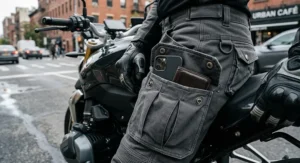
New utility riding pants need a break-in period, and skipping it is the single most common first-month mistake. In week one, wear the pants on short rides only — 20 to 30 minutes — so you can identify pressure points from armor before committing to a two-hour commute. Adjust armor position within the internal pockets; most CE knee armor has a few inches of vertical travel, and getting it centered over your kneecap rather than slightly high or low makes a real difference in both comfort and actual crash protection.
By week two, wash-test the pants following the manufacturer’s care label exactly — Kevlar and aramid liners generally tolerate machine washing on cold, but tumble-drying heat can degrade some armor foams over time, so air-drying is the safer default. Weeks three and four are when most riders report the denim or Cordura shell finally stops feeling stiff and starts moving with the body rather than against it. A common early mistake: overloading cargo pockets with heavy items like tools or a phone charger, which shifts weight during turns and can create pressure points against the outer thigh. Load heavier items in pockets closer to the hip, and save thigh pockets for lightweight items like a wallet or keys.
Real Riders, Real Rides: Off-Bike Versatility and Everyday Scenarios
If you’re a college student commuting eight miles daily between class and a part-time job, off-bike versatility matters as much as protection — you’re not changing clothes in a parking lot between rides. The Alpinestars Copper V2 Denim Pants or uglyBROS Motorpool Cargo-K Jeans make the most sense here: both pass as regular denim in a lecture hall or behind a retail counter, while still carrying CE-rated protection underneath.
If you’re a tradesperson riding a bike to job sites and need to carry tools, chalk lines, or a tablet for site plans, pocket capacity outranks styling. The CQR Duratex Ripstop Tactical Cargo Pants or HWK Dual Sport Cordura Cargo Pants offer the storage volume for that without the higher price tag of the premium options.
If you’re a suburban commuter doing 15-25 miles each way on mixed surface roads — some highway, some gravel shortcuts — the Tourmaster Flex LE 2.0 Over-the-Boot Cargo Pants or Klim Dakar Adventure Cargo Pants earn their keep through weatherproofing and reinforced construction that a pure city commuter pant doesn’t need. Matching the pant to the actual environment you ride through, not just the price tag, is what keeps daily gear from becoming an expensive drawer decoration.
Common Problems With Motorcycle Pants With Pockets (And How to Fix Them)
Problem: Cargo pockets flap or bounce at speed. Loose thigh pockets aren’t just annoying — they create drag and, on some designs, snag risk. Solution: look for models with a secondary compression strap or snug elastic pocket closure, and avoid overpacking pockets that weren’t designed to carry heavy items.
Problem: Armor migrates during a ride. This is common on budget pants with looser internal pockets. Solution: check that armor pockets have a hook-and-loop or snap retention point, and reposition armor before every long ride rather than assuming it stayed put from last time.
Problem: Pants feel great on the bike but look wrong at your destination. Solution: this is exactly the tradeoff the denim-style options on this list solve — if off-bike appearance matters, prioritize the Alpinestars Copper V2 Denim Pants or uglyBROS Motorpool Cargo-K Jeans over tactical-styled alternatives.
Problem: Overheating in stop-and-go traffic. Heavier Cordura or full-denim pants trap heat. Solution: look for models with vented panels behind the cargo pockets, like the Tourmaster Flex LE 2.0, or size up slightly to improve airflow without sacrificing armor fit.
Problem: Pockets with pockets — too many zippers to remember what’s where. Solution: designate specific pockets for specific items every time (phone always in the same pocket, keys in another) so muscle memory takes over instead of patting yourself down at every red light.
How to Choose Motorcycle Cargo Pants for Daily Riding
- Start with your commute distance and speed. Short, low-speed city rides can lean toward lighter Cordura options; highway-adjacent commutes should prioritize CE-certified Kevlar or aramid liners.
- Count the pockets you’ll actually use. More pockets sound appealing, but each one you never touch is just added bulk — match pocket count to your real daily-carry habits.
- Check the CE rating, not just the marketing copy. Look for CE Category II / PPE Regulation (EU) 2016/425 or a stated Class A/AA rating rather than vague phrases like “reinforced” or “tactical.”
- Consider off-bike appearance if your commute ends somewhere public. Denim-style cargo pants blend in; tactical-styled pants don’t.
- Factor in climate. Hot, humid regions favor lighter Cordura; colder or wetter climates benefit from included rain liners and thicker shells.
- Try the armor position before buying if possible. Ill-fitting knee armor is the single biggest daily-comfort complaint across every price tier.
- Budget for armor upgrades separately if needed. Some budget cargo pants ship armor-pocket-ready without full armor included — factor that into your true total cost.
Multi-Pocket Design: What Actually Matters
Not all multi-pocket design is created equal, and pocket count alone is a misleading spec. What actually matters is placement relative to your seated riding position — pockets positioned low near the knee tend to interfere with foot-peg movement and bunch uncomfortably when seated, while pockets set higher on the outer thigh, like on the uglyBROS Motorpool Cargo-K Jeans, stay clear of both the seat and your knees through a full range of motion.
Closure type matters just as much as placement. Velcro-only pocket flaps loosen over months of use and vibration, while zippered pockets with a secondary snap — seen on the CQR Duratex Ripstop Tactical Cargo Pants — hold small items far more reliably on rough roads. Finally, look at access while seated: a pocket that requires standing up to reach isn’t useful mid-commute, so test whether you can actually get a hand into each pocket while sitting on the bike before committing to a purchase.
Cargo Style Riding Gear vs Traditional Motorcycle Pants
Traditional motorcycle pants — think leather race pants or plain textile overpants — are built almost entirely around protection and aerodynamics, with storage as an afterthought or entirely absent. Cargo style riding gear flips that priority order without necessarily sacrificing protection, which is exactly why it’s become the default choice for daily commuters rather than track-day riders.
The tradeoff is real, though: cargo pockets add bulk and, on lower-end pants, occasionally compromise the fit of armor underneath if the pocket construction interferes with the internal armor sleeve. Reviewers consistently note that well-designed cargo pants, like the EndoGear San Marino Noir Kevlar Cargo Pants, solve this by routing pocket construction around the armor pockets rather than through them. Traditional pants still win for pure track or sport riding where minimal bulk and maximum aerodynamics matter more than carrying a wallet and keys — but for the daily commuter who needs to be functional both on and off the bike, cargo-style construction is the more practical category almost every time.
Common Mistakes When Buying Tactical Riding Pants
The biggest mistake buyers make with tactical riding pants is assuming “tactical” automatically means “motorcycle-rated.” Plenty of tactical-styled pants are built for hiking or law enforcement foot patrol, not motorcycle abrasion resistance — always confirm a CE rating or stated aramid/Kevlar lining rather than assuming ripstop fabric alone is sufficient for a slide at 30 mph.
A second common mistake is buying based on looks alone and skipping the armor-fit test entirely. Ill-fitting armor is worse than no armor in some cases, because it can shift out of position during a fall. Third, riders often underestimate break-in time and judge a pant as uncomfortable after one ride, when heavier materials like the uglyBROS Motorpool Cargo-K Jeans genuinely need several wears to soften. Finally, don’t ignore sizing charts in favor of your regular pants size — riding pants are frequently cut differently to accommodate armor and a seated riding position, so a size that fits your everyday jeans may run tight once armor is inserted.
What to Expect: Real-World Performance
On paper, spec sheets describe denier ratings and armor certifications. In practice, what you’ll actually notice day to day is subtler. Lighter Cordura pants like the HWK Dual Sport Cordura Cargo Pants genuinely do feel cooler within the first ten minutes of a ride compared to heavier denim, but that airflow advantage narrows once you’re moving above 40 mph and wind cools everything regardless of fabric weight.
Armor comfort is the performance factor riders underestimate most. Well-fitted knee armor, like the Bio-Flex system in the Alpinestars Copper V2 Denim Pants, becomes essentially unnoticeable within a few rides — you forget it’s there until you actually need it. Poorly fitted armor, by contrast, announces itself constantly through pressure points at stoplights and while walking. Pocket capacity performs differently in real use than on a spec sheet too: six pockets sound generous until you realize four of them are hard to reach one-handed while riding, which is why testing accessibility while seated matters more than counting pockets on a store rack.
Long-Term Cost & Maintenance
The upfront price tag is only part of the total cost of ownership for tactical riding pants and cargo-style gear generally. Budget options like the CQR Duratex Ripstop Tactical Cargo Pants carry a lower sticker price but often require a separate armor purchase to reach full daily-riding protection, which can close much of the price gap with mid-range competitors once you add it up.
Maintenance costs matter too. Kevlar and aramid liners generally hold up for years of regular washing without losing abrasion resistance, but armor foam does degrade with age and UV exposure — most manufacturers recommend armor replacement every three to five years of regular use, regardless of visible wear. Denim-based options like the uglyBROS Motorpool Cargo-K Jeans or Alpinestars Copper V2 Denim Pants tend to have the longest usable lifespan because the base fabric itself is inherently durable, while lighter Cordura shells on budget pants show wear at stitch points sooner under daily commuting stress. When you factor in armor replacement, expected lifespan, and off-bike versatility that saves you from buying separate “regular” pants, the premium options frequently work out to a lower cost-per-wear over a three-year window than repeatedly replacing budget gear.
Safety, Regulations & CE Certification Guide
In the United States, there’s no federal mandate requiring specific motorcycle apparel, but the safety case for it is well documented. The Motorcycle Safety Foundation’s personal protective gear guidance outlines the core categories riders should prioritize beyond the helmet, and it’s worth reading the full MSF protective gear resource before assuming any pair of pants with pockets qualifies as real riding gear.
The CE marking system is the most reliable protection benchmark to look for regardless of country. PPE Regulation (EU) 2016/425 requires independent testing for abrasion resistance, seam strength, and impact protection before a garment can carry the CE Category II mark, and the Class A/AA system further distinguishes lower-speed urban-rated gear (Class A) from higher-protection options (Class AA) rated for a broader range of impact and slide scenarios. When comparing spec sheets, a stated CE rating is a far more reliable signal than adjectives like “heavy-duty” or “reinforced,” which carry no independent verification behind them at all.
✨ Don’t Miss These Exclusive Deals!
🔍 Take your daily commute gear up a notch with these carefully selected cargo pants. Click on any highlighted pick to check current pricing and availability, and gear up with protection that actually holds up on the road.

FAQ: Motorcycle Cargo Pants for Daily Riding
❓ Are motorcycle cargo pants actually safe for daily commuting?
❓ Can I wear motorcycle cargo pants off the bike?
❓ How many pockets do I actually need on riding pants?
❓ Do cargo pockets interfere with motorcycle armor?
❓ How often should I replace the armor in my riding pants?
Conclusion
Choosing motorcycle cargo pants for daily riding really comes down to matching three variables honestly: how far and fast you actually ride, how much daily-carry storage you genuinely use, and whether your destination requires the pants to double as normal clothing. Budget options like the CQR Duratex Ripstop Tactical Cargo Pants and HWK Dual Sport Cordura Cargo Pants earn their spot for short, low-speed commutes on a tight budget. Mid-range picks like the Tourmaster Flex LE 2.0 Over-the-Boot Cargo Pants and Alpinestars Copper V2 Denim Pants balance protection and versatility for the widest range of riders. And for commuters who want the highest verified protection or genuine off-road capability, the EndoGear San Marino Noir Kevlar Cargo Pants and Klim Dakar Adventure Cargo Pants justify their premium pricing with certified abrasion resistance you can actually verify.
Whichever pair you land on, the underlying principle from every source in this guide stays the same: regular jeans were never built for a motorcycle, and a few extra dollars spent on rated protection is a small price against the alternative.
Recommended for You
- 7 Best Commuter Motorcycle Pants for Short Rides (2026)
- Kevlar Lined Jeans vs Armored Jeans: 7 Picks Tested for 2026
- Armored Motorcycle Pants vs Leather Pants: 7 Real Picks (2026)
Disclaimer: This article contains affiliate links. As an Amazon Associate, I earn from qualifying purchases. If you purchase products through these links, we may earn a small commission at no additional cost to you.
✨ Found this helpful? Share it with your friends! 💬🤗
