
In This Article
Picture the office lobby at 8:52 a.m. Helmet under one arm, jacket zipped, and a quick glance down at your feet. No buckles, no shin plates, no tank-tread soles. Just a clean pair of shoes that nobody looks at twice. That’s the promise of motorcycle sneakers that look like normal shoes: footwear built to crash-test standards but dressed like everyday trainers.

Riders who commute know the tension well. Proper boots protect you but clomp through a grocery store like a diving suit. Regular sneakers feel great and offer almost nothing when a bike lands on your foot. Wikipedia’s overview of motorcycle boots summarizes research showing lower-extremity injuries are among the most common in crashes, and that ankle-height or taller protective footwear is associated with a lower risk of foot and ankle fractures. So the question isn’t whether to protect your feet. It’s how to do it without looking like you’re headed to a track day.
This guide answers that with seven real, currently sold riding shoes. It covers stealth motorcycle sneakers, casual looking riding shoes, hidden armor inserts, everyday shoe styling, and office-appropriate footwear, all built from published specs and aggregated retailer review sentiment. Nothing here is a fabricated “I tested it” story. Prices are ranges only, since they move constantly; always check current price before you buy.
Quick Comparison: 7 Motorcycle Sneakers That Look Like Normal Shoes at a Glance
Here’s the fast version. Review signals come from retailer pages at the time of research, and small review pools are flagged as such.
| Product | Looks Like | Price Range | Weather | Review Signal | Best For |
|---|---|---|---|---|---|
| TCX Street 3 WP | Skate high-top | $150–$200 | Waterproof | Positive summaries; comfort and versatility | All-weather daily riders |
| Sidi Lynx | Retro basketball hi-top | Around $180 | Not waterproof | Too few ratings to judge | Sneakerheads who want clean lines |
| Cortech Menace | Classic canvas trainer | Around $100 | No waterproofing claimed | 4.5/5 (17 reviews) | Budget buyers |
| Dainese Metractive Air | Knit running trainer | $160–$210 | Vented, not waterproof | 4.5/5 (18 reviews) | Hot-climate commuters |
| REV’IT! Arrow 2 Air | Minimalist suede sneaker | $200–$240 | Vented, not waterproof | 4.5/5 (6 reviews, small pool) | Style-first urban riders |
| Gaerne G.Rome Gore-Tex | Plain leather ankle shoe | Around $200+ | Gore-Tex waterproof | Not verifiable | Office-appropriate footwear seekers |
| Cortech Slayer Checkered | Checkerboard skate shoe | Around $140 | No waterproofing claimed | 4.5/5 (4 reviews, tiny pool) | Skate-style fans |
Looking at the table, the Cortech Menace delivers the lowest entry price for genuinely certified protection, while the TCX Street 3 WP and Gaerne G.Rome Gore-Tex are the only two here with a waterproof membrane. If summers are brutal where you ride, the Dainese Metractive Air trades weather protection for airflow. Budget buyers should note that the cheapest pair isn’t the least protective, but it is the least refined.
💬 Just one click — help others make better buying decisions too!😊
What Are Motorcycle Sneakers That Look Like Normal Shoes?
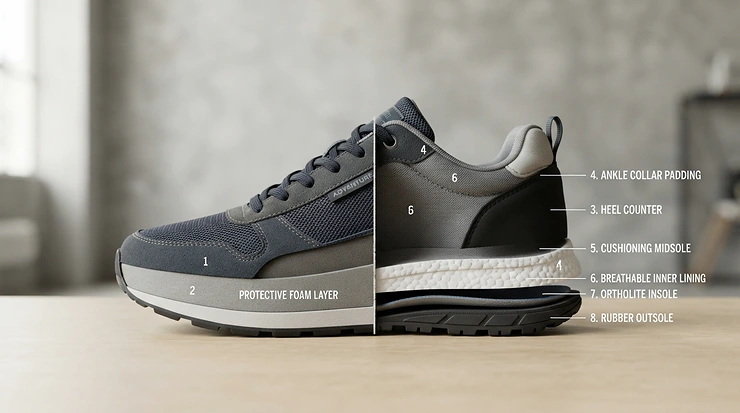
Motorcycle sneakers that look like normal shoes are certified riding shoes disguised as everyday footwear. They pair a casual upper (canvas, suede, knit, or microfiber) with concealed protection: a crush-resistant midsole, padded or armored ankle cups, and reinforced heel and toe zones. The goal is safety on the bike and no costume off it.
You’ll see them called riding sneakers, moto shoes, urban riding shoes, or “motosneakers.” The label matters less than what’s underneath. Three things separate a real riding shoe from a regular sneaker wearing a marketing sticker:
- A stiffened sole that resists twisting and crushing.
- Impact protection at the ankle bones, heel, and toes.
- Abrasion-resistant materials that survive a slide better than thin mesh or fashion canvas.
The good news is that the category has matured. Five years ago, “casual” often meant “chunky with a logo.” Today, several models are close enough to streetwear that a coworker would need to look hard to spot the difference. The catch is that the disguise always costs a little bulk, because protection takes physical space.
Top 7 Motorcycle Sneakers That Look Like Normal Shoes: Expert Analysis
1. TCX Street 3 WP — waterproof skate-shoe disguise
The TCX Street 3 WP keeps a high-top skate silhouette while quietly adding a T-Dry waterproof membrane, so a surprise downpour on the commute doesn’t turn your socks into sponges. Its suede-finished leather upper rides over a ZPLATE midsole, a shank that resists sideways crushing yet still flexes when you walk. D3O padding covers the ankle bones, OrthoLite cushioning sits underfoot, and the shoe meets EN 13634:2017.
Based on the spec comparison, that midsole is the real story. It’s what keeps the shoe from folding under a bike’s weight, and it’s the one thing a pair of skate shoes can’t offer. This is the strongest pick for riders who want one pair to handle commute, errands, and the pub. The trade-off is bulk, since it sits visibly chunkier than a true skate shoe. Retailer notes also mention a wide footbed, which helps broader feet.
Aggregated retailer review summaries describe riders praising comfort, protection, and versatile style, while some flag limited breathability and wet-weather grip.
Pros:
- ✅ Waterproof membrane with a genuine sneaker look
- ✅ D3O ankle protection plus a crush-resistant midsole
- ✅ Comfortable for all-day walking
Cons:
- ❌ Warmer in summer than vented rivals
- ❌ Bulkier than a real skate shoe
Expect a price in the $150–$200 range; it’s strong value if you ride through wet weather, so check current price.
2. Sidi Lynx — cleanest retro hi-top
The Sidi Lynx is about as close to a classic basketball hi-top as riding footwear gets. Its microfiber exterior uses doubled material in slide-prone zones, and Sidi’s Fortex insert acts as a flexible shank, so the sole resists twisting and crushing without turning walking into a chore. The outsole is designed to grip footpegs, and the CE-certified impact protection stays hidden beneath the surface.
What most buyers overlook is that the simplicity is the feature. There are no visible armor panels, no loud panels of contrast plastic, and the black colorway is about as understated as motorcycle footwear gets. That makes it one of the better stealth motorcycle sneakers for riders who dislike anything that screams “moto.” The downside is that there’s no waterproof version, so it’s a fair-weather or cover-when-wet choice. Price is also the sticking point: around the cost of a pair of premium retro basketball shoes.
On reviews, I couldn’t verify a meaningful customer pool. One major retailer showed only a handful of ratings at the time of research, all positive but too few to lean on.
Pros:
- ✅ Understated hi-top design that reads as regular sneakers
- ✅ Flexible shank keeps walking natural
- ✅ Doubled material in slide zones
Cons:
- ❌ No waterproof option
- ❌ Expensive compared with similar shoes
Expect around $180; it’s a design-led buy, worth it if the look is the priority.
3. Cortech Menace — Chuck Taylor look, budget price
The Cortech Menace is the shoe for anyone who wishes Converse would build a CE-certified All Star. Heavy-duty poly canvas replaces cotton for better abrasion resistance, and the shoe adds molded heel and toe caps, contoured ankle protectors, and an anti-twist midsole. An Armanox reactive comfort sole handles cushioning.
On paper, that’s a lot of protection for a modest price, which makes the Cortech Menace the obvious entry point for first-time riding-shoe buyers. What the spec sheet won’t tell you, but the reviews suggest, is that the fit has quirks: narrow toe boxes and occasional rub spots show up in complaints. It also looks chunkier than real Chucks, which matters if you’re chasing a truly invisible profile.
Aggregated retailer feedback is warm. Riders praise comfort, protection, and style, and describe the shoe as lightweight, with a 4.5/5 average across 17 reviews at one retailer.
Pros:
- ✅ Legit certified protection at a low price
- ✅ Familiar canvas sneaker look
- ✅ Light and comfortable on the bike
Cons:
- ❌ Narrow toe box for some feet
- ❌ Chunkier than real canvas trainers
Expect around $100, and the value verdict is excellent, provided your feet agree with the fit.
4. Dainese Metractive Air — best airflow for hot commutes
The Dainese Metractive Air looks like a running trainer, thanks to a highly ventilated knit upper. Beneath that sits reinforced heel and ankle protection, rigid inserts at the ankle bones with soft D-Foam on the inside, and a Groundtrax asymmetrical outsole with differentiated gear and brake zones. It’s certified to EN 13634 (Category II), and a lace pocket on the tongue keeps loose laces away from the shifter.
The clever part is the lace garage. Long laces near a gear lever are a genuine hazard, so tucking them away is safety engineering disguised as tidiness. According to RIDE Adventures’ review, the shoe borrows technology from TCX, which Dainese recently acquired, and it moves air better than anything else the reviewers had tried in hot weather. That’s precisely why it’s a poor choice for cold mornings: the same mesh that saves you in July will let the wind straight through in November.
Retailer reviews average 4.5/5 across 18 ratings, though a soft toe box is one reviewer complaint.
Pros:
- ✅ Outstanding ventilation for summer riding
- ✅ Lace garage adds practical peace of mind
- ✅ Trainer-style knit looks properly casual
Cons:
- ❌ Too breathable for cooler weather
- ❌ Toe box feels soft
Expect roughly $160–$210; it’s a solid summer-specialist buy.
5. REV’IT! Arrow 2 Air — quiet suede minimalism
The REV’IT! Arrow 2 Air wraps suede, polyester jacquard, and seamless TPU film into a sneaker that reads as premium European minimalism. Protection includes SEESOFT ankle discs, a thermoformed heel cup and toe cap, and a TPU gear-shift pad. The FLEXBLADE sole, visible through a small cutout as a design detail, damps impacts while retaining sideways rigidity. Laces and a side zipper make it easy to slip on.
What that means in practice is fast entry on a cold morning and a look that suits chinos as easily as jeans. One caution from the research: a retailer noted that the first shipment of the standard Arrow 2 carried a safety tag that didn’t match its actual certification paperwork. It’s a good reminder to check the certification documents for any riding shoe rather than trusting hangtags alone.
Retailer ratings sit at 4.5/5, but from only six reviews, so treat that as a hint rather than a verdict.
Pros:
- ✅ Refined suede-and-mesh styling
- ✅ Zipper plus laces for easy entry
- ✅ Heel reflection adds visibility
Cons:
- ❌ Vented design, not for rain
- ❌ Small review pool limits confidence
Expect $200–$240, a fair price for the design and the finish.

6. Gaerne G.Rome Gore-Tex — most office-ready leather
The Gaerne G.Rome Gore-Tex is the quiet one in this lineup. RIDE Adventures describes its supple full-grain leather upper as classic and unassuming, backed by a Gore-Tex waterproof membrane. An easy-entry side zipper gets a rubber gusset to keep water out, and a sculpted insole adds support. Impact and crush protection is described as generous, and the sole has an MX-inspired grip.
Here’s the honest analysis: this reads as a plain leather ankle shoe rather than a sneaker, which makes it the most natural fit for office-appropriate footwear. It won’t pass as a skate shoe, but under trousers it looks like a decent casual boot. The tread is more aggressive than a pure sneaker, which is the price of that grip. It was the most expensive pair on that list.
I could not verify a meaningful pool of customer reviews for this model at the time of research, so treat the praise above as editorial opinion.
Pros:
- ✅ Full-grain leather upper looks polished
- ✅ Gore-Tex waterproofing with zip entry
- ✅ Grippy sole suits varied surfaces
Cons:
- ❌ Priciest option in this roundup
- ❌ Customer review data hard to verify
Expect around $200 or more; the value verdict is fair for waterproof leather that dresses up.
7. Cortech Slayer Checkered — skate nostalgia with armor
The Cortech Slayer Checkered takes the classic black-and-white checkerboard skate-shoe look and adds molded heel and toe armor, dual-density ankle protectors, and a uni-directional anti-twist midsole. The outer shell combines heavyweight canvas and suede, over medium-density foam and a breathable mesh lining.
If you grew up in checkerboard slip-ons, the nostalgia lands. It’s honest to say that the pattern makes this the loudest choice here, so it’s not among the best stealth motorcycle sneakers. Reviewers also note it feels bulkier and stiffer than a true sneaker, which fits its heavy-duty construction. You’re trading some walkability for more visible toughness.
Retailer ratings average 4.5/5, but across only four reviews, which is far too few to be conclusive.
Pros:
- ✅ Iconic skate-shoe pattern
- ✅ Armor at heel, toe, and ankles
- ✅ Strong protection for the price
Cons:
- ❌ Bulky and stiff to walk in
- ❌ Loud pattern isn’t discreet
Expect around $140, which is decent value if you love the style.
Why Regular Sneakers Fail on a Motorcycle
Your favorite trainers do one job well: cushioning a walk. A motorcycle asks for something else entirely. In a fall, a foot can be pinned under hundreds of pounds of bike, and a standard sneaker sole folds like a taco. Dedicated riding shoes need a stiffened, crush-resistant sole for exactly that reason, and it’s the feature casual sneakers lack.
The second gap is material. Most fashion sneakers use thin split-grain leather, mesh, or fabric that can wear through quickly on asphalt. The third is the ankle, where a certified riding shoe adds padding or armor and a regular trainer leaves bone under a thin layer of fabric.
The evidence points the same way. A trauma-hospital study published in PMC found a significant association between inadequate protective footwear and more frequent, more severe soft-tissue injuries at the ankle and foot in motorcycle accident victims. It’s one regional study, so don’t treat it as universal, but it fits the broader pattern in the literature.
Casual sneakers can feel like a fair trade-off until the moment they aren’t. Motorcycle sneakers that look like normal shoes exist so you don’t have to choose between looking normal and being protected.

How to Choose Motorcycle Sneakers That Look Like Normal Shoes
Follow these six steps, and the shortlist writes itself.
- Confirm real certification. Look for EN 13634 on the label or in the paperwork. According to SATRA’s summary of the standard, testing covers abrasion, impact cut resistance, and transverse rigidity, so the label represents actual lab work rather than marketing.
- Check the sole first. A shank or midsole plate that resists twisting matters more than any upper. Flex the shoe sideways in a store; it shouldn’t fold easily.
- Match the upper to your climate. Knit and mesh breathe but leak in rain; leather with a waterproof membrane stays dry but runs warmer.
- Look for protection at the ankles, heel, and toe. Armor at both ankle bones is better than one side only.
- Prioritize fit. Sneaker-style riding shoes often run narrow, so try them with your usual socks and mind the toe box.
- Set your disguise level. Decide whether “normal” means skate shoe, office leather, or gym trainer, and let that steer the shortlist.
Stealth Motorcycle Sneakers: How Low-Profile Is Too Low-Profile?
Stealth motorcycle sneakers are the pairs that vanish into an ordinary outfit. Think black or gray, no visible armor panels, and a shape close to something you’d buy at a mall shoe store. The Sidi Lynx, the REV’IT! Arrow 2 Air, and the Dainese Metractive Air lead here.
There’s a physical limit, though. Protection takes volume: a shank, armor cups, a reinforced heel. Every gram of protection you add shows up somewhere in the silhouette. The Cortech Menace, for instance, is convincing from a few steps away but looks chunkier than real canvas trainers up close. Stealth is a spectrum, not a switch.
A practical test is the “coworker glance test.” Would someone notice these at lunch? If your answer depends on how carefully they’re looking, the shoe is doing its job. If it depends on whether they’ve ever heard of Alpinestars, it isn’t.
Also remember that stealth motorcycle sneakers should never be quieter than they are safe. A model that trades away the sole stiffness or ankle padding to look sleeker has missed the point.
Hidden Armor Inserts: What’s Really Inside Your Riding Sneakers
Hidden armor inserts are what turn a canvas shoe into protective gear. They come in three main flavors: molded heel and toe caps, ankle-bone protectors, and a midsole plate. The materials vary from hard TPU to flexible impact foam such as D3O.
| Product | Ankle | Heel / Toe | Sole Rigidity |
|---|---|---|---|
| TCX Street 3 WP | D3O over ankle bones | Reinforced toe box | ZPLATE midsole |
| Sidi Lynx | CE-certified impact protection | Doubled material in slide zones | Fortex flexible shank |
| Cortech Menace | Contoured ankle protectors | Molded heel and toe caps | Anti-twist midsole |
| Dainese Metractive Air | Rigid inserts plus D-Foam inside | Reinforced heel | Groundtrax outsole resists deformation |
| REV’IT! Arrow 2 Air | SEESOFT ankle discs | Thermoformed heel cup and toe cap; TPU shift pad | FLEXBLADE sole |
| Gaerne G.Rome Gore-Tex | Impact protection (check maker specs) | Impact protection (check maker specs) | Crush protection |
| Cortech Slayer Checkered | Dual-density ankle protectors | Molded heel and toe armor | Anti-twist midsole |
Reading this table, the TCX Street 3 WP and Dainese Metractive Air stand out for pairing soft padding with rigid inserts, which is friendlier to walking. The Cortech Menace and Cortech Slayer Checkered rely on more obvious molded parts, which explains their extra bulk. For the Gaerne G.Rome Gore-Tex, the published detail was thinner, so check the maker’s spec sheet before you commit.
One important caveat: armor helps with impacts, but it won’t do much for hyperflexion injuries. It’s damage reduction, not a force field.
Casual Looking Riding Shoes vs Boots vs Regular Sneakers
Casual looking riding shoes sit in the middle of a three-way trade-off, and the table shows where.
| Factor | Riding Shoes | Motorcycle Boots | Regular Sneakers |
|---|---|---|---|
| Crush-resistant sole | Yes (certified models) | Yes | No |
| Ankle protection | Ankle-height armor | Taller, more coverage | None |
| Walkability | Good | Fair to poor | Excellent |
| Looks off-bike | Blends in | Obviously moto | Normal |
| Best for | City commutes, errands | Touring, long rides | Not for riding |
| Example picks | Cortech Menace, REV’IT! Arrow 2 Air | Not covered here | Not applicable |
The analysis is straightforward. Boots still win on coverage for long trips and higher speeds, since more of the shin and ankle is protected. Casual looking riding shoes win the daily-life vote because you can actually wear them all day. Regular sneakers only win on comfort, and that’s a poor prize when your foot is under a bike.
For most city and commuter riding, riding shoes are the sensible compromise. If your typical day involves highway speeds, long distances, or off-pavement terrain, step up to a taller boot instead.
Office-Appropriate Footwear: Which Riding Shoes Survive a Dress Code?
Office-appropriate footwear is where most riding shoes fall apart. A skate-style high-top passes in a creative office and fails in a bank. Here’s how the seven picks map to dress codes.
- Smart casual and formal-adjacent: The Gaerne G.Rome Gore-Tex is the strongest candidate. Its leather upper looks polished with dark chinos or wool trousers.
- Business casual: The REV’IT! Arrow 2 Air, in a dark suede colorway, sits comfortably between sneaker and dress shoe.
- Relaxed or startup offices: The Sidi Lynx, Cortech Menace, and Dainese Metractive Air all work.
- Weekend-only: The Cortech Slayer Checkered is a fun off-duty pair, not a boardroom one.
A couple of practical points. Ask what “sneakers” means in your workplace’s dress policy, since some allow only leather or solid neutral colors. And keep a spare pair of laces in a neutral color, as the Harley-Davidson Wrenford approach of swapping lace colors shows how small details shift a shoe’s tone. If you commute in a rougher pair, you can also keep a second, dressier shoe at the office, though that defeats some of the point.
The best office-appropriate footwear for riders is simply the pair you’ll actually wear every day, because protection only works when it’s on your feet.

Everyday Shoe Styling: How to Make Riding Shoes Disappear Into Your Wardrobe
Everyday shoe styling is mostly about proportion and color. Riding shoes carry a little more volume than fashion trainers, so balance them with the rest of your outfit.
Pair them with the right trousers. Straight or slightly tapered jeans and chinos let the shoe sit naturally. Very skinny trousers can make the shoe look oversized, while wide-leg pants swallow the profile. Some riders note that you can’t tuck trousers into narrow-profile shoes the way you could with boots.
Lean on color. Black, charcoal, and gray keep the eye off the details. Save white or checkered pairs for casual outfits.
Match materials. Suede and leather uppers, such as those on the REV’IT! Arrow 2 Air and Gaerne G.Rome Gore-Tex, feel dressier. Canvas and knit, like the Cortech Menace and Dainese Metractive Air, read sportier.
Tuck the laces. A lace garage or elastic keeper, like the one on the Dainese Metractive Air, isn’t just for safety. It also cleans up the look.
Good everyday shoe styling is subtraction. The fewer moto cues the shoe shows, the more it behaves like a normal shoe.
Features That Actually Matter (And Those That Don’t)
Matter:
- A certified, stiffened sole. This is the biggest protective feature.
- Ankle protection on both sides. One-sided armor leaves a gap.
- A secure, lace-safe closure. Loose laces near a shifter are a real hazard.
- Fit. A shoe that rubs won’t get worn, so it won’t protect you.
Matter less than marketing suggests:
- Waterproofing badges. Useful in rain, but they make shoes warmer, so match them to your climate.
- Aggressive tread. Great for footpegs, less useful for pavement walking.
- Reflective trim. Nice, but a small bonus rather than a reason to buy.
The bottom line: if two shoes look equally good, pick the one with the better sole and ankle protection, not the fancier logo.
Long-Term Cost & Value
Cost per wear tells the real story. Take a pair in the $150–$200 range that you wear about 200 commuting days a year for two years. That’s roughly 400 wears, or somewhere around 40–50 cents each. A pair at the lower end, like the Cortech Menace at around $100, drops toward 25–30 cents.
Compare that with the price of even a minor foot injury: medical bills, missed work, and months off the bike. Retailer summaries and injury studies both point the same direction, which is that foot protection is cheap insurance.
Longevity varies. Leather and suede tend to hold up well with care, and knit uppers can wear faster. Vented shoes will need more frequent replacement in rainy climates. Also consider replacing shoes after a significant crash, since impact protection may be compromised even if the shoe looks fine.
Practical Usage Guide: Your First 30 Days in Riding Shoes
Week 1: Fit and break-in. Sneaker-style riding shoes often run narrow, and sizing complaints show up across several models. Try them with your usual socks, and consider sizing up half a size if you’re between sizes. Wear them around the house before your first commute.
Week 1–2: Learn the closure. Practice tucking laces into the lace garage or elastic keeper until it’s automatic. Check that nothing hangs near the shifter.
Week 2: Check the certification. Confirm that the label and paperwork show EN 13634. BSI’s summary of the standard explains that it covers protection, ergonomics, and marking, so the label should be present and readable.
Weeks 2–4: Build a care routine. Brush off suede weekly and avoid soaking non-waterproof pairs. Let wet shoes dry at room temperature, not on a heater. Swap insoles if they compress.
Common first-month mistakes:
- Skipping the break-in and getting rub spots on the first long ride
- Wearing vented shoes in heavy rain
- Leaving laces loose near the shifter
Real-World Scenarios: Three Riders, Three Picks
The downtown office commuter. Nine miles each way, a mild climate, and a business-casual dress code. A budget of around $200–$240 points toward the REV’IT! Arrow 2 Air for its refined look, or the Gaerne G.Rome Gore-Tex if the dress code leans formal and rain is common.
The year-round rain rider. Twelve-mile commute, mixed weather, one pair for everything. The TCX Street 3 WP is the logical choice: its T-Dry membrane and crush-resistant midsole cover the widest range of conditions, and its skate look is forgiving.
The budget-conscious student. Short summer rides to campus and part-time work. The Cortech Menace at around $100 delivers certified protection at the lowest price in this roundup, and its canvas look fits campus life. If summers run very hot, the Dainese Metractive Air adds airflow for a higher price.
The pattern: match the shoe to your dress code and climate first, then let budget break ties.

FAQ
❓ Are motorcycle sneakers that look like normal shoes actually safe?
❓ What are the best casual looking riding shoes for warm weather?
❓ How much should I spend on riding sneakers?
❓ Do riding shoes run small or narrow?
❓ Can riding shoes work with a strict dress code?
Conclusion
Motorcycle sneakers that look like normal shoes have finally grown up. You no longer have to choose between a bulky boot and a fashionable but flimsy trainer. Certified riding shoes now come in skate, retro, knit, suede, and leather styles, and the right one depends on your climate, your dress code, and your budget.
To recap: the TCX Street 3 WP is the all-weather all-rounder. The Sidi Lynx is the clean design pick. The Cortech Menace is the budget entry, and the Dainese Metractive Air is the summer specialist. The REV’IT! Arrow 2 Air is the refined minimalist, the Gaerne G.Rome Gore-Tex is the office-ready leather option, and the Cortech Slayer Checkered is the skate-nostalgia choice with genuine armor.
Whichever you pick, check the certification, test the fit, and wear them every ride. A great pair of shoes is only protective when it’s on your feet.
Recommended for You
- 7 Best Commuter Motorcycle Shoes 2026: Affordable & Tested Picks
- Motorcycle Sneakers For Daily Commuting: 7 Top Picks (2026)
- Urban Riding Shoes For City Traffic: 7 Best Picks For 2026
Disclaimer: This article contains affiliate links. As an Amazon Associate, I earn from qualifying purchases. If you purchase products through these links, we may earn a small commission at no additional cost to you.
✨ Found this helpful? Share it with your friends! 💬🤗
