
In This Article
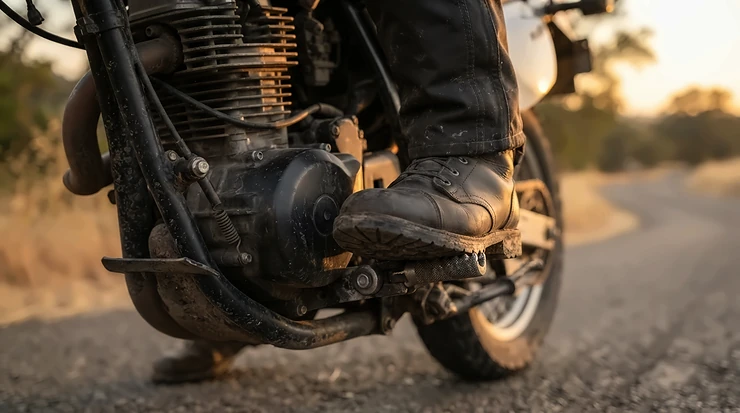
Nobody warns you about this part before your first summer track day: somewhere around lap six, your feet start cooking inside your boots like two potatoes wrapped in foil. The tarmac is radiating heat back up through your soles, your adrenaline has your heart rate through the roof, and suddenly your toes feel like they’re auditioning for a sauna documentary. That discomfort isn’t just annoying — it’s a real distraction when you need every ounce of focus to hit your braking marker. Choosing the right sport riding boots for hot weather track days is less about looking fast in the paddock and more about keeping your feet cool enough that your brain stays sharp when it matters most.
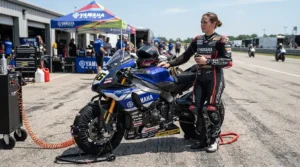
So what actually counts as sport riding boots for hot weather track days? In short: they’re CE-certified motorcycle boots built with perforated panels, mesh linings, and lightweight construction specifically engineered to move air through the boot while still meeting crash-protection standards for the ankle, shin, and heel. Think of them as the difference between a winter parka and a technical summer running jacket — both cover your body, but only one is designed for the conditions you’re actually riding in.
This guide breaks down seven real, currently available boots spanning budget, mid-range, and premium price points, based on manufacturer specifications and aggregated rider feedback from retailers and long-term owners. We’ll dig into what “ventilated” actually means in practice, why perforated leather isn’t automatically the same as a cool boot, and how heat-related fatigue can genuinely creep into your lap times without you noticing. By the end, you’ll know exactly which boot fits your riding style, your budget, and your climate — no guesswork required.
Quick Comparison: Best Sport Riding Boots for Hot Weather Track Days
| Boot | Best For | Ventilation Level | Price Range |
|---|---|---|---|
| Alpinestars Supertech R Vented | Serious track riders wanting max airflow | Extensive laser perforation | $600-$700 range |
| TCX RT-Race Pro Air | Riders who want race features at a fair price | Perforated microfiber + Air Tech mesh | $400-$580 range |
| Sidi ST Air | Riders who want long-term repairability | Technomicro + closable air intakes | $370-$400 range |
| Dainese Axial 2 Air | MotoGP-grade race replica seekers | Full perforated microfiber + airgap liner | $650-$700 range |
| Alpinestars SMX-6 v3 Vented | All-rounder street-to-track riders | Front, rear, and side vents | $300-$350 range |
| Shima RSX-6 | Budget riders wanting real perforated leather | Perforated leather front panel | $150-$190 range |
| Alpinestars SMX-1 R Vented | Entry-level track day riders on a budget | Large perforated microfiber zones | $190-$220 range |
Looking at this table, a clear pattern emerges: the more surface area a manufacturer perforates, the higher up the price ladder you tend to climb, because more perforation usually means more engineering to keep the boot’s structural rigidity intact. The Alpinestars SMX-6 v3 Vented stands out as the sweet spot for most riders — enough airflow for genuine summer track use without the four-figure racing pedigree price tag of the Dainese Axial 2 Air. If budget is your primary constraint, the Shima RSX-6 proves you don’t need to spend $600 to get real perforated leather and a certified safety rating.
💬 Found a boot that caught your eye already? Bookmark this page and keep scrolling — the full breakdown is coming up next.
Top 7 Sport Riding Boots for Hot Weather Track Days: Expert Analysis
1. Alpinestars Supertech R Vented — maximum airflow for serious track riders
The standout feature here is right in the name: this is Alpinestars’ definitive racing boot, reengineered with extensive laser perforation for warm-weather track duty. Built with a laser-perforated microfiber upper, a separate biomechanical inner bootie, and co-injected TPU/aluminum replaceable toe sliders, the Alpinestars Supertech R Vented is CE EN13634:2017 certified and shares its DNA with boots worn on MotoGP grids. In practice, that biomechanical bootie means the boot flexes with your ankle’s natural range of motion instead of fighting it lap after lap — a detail that matters more than any spec sheet number once you’re twenty minutes into a session.
Based on the design and certification, this boot is built for riders who take multiple track days a season seriously and want race-proven protection without sacrificing comfort in July heat. Reviewers consistently note that the extensive perforation delivers noticeably better airflow than the standard non-vented Supertech R, though several also flag durability concerns around zippers and sizing inconsistencies over time, with some riders recommending sizing down for a snugger fit.
Pros:
- ✅ Extensive laser perforation for serious heat management
- ✅ Biomechanical bootie moves naturally with your ankle
- ✅ Replaceable TPU/aluminum sliders extend usable lifespan
Cons:
- ❌ Reported zipper wear and durability issues over time
- ❌ Sizing runs inconsistently; sizing down often recommended
At around $600-$700, this sits at the premium end, but for riders logging 8+ track days a year, the cost-per-session math evens out fast — check current price for exact availability.
2. TCX RT-Race Pro Air — race-grade features without the race-team price tag
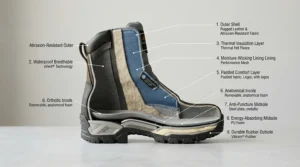
TCX built this as a collaboration between its R&D department and MotoGP-level riders, and the standout feature is the Fasten Fit Control internal lacing system, which lets the boot’s upper wrap around your foot with a precision most side-zip boots can’t match. The perforated microfiber upper is paired with a breathable Air Tech mesh lining and an OrthoLite insole engineered specifically to wick moisture while circulating air around the sole of your foot.
What most buyers overlook about the RT-Race Pro Air is that its Double Flex Control (DFC) anti-torsion system does double duty: it limits dangerous ankle over-extension in a crash while also making the boot noticeably easier to walk in during pit lane visits, which matters more than people expect over a full track day. Reviewers frequently praise the surprisingly reasonable price point relative to the feature set, with several longtime TCX owners noting the brand consistently under-prices its race-derived technology compared to Italian rivals.
Pros:
- ✅ Fasten Fit Control lacing gives a millimeter-precise fit
- ✅ OrthoLite insole actively wicks moisture and heat
- ✅ Double Flex Control reduces ankle over-extension risk
Cons:
- ❌ Some retailers recommend sizing up half a size
- ❌ Limited color options compared to Alpinestars lineup
Priced in the $400-$580 range depending on retailer, the RT-Race Pro Air is arguably the best value-to-protection ratio on this list — check current price, as it fluctuates by region.
3. Sidi ST Air — the repair-it-forever boot for long-term track riders
The standout feature on the Sidi ST Air is Sidi’s philosophy of making nearly every component replaceable, from the buckle and strap down to the shin plate and toe slider. That single design choice quietly transforms the boot’s total cost of ownership calculus, because you’re not buying a disposable product — you’re buying a chassis you can keep rebuilding for years. The Technomicro base material combines with additional perforated panels and closable air intakes, giving riders the rare ability to dial ventilation up or down depending on the day’s temperature.
Here’s what the spec sheet won’t tell you, but reviewers note repeatedly: the cam-lock buckle closure system borrowed from Sidi’s off-road boots makes entry and exit dramatically faster than traditional buckle-and-strap designs, which is a small thing until you’re fumbling with gear in a hot paddock between sessions. Aggregated customer sentiment praises the airflow and on-bike feel strongly, though a subset of owners report fit issues around boot width and some durability concerns with sole peeling after extended wear.
Pros:
- ✅ Nearly every bolt-on part is replaceable and resoleable
- ✅ Closable air vents let you tune ventilation per session
- ✅ Cam-lock buckle system speeds up entry and exit
Cons:
- ❌ Some reviewers report narrow fit, especially wide feet
- ❌ A minority note sole peeling after heavy long-term use
At $370-$400, the ST Air justifies its price for riders who plan on owning one pair of boots for the next decade rather than replacing them every season.
4. Dainese Axial 2 Air — the closest thing to a MotoGP grid boot you can buy
This is the boot literally worn by Dainese-sponsored riders across MotoGP, WSBK, and MotoAmerica grids, and the standout feature is the Axial Distortion Control System, a carbon-plate ankle mechanism that rotates with your foot’s natural movement while still locking down laterally in a crash. The Dainese Axial 2 Air upper uses perforated D-Stone fabric and split cowhide leather inserts, paired with a double-jersey airgap liner specifically engineered for breathability and temperature control rather than just being a thin mesh afterthought.
Based on the spec comparison against the rest of this list, the Axial 2 Air is the most track-focused, in-suit-style boot here — it’s designed to tuck under race suit legs rather than sit over them, which street riders should know before buying. Reviewers who’ve logged real track time consistently highlight the boot’s exceptional feel through the footpegs and shifter, crediting the Groundtrax racing sole for both grip and heat resistance, while some note the sizing runs small enough that a full size up is commonly recommended.
Pros:
- ✅ Race-proven Axial Distortion Control ankle system
- ✅ Double-jersey airgap liner built for real heat dissipation
- ✅ Groundtrax sole delivers exceptional footpeg feel
Cons:
- ❌ Premium pricing near the top of this entire category
- ❌ In-suit design isn’t ideal for street or commuting use
Expect to pay roughly $650-$700 for this one — it’s a genuine investment, but reviewers consistently rank it among the best pure track boots money can buy right now.
5. Alpinestars SMX-6 v3 Vented — the all-rounder built for street and first track days
The SMX-6 v3 Vented earns its spot as the most versatile boot on this list, with vents strategically placed at the front, rear, and side to maximize cross-flow airflow rather than relying on one perforated panel alone. Alpinestars markets this specifically as a third-generation “entry-level track/first track day” boot, and the redesigned upper is engineered to closely follow the anatomical contours of your foot for improved walking comfort — a detail that separates a boot you can wear all day at the track from one you’re desperate to peel off after every session.
Here’s what most buyers overlook: because the SMX-6 v3 Vented shares the same protective architecture as Alpinestars’ pricier Supertech R and SMX Plus V2, riders essentially get race-derived shin plating and calf support at half the cost. Aggregated reviews consistently praise the ankle support and overall protection, with many riders noting confidence in real accidents, though a portion of reviewers mention some sizing inconsistencies and note the ventilation, while strong, isn’t quite as extreme as fully perforated racing boots in peak summer heat.
Pros:
- ✅ Vented at front, rear, and side for genuine cross-flow
- ✅ Shares protective architecture with pricier race boots
- ✅ Anatomically contoured upper improves walking comfort
Cons:
- ❌ Some sizing inconsistencies reported across retailers
- ❌ Less extreme airflow than fully perforated race boots
At $300-$350, this is the boot most reviewers point new track day riders toward first, and it’s easy to see why once you compare the protection-per-dollar against the rest of the field.
6. Shima RSX-6 — proof that perforated leather doesn’t require a premium budget
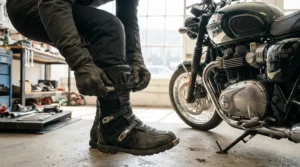
The standout feature of the Shima RSX-6 is straightforward: certified microfibre and genuine perforated leather on the front of the boot at a price point that undercuts nearly everything else on this list. It carries a full EN 13634:2017 protection rating, meaning it isn’t a stripped-down budget compromise — it’s tested to the same European safety benchmark as boots costing three times as much. The hard TPU tibia casing, reinforced heel cup, and metal side slider round out a protection package that punches well above its price class.
What the marketing copy won’t tell you is how much that TPU grip pad over the shifter area actually matters during a hot session — sweaty gloves and a slick shift lever are a bad combination, and Shima’s textured overlay solves a problem most riders don’t realize they have until they’re missing shifts on lap eight. Reviewers describe the RSX-6 as a legitimately capable sport boot for the price, frequently comparing it favorably to boots costing significantly more, though the ventilation is more moderate than the fully perforated options higher up this list since only the front panel breathes.
Pros:
- ✅ Full EN 13634:2017 certification at a budget price
- ✅ Genuine perforated leather, not synthetic mesh substitute
- ✅ TPU shift pad improves grip in sweaty conditions
Cons:
- ❌ Ventilation limited mostly to the front panel
- ❌ Calf area reportedly wide for slimmer leg shapes
Priced around $150-$190, the RSX-6 is the boot to recommend to a friend who’s skeptical they need to spend serious money to ride safely in summer heat.
7. Alpinestars SMX-1 R Vented — the short-shaft budget pick for first-timers
The Alpinestars SMX-1 R Vented takes a different approach than the taller race boots on this list: it’s a short-shaft design with large perforated zones built from durable microfiber and reinforced with TPU protectors, including a lateral slider and TPU heel guard. The standout feature here is genuinely large ventilation zones packed into a boot that’s noticeably lighter and less bulky than full-height racing boots, which matters if you’re still building comfort with a taller boot’s restricted ankle movement.
Based on the spec sheet, this is squarely an entry point for riders doing their first handful of track days who aren’t ready to commit $600+ to a boot yet, and it maintains a flexible upper area so you don’t sacrifice the feel needed for smooth gear changes. Riders shopping secondhand and current listings alike note the SMX-1 R Vented holds up reasonably well for casual and beginner track use, with the short-shaft design earning praise for being less intimidating to break in than taller Supertech-style boots, though naturally it offers less shin and calf coverage than the taller options on this list.
Pros:
- ✅ Large perforated zones in a lightweight short-shaft design
- ✅ TPU heel and lateral slider protection for the price
- ✅ Easier break-in period than tall racing-style boots
Cons:
- ❌ Less shin and calf coverage than tall race boots
- ❌ Not intended for the most aggressive track riders
At roughly $190-$220, this is a smart first step into dedicated track footwear before upgrading to something like the SMX-6 v3 down the line.
Building Your Ventilated Boot Setup: A Practical Usage Guide
Getting real value out of ventilated sport riding boots starts before you ever throw a leg over the bike. First, break them in properly: expect three to five track sessions before a race-oriented boot like the Supertech R or Axial 2 Air truly molds to your foot, so don’t judge airflow or comfort on day one alone. Second, always try boots on at the end of the day when your feet are naturally a bit swollen — this mimics track day conditions far better than a morning fitting and prevents the “felt fine in the shop, agony by lap ten” problem.
Once you own the boots, maintenance is simple but easy to neglect. Wipe down perforated leather or microfiber uppers after wet or dusty sessions, since debris trapped in perforation holes can eventually reduce airflow. If your boots have removable insoles, pull them out after every ride to air-dry fully; trapping moisture inside a warm boot overnight is exactly how odor and material breakdown start. A common first-30-days mistake is over-tightening buckles to “lock in” a new boot’s stiffness, which actually restricts the very airflow you paid extra for — snug is the goal, not vacuum-sealed.
Real-World Scenarios: Which Boot Fits Your Track Day Profile
Picture three riders pulling into the same paddock on the same 95-degree Saturday. The first is a college student on a budget, riding a used 600cc sportbike to her second-ever track day; for her, the Shima RSX-6 or Alpinestars SMX-1 R Vented makes sense, delivering certified protection without draining a semester’s book budget. The second is a weekend club racer doing 15+ sessions a year on a modified liter bike, chasing lap times seriously; he’s the ideal candidate for the Alpinestars SMX-6 v3 Vented or TCX RT-Race Pro Air, both of which balance genuine performance with a price he can justify riding hard and eventually replacing.
The third rider is further along: a licensed amateur racer competing regionally, spending entire summers on hot asphalt in full leathers. For her, the Dainese Axial 2 Air or Alpinestars Supertech R Vented earns its premium price through race-proven protection and airflow that has to perform reliably across back-to-back 20-minute sessions in extreme heat. None of these choices are wrong — they’re simply matched to frequency of use, budget, and how seriously heat management factors into the rider’s season.
How to Choose Sport Riding Boots for Hot Weather Track Days
- Check the CE certification level first. Look for the EN 13634:2017 label inside the tongue; a 2-2-2-2 rating indicates the highest tested protection across ankle height, abrasion resistance, transverse rigidity, and heel energy absorption.
- Prioritize perforation location, not just quantity. Front-panel-only perforation like on the Shima RSX-6 cools your toes; front, rear, and side venting like the SMX-6 v3 cools your whole foot more evenly.
- Match boot height to your riding style. Taller race boots protect more of your shin and calf but restrict movement more; short-shaft boots like the SMX-1 R trade some coverage for comfort and easier walking.
- Consider moisture-wicking liners as a non-negotiable. A liner like TCX’s Air Tech mesh or Dainese’s airgap system actively pulls sweat away from skin rather than just letting air pass through a hole.
- Factor in repairability for long-term value. Boots like the Sidi ST Air with replaceable bolt-on parts cost more upfront but can outlast two or three cheaper pairs.
- Size up if you’re between measurements. Multiple reviewers across nearly every brand on this list recommend sizing up for race-style boots, since a too-tight fit restricts both circulation and airflow.
- Buy for your actual season, not your aspirational one. If you only ride two or three hot days a year, a mid-range vented boot delivers nearly all the comfort benefit of a premium one at a fraction of the cost.
Ventilated Sport Riding Boots vs Traditional Motorcycle Boots
The core difference between ventilated sport riding boots and traditional non-vented or waterproof boots comes down to a genuine trade-off: airflow versus all-weather versatility. Traditional waterproof boots use membranes like Gore-Tex or Drystar that block water effectively, but as one boot reviewer bluntly put it, waterproof inner liners can completely stop cooling airflow even when the outer shell looks perforated. That’s a real problem if you buy a boot marketed as “summer-ready” without checking whether it actually skips the waterproof membrane.
| Feature | Ventilated Boots | Traditional/Waterproof Boots |
|---|---|---|
| Airflow in 90°F+ heat | Excellent to good | Poor to moderate |
| Wet weather performance | Poor to moderate | Excellent |
| Weight | Generally lighter | Generally heavier |
| Best For | Summer track days, dry climates | Mixed-weather touring, commuting |
This comparison makes the decision fairly straightforward once you know your riding calendar: if you live somewhere with genuinely hot, dry summers and mostly ride in daylight heat, a dedicated vented boot like the TCX RT-Race Pro Air will outperform a waterproof boot every single time on comfort. Riders who split time between summer track days and unpredictable spring or fall weather might instead consider owning two pairs, since no single boot construction excels at both extremes simultaneously.
Common Mistakes When Buying Ventilated Track Boots
The single biggest mistake riders make is assuming “perforated” automatically means “cool,” without checking whether an inner waterproof membrane cancels out the benefit — always confirm a boot skips waterproofing if summer airflow is your priority. A close second is ignoring calf and instep width; European brands like Sidi tend to run narrower than American or Japanese counterparts, and a boot that’s technically ventilated but painfully tight will restrict blood flow and actually trap heat against the skin. Riders also frequently underestimate break-in time, judging a boot’s comfort on a five-minute store try-on rather than the three-to-five session adjustment period most race boots genuinely need.
Another overlooked issue is buying based on MotoGP branding alone rather than matching the boot’s actual design intent to personal riding frequency — a boot like the Axial 2 Air is optimized for in-suit racing, not casual weekend riding in jeans and a jacket. Finally, many first-time buyers skip trying boots on with the same socks they’ll actually wear on track day; thick moisture-wicking liners inside the boot combined with thick riding socks can turn a true-to-size boot into a cramped one.
What to Expect: Real-World Performance in Summer Heat
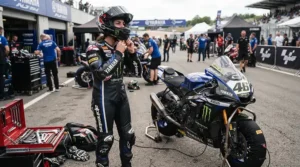
Specs on a page don’t capture what actually happens to your feet by session three of a 95-degree track day. Riders in fully perforated boots like the Supertech R Vented or Axial 2 Air typically report their feet staying merely warm rather than genuinely hot, with sweat evaporating through the perforation fast enough to prevent that swampy, waterlogged feeling. In boots with more limited or front-only ventilation, expect noticeably more heat buildup by the second half of a 20-minute session, especially around the toes and ball of the foot where circulation is already reduced by boot rigidity.
The research backs up why this matters beyond mere comfort. A controlled study of motorcyclists wearing full PPE in 95°F heat with 40% humidity found that after 90 minutes, participants’ core body temperature rose by roughly 2°C, heart rates climbed by 66 beats per minute, and reaction times fluctuated by about 8% compared to baseline — a measurable dip in the split-second processing that keeps a rider out of trouble on track. This is genuine heat-related fatigue in action, not just discomfort, and it’s a big part of why serious track riders treat ventilation as a performance feature rather than a luxury one.
Long-Term Cost & Maintenance: What You’ll Actually Spend
Thinking purely in cost-per-track-day reveals some surprising math. A $650 boot like the Dainese Axial 2 Air, worn across 40 track days over four seasons, works out to roughly $16 per session — genuinely reasonable for a race-proven boot that also holds resale value well thanks to the brand’s reputation. Compare that to buying two budget boots like the Shima RSX-6 over the same period because the first pair wore out faster; at roughly $170 each, that’s still cheaper per session, but you’re accepting a step down in ankle articulation and long-term durability.
Boots with replaceable components, like the Sidi ST Air’s bolt-on sliders and buckles, shift the entire calculation further in your favor over a five-year ownership window, since a $30-40 replacement slider avoids a full $380 repurchase. Riders logging fewer than five track days a year will almost always come out ahead financially with a mid-range vented boot in the $190-$350 range rather than stretching for a premium racing boot that will barely see enough use to justify the investment.
Features That Actually Matter (And Those That Don’t)
Certain marketing terms genuinely translate to on-track benefit, while others are mostly noise. A CE EN 13634:2017 rating, replaceable toe and heel sliders, and a documented moisture-wicking liner all directly affect your safety and comfort in ways you’ll notice. Meanwhile, cosmetic touches like colorway options, reflective piping for daylight track use, or brand racing pedigree without matching certification numbers don’t meaningfully change how the boot performs once you’re actually riding.
One feature worth genuine attention that often gets buried in spec sheets is closable versus fixed ventilation, found on boots like the Sidi ST Air. It’s a small mechanical detail, but the ability to shut vents on a cooler morning session and open them for an afternoon heat spike gives you flexibility that fixed-perforation boots simply can’t match, according to the U.S. Department of Transportation’s general guidance on protective riding gear for varying conditions.
Safety, Regulations & Compliance for Track Riding Footwear
In the United States, motorcycle boots aren’t subject to a federal safety standard the way helmets are under FMVSS 218, which means CE certification under EN 13634:2017 — technically a European requirement — has become the de facto quality benchmark American riders rely on anyway. That standard classifies certified boots as Category 2 Personal Protective Equipment, requiring third-party testing across impact resistance, abrasion resistance, and crush protection before a boot can carry the certification label.
Most race organizations and track day providers in the U.S. require closed-toe, ankle-covering footwear at minimum, and many explicitly mandate CE-certified motorcycle boots for track sessions rather than allowing sneakers or hiking boots. Every boot featured in this guide meets or exceeds EN 13634:2017, so compliance with virtually any American track day tech inspection shouldn’t be a concern regardless of which option you choose.
FAQ
❓ Are perforated leather boots actually cooler than mesh boots?
❓ Do ventilated motorcycle boots offer less protection than regular boots?
❓ How much should I expect to spend on good summer track boots?
❓ Can I wear regular perforated motorcycle boots at a track day?
❓ What's the best way to prevent heat-related fatigue during a hot track day?
Conclusion
Choosing among sport riding boots for hot weather track days really comes down to matching your riding frequency, budget, and climate to the right level of ventilation and protection. Casual riders doing a handful of summer sessions will get excellent value from the Shima RSX-6 or Alpinestars SMX-1 R Vented, while serious club racers logging a full season of hot-weather laps will find the investment in the Dainese Axial 2 Air or Alpinestars Supertech R Vented pays off in both comfort and confidence. For most riders in between, the Alpinestars SMX-6 v3 Vented and TCX RT-Race Pro Air hit the sweet spot of genuine airflow, proven protection, and a price that doesn’t require selling a kidney.
Whichever boot you land on, remember that ventilation isn’t a vanity feature — it’s directly tied to how sharp your reaction times stay deep into a hot session. Your feet do more work than you’d think keeping you connected to the bike, and giving them room to breathe is one of the simplest upgrades you can make to your entire track day experience this summer.
Recommended for You
- Track Boots for Beginner Riders: 7 Best Picks for 2026
- 7 Budget Racing Boots for Amateur Racers (Don’t Overpay in 2026)
- Professional Racing Boots: 7 Best Picks for 2026
Disclaimer: This article contains affiliate links. As an Amazon Associate, I earn from qualifying purchases. If you purchase products through these links, we may earn a small commission at no additional cost to you.
✨ Found this helpful? Share it with your friends! 💬🤗
