
In This Article
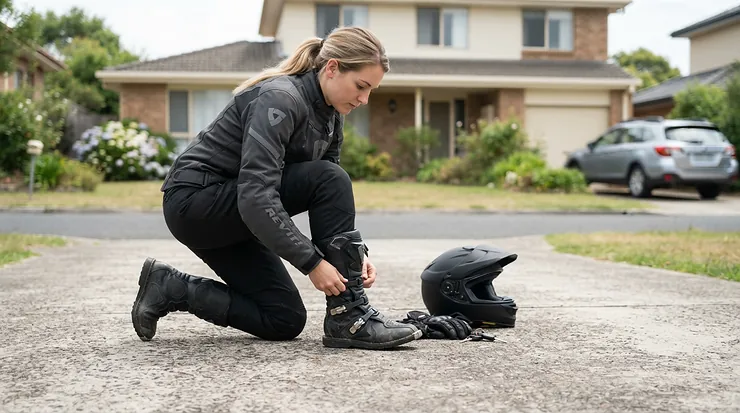
Red motorcycle boots for sport bikes are performance riding boots finished in a red colorway. They add reinforced ankle bracing, shin and heel protection, and a thin sole that lets you feel the shifter and pegs. They pair racetrack-derived safety with a color that makes a statement, whether you’re matching a fairing or you’re simply done with all-black everything.
Why do boots matter at all? Because feet and ankles take a beating in a crash, and they heal slowly. University of Lyon research, as summarized on Wikipedia, found that both ankle-height and knee-high boots reduced the risk of foot and ankle fractures. So boots are not an accessory. They’re one of the more affordable ways to protect the bones that run your shifter and rear brake.
Still, you didn’t search for red motorcycle boots for sport bikes to read about tibias. You want boots that look right beside a tomato-red tail section, and you want them to work when physics turns rude. Fair enough. This guide covers both halves of that wish. We compared seven real boots across budget, mid-range, and premium tiers, drawing on spec sheets and aggregated review sentiment, and we explain what each spec means once you’re on the bike. Along the way, we’ll dig into sport bike livery matching, color matched motorcycle gear, race-inspired styling, and the murkier science behind high-visibility color choices.
One heads-up before we start: “red” is a spectrum. Some of these boots are fully red, others wear red as an accent on black, and a few come in a fluorescent “Fluo” shade that glows like a highlighter. We’ll flag which is which, because a red boot and a boot with red trim look very different next to your bike’s paint.
Red Motorcycle Boots for Sport Bikes: Quick Comparison
Here’s the cheat sheet. Colorways are as listed by retailers at the time of research and can change, so confirm the exact shade before you buy.
| Boot | Red Colorway (as listed) | Tier | Best For |
|---|---|---|---|
| Alpinestars Supertech R | Bright Red / Red Fluo | Premium | Track days and an unmistakable all-red look |
| Dainese Axial 2 Air | Black / Fluo Red | Premium | Racers, especially in matching Dainese leathers |
| TCX RT-Race Pro Air | Black / Red / White | Mid-to-premium | Pedal and shifter feel with MotoGP-style looks |
| Alpinestars SMX-6 V3 | Black / Red Fluo, Black / Silver / Red, Red (vented) | Mid-range | Street riders who also do occasional track days |
| Sidi Vertigo 2 | Black / Red | Mid-range | Riders with unusual calf sizes who want adjustability |
| Forma Ice Pro | Red | Mid-range value | A full red boot without the flagship price |
| Alpinestars Faster-3 | Black / White / Red, Black / Grey / Red Fluo | Budget | Casual sport riding and commuting |
Looking at the comparison above, the Alpinestars Supertech R and Dainese Axial 2 Air sit in a premium tier built for racing, while the Alpinestars SMX-6 V3 and Sidi Vertigo 2 deliver much of that DNA for noticeably less money. Budget-minded riders should note that the Alpinestars Faster-3 trades full race protection for everyday walkability, a compromise reviewers consistently describe. If an all-red look is the goal, the Supertech R and Forma Ice Pro are the standouts, while the rest lean on red accents over black. A tip on reading that colorway column: “Fluo” means fluorescent, which reads brighter in daylight than almost any paint code.
💬 Just one click — help others make better buying decisions too!😊
Top 7 Red Motorcycle Boots for Sport Bikes: Expert Analysis
Every pick below comes with the same three ingredients: what the specs mean in practice, what reviewers consistently report, and who should (and shouldn’t) spend the money. Prices are ranges, so check current price before buying.
1. Alpinestars Supertech R — the loudest red you can buy
That Bright Red / Red Fluo colorway isn’t subtle, and that’s exactly the point. The upper is hard-wearing microfibre with stretch fabric. It features a redesigned top gaiter with TPU over-injection, a micro-adjustable ratchet strap, and a bio-mechanical 3D mesh inner boot. In plain English, the inner boot hugs your ankle like a ski-boot liner, while the ratchet lets you dial pressure in without untying anything. Replaceable toe sliders and a shifter pad also mean the first parts to wear out are the parts you can swap.
Based on the spec comparison, this is the benchmark the other boots here get measured against. It’s clearly track-first, and one reviewer warned against buying it for road-only riding. On a lazy coffee run, the stiffness will feel like overkill. If you do ride track days and your bike wears red, though, it’s hard to argue with.
Aggregated reviews skew strongly positive. Owners describe comfort straight out of the box and a roomier fit than most race boots. One repeat buyer called them the only boots wide enough for their feet, and several note the red really is vivid.
Pros:
- ✅ Race-grade ankle support from the inner boot
- ✅ Replaceable toe sliders and shifter pad
- ✅ Comfortable out of the box, per reviewers
Cons:
- ❌ Track-focused, overkill for relaxed street riding
- ❌ Top price tier on this list
Expect roughly the $550–$700 range, depending on vented versus non-vented. Verdict: expensive, but cheap per mile if it lasts several seasons.
2. Dainese Axial 2 Air — built to disappear inside a race suit
Dainese’s flagship is designed to slip inside matching race leathers, which tells you who it’s for. The construction combines D-Stone microfibre with split cowhide inserts, perforated leather for airflow, and a carbon-and-aramid Axial Distortion Control System that fights ankle twisting. Replaceable magnesium sliders and a Groundtrax sole with a focus on grip and heat resistance round it out. The “IN” design joins boot and suit with wide Velcro straps, which Dainese says improves impact resistance and aerodynamics.
On paper, this is the most protection-dense boot on the list, and the Black / Fluo Red colorway gives you red accents rather than a full red boot. The catch is fit. A retailer fit note describes an aggressive race fit with a narrow sole and a footbed that runs short, so wide-footed riders should size carefully or look elsewhere.
Review volume on the Axial 2 itself is thin, so the safest read comes from its predecessor, the Dainese Axial D1. Its reviewers repeatedly praised out-of-the-box fit, light weight, and how neatly it connects to Dainese leathers.
Pros:
- ✅ Carbon-and-aramid ankle control system
- ✅ Perforated upper for serious airflow
- ✅ Suit-connection design for racing
Cons:
- ❌ Narrow, race-focused fit
- ❌ Few reviews for the current generation
Expect about the $500–$700 range, with discounts appearing at some retailers. Verdict: a specialist’s boot, best justified if you already ride in Dainese gear.
3. TCX RT-Race Pro Air — Michelin-soled feel with Italian race styling
The headline feature is a Michelin dual-compound sole with specific grip areas for the peg, shifter, and rear brake. That’s the kind of detail you only appreciate once your foot stops sliding around under braking. The perforated microfibre upper adds a shin plate with air intakes, replaceable magnesium toe and heel sliders, Air Tech mesh lining, and an internal lace-up system with a zipper. Combined, those specs favor control and cooling over plush padding.
AMCN’s review noted that these are the same boots Johann Zarco races in. That’s a nice bit of race-inspired styling, though it’s worth remembering a racer’s feet are not a commuter’s feet. In practice, expect a boot built to be felt through, not floated on.
Reviewers often report real comfort and a fairly short break-in. A few say it fits snug or runs small, and one reported a failed zipper, so inspect closures early. Some US retailers listed it as closeout or out of stock at the time of research, so confirm availability first.
Pros:
- ✅ Grip zones for peg, shifter, and brake
- ✅ Perforated upper keeps feet cooler
- ✅ Replaceable magnesium sliders
Cons:
- ❌ Snug fit with a break-in period
- ❌ Spotty US availability at research time
Pricing has run roughly in the $350–$450 range depending on retailer. Verdict: strong value if you can find your size.
4. Alpinestars SMX-6 V3 — flex zones that make walking less miserable
The upgrade that matters here is mobility. The microfibre upper uses front and rear flexion zones, so the boot bends where your foot does instead of fighting you. It adds an ankle brace system with Achilles and ankle impact protection, plus a new back-calf TPU bridge for support. It’s CE certified to EN 13634:2017 and comes in standard, vented, and Drystar waterproof versions. Red options include Black / Red Fluo, Black / Silver / Red, and a vented all-red version.
My read: this is the sweet spot for riders who want one boot for the weekday ride and the Sunday canyon run. It gives up some of the Alpinestars Supertech R‘s stiffness but gains everyday wearability. Reviews are encouraging, with Alpinestars’ own listing showing a high average across nearly a hundred reviews for one colorway, and UK buyers describe comfort from the first wear.
Pros:
- ✅ Flexion zones ease walking and shifting
- ✅ Waterproof Drystar option available
- ✅ Replaceable toe slider
Cons:
- ❌ Less rigid than flagship race boots
- ❌ Waterproof version costs noticeably more
Expect roughly $330–$400 depending on version. Verdict: the best all-rounder for most riders.
5. Sidi Vertigo 2 — calf adjustment that fits legs most boots ignore
The standout is the Tecno VR adjustable calf system, designed to accommodate virtually any calf size in a clean, supportive design. If you’ve ever fought a boot that squeezed your calf or flapped around it, that’s a real benefit. The Technomicro microfibre upper is water and tear resistant, a Tecno-3 Iron mechanism handles closure, and a single ankle support brace limits lateral movement. An air intake and replaceable toe sliders complete the package, and Visordown describes the Vertigo 2 as a CE Level 2 certified summer track boot.
The honest trade-off is comfort. Visordown’s reviewer found thin internal padding that signals a boot built for speed and efficiency rather than pillowy comfort, and buyers mention a break-in period and a snug fit. One reviewer felt the back clasps seemed lesser in quality than older Sidi boots. Even so, many reviewers praise durability and long-term value.
Pros:
- ✅ Adjustable calf fit for unusual leg shapes
- ✅ Ankle brace and air intake
- ✅ Trusted brand with a durability reputation
Cons:
- ❌ Thin padding and a break-in period
- ❌ Snug fit that runs small
Look for around the low-$300s. Verdict: smart money if calf fit has been your problem.

6. Forma Ice Pro — a full red colorway for mid-range money
This is one of the few boots here offered in a straightforward all-red colorway. The Forma Ice Pro uses a microfibre upper, ankle torsion prevention, external plastic armour, ventilation, and a double-density anti-slip race compound sole. Those features translate into a boot that supports the ankle against twisting while the sole keeps your foot planted on the peg.
Reviewers describe comfort straight out of the box, easy fastening, and no interference with gear changes or the rear brake. One buyer used them for a race weekend at Brands Hatch, while another chose them over a Sidi purely on looks. The review pool is smaller and mostly UK-based, so treat this as encouraging rather than conclusive. Also note that US availability can vary.
Pros:
- ✅ True all-red colorway
- ✅ Easy to fasten and comfortable early on
- ✅ Doesn’t hamper shifting or braking
Cons:
- ❌ Smaller review pool than rivals
- ❌ US availability can be inconsistent
Pricing sits in a mid-range tier, so check current price and availability. Verdict: a good fit for riders who want red first and flagship specs second.
7. Alpinestars Faster-3 — budget red you can actually walk around in
This lightweight lace-up uses abrasion-resistant microfibre with enhanced TPU ankle protection, a TPR lateral toe for flexibility, a reinforced heel counter, and 3D mesh lining. The rubber sole includes an integrated support shank, and the shoe is CE certified to EN 13634:2017. The red appears as accents on Black / White / Red and Black / Grey / Red Fluo versions, plus a knitted Rideknit variant.
Realistically, this is the entry point. Reviewers describe it as lightweight, stylish, and excellent for summer riding and shorter journeys, but several note it doesn’t offer full protection like race boots. Some swapped to speed laces so loose laces can’t catch on anything, and sizing advice leans toward going up half a size.
Pros:
- ✅ Lightweight and cool in warm weather
- ✅ Comfortable to walk in off the bike
- ✅ Lowest price on the list
Cons:
- ❌ Less protection than full race boots
- ❌ Often runs small
Expect about the $190–$240 range. Verdict: great for commuters, but not a track-day boot.
Side-by-Side Spec Breakdown
| Boot | Ventilation Options | Standout Protection Feature | Price Range | Best For |
|---|---|---|---|---|
| Alpinestars Supertech R | Vented version available | Bio-mechanical 3D mesh inner boot | $550–$700 | Track days |
| Dainese Axial 2 Air | Perforated | Axial Distortion Control System | $500–$700 | Racing in Dainese gear |
| TCX RT-Race Pro Air | Perforated, shin air intakes | Replaceable magnesium sliders | ~$350–$450 (verify) | Control and feel |
| Alpinestars SMX-6 V3 | Standard, vented, Drystar | Back-calf TPU bridge | $330–$400 | All-round use |
| Sidi Vertigo 2 | Air intake | Adjustable calf plus ankle brace | Low-$300s | Odd calf sizes |
| Forma Ice Pro | Ventilated | Ankle torsion prevention | Mid-range (verify) | Red on a budget |
| Alpinestars Faster-3 | 3D mesh lining | TPU ankle protection | $190–$240 | Commuting |
Read together, the table shows protection and price rising in lockstep, which is no surprise. The more interesting gap sits in the middle, where the Alpinestars SMX-6 V3, Sidi Vertigo 2, and Forma Ice Pro deliver serious ankle protection at roughly half the price of the flagships. For most riders, the sensible question isn’t which boot is best, but how much race-grade protection your riding actually needs.
Break-In and Care: Keeping Red Boots Looking Fresh
Red boots reward a little effort. Here’s the playbook for the first 30 days and beyond, based on manufacturer guidance and common reviewer experience.
Week one: break them in on purpose. Wear your boots around the house for short stretches with the socks you’ll ride in. Race boots such as the Alpinestars Supertech R and Sidi Vertigo 2 usually need a few rides to settle, and reviewers repeatedly mention snug fits that loosen. If a boot hurts in a way that feels like a pressure point rather than general snugness, stop and reassess sizing before wearing it down.
Fasten them properly every time. Tighten the closure fully before you ride, then walk, crouch, and sit on the bike to confirm nothing pinches. A boot fastened loosely isn’t protecting you the way it’s designed to.
Cleaning. Manufacturer guidance generally says to clean boots under running water with a sponge and to avoid high-pressure washing. Let them dry naturally, not on a radiator.
Protect the red. Park them out of direct sun when you’re not riding. Strong, saturated colors can look tired after seasons of UV exposure, so a closet beats a back seat.
Common first-30-day mistakes:
- Buying a full size too small because a review said “runs small”
- Ignoring toe-slider wear until it exposes the boot
- Skipping the zipper and closure check on new boots
Real-World Scenarios: Matching Boots to Your Riding Life
Specs are abstract. Riders aren’t. Here are three profiles with reasoning.
The weekend track-day rider. If you’re riding roughly ten track days a year on a red sport bike and you want maximum protection, the Alpinestars Supertech R is the obvious pick. Based on the spec comparison, its inner boot and ratchet closure are built for exactly this use. If you own Dainese leathers, the Dainese Axial 2 Air becomes tempting thanks to its suit-connection design. Budget: $500 and up.
The commuter with a desk job. Imagine you ride eight miles each way, then walk across an office park. You need walkability more than lap-time protection. The Alpinestars SMX-6 V3 vented version offers flex zones and ankle protection in a boot you can stand in all day. If the budget is tighter, the Alpinestars Faster-3 works, as long as you accept its lighter protection. Budget: $200–$400.
The wide-footed rider chasing a red look. Many race boots run narrow. Reviews of the Alpinestars Supertech R note a roomier fit, and the Forma Ice Pro earns praise for out-of-the-box comfort. Either could suit you, but try before committing. Budget: roughly $300–$700.
Problem and Solution Guide: Common Red-Boot Headaches
Problem: my red doesn’t match my bike’s red. Solution: stop chasing a perfect match. Choose boots with red accents over black, like the Dainese Axial 2 Air, so slight shade differences read as intentional contrast rather than a near-miss.
Problem: my feet cook in summer. Solution: look for ventilation. The Alpinestars SMX-6 V3 vented, TCX RT-Race Pro Air, and Dainese Axial 2 Air all use perforation or air intakes, though ventilation reports vary by rider.
Problem: I’m worried drivers won’t see me. Solution: don’t rely on boots alone. NHTSA’s focus-group report on hi-viz gear notes that crashes at intersections often involve a driver who didn’t see the motorcycle, and that high-visibility gear appears to mitigate some of that risk. Put your brightest colors higher up on your jacket and helmet.
Problem: sizing feels off. Solution: boots such as the Alpinestars Faster-3 and Sidi Vertigo 2 are described by reviewers as running small. Try them with riding socks and check the return policy.
Problem: sliders are worn. Solution: replace them early. Boots like the TCX RT-Race Pro Air and Alpinestars Supertech R are designed with replaceable parts.
How to Choose Red Motorcycle Boots for Sport Bikes
The short answer: choose protection and fit first, then color. Here are seven steps.
- Check the certification label. Look for EN 13634 and note whether the boot is Level 1 or Level 2. Level 2 is the higher performance tier.
- Define your riding split. Mostly track means a flagship like the Alpinestars Supertech R. Mostly street means something like the Alpinestars SMX-6 V3.
- Prioritize fit over looks. A narrow race boot on a wide foot is a bad day waiting to happen.
- Match ventilation to climate. Vented boots help in heat, while Drystar-type options help in rain.
- Inspect the closure system. Ratchet straps, internal laces, and back zippers each feel different.
- Look for replaceable parts. Sliders and shifter pads extend a boot’s life.
- Pick the red last. Once two or three boots meet your protection and fit needs, choose the shade you love.
Sport Bike Livery Matching: Getting the Right Red
Livery matching sounds simple until you hold two reds side by side. Paint is glossy and layered, while microfibre is matte and textured, so the same red can read differently. That’s why chasing a perfect match often disappoints.
A smarter approach is to match the idea rather than the pixel. If your bike is Italian-style red, choose boots with clean red accents on black and let the black do the unifying. If your bike wears a multi-color race scheme, pull one accent color, such as white or silver, from the paint and echo it on the boot. The Alpinestars SMX-6 V3 is offered in several accent combinations for exactly this reason.
Licensed liveries exist too. A Honda-licensed version of the previous Alpinestars Honda SMX-6 V2 existed in Black / Red / Blue, though it has been discontinued, which is a reminder that official matching options come and go.
Practical tips for sport bike livery matching:
- Compare boots and bike outdoors in daylight, not under garage lights
- Photograph both together before buying
- Check the retailer’s colorway name, because “Red Fluo” differs from “Bright Red”
- Treat a slight mismatch as contrast, not failure
Color Matched Motorcycle Gear: Building a Cohesive Kit
Color matched motorcycle gear works best when it looks deliberate, not like a uniform. A good rule of thumb is a dominant color, a supporting color, and a small accent. If your bike is red and your leathers are black, red boots become the accent that ties the lower half of your outfit to the bike.
Avoid the “everything matches” trap. Red helmet, red gloves, red jacket, and red boots can look like a costume. Pick two or three red touches and let black or white fill in the rest.
Think about contrast, too. Red boots on a black bike can look sharp, while red boots on a red bike can blur into the paint. Both work, but they say different things.
Finally, keep resale and versatility in mind. Gloves and boots wear out, so choose colors you’ll still enjoy after your next bike purchase.
✨ Ready to Find Your Perfect Red Pair?
🔍 Take your riding style to the next level with these carefully selected boots. Click on any highlighted product to check current pricing and availability. These picks will help you build a look, and a level of protection, you’ll feel confident in every ride!
Race-Inspired Styling: Why Racing Boots Look the Way They Do
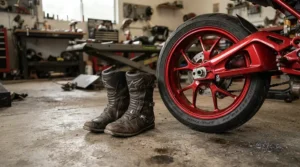
Race-inspired styling isn’t just fashion. Most of what makes a racing boot look aggressive is functional: external plates, sliders, shin guards, and tight closures. Form follows function, and then marketing paints it red.
Examples are everywhere. Alpinestars says the Supertech R incorporates innovations from feedback in its top-flight racing program. Dainese describes the Dainese Axial 2 Air as worn on the track by MotoGP champions, and AMCN noted the TCX RT-Race Pro Air is the model Johann Zarco wears.
But here’s the nuance. “Race-inspired” isn’t “race-ready.” The Alpinestars Faster-3 borrows styling cues but offers lighter protection, and reviewers say so. If you want the look, fine, but know what you’re buying.
When shopping for red sport bike riding boots, ask three questions:
- Does the boot have real ankle bracing, or just printed plastic-look panels?
- Are the sliders and shifter pad replaceable?
- Is the certification label on the product itself?
High-Visibility Color Choices: Do Red Boots Make You Safer?
Honestly? Probably a little, but don’t overstate it. A population-based case-control study in Auckland, summarized by SWOV, found that riders wearing reflective or fluorescent clothing had a 37% lower risk of crash-related injury. White helmets and daytime headlights were also associated with lower risk, while the front color of clothing or motorcycle showed no association.
That’s useful, but it comes with limits. The study is older, and it didn’t isolate boot color. Boots sit low on your body, where they’re less likely to be what a driver notices first. So high-visibility color choices matter most on your helmet, jacket, and bike lighting.
So how should you think about fluorescent red boots? Treat them as a bonus, not a strategy. If you’re choosing between two otherwise equal boots, a “Fluo” colorway costs you nothing. But protection and fit should still decide the purchase. Meanwhile, put reflective panels and brighter colors higher on your body, where they count most.
Red Boots vs Black Boots: What You Gain and Lose
| Factor | Red Boots | Black Boots | Best For |
|---|---|---|---|
| Style impact | High, immediately noticeable | Understated | Red for livery matching |
| Showing dirt and scuffs | Scuffs can stand out | Hides wear well | Black for hard use |
| Color fade risk | Saturated colors may fade with UV | Less noticeable | Black for sun-heavy storage |
| Versatility | Works best with a plan | Matches nearly anything | Black for mixed gear |
| Availability of options | Fewer, with limited sizes | Wide | Black for hard-to-fit riders |
Looking at the table above, red wins on personality and loses on versatility. If your gear is mostly black, red boots can be the single accent that makes the whole kit look intentional. If your closet is a rainbow, black may keep things calmer. Either way, the Alpinestars SMX-6 V3 and Forma Ice Pro show you don’t have to compromise on protection to get color.
EN 13634 Safety Standards Explained
Protective footwear for motorcycle riders is covered by EN 13634. SATRA’s overview explains that the first version appeared in 2002 for professional riders and the standard has since been revised, including a third revision in 2017. In Europe and the UK, CE certification is a legal requirement for these boots, per Wikipedia.
The 2017 edition defines two performance levels, with Level 1 offering a lower level of protection than Level 2. Check the label directly, because marketing text and actual certification can differ.
Why does this matter for red boots? Because color is the easy part. A red boot without a clear certification label is a costume. The Alpinestars SMX-6 V3 and Alpinestars Faster-3 are listed as CE certified to EN 13634:2017, while the Sidi Vertigo 2 is described by Visordown as Level 2. Always verify the label on the boot you receive.
Price Range and Value Analysis
| Tier | Boots | Price Range | Value Note |
|---|---|---|---|
| Premium | Alpinestars Supertech R, Dainese Axial 2 Air | $500–$700 | Highest protection, race-focused fit |
| Mid-range | TCX RT-Race Pro Air, Alpinestars SMX-6 V3, Sidi Vertigo 2, Forma Ice Pro | ~$300–$450 | Best balance for most riders |
| Budget | Alpinestars Faster-3 | $190–$240 | Casual riding, lighter protection |
Value isn’t just sticker price. A boot near the $600 mark used 40 days a year for four years works out to under $4 per ride day, while a cheaper pair that you outgrow in a season costs more over time. Replaceable sliders and shifter pads stretch that value further.
Based on that table, the mid-range tier looks like the sweet spot. You get real protection and often a comfortable fit without paying for a design built around lap times. Premium boots make sense if you track regularly, and the Alpinestars Faster-3 makes sense if protection needs are modest.
FAQ: Red Motorcycle Boots for Sport Bikes
❓ Are red motorcycle boots less safe than black ones?
❓ Do red riding boots fade in the sun?
❓ Which red boots suit a Ducati-style red bike?
❓ Can I walk in sport bike boots all day?
❓ Should I size up in race boots?
Conclusion
Red motorcycle boots for sport bikes can be more than a style choice. Done right, they’re serious protective gear that happens to look fantastic. The Alpinestars Supertech R is the pick for riders who want the loudest red and track-grade support, while the Dainese Axial 2 Air suits racers in Dainese leathers. For most riders, the Alpinestars SMX-6 V3, Sidi Vertigo 2, and Forma Ice Pro offer the best balance of protection, comfort, and price. The TCX RT-Race Pro Air is worth a look if you can find your size, and the Alpinestars Faster-3 covers casual riders on a budget.
Remember the priorities: certification and fit first, then color, then the finishing touches of sport bike livery matching and color matched motorcycle gear. As for high-visibility color choices, treat red boots as a bonus rather than a safety strategy.
✨ Don’t Miss Your Perfect Pair!
🔍 Take your sport bike look to the next level with these carefully selected red boots. Click on any highlighted product to check current pricing and availability. Ride confidently, ride safely, and ride in style! 🏍️
Recommended for You
- Black Motorcycle Boots: 7 Best Budget Picks For 2026
- Brown Leather Motorcycle Boots For Casual Wear: 7 Proven Picks 2026
- Black Motorcycle Boots For Everyday Riding: 7 Best Picks 2026
Disclaimer: This article contains affiliate links. As an Amazon Associate, I earn from qualifying purchases. If you purchase products through these links, we may earn a small commission at no additional cost to you.
✨ Found this helpful? Share it with your friends! 💬🤗
