
In This Article
You know that feeling when you’re cruising down the highway and suddenly realize your helmet feels like it’s protecting you about as well as a bicycle cap? Yeah, that’s not the vibe we’re going for. When it comes to protecting your noggin, DOT motorcycle helmets aren’t just a legal requirement—they’re your best friend on two wheels.

✨Was this helpful? Spread the word! 🚀
Here’s the thing: not all helmets are created equal. I’ve tested dozens of motorcycle helmets over the years, and the difference between a mediocre lid and a quality DOT approved helmet is literally night and day. Whether you’re a weekend warrior or a daily commuter, choosing the right DOT certified motorcycle helmet can mean the difference between walking away from an accident and, well… let’s not go there.
Quick Comparison Table
| Helmet Model | Type | Weight | Price Range | Key Feature |
|---|---|---|---|---|
| HJC i10 | Full-Face | 3.05 lbs | $159-$179 | SNELL M2020 certified |
| Bell Qualifier DLX MIPS | Full-Face | 3.8 lbs | $249-$329 | MIPS technology |
| Scorpion EXO-R420 | Sport | 3.6 lbs | $149-$189 | Budget-friendly racing |
| LS2 Valiant II | Modular | 3.9 lbs | $269-$329 | 180° flip mechanism |
| AGV K6 S | Sport-Touring | 2.95 lbs | $499-$659 | Ultra-lightweight carbon |
| ILM Modular 953 | Modular | 3.7 lbs | $129-$169 | Bluetooth-ready |
| Daytona Skull Cap | Half-Shell | 1.8 lbs | $59-$89 | Smallest DOT helmet |
💬 Just one click – help others make better buying decisions too! 😊
✨ Ready to Upgrade Your Ride? 🏍️
These DOT certified helmets represent the best protection available today. Click any highlighted product to check current Amazon prices and read thousands of real rider reviews. Your perfect helmet is just a click away!
Top 7 DOT Motorcycle Helmets – Expert Analysis
1. HJC i10 Full-Face Helmet – Best Budget Track-Ready Option
The HJC i10 is honestly a steal. At around $160, you’re getting a helmet that meets SNELL M2020 standards—the same certification required for most track days across North America. That’s ridiculously impressive for the price point.
Key Specifications:
✅ Advanced Polycarbonate Compact Shell
✅ SNELL M2020 and DOT FMVSS 218 certified
✅ RapidFire Shield Replacement System
✅ Multi-Cool moisture-wicking liner
✅ Smart HJC READY for Bluetooth (sold separately)
Price Range: $159-$179
What Riders Say: Customers consistently praise the ventilation system and overall comfort. One rider mentioned, “The visor works very well and is easy to see through, and also easy to operate.” Many note that sizing runs slightly large, so consider ordering your usual size or even downsizing.
Pros:
✅ Exceptional value for SNELL-rated helmet
✅ Excellent ventilation system
✅ Glasses-friendly design
Cons:
❌ Pinlock insert not included
❌ Slightly heavier than premium options
2. Bell Qualifier DLX MIPS – Best Overall Safety Technology
If you’re serious about brain protection, the Bell Qualifier DLX MIPS is where it’s at. The Multi-directional Impact Protection System isn’t just marketing hype—it’s proven technology that reduces rotational forces during impacts.
Key Specifications:
✅ MIPS technology for rotational impact protection
✅ DOT and ECE 22.05 certified
✅ Intermediate oval fit
✅ Velocity Flow ventilation system
✅ Transitions face shield compatible
Price Range: $249-$329
What Riders Say: Track day regulars swear by this helmet. It’s quieter than competitors at highway speeds and the aerodynamics are excellent for sport riding. However, some riders note that installing Bluetooth systems takes longer due to the MIPS liner configuration.
Pros:
✅ MIPS significantly improves safety
✅ Quieter at high speeds
✅ Great for racing and sport riding
Cons:
❌ Bluetooth installation more complex
❌ Limited color options
3. Scorpion EXO-R420 – Best Budget Sport Helmet
The Scorpion EXO-R420 punches way above its weight class. For under $190, you’re getting a SNELL M2020 certified helmet with surprisingly good aerodynamics and ventilation. It’s perfect for riders who want track-capable protection without the premium price tag.
Key Specifications:
✅ SNELL M2020, DOT, and ECE certified
✅ KwikWick II moisture-wicking liner
✅ Ellip-Tec quick-release cheek pads
✅ Aerodynamic shell design
✅ Multiple shell sizes
Price Range: $149-$189
What Riders Say: Summer riders love the KwikWick II liner—it keeps the interior dry even in temperatures exceeding 95°F. The helmet is slightly heavier and noisier than the Bell Qualifier DLX MIPS at racing speeds, but for the price difference, most riders consider it a fantastic value.
Pros:
✅ Outstanding value for SNELL certification
✅ Excellent summer ventilation
✅ Great color and graphic options
Cons:
❌ Heavier than racing-focused alternatives
❌ Can be noisy at speeds over 90 mph
4. LS2 Valiant II Modular Helmet – Best Versatility
Here’s where things get interesting. The LS2 Valiant II is one of those helmets that makes you wonder why you’d ever buy anything else. The 180-degree flip mechanism is smooth as butter, and the fact that it’s DOT certified as both a full-face and open-face helmet? Game changer.
Key Specifications:
✅ DOT FMVSS 218 and ECE 22.05 certified (P and J standards)
✅ Kinetic Polymer Alloy shell
✅ Pinlock insert included
✅ Built-in sun shield
✅ 2 shell sizes
Price Range: $269-$329
What Riders Say: Touring riders and motorcycle instructors consistently rate this as one of the best modular helmets under $350. One rider noted it’s “lighter, quieter, and has better ventilation” than competitors costing twice as much. The built-in sun shield mechanism is particularly praised for its smoothness and ease of use.
Pros:
✅ Versatile full-face to open-face conversion
✅ Excellent value for features
✅ Includes Pinlock anti-fog insert
Cons:
❌ Slightly heavier than full-face equivalents
❌ Can be noisy without earplugs
5. AGV K6 S Sport-Touring Helmet – Best Premium Lightweight
When weight matters, the AGV K6 S is in a league of its own. Weighing just 2.95 pounds in medium, this carbon-aramid shell helmet makes long days in the saddle significantly more comfortable. It’s the same technology AGV develops for MotoGP, but refined for street use.
Key Specifications:
✅ Carbon-aramid composite shell
✅ DOT and ECE 22.06 certified
✅ SHARP 5-star safety rating
✅ 4 different shell sizes
✅ Pinlock-ready
Price Range: $499-$659
What Riders Say: Sport-touring riders who’ve made the switch from Shoei RF-1400 models consistently mention the weight difference as the biggest benefit. After 10-hour riding days, neck fatigue is noticeably reduced. The wide eyeport provides excellent peripheral vision, and the faceshield mechanism is praised as one of the best in the industry.
Pros:
✅ Exceptionally lightweight
✅ 5-star SHARP safety rating
✅ Excellent build quality
Cons:
❌ Premium price point
❌ No built-in sun visor
6. ILM Modular 953 Bluetooth Helmet – Best Tech Integration
The ILM Modular 953 is perfect for riders who want modern connectivity without breaking the bank. The built-in Bluetooth system means you’re not fumbling with aftermarket installations, and the modular design adds convenience for quick stops.
Key Specifications:
✅ DOT FMVSS 218 certified
✅ Integrated Bluetooth communication
✅ Dual visor system
✅ 180° flip-up mechanism
✅ Mp3 and intercom capable
Price Range: $129-$169
What Riders Say: Budget-conscious riders love the included Bluetooth functionality—you’d typically pay $100+ for an aftermarket system. The modular design works well for city riding and quick gas station stops. Some riders note the Bluetooth range isn’t as extensive as premium Cardo or Sena systems, but for the price, it’s hard to complain.
Pros:
✅ Built-in Bluetooth included
✅ Excellent price-to-features ratio
✅ Good ventilation system
Cons:
❌ Bluetooth range limited vs. premium systems
❌ Heavier than full-face equivalents
7. Daytona Skull Cap Half-Shell Helmet – Best Minimalist Option
Sometimes you just want the bare minimum to stay legal, and that’s where the Daytona Skull Cap comes in. As the smallest DOT-approved half-shell helmet ever made, it’s popular with cruiser riders who prioritize style and freedom over maximum protection.
Key Specifications:
✅ DOT FMVSS 218 approved
✅ Smallest profile DOT helmet
✅ Weighs only 1.8 lbs
✅ Beanie style design
✅ Multiple color options
Price Range: $59-$89
What Riders Say: Cruiser and Harley riders appreciate the low profile and minimal interference with their riding experience. However, it’s important to note this provides significantly less protection than full-face or even three-quarter helmets. It meets minimum DOT standards but offers no face or jaw protection.
Pros:
✅ Extremely lightweight
✅ Minimal profile
✅ Budget-friendly
Cons:
❌ Minimal protection vs. full-face
❌ No face or jaw protection
Understanding DOT Helmet Standards
What Does DOT Certification Really Mean?
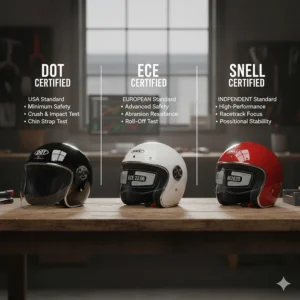
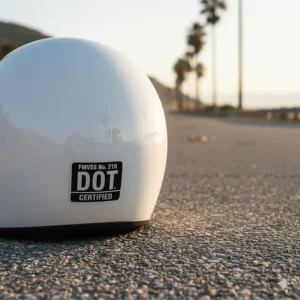
Let’s clear something up right away: DOT certification isn’t optional in the United States. The Department of Transportation’s Federal Motor Vehicle Safety Standard 218 (FMVSS 218) sets minimum requirements for motorcycle helmet protection. However, here’s what most riders don’t realize—DOT certification works on an honor system.
Manufacturers self-certify their helmets and affix the DOT sticker. The DOT randomly pulls helmets from store shelves and tests them after they’re already being sold. If a helmet fails, it gets recalled, but that doesn’t help the riders who already bought it. This is why understanding additional certifications like SNELL and ECE matters.
DOT vs. SNELL vs. ECE—What’s the Difference?
DOT (FMVSS 218):
✅ Legal requirement in the USA
✅ Tests impact absorption, penetration resistance, and chin strap strength
✅ Self-certified by manufacturers
✅ Lower impact test speeds than SNELL
SNELL M2020:
✅ Independent third-party testing
✅ More rigorous impact testing
✅ Required for most track days
✅ Not legally required but highly respected
ECE 22.05/22.06:
✅ European standard (newest is 22.06)
✅ Includes oblique impact testing
✅ Regular production testing required
✅ Generally considered more stringent than DOT
Think of it this way: DOT is your baseline, ECE is your mid-level protection, and SNELL is your gold standard. Many premium helmets carry all three certifications, which is honestly your best bet if safety is your top priority.
How to Choose the Right DOT Motorcycle Helmet
Helmet Types and Their Uses
Choosing between helmet styles isn’t just about looks—it’s about matching protection to your riding style.
Full-Face Helmets:
These offer maximum protection covering your entire head, face, and jaw. According to research, 45% of impacts occur in the chin bar area, making full-face helmets the safest option. They’re mandatory for track riding and highly recommended for highway use.
Modular (Flip-Up) Helmets:
Modular helmets combine convenience with protection. The flip-up chin bar makes them perfect for touring riders who frequently stop, wear glasses, or want quick access without removing the entire helmet. Modern modular helmets can be DOT certified in both open and closed positions.
Open-Face (Three-Quarter) Helmets:
These cover the top, back, and sides of your head but leave your face exposed. They’re popular with cruiser riders and urban commuters. They provide more protection than half-shells but significantly less than full-face designs.
Half-Shell Helmets:
The minimalist option that covers only the top of your head. They meet minimum DOT standards but offer the least protection. Popular with custom bike builders and cruiser riders prioritizing style and minimal interference.
Fit is Everything—Here’s How to Get It Right
I can’t stress this enough: the best helmet in the world is worthless if it doesn’t fit properly. Here’s how to nail your fit:
Step 1: Measure Your Head
Wrap a soft measuring tape around your head about one inch above your eyebrows. That’s your circumference, and it determines your size.
Step 2: Understand Head Shapes
Helmets come in different internal shapes:
- Intermediate Oval: Most common in North America (Bell, HJC)
- Round Oval: Common in Asian markets (some Arai models)
- Long Oval: Less common but important for some riders (Shoei)
Step 3: The Cheek Test
A properly fitted helmet should feel snug on your cheeks without painful pressure points. Your cheeks should be compressed, but you should still be able to talk and swallow comfortably.
Step 4: The Shake Test
With the chin strap fastened, try to move the helmet side to side and front to back. It should move your skin with it, not slide independently. If it slides easily, it’s too big.
Step 5: The Wear-In Period
Quality liners compress about 15-20% over the first few weeks of use. If a helmet feels perfect in the store, it’ll likely become too loose. It should feel slightly snug when new.
Safety Features That Actually Matter
Impact Absorption Technology
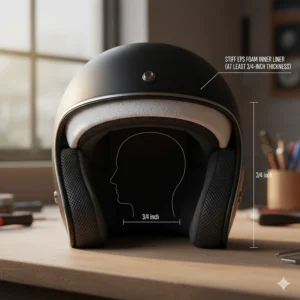
Let’s talk about what’s actually protecting your brain. The outer shell—whether polycarbonate, fiberglass composite, or carbon fiber—distributes impact forces. But the real hero is the EPS (expanded polystyrene) liner inside.
Premium helmets like the AGV K6 S use five-density EPS liners. Different densities absorb impacts at different speeds, providing better protection across a range of accident scenarios. Budget helmets typically use single-density EPS, which works but isn’t as sophisticated.
MIPS and Rotational Impact Protection
Here’s something most riders don’t know: rotational impacts (where your head twists during impact) can cause serious brain injuries even when direct impact forces are low. Traditional DOT testing doesn’t evaluate rotational forces.
MIPS (Multi-directional Impact Protection System) adds a low-friction layer inside the helmet that allows slight rotation during impact, reducing the rotational forces transmitted to your brain. Helmets like the Bell Qualifier DLX MIPS include this technology, and research shows it can reduce brain injury risk by up to 40% in certain crash scenarios.
Visibility and Face Shield Quality
A helmet that limits your vision is dangerous, period. Look for these features:
✅ Wide eyeport: Larger field of view reduces blind spots
✅ Anti-fog coating: Prevents dangerous fogging
✅ Pinlock compatibility: Double-pane system eliminates fogging
✅ UV protection: Prevents eye fatigue on long rides
✅ Tool-free shield changes: Quick swaps between clear and tinted
The LS2 Valiant II includes a Pinlock insert in the box—that alone saves you $30-40 and prevents the frustration of fogged visors on cold mornings.
Price vs. Value: What Should You Spend?
Budget Tier ($50-$200)
This range includes solid options like the HJC i10 ($159-$179) and Scorpion EXO-R420 ($149-$189). You’re getting legitimate DOT and often SNELL certification at prices that won’t break the bank. The compromises are usually in comfort features, weight, and noise reduction rather than core safety.
Best For: New riders, commuters, secondary helmets
Mid-Range Tier ($200-$400)
This sweet spot includes helmets like the Bell Qualifier DLX MIPS ($249-$329) and LS2 Valiant II ($269-$329). You’re getting advanced safety features, better ventilation, lighter weight, and premium comfort. This is where most experienced riders shop.
Best For: Regular riders, sport-touring enthusiasts, track day participants
Premium Tier ($400-$700+)
The AGV K6 S ($499-$659) represents this category. You’re paying for cutting-edge materials, minimal weight, superior aerodynamics, and often hand-assembled construction. The safety benefits over mid-range helmets are incremental, but the comfort and quality-of-life improvements are significant.
Best For: Daily riders, long-distance touring, riders prioritizing weight reduction
Maintenance and Lifespan of DOT Helmets
How Long Does a Helmet Last?
The Snell Memorial Foundation recommends replacing helmets every five years, regardless of impact history. Why? The EPS liner degrades over time due to UV exposure, body oils, and temperature cycling. Even if your helmet looks perfect, its protective capabilities diminish.
After any significant impact—even if there’s no visible damage—replace your helmet immediately. The EPS liner is designed to crush once, absorbing impact energy. It can’t do its job a second time.
Cleaning and Care Tips
Proper maintenance extends your helmet’s life and keeps it comfortable:
Weekly:
✅ Wipe down the exterior with mild soap and water
✅ Clean the visor with appropriate cleaner (never Windex on anti-fog coatings)
✅ Air out the interior
Monthly:
✅ Remove and wash liner and cheek pads (if removable)
✅ Check chin strap for wear
✅ Inspect visor mechanism for smooth operation
Never:
❌ Use harsh chemicals or solvents
❌ Store in direct sunlight
❌ Hang by the chin strap (damages retention system)
❌ Paint over the shell (can weaken materials)
Common DOT Helmet Myths Debunked
“Expensive Helmets are Safer”
Not necessarily. The HJC i10 at $160 has the same SNELL M2020 certification as helmets costing $500+. What you’re paying for in premium helmets is lighter weight, better ventilation, quieter operation, and more sophisticated comfort features. Safety baseline? Pretty much the same if certifications are equal.
“Bright Colors Make You Safer”
Visibility does matter, but studies show it’s more complex than just wearing a bright helmet. Conspicuity depends on contrast, not just color. A white helmet against a light sky might be less visible than a matte black helmet against a dark background. What actually helps? Reflective elements and proper lighting on your bike.
“Half-Shells are Just as Safe as Full-Face”
This one drives me crazy. Research shows 45% of helmet impacts occur in the chin bar area. Half-shells meet minimum DOT standards but provide zero protection to your face and jaw. They’re legal, but they’re not providing equivalent protection. If safety is your priority, go full-face.
“Used Helmets are Fine if They Look Good”
Never, ever buy a used helmet unless you know its complete history. You don’t know if it’s been dropped, left in a hot trunk for years, or involved in an accident. The $100 you save isn’t worth the risk of compromised protection. Budget helmets from reputable brands are always better than used premium helmets.
Helmet Laws by State (2025 Overview)
Universal Helmet Law States
Currently, 19 states and the District of Columbia require all motorcycle riders to wear DOT-approved helmets regardless of age or experience. These states include California, New York, Georgia, Louisiana, Massachusetts, Michigan (with exceptions), Missouri, Nebraska, Nevada, New Jersey, New York, North Carolina, Oregon, Tennessee, Vermont, Virginia, Washington, and West Virginia.
Partial Helmet Law States
Most states have partial laws requiring helmets for riders under a certain age (typically 18-21) or without specific insurance coverage. Always check your local laws, as they change periodically and penalties vary significantly.
No Helmet Law States
Illinois, Iowa, and New Hampshire don’t require helmet use for adult riders. However, just because it’s legal to ride without a helmet doesn’t mean it’s smart. The statistics on unhelmeted rider fatalities are sobering—head injuries are the leading cause of death in motorcycle accidents.
Special Considerations for Different Riders
Cruiser and Harley Riders
Cruiser riders often prioritize style and low profile, which is why half-shells and open-face helmets dominate this segment. The Daytona Skull Cap represents this perfectly—minimal, legal, and stylish. However, consider upgrading to a three-quarter or modular helmet for better protection without sacrificing too much of that cruiser aesthetic.
Sport and Track Riders
If you’re hitting the track, SNELL certification isn’t optional—most organizations require it. Full-face helmets with excellent aerodynamics and ventilation are essential. The HJC i10 and Bell Qualifier DLX MIPS are both track-approved and won’t break the bank.
Adventure and Dual-Sport Riders
ADV riders need versatility. Modular helmets like the LS2 Valiant II work brilliantly because you can flip up the chin bar during off-road sections for better airflow, then close it for highway stretches. Peak visors help with sun glare on long rides.
Commuters and Urban Riders
City riders benefit from modular designs for convenience and quick-release systems. Built-in sun visors are clutch when you’re riding east in the morning and west in the evening. The ILM Modular 953 with Bluetooth is perfect for navigation prompts and taking calls at stoplights.
Advanced Features Worth Considering
Bluetooth Communication Systems
Integrated Bluetooth (like the ILM 953) versus aftermarket systems (Cardo, Sena) is an ongoing debate. Integrated systems are convenient and cost-effective initially, but aftermarket systems typically offer better sound quality, range, and upgrade potential.
Photochromic and Transitions Shields
Light-adaptive shields that darken in sunlight eliminate the need to carry multiple visors. The Bell Qualifier series is compatible with Transitions shields, which automatically adjust from clear to dark in seconds. For riders who hate switching visors mid-ride, this feature is worth every penny.
Emergency Quick-Release Systems
Some helmets like the HJC i10 include quick-release cheek pads designed for emergency responders. In an accident, these allow EMTs to remove the helmet with minimal head movement, potentially preventing spinal injuries.
Aerodynamic Spoilers and Diffusers
Premium helmets feature wind-tunnel-tested spoilers that reduce lift at high speeds. The AGV K6 S’s redesigned spoiler reduces lift by 4% compared to the K6. For sport riders regularly exceeding 100 mph, these aerodynamic refinements meaningfully reduce neck fatigue and improve stability.
The Environmental Impact of Helmet Manufacturing
Sustainable Helmet Options
The motorcycle industry is slowly addressing environmental concerns. Some manufacturers are exploring recyclable materials, reducing packaging waste, and implementing more sustainable manufacturing processes. Unfortunately, EPS foam (the primary impact-absorbing material) isn’t easily recyclable with current technology.
Proper Helmet Disposal
When retiring a helmet, check with local recycling programs. Some municipalities accept the polycarbonate or composite shells separately from the EPS liner. Otherwise, helmets typically end up in landfills. As the industry evolves, we’ll hopefully see more sustainable options that don’t compromise safety.
❓ Frequently Asked Questions
❓ How often should I replace my dot motorcycle helmets?
❓ Can I use a DOT helmet for track days?
❓ Are modular helmets as safe as full-face helmets?
❓ What does DOT certification actually test?
❓ Do I need to wear a DOT helmet if my state doesn't require it?
Conclusion: Finding Your Perfect DOT Motorcycle Helmet
Here’s the bottom line: the best DOT motorcycle helmet is the one you’ll actually wear every single ride. Whether that’s the ultra-lightweight AGV K6 S at $500+ or the budget-friendly HJC i10 at $160, proper fit and consistent use matter more than brand names or price tags.
Throughout my years of riding and testing gear, I’ve learned that helmet shopping isn’t about finding “the best” helmet—it’s about finding the best helmet for your specific needs, head shape, riding style, and budget. The HJC i10 offers incredible value with SNELL certification for track enthusiasts. The LS2 Valiant II provides unmatched versatility for touring riders. The AGV K6 S delivers premium lightweight comfort for daily riders willing to invest in long-term comfort.
Whatever you choose, remember these key points: proper fit is non-negotiable, DOT certification is your baseline (not your ceiling), and replace helmets every five years or after any significant impact. Your brain is worth protecting with the best equipment you can afford.
Stay safe out there, and remember—the best ride is the one you come home from.
🛒 Take Action Now! Your Safety Matters! 🏍️
Don’t wait another day riding with inadequate protection. Click on any of the highlighted helmet names above to check current Amazon pricing, read thousands of verified customer reviews, and find the perfect DOT motorcycle helmet for your riding style. Most qualify for free Prime shipping, meaning you could be protected by next week!
Recommended for You
- Bell Motor Racing Helmets: 7 Best Picks for Safety 2025
- Youth Dirt Bike Helmet: 7 Best Options for Safety 2025
- Kids Full Face Helmet: 7 Best Picks That Parents Trust (2025)
Disclaimer: This article contains affiliate links. If you purchase products through these links, we may earn a small commission at no additional cost to you.
✨ Found this helpful? Share it with your friends! 💬🤗
