
In This Article
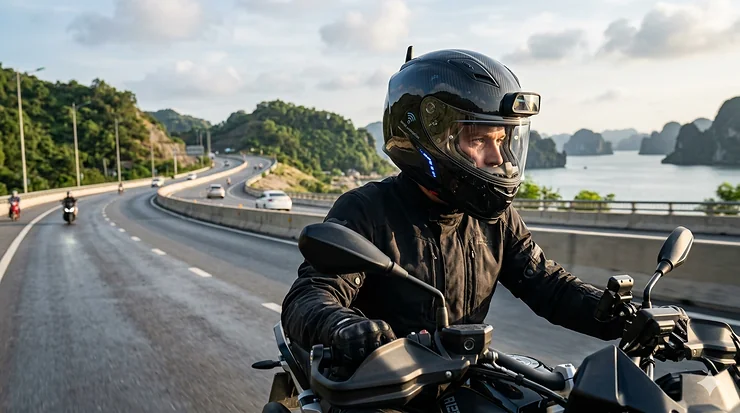
Picture this: you’re cruising down the Pacific Coast Highway when your helmet alerts you to an incoming call, reads your GPS directions aloud, and lets you chat with your riding buddy three bikes back—all without taking your hands off the grips. This isn’t science fiction anymore. The connected motorcycle helmet has transformed from a novelty into an essential piece of intelligent riding gear that serious motorcyclists depend on daily.

The difference between today’s smart helmets and traditional gear is staggering. Modern IoT motorcycle helmet technology integrates Bluetooth communication, mesh networking, voice commands, and smartphone connectivity directly into the shell you’re already wearing. According to the National Highway Traffic Safety Administration, while DOT certification remains the legal baseline for head protection, the evolution of connected safety helmet features now addresses communication gaps that previously forced riders to choose between safety and connectivity.
What most riders don’t realize is that smart helmet technology has progressed beyond simple Bluetooth speakers. Today’s intelligent helmet system offerings incorporate mesh intercom networks that connect up to 24 riders simultaneously, active noise cancellation that makes 70 mph conversations crystal clear, and automatic firmware updates that improve performance while you sleep. The integration of Internet of Things (IoT) technology in motorcycle gear represents a fundamental shift in how we approach rider safety and group communication.
Quick Comparison: Top Connected Motorcycle Helmets at a Glance
| Helmet Model | Communication Type | Talk Time | Intercom Range | Best For | Price Range |
|---|---|---|---|---|---|
| Sena Stryker | Mesh + Bluetooth | 18 hours | Up to 1.2 miles | Premium full-face riders | $550-$650 |
| Sena Impulse | Mesh + Bluetooth | 18 hours | Up to 1.2 miles | Modular versatility seekers | $650-$750 |
| Sena Outrush 2 | Mesh 3.0 + Wave | 21 hours | 1 km (0.6 miles) | Budget-conscious mesh users | $350-$400 |
| ILM 953 PRO | Bluetooth 3.0 | 8 hours | 1,640 feet | Entry-level riders | $140-$180 |
| BILT Techno 3.0 | Sena DWO-6 BT 4.1 | 8 hours | 1,000 meters | Value-focused commuters | $280-$320 |
| LS2 Advant (Cardo 4X) | Bluetooth 5.2 + OBI | Not specified | 1.2 km (0.75 miles) | Premium modular riders | $450-$550 |
| FreedConn BM2-S | Bluetooth 3.0 | 8 hours | 500 meters | Ultra-budget option | $100-$140 |
Looking at the comparison above, the Sena Outrush 2 delivers exceptional value at under $400 with Mesh 3.0 technology that outperforms basic Bluetooth systems on helmets costing twice as much. However, if battery life is your priority, both the Stryker and Impulse’s 18-hour runtime means weekend touring without charging concerns. Budget riders should note that while the ILM 953 PRO and FreedConn BM2-S sacrifice advanced features, they still provide legitimate DOT-certified protection with basic communication—the FreedConn’s 8-hour talk time actually matches helmets in the $300 range.
💬 Just one click — help others make better buying decisions too! 😊
Top 7 Connected Motorcycle Helmets: Expert Analysis
1. Sena Stryker — The Premium Performance Champion
The Sena Stryker represents the pinnacle of what happens when a communication company builds a helmet from scratch instead of retrofitting technology into someone else’s shell. This full-face smart helmet integrates Sena’s industry-leading Mesh Intercom with Bluetooth, but what sets it apart is the Sound by Harman Kardon audio system engineered specifically for motorcycle environments.
The composite fiberglass shell houses 40mm premium speakers positioned with acoustic dampening that transforms helmet audio from “good enough” to genuinely impressive. What this means in practice: you’ll hear every note of your playlist at 75 mph without cranking volume to dangerous levels that mask traffic sounds. The Mesh Intercom supports up to 24 riders in Group Mesh mode, with Multi-Channel Open Mesh accommodating virtually unlimited participants across 6 channels—critical for large rally rides where Bluetooth’s 4-rider limit falls short.
Expert commentary: This helmet suits riders who refuse to compromise on either audio quality or communication capability. The integrated LED taillight adds genuine safety value during dawn and dusk rides, and the magnetic pogo charging port means no fumbling with rubber flaps in rain. However, at around $600, you’re paying premium for the Harman Kardon collaboration—riders who primarily listen to podcasts rather than music might find better value elsewhere.
Customer feedback consistently praises the helmet’s comfort during all-day rides and the clarity of voice communication even at highway speeds. Some riders note the weight (approximately 1,690g for medium size) feels substantial compared to non-integrated options, though the balanced weight distribution prevents neck fatigue.
Pros:
✅ Harman Kardon premium audio rivals dedicated headphones
✅ 18-hour Bluetooth talk time covers weekend tours without charging
✅ Seven-vent design with retractable sun visor maximizes comfort
Cons:
❌ Premium pricing puts it beyond budget-conscious riders
❌ Heavier than basic helmets due to integrated technology
Price range: Around $550-$650. For riders who spend 10+ hours weekly on their bike, the per-ride cost justifies the investment through superior comfort and communication reliability.

2. Sena Impulse — Modular Flexibility Meets Premium Sound
The Sena Impulse takes everything great about the Stryker and packages it in a modular design that flips up for convenience without sacrificing protection. DOT-rated with a composite fiberglass shell, this helmet earned P/J dual homologation—meaning it maintains safety certification whether the chin bar is up or down, unlike cheaper modular helmets that only certify in the closed position.
The Sound by Harman Kardon speakers here benefit from additional acoustic optimization possible in the modular design, with interior dampening that Sena specifically tuned for the Impulse’s geometry. Mesh Intercom range extends up to 1.2 miles in open terrain, and with a minimum of 6 riders, the network can daisy-chain signals up to 5 miles total—transforming group rides from constant “where are you?” confusion into seamless coordination.
Expert commentary: The Impulse targets touring riders and commuters who value the ability to flip up the chin bar at stoplights or gas stations without removing the entire helmet. The integrated LED taillight—Sena’s first implementation in a helmet—provides 360-degree visibility enhancement that matters most during lane splitting or heavy traffic. Voice commands in 8 languages mean international riders can operate the helmet in their native tongue, and the digital assistant integration (Google Assistant/Siri) turns the helmet into a true command center.
Customer feedback highlights the four-vent airflow system’s effectiveness even in summer heat, and riders appreciate the Pinlock anti-fog lens inclusion (many competitors charge extra). A few users mention the modular mechanism adds slight weight over the Stryker, though at intermediate oval fitment, most find the comfort acceptable for 4+ hour rides.
Pros:
✅ Modular convenience for gas stops without full helmet removal
✅ First Sena helmet with integrated LED taillight for enhanced visibility
✅ Voice commands and digital assistant access keep hands on controls
Cons:
❌ Modular mechanism adds weight and complexity versus full-face
❌ Premium pricing around $700 requires serious commitment
Price range: In the $650-$750 bracket. The modular functionality and Harman Kardon audio justify the cost for riders who regularly navigate city traffic or take frequent breaks on long tours.
3. Sena Outrush 2 — Mesh 3.0 Performance at Mid-Range Price
The Sena Outrush 2 marks a significant leap in the evolution of affordable smart helmets by integrating Mesh Intercom 3.0 with the innovative Wave Intercom technology—a cellular network-based protocol that eliminates the traditional distance limitations plaguing Bluetooth systems. This ABS shell modular helmet delivers advanced connectivity at a price point that was impossible just two years ago.
Mesh Intercom 3.0 provides 1 km range in open terrain with Open Mesh supporting 6 channels and unlimited participants, while Group Mesh connects up to 24 riders in a private network. What this means in real-world riding: your group stays connected through tunnels and around curves where traditional Bluetooth drops, and the auto-healing network seamlessly reconnects riders who temporarily fall out of range. Wave Intercom takes this further by using cellular networks to connect riders within a 1-mile radius regardless of obstacles—including non-Sena users thanks to the open protocol.
Expert commentary: This helmet represents the sweet spot for riders who want legitimate mesh networking without paying Stryker/Impulse prices. The second-generation HD speakers deliver surprisingly good audio quality, and the Intelligent Power Management automatically powers down the helmet when accelerometers detect no movement—solving the “forgot to turn it off” battery drain problem that plagues every Bluetooth helmet owner eventually. The P/J dual homologation means safety isn’t compromised for the modular convenience.
Customer feedback consistently mentions the 21-hour battery life as a standout feature—that’s three times the talk time of budget Bluetooth helmets at only $100 more in price. Some riders note the ABS shell feels slightly less premium than fiberglass options, though at approximately 4 pounds, the weight stays reasonable for all-day wear.
Pros:
✅ Wave Intercom connects with any brand headset over cellular networks
✅ 21-hour battery life eliminates mid-tour charging anxiety
✅ Auto power management prevents battery drain from user error
Cons:
❌ ABS shell lacks the premium feel of fiberglass alternatives
❌ Wave Intercom requires cellular coverage (works great in populated areas, limited in remote regions)
Price range: Around $350-$400. For riders who primarily tour in areas with cell coverage and want mesh networking without breaking the bank, the Outrush 2 delivers 80% of premium helmet features at 60% of the cost.
4. ILM 953 PRO — Budget Entry Point with Group Intercom
The ILM 953 PRO serves a specific niche: riders who want their first connected helmet without committing premium dollars while they figure out if smart features matter to them. This DOT-certified modular helmet integrates Bluetooth 3.0 technology with FreedConn hardware, supporting 6-8 rider group intercom where riders can talk simultaneously—a significant upgrade from the base 953 model’s 2-3 rider limit.
The dual visor system (clear face shield plus drop-down sun visor) and ABS shell construction meet FMVSS-218 standards, providing legitimate head protection despite the budget price. The group intercom function operates at up to 1,640 feet in open terrain, and DSP echo cancellation plus noise suppression technology delivers clearer audio than you’d expect at this price point. However, here’s the critical limitation: ILM helmets only pair with other ILM or FreedConn units—you can’t connect to Sena, Cardo, or other brands.
Expert commentary: This helmet works for riding groups who buy matching units or solo riders who primarily use the Bluetooth for music and GPS rather than rider-to-rider communication. The 8-hour talk time matches helmets costing twice as much, and the 110-hour standby means the battery won’t die between weekend rides. Important sizing note: this helmet runs one size smaller than standard due to the built-in Bluetooth module—measure your head and order up if you’re between sizes.
Customer feedback splits between riders who appreciate the value proposition and those frustrated by the proprietary intercom system. The helmet’s build quality receives mixed reviews—it’s not premium, but at $150, expectations should align accordingly. The washable microfiber lining and adjustable vents provide decent comfort for commuting distances.
Pros:
✅ Budget-friendly entry point under $200 for connected features
✅ 6-8 rider simultaneous group intercom at this price is impressive
✅ 8-hour talk time and 110-hour standby match mid-range helmets
Cons:
❌ Proprietary system only pairs with ILM/FreedConn units
❌ ABS shell and build quality reflect budget positioning
Price range: In the $140-$180 range. Best for cost-conscious riders willing to accept limited intercom compatibility in exchange for rock-bottom pricing on legitimate DOT protection with smart features.
5. BILT Techno 3.0 — Sena Technology at Value Pricing
The BILT Techno 3.0 occupies interesting territory as a value brand that integrates legitimate Sena hardware—specifically the DWO-6 Bluetooth 4.1 system. This full-face helmet with aggressive polycarbonate shell design provides DOT certification and integrated communication without requiring you to purchase and install a separate Bluetooth unit.
The Sena DWO-6 system supports 4-way intercom with up to 1,000 meters (0.6 miles) range, voice-operated phone and intercom communication, and automatic audio boost that increases volume as speed increases—addressing the primary frustration of helmets where you can hear fine at 35 mph but lose everything at 65 mph. Music sharing capability lets you broadcast your playlist to other connected riders, and compatibility with Sena Remote Control devices adds convenience for riders who prefer handlebar-mounted controls over helmet buttons.
Expert commentary: This helmet targets commuters and weekend riders who want Sena ecosystem compatibility without paying Sena helmet prices. The smartphone app support provides firmware updates and configuration options usually reserved for premium units, and the drop-down sun visor plus eyeglass-compatible cheek pads address practical daily riding needs. Important caveat from customer feedback: this helmet runs small—most riders recommend sizing up at least one size from your normal measurement.
Customer reviews highlight solid value but note wind noise exceeds premium helmets, and some users report inconsistent sizing between units. The 8-hour talk time and 7-day standby battery life align with expectations at this price point. The multi-point surface-mounted airflow ventilation system (chin, forehead, and metal mesh rear exhaust vents) provides adequate cooling for three-season riding.
Pros:
✅ Legitimate Sena DWO-6 hardware provides ecosystem compatibility
✅ Automatic audio boost maintains clarity as speed increases
✅ App support and firmware updates typically reserved for premium helmets
Cons:
❌ Runs small—order up at least one size from normal measurement
❌ Wind noise and ventilation don’t match premium helmet standards
Price range: Around $280-$320. For riders who primarily commute and want reliable Sena-compatible communication without premium helmet investment, the Techno 3.0 delivers functional smart features at a price that won’t sting if you upgrade in two years.
6. LS2 Advant with Integrated Cardo 4X — European Engineering Meets Premium Communication
The LS2 Advant represents a different approach to smart helmets: a well-established helmet manufacturer partnering with a premium communication brand (Cardo) to deliver integrated excellence. Available in three variations (standard Kinetic Polymer Alloy, fiberglass composite Advant X, and ultra-light 9K carbon fiber Advant X Carbon), this modular helmet features the Cardo 4X USC Bluetooth system with 1.2 km range and Bluetooth 5.2 technology.
The Cardo 4X integration provides Natural Voice control that actually works reliably—no shouting or precise pronunciation required. The system connects up to 4 riders with Open Bluetooth Intercom (OBI) compatibility, meaning it pairs seamlessly with other brands’ OBI-compliant systems, solving the ecosystem lock-in problem that plagues ILM and some Sena models. The 180-degree modular system allows the entire chin bar assembly to rotate back, providing true open-face functionality while maintaining P/J dual homologation safety certification.
Expert commentary: This helmet suits riders who prioritize helmet shell quality and safety technology as much as communication features. LS2’s Advanced Rotational Energy Management (AREM) system addresses the rotational impact forces that cause traumatic brain injury—a safety feature absent from many budget smart helmets focused solely on communication. The premium “A Class” polycarbonate face shield with Pinlock Max insert provides fog-free visibility in conditions where cheaper helmets obscure your vision. The 3D laser-cut cheek pads designed for intermediate oval head shape provide comfort that matches custom-molded helmets at fraction of the cost.
Customer feedback emphasizes the helmet’s premium feel and construction quality—you’re getting a legitimate high-end helmet that happens to include Cardo communication, not a communication system with basic helmet wrapped around it. Important sizing note: this helmet runs small, and LS2 specifically recommends ordering at least one size larger than the sizing chart suggests. The carbon fiber version weighs just 1,470g (±50g), making it among the lightest integrated smart helmets available.
Pros:
✅ AREM rotational impact protection addresses TBI concerns
✅ OBI compatibility works with multiple brands’ communication systems
✅ Premium shell options from polymer to ultra-light carbon fiber
Cons:
❌ Runs significantly small—order up at minimum one full size
❌ Premium pricing reflects both helmet and communication quality
Price range: Standard version around $450-$550, fiberglass composite Advant X approximately $100-$150 more, carbon fiber version in the $700-$850 range. For riders who refuse to compromise on helmet safety technology and want premium communication without Sena/Cardo ecosystem lock-in, the LS2 Advant delivers on both fronts.
7. FreedConn BM2-S — Ultra-Budget Communication for Casual Riders
The FreedConn BM2-S serves riders who need DOT-certified protection with basic Bluetooth connectivity at the absolute lowest price point. This modular helmet features Bluetooth 3.0 technology supporting 3-rider pairing (though only 2 can talk simultaneously) with up to 500 meters (1,640 feet) intercom range in open terrain.
The ABS engineering plastic injection molding provides DOT FMVSS-218 Safety Standard compliance, with high-density EPS cushion layer for impact absorption. The dual visor system includes a clear face shield and flip-down sun visor, and the helmet weighs approximately 4 pounds—reasonable for a budget modular with integrated electronics. Advanced DSP echo cancellation and noise suppression technology deliver clearer audio than the price suggests, with built-in speakers providing full stereo sound for music and GPS directions.
Expert commentary: This helmet fills a specific niche—riders who need Bluetooth for phone calls and GPS but don’t care about premium audio or multi-rider group communication. The 8-hour talk time and 110-hour standby match helmets costing twice as much, addressing the primary concern that budget electronics die quickly. The one-button control system (answering, rejecting calls, redialing) keeps operation simple while riding, and incoming calls automatically override intercom, music, FM radio, and GPS audio—prioritizing safety-critical communication.
Critical limitations to understand: Like the ILM, FreedConn helmets only pair with other FreedConn or compatible ILM units for intercom use. The helmet is NOT ECE certified—only DOT—limiting its use in European markets. Customer feedback consistently mentions the helmet runs one size smaller than normal helmets due to built-in Bluetooth modules, so measure carefully and consider ordering up. Build quality reflects budget positioning—functional but not refined.
Pros:
✅ Ultra-budget pricing under $150 includes integrated Bluetooth
✅ 8-hour talk time matches helmets costing 2-3x more
✅ Simple one-button control minimizes distraction while riding
Cons:
❌ Proprietary intercom only works with FreedConn/ILM units
❌ Build quality and materials reflect rock-bottom pricing
Price range: Around $100-$140, occasionally dropping below $100 during sales. Best for casual riders, beginners, or those needing a second helmet for passenger use who want basic connectivity without investment in premium features they won’t use regularly.
Smart Helmet Setup Guide: Getting Connected in Under 10 Minutes
Most riders overthink their first smart helmet setup and waste 45 minutes fumbling through manuals. Here’s the streamlined process that works across all Bluetooth and mesh systems:
Before First Ride (5 minutes):
- Charge the helmet fully—most ship at 40-60% capacity
- Download the manufacturer’s app (Sena Motorcycles, Cardo Connect, or brand-specific)
- Power on the helmet while wearing it to hear audio prompts
- Open the app and select “Add New Device”
- Follow the pairing wizard—it handles firmware updates automatically
Pairing Your Phone (2 minutes): Most smart helmets support two-phone connectivity. Pair your primary phone first through Bluetooth settings, then the helmet app recognizes it automatically. Second phone requires manual pairing through settings but maintains separate profiles for music versus calls.
Common First-Week Mistakes to Avoid:
- Cranking volume to 100%: Start at 60% and adjust while riding—many helmets auto-adjust for speed anyway
- Forgetting to disable auto-pairing: Your helmet will connect to the last paired device by default, causing confusion in group rides
- Neglecting voice command calibration: Spend 3 minutes teaching the system your voice in a quiet environment—it dramatically improves recognition accuracy at speed
Optimization for Long-Term Performance: Enable automatic firmware updates via WiFi (Sena Stryker/Impulse feature) or check monthly via the app. Clean speaker grills quarterly with compressed air—road dust accumulation reduces audio quality noticeably. Replace foam windscreens on boom microphones every 6 months ($8-$15) to maintain call clarity.
Real-World Scenario Guide: Matching Helmet to Riding Style
The Daily Commuter (15-30 miles, mixed traffic)
Best Choice: BILT Techno 3.0 or Sena Outrush 2
You need GPS navigation clarity, podcast audio that doesn’t require constant volume adjustment, and quick phone access for the inevitable “running late” call. The BILT’s automatic audio boost handles highway-to-surface-street transitions seamlessly, while the Outrush 2’s 21-hour battery means you won’t face Friday morning dead-helmet panic after forgetting to charge Thursday night.
Budget Alternative: FreedConn BM2-S provides phone and GPS connectivity at $100—adequate for 95% of commuting needs if you’re not particular about audio fidelity.
The Weekend Group Rider (100-300 mile rides, 3-8 riders)
Best Choice: Sena Outrush 2 or LS2 Advant (Cardo 4X)
Group rides expose the critical difference between 4-rider Bluetooth limit and mesh systems’ flexibility. The Outrush 2’s Mesh 3.0 with Wave Intercom connects riders over cellular networks, solving the “who dropped off the network” problem that ruins Bluetooth group rides. The LS2’s OBI compatibility matters if your group runs mixed brands—you’re not forcing everyone to buy matching systems.
Premium Upgrade: Sena Impulse’s modular design and 1.2-mile mesh range accommodate larger groups and gas-station convenience without removing your helmet.
The Solo Tourer (Multi-day rides, varying terrain)
Best Choice: Sena Stryker or Sena Impulse
Long-distance solo touring demands battery life (18 hours covers two full days), audio quality that makes 8-hour rides enjoyable, and reliability in remote areas where “helmet didn’t connect” becomes a serious problem. The Harman Kardon audio transforms podcasts and audiobooks from background noise to genuine entertainment. The modular Impulse adds flip-up convenience for photo stops and small-town diners.
Budget Alternative: Sena Outrush 2’s 21-hour battery and solid audio cover most touring needs at $300 less than premium options.

How to Choose Your Connected Motorcycle Helmet: Decision Framework
Start with budget reality—smart helmets range from $100 to $750, and your riding frequency determines value. Ride 2-3 times monthly? Budget options suffice. Ride 3+ times weekly? Premium features pay for themselves in convenience and comfort.
Priority 1: Safety Certification Every helmet here is DOT-certified, but riders in states with strict enforcement should verify the DOT label includes “FMVSS No. 218 CERTIFIED” as specified by federal regulations. Modular helmets need P/J dual homologation if you’ll flip up the chin bar while moving—many budget modular helmets only certify in full-face configuration.
Priority 2: Communication Ecosystem This decision impacts five years of riding:
- Sena ecosystem: Largest market share, best app support, proprietary mesh (doesn’t connect to other brands’ mesh)
- Cardo ecosystem: Premium audio focus, JBL partnership, DMC mesh (doesn’t connect to Sena mesh)
- Open systems (OBI-compatible): LS2/Cardo 4X, future-proof as industry standardizes
- Proprietary budget (ILM/FreedConn): Only pair with same-brand units
If you ride solo 90% of the time, ecosystem matters less. Group riders should match brands or choose OBI-compatible systems.
Priority 3: Battery Life Reality Check Manufacturer specs show “maximum talk time”—reduce by 30% for real-world usage with music, GPS, and occasional intercom. Eight-hour rated battery delivers 5-6 hours mixed use. For multi-day tours, 18+ hour batteries (Stryker, Impulse, Outrush 2) eliminate daily charging stops.
Priority 4: Audio Quality Hierarchy Harman Kardon integration (Stryker, Impulse) → JBL systems (Cardo) → Second-generation HD speakers (Outrush 2) → Standard speakers (BILT, ILM, FreedConn). If you primarily use GPS directions, standard speakers suffice. Music enthusiasts and audiobook listeners benefit from premium audio investment.
Priority 5: Shell Construction and Weight Carbon fiber (<1,500g) → Fiberglass composite (1,600-1,700g) → Polycarbonate/ABS (1,750-2,000g). Neck fatigue develops after 3-4 hours with heavier helmets. Riders over 50 particularly benefit from lightweight options. Budget helmets sacrifice weight for price—acceptable for 60-minute commutes, problematic for day-long tours.
Connected Helmet vs Traditional Bluetooth Headset: The Total Cost Reality
Many riders assume buying a $150 helmet plus a $200 Bluetooth headset ($350 total) beats a $400 integrated smart helmet. The math looks appealing until you account for installation complexity, long-term maintenance, and performance differences.
Traditional Setup Total Cost:
- Quality DOT helmet: $150-$200
- Mid-range Bluetooth unit: $150-$250
- Installation time: 1-2 hours first time (learning curve)
- Clamp system creates helmet pressure points (common complaint)
- Battery replacement every 2-3 years: $30-$50
- Total 5-year cost: $450-$650
Integrated Smart Helmet Total Cost:
- Mid-range smart helmet: $350-$450
- Installation time: 0 minutes (pre-installed)
- Optimized speaker positioning eliminates pressure points
- Integrated battery typically lasts helmet lifespan
- Total 5-year cost: $350-$450
The integrated option costs less and delivers better audio positioning since manufacturers optimize speaker placement during helmet design rather than forcing generic speakers into whatever space exists post-production.
When Traditional Headsets Make Sense: You already own premium helmets you love, you switch between multiple helmets frequently, or you’re uncertain about committing to smart features long-term. Quality clamp-on units (Cardo Packtalk Bold, Sena 50S) provide flagship features with helmet flexibility.
Battery Life Optimization: Extending Your Helmet’s Range
Every smart helmet rider eventually experiences the “dead battery 50 miles from home” panic. These optimization strategies extend battery life 30-40% beyond stock settings:
Disable Unused Features: FM radio consumes 15-20% additional battery even when you’re not actively listening. GPS voice prompts use 10% more than music-only mode. If you memorize your route, disable GPS to extend battery 2-3 hours.
Adjust Auto-Connection Settings: Most helmets search for the last-paired device on power-up, burning battery until connection confirms. Disable auto-pair if you’re not using intercom features—extend standby time from 7 days to 10-12 days.
Volume Matters More Than You Think: Running volume above 80% increases power draw 25-30% compared to 60% volume. Most riders find 65-70% volume adequate at highway speeds with proper helmet fit (wind noise reduction). Premium helmets with active noise cancellation reduce required volume significantly.
Temperature Impact: Lithium batteries lose 20% capacity below 40°F. Winter riders should warm helmets indoors before rides or expect 6-hour batteries to deliver 4-5 hours. Conversely, storage above 85°F degrades battery chemistry—never leave your smart helmet in direct sunlight for extended periods.
Firmware Updates Actually Help: Manufacturers optimize power management with firmware updates. Sena’s 2024 updates improved Outrush 2 battery life by 1.5-2 hours through better sleep mode algorithms. Check monthly for updates rather than assuming your 2-year-old helmet can’t improve.
❓ Frequently Asked Questions
❓ Can connected motorcycle helmets pair with non-motorcycle Bluetooth devices like regular headphones?
❓ Do I need cellular service for mesh intercom features to work?
❓ How often do I need to charge my connected motorcycle helmet?
❓ Can I upgrade the Bluetooth system in my current helmet instead of buying a smart helmet?
❓ Are connected motorcycle helmets legal in all U.S. states?
Conclusion: Making Your Connected Helmet Decision
The connected motorcycle helmet has evolved from experimental gadget to legitimate safety enhancement that changes how you experience every ride. Whether you’re coordinating with five riders on a mountain pass, receiving critical navigation updates without looking down at your phone, or simply enjoying your favorite podcast during a solo tour, smart helmet technology delivers value that’s impossible to quantify until you’ve experienced riding without it.
The right choice depends on your riding profile. Daily commuters gain most from mid-range options like the BILT Techno 3.0 or Sena Outrush 2 that balance features against daily-use practicality. Weekend warriors benefit from mesh systems’ reliability in group scenarios—the Outrush 2’s Wave Intercom or the LS2 Advant’s OBI compatibility solving the mixed-brand group ride problem. Premium buyers choosing between the Sena Stryker and Impulse should prioritize full-face (Stryker) for maximum protection and modular (Impulse) for gas station convenience.
The technology will continue evolving—expect AI-powered voice assistants, integrated cameras, and heads-up display integration within 3-5 years. However, today’s smart helmets already deliver transformative functionality that enhances both safety and enjoyment. Start with your primary use case, set a realistic budget that reflects your riding frequency, and choose the ecosystem that matches your group riding needs. Your connected helmet purchase today positions you for a decade of continuously-improving features through firmware updates and ecosystem growth.
Recommended for You
- 7 Best Ladies Motorcycle Protection Gear Every Rider Needs 2026
- 7 Best Kids Motorcycle Protection Sets That Work (2026)
- 7 Best Quad Riding Helmets That Crushed Safety Tests in 2026
Disclaimer: This article contains affiliate links. As an Amazon Associate, I earn from qualifying purchases. If you purchase products through these links, we may earn a small commission at no additional cost to you.
✨ Found this helpful? Share it with your friends! 💬🤗
