
In This Article
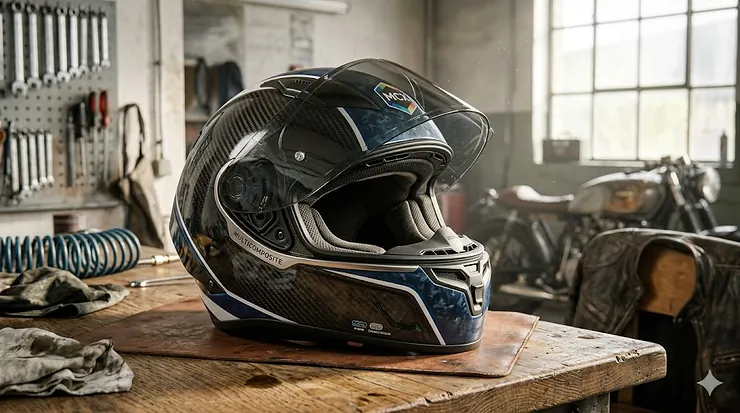
Here’s the uncomfortable truth most riders don’t want to hear: not all helmets are built the same way. Two helmets can both carry a DOT sticker, weigh almost identical amounts, and sit in the same price bracket — and yet, in an actual crash, one will scatter energy across a sophisticated web of interlocked materials while the other basically just… cracks. The difference? What the shell is actually made of.
Multi-material composite construction has quietly become the gold standard in motorcycle helmet engineering — and in 2026, it’s no longer reserved for MotoGP pros with sponsor budgets. The technology has trickled down to helmets that everyday street riders, track-day enthusiasts, and adventure tourers can actually afford. But here’s the thing: “composite” gets thrown around so loosely in marketing copy that it’s almost become meaningless. Polycarbonate blends get called composite. Single-fiber shells get called composite. It’s a mess.
So let’s be precise. When we talk about true multi-material composite helmets in this guide, we mean shells that deliberately combine two or more distinct structural materials — carbon fiber, fiberglass, aramid (Kevlar), organic fibers — each chosen to do a specific job. The result is a layered protection system that outperforms any single material on its own. Carbon brings stiffness and energy dispersal. Aramid absorbs impact shear. Fiberglass provides controlled flex. Together, they create something close to engineering magic.
In this guide, you’ll find 7 real products currently available on Amazon, covering everything from budget-conscious builds that still punch well above their price point to premium shells that rival what professional racers wear. We’ll break down not just what’s in each helmet, but what those materials actually mean when your head hits asphalt at 45 mph. Because at that point, the marketing brochure doesn’t matter — only the engineering does.
Quick Comparison Table: 7 Best Multi-Material Composite Helmets (2026)
| Helmet | Shell Construction | Safety Cert | Weight | Price Range | Best For |
|---|---|---|---|---|---|
| HJC RPHA 11 Pro | P.I.M. Plus (Carbon + Fiberglass + Aramid) | DOT, ECE, Snell | ~3.1 lbs | $300–$400 | Sport-touring riders |
| Shoei RF-1400 | AIM+ Matrix (Fiberglass + Organic Fiber) | DOT, ECE, Snell M2020D | ~3.6 lbs | $500–$620 | Premium everyday street |
| Bell Race Star Flex DLX | Tri-Matrix Composite | DOT | ~3.4 lbs | $580–$700 | Track-to-street crossover |
| AGV K6 S | Carbon-Aramid Fiber Composite | ECE 22.06, DOT | ~2.7 lbs | $400–$500 | Lightweight performance |
| Alpinestars Supertech R10 Carbon | 3K Carbon + Aramid + Fiberglass | ECE 22.06, DOT | ~2.7 lbs | $700–$900 | Advanced/race riders |
| ScorpionEXO R420 | Advanced Polycarbonate Composite | DOT, Snell | ~3.3 lbs | $150–$200 | Entry-level quality build |
| Troy Lee Designs Stage 2026 | Polylite + Fiber Reinforcement (EPP+EPS) | DOT/CE | ~2.9 lbs | $300–$500 | Mountain bike / enduro |
Analysis: The table above tells a clear story. If you need Snell certification — the most demanding independent safety standard — your shortlist is the HJC RPHA 11 Pro, Shoei RF-1400, Bell Race Star Flex DLX, and ScorpionEXO R420. Budget decides a lot here, but the gap between the $200 Scorpion and the $600 Shoei isn’t purely prestige — it’s additional shell complexity, fit refinement, and noise management. The Alpinestars is for riders who’ve genuinely outgrown everything else.
✨ Don’t Miss These Exclusive Deals!
🔍 Ready to upgrade your helmet? Click on any highlighted product name to check current pricing and availability on Amazon. Deals change fast — don’t let the right lid slip away.
💬 Just one click — help others make better buying decisions too! 😊
Top 7 Multi-Material Composite Helmets — Expert Analysis
1. HJC RPHA 11 Pro — Best Mid-Range Composite Performer
The HJC RPHA 11 Pro is the helmet that consistently makes serious riders do a double-take when they learn its price. The standout feature is HJC’s P.I.M. Plus (Premium Integrated Matrix Plus) shell construction — a genuine three-material hybrid of carbon fiber, fiberglass, and aramid woven into a single optimized structure.
What does that mean in practice? Carbon fiber handles initial impact stiffness, preventing the shell from collapsing inward too quickly. Fiberglass adds controlled elasticity — essentially the shell’s ability to flex slightly and spread energy across a wider surface area. Aramid, the same family of materials used in ballistic body armor, provides cut-through resistance and prevents catastrophic shell fracture during complex impacts. Three materials, three different jobs, working simultaneously. The result is a shell HJC claims sits significantly lighter and stronger than a comparable single-material polycarbonate shell at the same price point — and in testing, that claim holds up. Weight comes in around 3.1 lbs for a medium, which is genuinely impressive for a helmet at this price.
Who is this for? The RPHA 11 Pro is the sweet spot for sport-touring riders who cover 5,000+ miles a year and want genuine engineering quality without writing a $600 check. The aerodynamic shell geometry cuts wind drag at highway speeds, and the wider eye port gives better peripheral vision than most helmets in this class. Honestly, if you’re coming from a polycarbonate helmet, this will feel like a revelation.
Customer feedback consistently praises the quiet ride and the quality of the anti-fog, quick-release face shield. Common feedback is that fit runs slightly more snug in the cheeks initially, but riders report it breaks in well over the first 20–30 hours.
✅ Three-material P.I.M. Plus shell — genuine composite, not marketing speak
✅ DOT, ECE, and Snell M2015 certified — passes all major standards
✅ Superior peripheral vision with enlarged eye port
❌ Cheek pads initially snug — not ideal for wider oval head shapes
❌ Some riders find interior fit runs warm in summer
Price range: $300–$400 | Value verdict: One of the strongest composite builds per dollar available today.
2. Shoei RF-1400 — The Benchmark Mid-Premium Composite Shell
If there’s one helmet engineers point to when they want to explain what thoughtful composite layered protection actually looks like, it’s the RF-1400. Shoei’s proprietary AIM+ (Advanced Integrated Matrix Plus) shell takes a radically different approach from HJC: rather than weaving in carbon fiber, Shoei hand-lays interwoven layers of fiberglass alongside lightweight organic fibers in a matrix structure — the same technique you find in aerospace components.
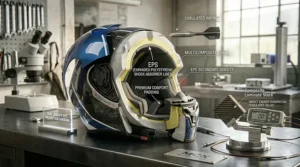
The difference between hand-laid composite construction and machine-pressed polycarbonate is enormous. Hand-laid fiber orientation allows engineers to deliberately control exactly where the shell is stiffest, where it flexes, and where it absorbs versus deflects energy. The RF-1400 shell is Shoei’s strongest and most elastic helmet to date, which is a genuinely important distinction: the best impact protection comes from shells that can flex without breaking, not ones that simply resist deformation. Add a dual-density EPS foam liner that channels airflow while providing multi-density impact absorption, and you have a helmet that simultaneously manages fast and slow impacts.
This helmet earned Snell M2020D certification — a standard that tests harder than DOT and includes visor impact testing as part of the protocol. Aerodynamically, Shoei documented a 4% drag reduction and 6% lift reduction versus the RF-1200 it replaced. At 70 mph, that translates to noticeably less neck fatigue on a long day.
Customer reviews consistently cite the near-silent wind noise management as a standout quality. The CWR-F2 shield system with its tool-free swap in under 10 seconds earns particular praise from riders who ride in variable conditions.
✅ Hand-laid AIM+ matrix fiberglass — aerospace-grade layup process
✅ Snell M2020D certified — the most current Snell motorcycle standard
✅ 6% lift and 4% drag reduction vs. previous generation
❌Heavier than carbon-only shells at 3.6 lbs
❌ Premium price tag that requires justification for casual riders
Price range: $500–$620 | Value verdict: The engineering standard that other composite helmets measure themselves against.
3. Bell Race Star Flex DLX — Track-Bred Multi-Layer Shell for the Street
The Bell Race Star Flex DLX carries one of the most structurally interesting shell designations in this list: Tri-Matrix composite. Bell engineers three distinct material types into a single integrated shell structure, building in what they call “hybrid composite layered protection” — a setup where each layer is specifically tuned for a different type or stage of impact energy.
Here’s the part that matters most for the buyer: Bell provides 6 separate shell sizes across helmet size runs. Most manufacturers use 3. Why does this matter? When a manufacturer offers only 3 shell sizes across 8 helmet sizes, riders in the “between” sizes end up wearing an oversized shell with extra foam padding to fill the gap. The structural geometry of that shell is optimized for a different head volume, which subtly undermines performance. Bell’s 6-shell approach means every size helmet has a shell architecture properly matched to that skull dimension. That’s genuinely smart engineering, and it’s something most buyers walk right past.
The Flex DLX also ships with a Panovision ProTint photochromatic face shield — the kind that darkens automatically in sunlight and clears indoors. That alone adds real-world value for riders who commute through changing light conditions, saving them the fumble of flipping between two shields.
Customer feedback praises fit for riders with round-oval head shapes. Multiple riders with previous Bell helmets report significant noise reduction improvements in the Flex DLX versus earlier Race Star generations.
✅ Tri-Matrix composite shell with 6 separate shell/EPS sizes
✅ Includes photochromatic ProTint face shield (not sold separately)
✅ Magnefusion magnetic cheek pads for easy removal
❌ Heavier at the premium end of the composite spectrum
❌ Best suited to intermediate-oval head shapes; can feel tight for long oval heads
Price range: $580–$700 | Value verdict: The 6-shell sizing system alone makes this worth serious consideration for anyone who’s ever felt helmet geometry was slightly “off.”
4. AGV K6 S — Carbon-Aramid Hybrid That Weighs Almost Nothing
The AGV K6 S is the featherweight in this lineup, and the first time you pick one up in a shop, you’ll probably look around for the hidden compartment that must be missing. The shell — a genuine carbon-aramid fiber composite — comes in at around 2.7 lbs for a large, which is extraordinary for a full-face DOT/ECE 22.06 certified helmet.
Carbon-aramid construction is a fundamentally different approach from fiberglass composites. Carbon fiber provides extremely high stiffness — meaning the shell doesn’t flex, it resists. Aramid fibers layered alongside act as a capture net for fracture propagation: if the carbon layer begins to crack under impact, the aramid fibers prevent that crack from propagating across the shell. It’s the same reason ballistic armor uses hybrid material stacking. In practical terms, carbon-aramid shells tend to perform extremely well in high-speed, high-energy impacts, which is why this design dominates race helmet engineering.
For the street rider, the K6 S offers a 5-density EPS liner (most helmets use 2–3 densities), which manages both low-speed parking-lot drops and high-speed impacts in a single liner. The aerodynamic profile is genuinely refined — AGV designed it specifically to reduce turbulence at higher speeds, with an integrated spoiler and five front vents plus a rear extractor. The SHARP independent testing agency awarded the AGV K6 S a 5-star rating — the highest achievable — which is the clearest external validation of its protection credentials.
Riders consistently cite the interior comfort and the Ritmo fabric lining as premium-feeling, and note how the large eye port with Pinlock-ready visor stays fog-free in cold morning commutes.
✅ Carbon-aramid shell — 5-star SHARP safety rating
✅ 5-density EPS liner handles wide range of impact severities
✅ Genuinely ultralight at ~2.7 lbs — reduces neck strain on long rides
❌ ECE 22.06 and DOT certified but not Snell — may matter for track riders in some clubs
❌ Premium construction = premium price; mid-budget riders will look elsewhere
Price range: $400–$500 | Value verdict: For riders who prioritize weight and have experienced neck fatigue on long days, the K6 S’s engineering pays off in real-world comfort.
5. Alpinestars Supertech R10 Carbon — Multi-Composite Construction for Serious Riders
The Alpinestars Supertech R10 Carbon isn’t a helmet you casually wander into. It represents the top tier of multi-material composite construction available to non-professional riders, and its shell architecture is worth examining in detail. According to Alpinestars’ own documentation (confirmed in GearJunkie’s 2026 review), the R10 uses four distinct material layers bonded with epoxy: a 3K high-density carbon outer layer, a unidirectional carbon composite layer, an aramid fiber layer, and a fiberglass layer.
Each layer is doing something different. The outer 3K carbon manages initial impact energy dispersal across the shell surface. The unidirectional carbon reinforces structural integrity in a specific load direction. The aramid layer provides fracture resistance — same principle as the K6 S, but deeper in the stack. The fiberglass base layer provides a flexible substrate that absorbs residual energy after the higher layers have done their work. It reads like a crash engineering seminar, and honestly, it basically is.
This isn’t a helmet for someone who rides on weekends. It’s for the rider who tracks seriously, covers significant mileage, and understands that spending $800 once beats replacing a cheaper helmet every two years. The vision angles are particularly impressive: 220 degrees lateral and 57 degrees vertical — wider than almost any competitor — which is critical for scanning corners and merging lanes on a track or aggressive street ride.
Customer feedback from experienced riders consistently highlights the comfort-to-protection ratio as the R10’s greatest achievement: it doesn’t feel like a racing helmet that you’re tolerating; it feels like a performance helmet you genuinely want to wear.
✅ Four-material composite shell — the deepest material stack in this guide
✅ 220° lateral + 57° vertical vision — exceptional sightlines
✅ 4-density EPS liner with integrated MIPS rotational protection
❌ Price point demands serious commitment — not for occasional riders
❌ Very aggressive fit; narrow face shapes and long oval heads may need to size up
Price range: $700–$900 | Value verdict: For the rider who needs the absolute best multi-material benefits available outside a professional team budget, this delivers.

6. ScorpionEXO R420 — Best Composite Construction Under $200
Yes, we’re putting a sub-$200 helmet in a composite helmet guide. Here’s why: the ScorpionEXO R420 deserves its place not because it’s cheap but because it redefines what “cheap” means in this category. The R420’s advanced polycarbonate composite shell is specifically engineered for impact energy dispersal — Scorpion’s own description calls it “state-of-the-art materials” with an aero-tuned shell sculpture that reduces drag while maintaining structural integrity. Crucially, it carries Snell M2015 and DOT certification, which means it’s been independently tested to a standard most helmets in the $200 range simply skip.
The multi-layer EPS liner is what separates this from basic polycarbonate helmets in the $100 range. Single-density foam absorbs energy until it’s saturated; multi-layer EPS manages different impact speeds at different layers, providing meaningful protection across a wider range of crash scenarios. The Ellip-tec II face shield system with its Everclear no-fog coating is borrowed from Scorpion’s higher-end models. It seals well against the gasket and removes without tools in seconds.
The R420 is the right answer for three types of buyers: new riders building their first serious gear kit, commuters who need a quality daily-wear lid without breaking the bank, and experienced riders who want a reliable spare helmet for friends who join them on rides.
✅ Snell and DOT certified — passes independent testing most budget helmets skip
✅ Multi-layer EPS with aero-tuned shell — punches well above price bracket
✅ Kwik-Wick II liner is antimicrobial and removable/washable
❌ Polycarbonate composite — still outperformed by genuine carbon/fiberglass shells under extreme loads
❌ Limited ventilation compared to premium competitors
Price range: $150–$200 | Value verdict: The most Snell-certified money you can spend under $200. Full stop.
7. Troy Lee Designs Stage 2026 — Advanced Composite Shell for Off-Road and Enduro
The TLD Stage 2026 is the specialist in this lineup — built specifically for mountain biking, enduro, and off-road riding, but its composite construction methods are worth understanding for anyone interested in advanced construction methods in protective gear. The Stage uses a Polylite shell with fiber reinforcement paired with a dual-foam liner system combining EPP (Expanded Polypropylene) and EPS (Expanded Polystyrene) — each with a fundamentally different energy management profile.
This is genuinely clever engineering. EPS is what most helmets use: it manages high-energy, single-impact crashes well, but crushes permanently and must be replaced after any significant impact. EPP, by contrast, is a resilient material that can recover its shape after low-to-moderate impacts — meaning the TLD Stage can withstand repeated lower-velocity impacts (think: multiple crashes on a trail day) without compromising its protection for the next one. For mountain bikers who take falls regularly, this isn’t a marginal benefit — it’s structurally significant.
Three shell sizes are fitted across the size range so each head circumference gets geometry purpose-built for it, not adapted from an oversized mold. The MIPS layer provides rotational impact protection — a particularly important feature for off-road falls, which frequently involve oblique rather than straight-on impacts.
The 2026 Stage is described by Troy Lee as the lightest and most versatile full-face helmet in its class, and the ventilation system with massive chinbar openings supports all-day wearability on technical trails.
✅ EPP + EPS dual-foam system — handles both single and repeated impacts
✅ MIPS rotational protection included — essential for off-road impact angles
✅ Three shell sizes — proper geometric fit per size
❌ Off-road/cycling focused — not motorcycle-certified for road use
❌ Less aerodynamically optimized than road-specific shells
Price range: $300–$500 | Value verdict: The most structurally sophisticated off-road composite helmet available in this price range.
How to Use Your Multi-Material Composite Helmet for Maximum Longevity — A Practical Guide
Spending $400+ on a composite shell helmet and then unknowingly degrading its performance inside two years is a uniquely avoidable tragedy. Here’s what the spec sheet won’t tell you.
First 30 Days: Breaking In Without Breaking Down
New composite helmets, especially those with hand-laid fiberglass or carbon-aramid shells, have interiors that mold slightly to your head shape over the first 15–20 hours of wear. Resist the urge to return a helmet because it feels slightly firm at first. That’s the liner doing what it’s designed to do. What you should return a helmet for: any pressure point that causes actual pain, or a chinbar that makes contact with your chin while the top of the shell feels loose.
First-use tip: wear the helmet for 30-minute sessions at home before your first real ride. Walk around, move your head through a full range of motion, and identify any hotspots early. That’s infinitely easier to address before you’re committed at speed on a highway.
Chemical Enemies of Composite Shells
The biggest hidden performance killer of composite helmets isn’t crashes — it’s petroleum-based products. Fuel spills, chain lubricants, sunscreen, and insect repellents containing DEET all chemically attack the resin matrix holding fiber layers together. A single fuel spill that isn’t cleaned immediately can begin micro-fracturing the resin bond between carbon and aramid layers — damage completely invisible from the outside but structurally significant.
Clean your shell only with mild soap and water. Use a clean microfiber cloth. Keep fuel, solvents, and aerosol sprays away from the shell. Check the area around visor screws and any mounting hardware annually — these are stress concentration points where surface damage often begins.
The 5-Year Rule and Impact Retirement
Industry guidance from SNELL and major manufacturers recommends replacing composite helmets every 5 years even without crashes, as UV exposure and material fatigue gradually degrade shell performance. After any impact significant enough to compress the EPS liner — even a helmet dropped from head height onto concrete — retire it. The EPS doesn’t recover. The protection it was providing for your next crash no longer exists.
Common mistake: riders touch the EPS liner with their fingers after a suspected impact to see if it “bounced back.” EPS foam doesn’t visibly deform when it absorbs an impact at the microscopic level where damage actually occurs. If in doubt, replace it.
Composite Helmet Buyer Profiles — Which One Is Actually Right for You?
The right helmet isn’t determined by specs alone. It’s determined by how you ride, where you ride, and how your head is shaped. Let’s be specific.
The Daily Commuter (Urban + Highway Mix, 8,000–15,000 Miles/Year)
You need durability above all else. A helmet that gets used daily accumulates interior wear, visor scratches, and sweat exposure far faster than a weekend-only lid. The HJC RPHA 11 Pro is built for this profile. Its P.I.M. Plus composite shell is durable enough for daily use, the quick-release anti-fog visor handles commuter conditions, and the washable Kwik-Comfort liner stays manageable through heavy use. At $300–$400, it won’t devastate you when replacement time comes at five years.
The Weekend Track Day Rider
You need maximum safety certification (Snell is non-negotiable at most club track days), aerodynamic stability at speed, and excellent vision. The Bell Race Star Flex DLX or Shoei RF-1400 are your two candidates. Both carry Snell. The Bell wins on the photochromatic shield (one less thing to manage). The Shoei wins on aerodynamic refinement and fit consistency. Head shape will decide it: the Shoei fits intermediate-oval heads more precisely; the Bell is slightly more accommodating.
The Adventure Tourer (Long Distance, Variable Terrain)
You need wind noise management, comfort over 6+ hour days, and a shell stiff enough to handle high-speed highway travel alongside occasional gravel sections. The AGV K6 S is the recommendation here — the ultralight carbon-aramid build reduces neck fatigue on marathon days, and the 5-density EPS handles the wide range of impact speeds adventure riding involves. The Shoei RF-1400 is the quieter alternative if budget allows.
The New Rider (First Serious Lid)
Don’t start with polycarbonate just because you’re new. The ScorpionEXO R420 gives you Snell certification and multi-layer composite construction at a price that doesn’t require a loan. Learn to ride in a helmet that actually passes independent safety testing. Upgrade to a carbon or fiberglass shell once you know your head shape preference and riding style.
How to Choose a Multi-Material Composite Helmet — 7 Expert Criteria
Picking the right helmet involves more than matching a price to a budget. Here’s how to evaluate composite helmets systematically before clicking “buy.”
1. Verify the shell construction claim — “Composite” on the packaging means nothing without specifics. Look for named material combinations (carbon + fiberglass + aramid) and proprietary shell system names (P.I.M. Plus, AIM+, Tri-Matrix). If the product page doesn’t name the materials, treat the shell as single-material polycarbonate.
2. Match certification to your use case — DOT is the legal minimum for road use in the US. ECE 22.06 is Europe’s more comprehensive standard. Snell M2020D is the most demanding independent standard. For track use at organized events, Snell is often mandatory. For daily street commuting, ECE 22.06 offers meaningful additional testing coverage beyond DOT alone. Check the SHARP Helmet Testing Database for independent star ratings.
3. Get the right shell size, not just the right fit — Ask the seller how many distinct shell sizes the helmet uses across its size range. Three shells across 8 sizes means you may be wearing an oversized structural geometry filled with extra foam. Six shells means genuine size-matched protection.
4. Evaluate the EPS liner density — Single-density EPS is entry-level. Two-density is standard. Three or more densities indicate a liner engineered to manage impacts across a range of speeds and energy levels. Higher density counts matter most for riders who may encounter both low-speed urban impacts and higher-speed incidents.
5. Check independent testing results — Beyond manufacturer claims, look for third-party testing data. SHARP (UK government) tests real helmets at retail and publishes star ratings. Virginia Tech’s Helmet Ratings program evaluates rotational impact performance. Cross-referencing manufacturer specs against independent test data is the most honest way to evaluate protection claims.
6. Factor in visor quality — The visor is the weakest structural point on most helmets and the component most likely to fail first. Pinlock-ready visors with anti-fog inserts and tool-free removal are the standard for any helmet above $250. Anything less in that price range is a manufacturer cutting corners on a daily-use component.
7. Test fit with your specific riding position — Stand up straight when trying a helmet. Then replicate your actual riding position: chin down, eyes looking slightly upward. Many helmets that feel perfect upright create peripheral blind spots when you’re in position over the bars. Test peripheral vision before you buy.
Multi-Material Composite vs. Single-Material Polycarbonate — What the Real Difference Means for You
| Feature | Multi-Material Composite | Single-Material Polycarbonate |
|---|---|---|
| Shell Weight | 15–35% lighter | Heavier for equivalent volume |
| Impact Energy Dispersal | Multi-mechanism across layers | Single-mechanism through flex |
| Crash Behavior | Controlled failure with energy absorption | More variable — can shatter |
| Long-Term Durability | Higher resistance to UV/fatigue | Faster UV degradation |
| Safety Certification | Often Snell/ECE 22.06 achievable | Typically DOT-only at budget price points |
| Price Range | $150–$900+ | $50–$300 |
| Best For | Regular/serious riders | Occasional use, budget builds |
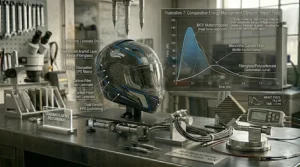
Analysis: The single most important column in this table for practical buyers is “crash behavior.” Polycarbonate manages impacts through a controlled flexing mechanism, which works — until it doesn’t. Under high-energy or complex impacts, polycarbonate behavior is less predictable than layered composites. Composite shells fail in more controlled, graduated ways: the outer layers dissipate energy first, buying time and reducing transmitted force to the EPS and ultimately to your skull. This is not a knock on polycarbonate — the ScorpionEXO R420 proves a well-engineered polycarbonate composite at $200 outperforms a poorly designed fiberglass shell at $400. Engineering matters more than material prestige.
Common Mistakes When Buying a Multi-Material Composite Helmet
Even experienced riders make expensive, occasionally dangerous buying mistakes. Here are the ones worth explicitly calling out.
Assuming “carbon fiber” means the whole shell is carbon. Some helmets use a decorative carbon-weave outer coating over a polycarbonate shell. It looks premium. It’s cosmetic. Real carbon-fiber composite construction is mentioned specifically in the shell construction details — words like “3K carbon fiber layer” or “carbon-aramid fiber matrix.” Carbon pattern paint is not the same thing.
Over-trusting DOT certification as quality assurance. Here’s the reality that the US NHTSA explains clearly: DOT helmets are self-certified by manufacturers. NHTSA does conduct random compliance testing, but DOT on the sticker means the manufacturer claims compliance, not that an independent body verified it. Snell and ECE 22.06 require third-party testing of actual production helmets. For genuine peace of mind, look for Snell or ECE in addition to DOT.
Buying for looks first. The most common mistake, full stop. Graphics are applied to the outer shell — they have zero effect on protection. Some premium graphic finishes actually use slightly thinner clear coats to maintain shell geometry, which can affect minor surface scuffs over time but not impact performance. Buy the engineering first, find the colorway you can live with second.
Ignoring the EPS replacement issue. A common rider habit: taking a dropped or lightly impacted helmet to a shop, having someone press on the EPS, hearing “feels fine to me,” and continuing to use it. As referenced by composite material research from the Composite Materials Handbook, EPS damage at the fiber/cell level is invisible to tactile inspection. If the helmet has experienced a meaningful impact, replace it.
Buying online without knowing your head shape. This one costs money. Composite helmets in the $400–$700 range are not returnable once ridden. Know whether you have an intermediate oval, round oval, or long oval head shape before ordering. Most major brands publish head shape guidance.
What to Expect: Real-World Performance of Composite Safety Construction
The spec sheet tells you the weight, the certification, and the material names. It doesn’t tell you what riding in a composite helmet actually feels like across 500 miles.
Wind noise management. This is where the quality of composite shell construction becomes immediately obvious. A precisely formed composite shell — especially one built with aerodynamic modeling like the Shoei RF-1400 or AGV K6 S — manages airflow around the helmet profile in a way that polycarbonate shells simply can’t match at the same price. You’ll notice it within the first hour on a highway. The difference between a noisy helmet and a quiet one at 75 mph is roughly 75–80 dB versus 88–93 dB. That’s not trivial — extended exposure above 85 dB causes cumulative hearing damage. Multi-material composite construction, by virtue of enabling more precise shell geometries, consistently produces quieter helmets than single-material builds.
Thermal behavior. Carbon-based composite shells absorb and retain heat slightly more than fiberglass shells in direct sun — something to consider if you ride extensively in hot climates. A helmet sitting in the sun before a ride will be warmer to put on if it’s carbon-dominant. Most riders address this by simply storing helmets in shade or a bag, but it’s worth knowing if you’re comparing a fiberglass composite to a carbon-aramid shell in Texas in July.
Micro-impact fatigue across years of use. Every ride adds minor stresses to your helmet: vibration, minor wind buffeting, the occasional low-speed contact. Multi-material composite shells, particularly those with aramid fiber layers, maintain their structural properties under cumulative micro-fatigue better than single-material alternatives. Research on composite materials consistently demonstrates that multi-fiber matrix designs outperform single-material shells in long-term structural integrity. This is why the industry standard replacement cycle of 5 years is built around actual material fatigue data, not arbitrary marketing.
Long-Term Cost and Maintenance of Composite Helmets
The true cost of a composite helmet isn’t the sticker price. It’s the sticker price divided by years of reliable use, plus maintenance costs. Let’s do that math honestly.
A $600 Shoei RF-1400 used for 5 years costs $120/year. A $180 DOT-only polycarbonate helmet that you replace every 3 years (typical wear pattern for daily commuters due to interior degradation) costs $60/year. The composite helmet costs twice as much annually — but you’re getting Snell certification, better aerodynamics, quieter operation, and a significantly more refined fit and finish for that premium. The value case becomes even clearer if you factor in visor replacements: premium composite helmets use high-quality optical-grade visors that resist scratching better, requiring less frequent replacement.
Maintenance schedule that extends composite helmet life:
- Monthly: Wipe interior liner with a damp cloth. Remove and air-dry padding.
- Quarterly: Clean visor with recommended lens cleaner (not glass cleaners — they contain ammonia which attacks anti-fog coatings). Inspect visor seal for compression damage.
- Annually: Remove all padding and wash per manufacturer instructions. Inspect shell exterior for paint cracking, especially around visor base plates — micro-cracks there can indicate shell stress. Inspect all mounting hardware.
- At 5 years or any significant impact: Replace, regardless of apparent condition.
One commonly overlooked maintenance cost: Pinlock inserts. These anti-fog lens inserts are consumable items that typically last 1–2 seasons before the silicone seal around the perimeter degrades. Budget around $20–$30 per year for replacement. It’s a minor cost that most buyers forget to include, and it’s the difference between a fogging visor at 40°F and a crystal-clear view.
Frequently Asked Questions
❓ What is a multi-material composite motorcycle helmet?
❓ Is a composite shell helmet worth the extra cost over polycarbonate?
❓ How do I know if a helmet is truly composite or just marketing language?
❓ Does a composite helmet need special care compared to polycarbonate?
❓ Can I use a multi-material composite helmet for both track and street riding?
Conclusion — The Right Shell Is the One You’ll Actually Wear
Here’s the thing about composite helmet technology that gets lost in all the material science talk: the absolute best helmet in the world is worthless if you don’t wear it. A Shoei RF-1400 sitting on a shelf because it’s “too nice for commuting” protects nobody. A Bell Race Star in the garage because the rider forgot to budget for the photochromatic lens is a $650 decorative object.
Multi-material composite construction matters because it lets manufacturers build helmets that are simultaneously safer, lighter, and more comfortable than their single-material predecessors. That comfort factor is not trivial — a lighter, quieter helmet is one you’re more likely to actually put on for the short rides, the quick errands, the “just going down the street” trips that statistically account for a disproportionate number of rider incidents.
For most street riders, the HJC RPHA 11 Pro sits in the exact right intersection of genuine composite construction, Snell certification, and real-world value. If budget allows, the Shoei RF-1400 raises the ceiling on aerodynamic refinement and fit precision. And if you’re starting out, don’t skip the ScorpionEXO R420 — a Snell-certified composite for $200 is a genuine accomplishment in helmet engineering.
Whatever your budget, prioritize real material transparency, independent safety certification, and proper fit. Those three things will do more for your protection than any brand name on the box.
✨ Don’t Miss These Exclusive Deals!
🔍 Ready to find your perfect composite helmet? Click any highlighted product in this guide to check current prices and availability on Amazon. Inventory moves fast on Snell-certified helmets — don’t wait.
Recommended for You
- 7 Best Fiberglass Composite Shell Helmets for Ultimate Protection 2026
- 7 Best Ultra-Light Protection Helmets That Eliminate Neck Fatigue in 2026
- 7 Best Heads-Up Display Helmets in 2026
Disclaimer: This article contains affiliate links. As an Amazon Associate, I earn from qualifying purchases. If you purchase products through these links, we may earn a small commission at no additional cost to you.
✨ Found this helpful? Share it with your friends! 💬🤗
