
In This Article
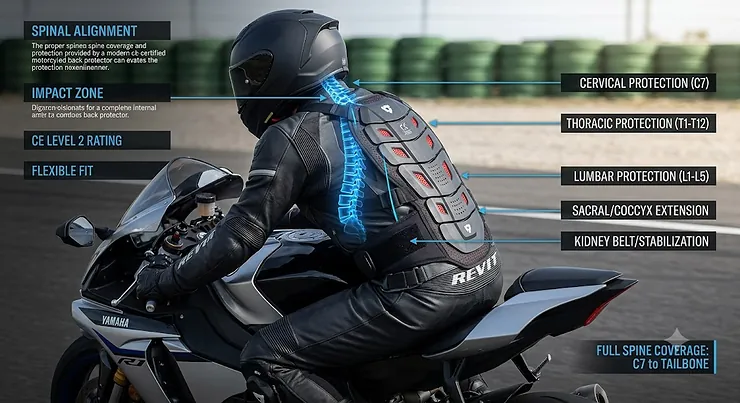
Here’s the blunt version: your spine is a stack of bones wrapped in the most important cable in your body, and asphalt does not care. A motorcycle back protector is a certified piece of armor — usually foam, a honeycomb shell, or a hard plastic plate — worn over or inside your jacket to spread and absorb impact force before it reaches your vertebrae. That’s the whole job description, and it’s a job worth taking seriously.
Most riders think about helmets first, gloves second, and the back somewhere around “eventually.” That’s backwards when you look at how crashes actually unfold. A high side or a low side doesn’t politely aim itself at your palms — it throws your whole body, and your spine absorbs whatever the ground has to say about it. This guide walks through what a spine protector motorcycle riders actually rely on looks like in practice, what separates a bargain foam pad from a genuine CE back protector motorcycle safety gear should include, and seven real products worth your money in 2026, from budget inserts to race-grade hard shells.
We’ll get into specs, but specs alone are marketing filler if nobody tells you what they mean for your ride. So every product below comes with the “so what” attached — who it’s actually built for, where it falls short, and whether the price tag is justified. Let’s get into it.
Quick Comparison Table
Before the deep dive, here’s the fast version for anyone who wants to skim and click.
| Product | CE Rating | Type | Price Range | Best For |
|---|---|---|---|---|
| Alpinestars Nucleon KR-1 Cell | Level 2 | Standalone hard shell | $200-$230 | Track and sport riders |
| Forcefield Pro L2K Evo | Level 2 | Standalone Kevlar/foam | $130-$200 | Best overall value |
| Knox Aegis | Level 2 | Standalone honeycomb | $150-$190 | Maximum coverage |
| Icon Field Armor Stryker Vest | Level 2 | Standalone vest | $120-$140 | Street commuters |
| Leatt ReaFlex Stealth | Level 2 | Standalone slim gel | $120-$150 | All-day comfort |
| SAS-TEC SC-1/15 Tripleflex | Level 2 | Jacket insert | $30-$90 | Jacket pocket replacement |
| PSLER CE Level 2 Armor Insert | Level 2 | Jacket insert | $20-$35 | Tight budgets |
A quick read of that table tells a story worth spelling out: price doesn’t track neatly with protection level here, since every single one of these seven is CE Level 2. What you’re actually paying for as the price climbs is comfort under load, ventilation, coverage area, and how the armor moves with your body rather than against it. The SAS-TEC SC-1/15 Tripleflex and PSLER CE Level 2 Armor Insert prove you can hit the same force-transmission threshold as a $220 race protector for a fraction of the cost — you’re just trading away some fit customization and standalone versatility to get there. According to the European standard developed for back protection, Level 2 has been the recognized benchmark for serious impact reduction since the standard’s 2014 revision, and every product on this list meets it.
💬 Just one click — help others make better buying decisions too!😊
Top 7 Motorcycle Back Protectors: Expert Analysis
We picked these seven to cover every riding style and budget tier — hard shell and soft foam, standalone and insert, $25 and $225. Every one is a real, currently available product with genuine CE Level 2 certification under EN 1621-2:2014.
1. Alpinestars Nucleon KR-1 Cell — best hard-shell protection for track and sport riding
The Nucleon KR-1 Cell is Alpinestars’ answer to riders who want race-grade back protection and aren’t willing to compromise on it, and that ambition shows in the first five seconds of handling it.
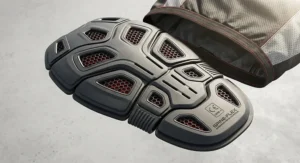
Built around Alpinestars’ proprietary Cell Technology — a lattice-structured polymeric shell rather than a solid plastic plate — the Alpinestars Nucleon KR-1 Cell is engineered in three waist-to-shoulder size profiles so the protection zone actually lines up with your spine instead of your shoulder blades. The extended lower-back section and horizontal flexion grooves mean it bends with your torso when you tuck into a corner rather than levering against your lower back, which is the exact failure point of cheaper rigid plates.
This is the pick for riders logging track days or fast canyon miles, where the priority shifts from all-day comfort toward maximum, uncompromising force reduction. Based on the spec comparison against softer foam competitors, the hard-shell lattice design distributes point impacts — like landing on a curb edge — more evenly than viscoelastic foam alone, which matters most in high-speed, high-consequence riding.
Riders consistently report that the Alpinestars Nucleon KR-1 Cell feels lightweight and becomes nearly unobtrusive under a leather suit once broken in, though a handful mention it runs bulky or fights against tighter race-suit backs before that break-in period. Overall satisfaction among owners skews strongly positive.
Pros:
- ✅ Race-proven Cell Technology lattice shell
- ✅ Three sizes for accurate torso fit
- ✅ Extended lower-back coverage zone
Cons:
- ❌ Premium price versus insert-style options
- ❌ Some fit adjustment needed with tight suits
Expect to pay in the $200-$230 range for the KR-1 Cell — steep next to a jacket insert, but justified if track days or sport riding are the actual use case rather than the occasional commute.
2. Forcefield Pro L2K Evo — best overall value with Kevlar-reinforced durability
If you only read one entry on this list before buying, make it this one — the Pro L2K Evo has quietly become the back protector serious riders recommend to their friends without being asked.
The Forcefield Pro L2K Evo uses Kevlar thread stitching throughout its construction — the same fiber used in body armor, chosen here for cut and abrasion resistance rather than bullet resistance — combined with NitrexEvo, a triangular-cell shock-absorbing material that Forcefield states exceeds the EN 1621-2 Level 2 threshold rather than just scraping past it. What that means practically is a protector that doesn’t just pass the test, it passes it with margin, and margin is what you want between your spine and the pavement.
This is the protector for riders who want one purchase to last years across commuting, touring, and the occasional spirited weekend ride, since the Repeat Performance Technology in the NitrexEvo layer is designed to maintain its absorption properties after multiple impacts rather than compressing permanently like basic foam. A three-point strap system and heat-activated body molding mean it also holds its position on your spine instead of migrating during a long ride, which is a common complaint with cheaper strap-on units.
One widely cited long-term owner review calls it among the most fault-resistant pieces of gear they own, noting that despite the roughly $200 MSRP, the comfort and multi-impact durability make it worth the spend — a sentiment echoed across several retailer listings that regularly discount it toward $130.
Pros:
- ✅ Exceeds Level 2 force-transmission requirements
- ✅ Kevlar stitching adds long-term durability
- ✅ Multi-impact NitrexEvo doesn’t lose performance
Cons:
- ❌ Runs warm without ventilation on hot days
- ❌ Sizing overlaps between Medium and Large
Current pricing sits in the $130-$200 range depending on retailer promotions — watch for the frequent markdowns, since this is regularly the best value-per-kilonewton on this entire list.
3. Knox Aegis — largest coverage for maximum spine protection
Coverage area is one of those specs nobody markets loudly, but it’s arguably the single biggest factor in whether a back protector actually catches the impact your spine takes.
The Knox Aegis pairs honeycomb-structured shock absorption with a tough outer shell across the largest protection footprint of any protector in this roundup, available in six sizes from a compact women’s fit up to a nine-plate men’s Large that runs 525mm in length. That plate count matters in practice: more segmented plates means the honeycomb flexes at more points along your spine, so the armor curves with your back through a full range of riding postures instead of bridging stiffly across it.
What most buyers overlook about coverage-focused protectors is that bigger isn’t automatically better for every rider — a taller plate count is a real advantage for riders with longer torsos or those who want protection extending well past the lumbar region, but shorter riders may find the largest size overlaps uncomfortably with a seat or tank bag. Knox’s temperature testing to +40°C and -20°C also signals this is built for riders who tour through genuine seasonal extremes, not just fair-weather Sunday laps.
Verified independent review volume for the Aegis is thinner online than for some competitors, but the spec sheet tells a consistent story: EN 1621-2:2014 Level 2 certification, a removable machine-washable liner for odor control, and compatibility with Knox’s optional Micro-Lock chest protector for riders who want to upgrade to full torso coverage later.
Pros:
- ✅ Largest back coverage in this comparison
- ✅ Six sizes fit both men and women accurately
- ✅ Machine-washable liner stays fresh longer
Cons:
- ❌ Largest sizes may crowd shorter torsos
- ❌ Less brand recognition than Alpinestars or Dainese
Pricing runs around $150-$190, positioning the Aegis as a genuine mid-tier alternative to the bigger sport brands, with coverage that arguably beats them both.
4. Icon Field Armor Stryker Vest — best vest-style standalone for street riders
Not every rider wants to strap a plate to their back and call it done — some want something that feels like gear, not equipment, and that’s exactly the gap the Stryker Vest fills.
The Icon Field Armor Stryker Vest builds its back protection into a low-profile vest using D3O intelligent foam, a shear-thickening material that stays soft and flexible during normal movement but locks rigid on sudden impact. Because it’s a vest rather than a strap-on plate, it distributes weight across both shoulders and the torso rather than hanging entirely off a waist belt, which noticeably reduces the “sagging” feeling some standalone protectors develop over a long ride.
This is the pick for street and commuter riders layering armor under a hoodie, flannel, or unarmored jacket, since the vest format works as genuine everyday protection rather than something reserved strictly for track-oriented gear. The removable shoulder and waist straps mean it can also be pulled apart and mounted inside select Icon jackets, giving commuters a hybrid option between standalone and insert-style protection depending on the season.
Icon markets this as CE-certified PPE conforming to defined European motorcycle safety standards, and the D3O material itself has a well-documented track record across multiple protective-gear brands for maintaining flexibility until the moment of impact rather than staying stiff all day like a hard shell.
Pros:
- ✅ Vest format distributes weight comfortably
- ✅ D3O foam stays flexible until impact
- ✅ Convertible between standalone and jacket insert use
Cons:
- ❌ Less rigid than a hard-shell plate
- ❌ Bulkier under slim-fit jackets
At around $120-$140, the Stryker Vest lands as one of the more accessible standalone options without dropping down to entry-level materials.
5. Leatt ReaFlex Stealth — slimmest profile for all-day comfort
Some riders will trade a little bit of theoretical peak protection for something they’ll actually wear every single ride without complaint — and comfort-driven compliance is genuinely part of the safety equation.
The Leatt ReaFlex Stealth uses ReaFlex, a reactive impact gel that stays soft and pliable during normal riding but hardens progressively under impact force, all packed into what is easily the slimmest full-length back protector in this lineup. Because it skips a rigid outer shell entirely, it folds and flexes with your torso rather than creating a hard edge against your lower back when you lean forward over the tank.
What the spec sheet won’t tell you outright is how much that slimness matters for riders layering under snug jackets or riding in hot climates where a bulky hard-shell protector becomes its own source of fatigue. This is the back protector for the rider who has skipped wearing protection in the past specifically because it felt cumbersome — removing that excuse is a genuine safety win even before you factor in the CE Level 2 rating itself.
Leatt’s certification documentation confirms independent testing to EN 1621-2 Level 2 standards, and the ReaFlex material family (formerly branded AirFlex) has built a reputation across Leatt’s broader body-armor line for holding its progressive-hardening properties through repeated impacts rather than degrading after the first hit.
Pros:
- ✅ Thinnest profile of any product tested here
- ✅ Reactive gel flexes naturally with the body
- ✅ Full-length spine coverage despite slim build
Cons:
- ❌ Less structural rigidity than hard-shell designs
- ❌ Premium pricing for a soft-armor product
Expect to pay roughly $120-$150, which puts it squarely in the mid-tier bracket alongside the Aegis, just with a completely different feel on the body.
6. SAS-TEC SC-1/15 Tripleflex — best insert for jacket back pocket compatibility
If your jacket already has a back protector pocket and you’re just replacing weak factory foam, this is very likely the exact part number you’re about to buy — even if the box says a different brand name.
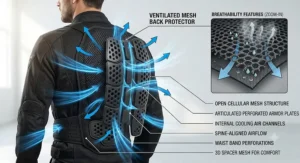
The SAS-TEC SC-1/15 Tripleflex is a viscoelastic soft-foam insert manufactured in Germany, engineered without a hard shell or exposed edges so it slides cleanly into a jacket’s dedicated armor pocket. SAS-TEC states its closed-cell foam surpasses the CE Level 2 force-transmission requirement by roughly 50%, and independent measurements cited by gear reviewers have recorded residual transmitted force around 7 kilonewtons against the 9kN Level 2 ceiling — real margin, not just a passing grade.
Here’s what most riders shopping for an insert back protector motorcycle jacket manufacturer didn’t include at the factory don’t realize: SAS-TEC doesn’t just sell under its own name. It white-labels this exact armor to brands including Scorpion, Cortech, Held, and several others, meaning you may already own SAS-TEC protection without knowing it. Buying it direct is often the cheaper path to the identical part.
The SC-1/15 has developed a strong reputation among riders and reviewers as the go-to CE Level 2 back armor swapped into jackets that ship with only Level 1 or unrated foam, prized specifically for being nearly unnoticeable once installed while still delivering measurable, tested impact reduction.
Pros:
- ✅ Independently measured well under Level 2 limit
- ✅ Fits pockets across many major jacket brands
- ✅ Washable with less than 1% water absorption
Cons:
- ❌ Requires an existing compatible jacket pocket
- ❌ No standalone strap system included
Pricing varies widely by retailer and branding, roughly $30-$90 — buying direct from SAS-TEC-focused sellers rather than a rebadged version typically lands at the lower end.
7. PSLER CE Level 2 Armor Insert — best budget pick under $35
Nobody should skip back protection because of price, and this is the product that removes that excuse entirely.
The PSLER CE Level 2 Armor Insert is built from abrasion-resistant PU memory foam with a dual-sided design — one face perforated for ventilation on hot rides, the reverse face offering extra cushioning for cold-weather layering. It’s a reversible, seasonally adaptable insert that still carries genuine CE Level 2 certification, which is a rare combination at this price point.
This is squarely the entry point for new riders building out a first protective kit, or anyone whose current back protection is either nonexistent or unrated foam padding that offers no certified impact reduction whatsoever. Based on the spec comparison against premium hard-shell options, the trade-off here is coverage sophistication and long-term shell durability rather than baseline safety certification — Level 2 is Level 2, whether it costs $25 or $225.
Verified independent customer-review data specific to this exact listing is limited, which is common for budget PPE inserts sold primarily through marketplace listings rather than dedicated motorcycle retailers; what’s verifiable is the CE Level 2 certification itself and the described full-back coverage and multi-sport compatible sizing.
Pros:
- ✅ Genuine CE Level 2 certification at entry pricing
- ✅ Reversible design adapts to hot or cold weather
- ✅ Fits a wide range of jackets and vests
Cons:
- ❌ Less brand history than established motorcycle-gear makers
- ❌ Limited independent long-term durability data
At roughly $20-$35, this is the cheapest legitimate CE Level 2 option on the list — a genuinely defensible starting point rather than a corner cut.
How to Install, Break In, and Maintain Your Motorcycle Back Protector
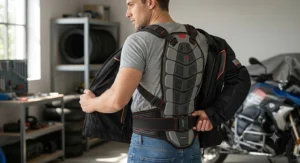
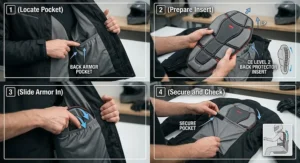
Buying the armor is step one; wearing it correctly is the part that actually determines whether it does its job. For standalone units like the Forcefield Pro L2K Evo or Knox Aegis, start by adjusting the waist strap snug enough that the protector doesn’t shift when you bend forward, then set the shoulder straps so the top edge sits roughly level with your shoulder blades — too low and you lose upper-spine coverage, too high and it digs into your neck at speed.
Insert-style armor like the SAS-TEC SC-1/15 Tripleflex or PSLER CE Level 2 Armor Insert needs a different first step: measure your jacket’s back pocket before ordering, not after. Most factory pockets run somewhere between 12 and 16 inches tall and 10 to 13 inches wide, but that varies enough by brand that a protector sized for one jacket can bind or gap in another.
Expect a genuine break-in period with hard-shell and Kevlar-stitched protectors — the first few rides often feel stiffer than they will after two or three weeks of regular wear, as straps settle and heat-activated materials mold slightly to your body. Common first-30-day mistakes include over-tightening straps to fight a feeling of looseness that break-in would otherwise resolve, and skipping the manufacturer’s washing instructions on liners, which shortens the useful life of moisture-wicking layers considerably.
For maintenance, wipe hard shells down after wet rides and let soft-foam inserts air dry fully before storage — trapped moisture degrades viscoelastic foam faster than UV exposure does. Most manufacturers recommend replacement after any impact hard enough to have “used up” the compressive properties of foam-based protectors, even without visible damage.
Real-World Scenarios: Matching the Right Back Protector to Your Riding
The daily commuter on a budget. Twelve miles each way, mostly surface streets, occasionally caught in rain. The PSLER CE Level 2 Armor Insert or the SAS-TEC SC-1/15 Tripleflex covers the realistic risk profile here — low-speed drops and the occasional distracted-driver close call — without asking a beginner to spend track-day money on street-riding protection.
The weekend canyon rider. Faster corners, higher lean angles, real consequences if something goes wrong. This rider should be looking at the Forcefield Pro L2K Evo or Alpinestars Nucleon KR-1 Cell, both built with the durability and force-margin to handle repeated hard use rather than a single worst-case impact.
The touring rider covering long, varied miles. Comfort across an eight-hour riding day in changing weather matters as much as raw protection. The Knox Aegis, with its wide temperature certification and washable liner, or the slim Leatt ReaFlex Stealth for riders prioritizing all-day wearability, both fit this profile well.
Common Back Protector Problems and How to Fix Them
Problem: the protector rides up during long stints in the saddle. This is almost always a strap-tension issue rather than a sizing issue — re-tighten the waist strap first before assuming you need a different size.
Problem: sweating through the back on hot rides. Look toward perforated or dual-sided designs like the PSLER CE Level 2 Armor Insert, or a hard-shell option like the Alpinestars Nucleon KR-1 Cell, both built with active ventilation channels rather than solid foam.
Problem: the insert doesn’t fit the jacket’s back pocket. Measure the pocket dimensions directly rather than trusting a jacket’s stated size, since factory pocket dimensions vary meaningfully even within the same brand’s size run.
Problem: uncertainty about whether an impact “used up” the armor. For foam-based protectors, if the material shows visible compression or the area feels noticeably thinner than the rest of the pad, replace it — most CE Level 2 foam armor is rated for a specific number of significant impacts, not unlimited use.
✨ Don’t Miss These Exclusive Deals!
🔍 Take your back protection to the next level with these carefully selected picks. Click on any highlighted product to check current pricing and availability, and gear up with genuine CE Level 2 protection your spine will thank you for.
How to Choose a Motorcycle Back Protector: 7 Expert Criteria
- Confirm CE Level 2 certification specifically, not just “CE approved” — Level 1 and Level 2 are entirely different force-transmission thresholds, and vague marketing language sometimes blurs that distinction on purpose.
- Decide standalone versus insert before you shop, since this eliminates roughly half the market immediately and prevents wasted comparison time.
- Measure your torso length, not just your jacket size, because standalone protectors size against waist-to-shoulder distance rather than chest measurement.
- Check jacket back pocket size compatibility if buying an insert — pocket height, width, and depth all matter, and a protector that’s even 10mm too tall will bunch uncomfortably.
- Weigh coverage area against mobility, since larger plates like the Knox Aegis protect more spine but flex less freely through extreme riding postures.
- Consider your climate and riding season, prioritizing ventilated or temperature-rated protectors if you ride through genuine heat or cold rather than mild weather year-round.
- Set a realistic budget band, remembering that every product that passes EN 1621-2:2014 Level 2 testing meets the identical force-transmission requirement regardless of price.
CE Level 1 vs CE Level 2: What EN 1621-2 Actually Measures
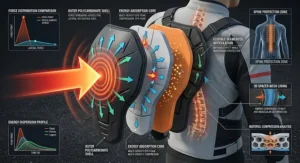
The EN 1621-2 standard back protector rating system isn’t marketing fluff — it’s a specific, repeatable drop test. A weighted striker is dropped onto the protector at a controlled energy level, and sensors measure how much force transmits through to a simulated spine underneath. To pass Level 1, the mean transmitted force must stay under 18kN, with no single reading exceeding 24kN. Level 2 cuts that bar roughly in half: under 9kN mean, 12kN peak.
That gap matters more than it sounds. Medical researchers generally consider any transmitted force above roughly 4kN as carrying meaningful injury risk to the spine, meaning even Level 2 protection isn’t a guarantee — it’s a substantial risk reduction, not immunity. Every product featured in this guide meets the level 2 back protector threshold, which is why we didn’t include any Level 1-only options despite several popular Level 1 inserts being cheaper and lighter.
The trade-off historically was weight and thickness — Level 2 armor used to mean a noticeably bulkier pad. Modern viscoelastic materials, like those used in the SAS-TEC SC-1/15 Tripleflex and Leatt ReaFlex Stealth, have largely closed that gap, so there’s less practical reason today to settle for Level 1 back protection on a street or sport bike than there was a decade ago.
Standalone Back Protector vs Insert Back Protector: Which Should You Buy
This is the decision that should come before brand or price. A standalone back protector rider chooses a self-contained unit — like the Forcefield Pro L2K Evo or Icon Field Armor Stryker Vest — worn under any jacket via its own strap or vest system, independent of what outerwear is on top. The upside is flexibility: one protector works across a leather jacket, a mesh summer jacket, or even a plain hoodie on a short ride.
An insert back protector motorcycle jacket owners install instead slots directly into a factory-sewn pocket, typically replacing weak stock foam with something like the SAS-TEC SC-1/15 Tripleflex. The upside here is a slimmer overall profile since you’re not layering a full protector plus jacket lining plus jacket shell — you’re simply upgrading one component the jacket was designed around.
Neither approach is objectively superior; they solve different problems. Riders who own one primary jacket and just want better armor inside it should shop inserts. Riders who layer between multiple jackets seasonally, or who want protection that travels with them regardless of outerwear, should shop standalone.
Jacket Back Pocket Size Compatibility: Getting the Fit Right
Jacket back pocket size compatibility is the single most common insert-shopping mistake, and it’s an easy one to avoid with five minutes of measuring before you order. Unzip your jacket’s back pocket and measure height, width, and — critically — the depth available for the protector to sit without bunching against the outer shell.
Most mainstream jackets run pockets between roughly 30-40cm tall and 25-33cm wide, but this varies enough between brands like Alpinestars, REV’IT!, and Klim that a protector sized correctly for one won’t necessarily fit another, even at the “same” jacket size label. The SAS-TEC SC-1/15 Tripleflex is manufactured in multiple dimension variants specifically because of this inconsistency across brands, and its product documentation explicitly recommends verifying pocket dimensions before ordering rather than assuming compatibility from jacket size alone.
If your measurements land between two available sizes, sizing down generally causes less discomfort than sizing up — a slightly smaller protector still provides certified protection across its covered area, while an oversized one can buckle or fail to seat flat against your back, undermining the very fit the CE test assumes.
What the Spinal Injury Data Says About Wearing a Back Protector
It’s worth being direct about why this gear category exists at all. Peer-reviewed spinal cord injury motorcycle statistics paint a sobering picture: a widely cited analysis of over 1,100 motorcycle crash patients found spinal injury occurred in roughly 11% of riders studied, with the thoracic spine — the mid-back region a back protector is specifically designed to shield — injured in the majority of those cases. Nearly 20% of injured riders in that same dataset sustained a neurological injury, and almost 9% required spinal surgery.
Separate research examining a broader set of orthopedic motorcycle injuries in the United States found spine fractures occurring in over 16% of evaluated crash patients, placing spinal injury among the most common serious fracture categories alongside the lower leg and forearm. None of this data proves any individual protector prevents any individual injury — that’s not how epidemiology works — but it does establish clearly why the back protector category exists and why CE Level 2 certification specifically targets reducing transmitted spinal force rather than just checking a PPE compliance box.
Common Mistakes When Buying a Motorcycle Back Protector
The most frequent mistake is buying based on brand recognition alone rather than checking the actual CE rating on the specific product — the same brand often sells both Level 1 and Level 2 versions of visually similar protectors. A close second is guessing at torso size instead of measuring, which leads to protectors that either gap at the shoulders or crowd the tailbone.
Riders also commonly assume standalone protectors and jacket inserts are interchangeable purchases, when they’re solving genuinely different problems as covered above. Finally, plenty of riders buy protection once and never revisit it — foam-based armor does degrade with age and UV exposure even without a documented impact, and a decade-old Level 2 protector may no longer perform to its original spec.
Long-Term Cost, Durability & Replacement Schedule
| Protector Type | Typical Lifespan | Replace After |
|---|---|---|
| Hard-shell (Alpinestars Nucleon KR-1 Cell) | 5-8 years | Any significant impact or visible shell cracking |
| Kevlar/foam hybrid (Forcefield Pro L2K Evo) | 4-6 years | Multiple documented impacts per RPT rating |
| Honeycomb (Knox Aegis) | 4-6 years | Loss of flex or visible honeycomb collapse |
| Soft gel/foam insert (SAS-TEC, PSLER, Leatt) | 3-5 years | Visible compression or after one hard impact |
Looking at the table above, hard-shell and honeycomb designs generally outlast soft-foam inserts by a couple of years simply because their structural materials resist compression fatigue better over time. That said, cost-per-year tells a different story than sticker price alone: the PSLER CE Level 2 Armor Insert at roughly $25 replaced every three years works out to under $10 annually, while the Alpinestars Nucleon KR-1 Cell at $220 over seven years lands closer to $31 per year — still cheap insurance against a catastrophic outcome, but worth factoring into a genuinely honest budget comparison rather than comparing sticker prices in isolation.
Frequently Asked Questions
❓ What CE level should a motorcycle back protector be?
❓ Can I wear a standalone back protector under any jacket?
❓ Do all motorcycle jackets have a back protector pocket?
❓ How long does a motorcycle back protector last?
❓ Is a more expensive back protector always safer?
Conclusion
Every protector on this list clears the same CE Level 2 bar, which is the whole point of a certification standard — it levels the playing field so your decision comes down to fit, riding style, and budget rather than gambling on unverified protection claims. Track and sport riders get the clearest upgrade from the Alpinestars Nucleon KR-1 Cell‘s hard-shell margin, while the Forcefield Pro L2K Evo remains the pick most riders will be happiest with across years of ownership. Budget-conscious riders and anyone upgrading a jacket’s factory foam should look hard at the SAS-TEC SC-1/15 Tripleflex or the genuinely impressive PSLER CE Level 2 Armor Insert.
The honest takeaway is simpler than seven separate product pitches suggest: the biggest safety upgrade most riders can make isn’t picking the single best protector from this list — it’s picking any certified Level 2 protector over riding without one at all. From there, match the type and fit to how and where you actually ride, measure before you buy an insert, and treat the whole category the way you already treat your helmet: non-negotiable, not optional.
Recommended for You
- Motorcycle Chest Protector Guide 2026: 7 Best CE Level 2 Picks
- Sport Mesh Motorcycle Jacket: 7 Picks That Won’t Cook You (2026)
- Ventilated Motorcycle Jacket: 7 Cool-Riding Picks for 2026
Disclaimer: This article contains affiliate links. As an Amazon Associate, I earn from qualifying purchases. If you purchase products through these links, we may earn a small commission at no additional cost to you.
✨ Found this helpful? Share it with your friends! 💬🤗
