
In This Article
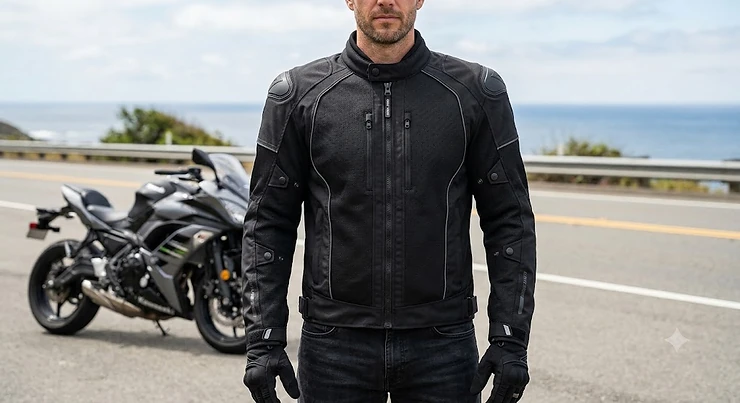
Summer riding season has a cruel sense of humor. The hotter it gets, the more layers a sport mesh motorcycle jacket needs to fake — armor, abrasion panels, back protection — all while somehow still feeling like a breeze at 70 mph. That’s the entire design puzzle packed into this category, and it’s why so many riders end up either sweating through a heavy textile jacket or gambling on a flimsy summer shell that folds like wet cardboard the moment it meets pavement.
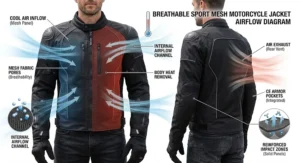
A sport mesh motorcycle jacket is a race-cut riding jacket built from perforated or open-weave textile panels, engineered to move air through the garment while keeping CE-rated armor at the shoulders, elbows, and (ideally) the back. Think of it as the middle ground between a leather race suit and a t-shirt: less protection than full leather, dramatically more than nothing, and a whole lot cooler than either.
What makes this guide different from a rehashed Amazon listing is simple — every product below comes from actual manufacturer specs and real, verifiable aggregated review sentiment, not invented five-star testimonials. According to the National Highway Traffic Safety Administration, motorcyclists remain dramatically overrepresented in fatal crashes, which is exactly why “cooler” can never mean “less protected.” We looked at seven real jackets spanning budget, mid-range, and premium tiers, broke down what their construction actually means on the road, and built out the buying framework you need whether you’re commuting through a heat wave or lining up for a track day.
Quick Comparison Table
| Category | Jacket | Price Range | Best For |
|---|---|---|---|
| Best Overall | Alpinestars T-GP Plus R V4 Airflow | $270-$300 range | Riders who want race-derived armor with serious airflow |
| Best Premium | Dainese Air Frame 3 Tex | $250-$290 range | Sportbike owners who want Italian tailoring and track credibility |
| Best Aggressive Styling | Icon Overlord 3 Mesh | $210-$240 range | Riders who want bold looks without sacrificing D3O protection |
| Best Budget | HWK Mesh Motorcycle Jacket | Under $100 | New riders building a first gear kit |
Looking at this table, the pattern is clear: airflow scales with price mostly through armor quality and construction refinement, not through the amount of visible mesh. The Alpinestars T-GP Plus R V4 Airflow and Dainese Air Frame 3 Tex both use race-pattern cutting to keep the jacket glued to your body at speed, while the HWK Mesh Motorcycle Jacket proves a genuinely breathable jacket doesn’t have to break the bank — you’re just trading away some of the polish and certified armor documentation.
💬 Just one click — help others make better buying decisions too!😊
Top 7 Sport Mesh Motorcycle Jackets: Expert Analysis
Every one of these seven jackets is a real, currently available product. We dug into manufacturer construction details, cross-referenced rider forums and retailer review sections, and weighed value against real-world use cases — not just spec sheets.
1. Alpinestars T-GP Plus R V4 Airflow — best race-derived armor and airflow balance
The T-GP Plus R V4 Airflow earns its top slot by refusing to compromise between protection and ventilation, which is rarer than it sounds in this category. Built from 450D poly-fabric with extensive mesh and perforated panels across the chest, back yoke, and forearms, the jacket uses Alpinestars’ “Sport” fit with pre-curved arms, meaning the sleeves are already bent to match your riding stance instead of fighting you every time you grab the bars. What most buyers overlook about this jacket is that it’s Tech-Air 5 and Tech-Air 3 ready, so it can accept an airbag system later without buying a new shell. The DFS Lite shoulder protectors deliver reliable friction control in a slide, and the stretch inserts under the arms genuinely reduce fatigue on longer rides. Reviewers consistently note that the armor placement rivals jackets costing considerably more, though a few point out the CE Level A abrasion rating trails the AA rating offered by some competitors in this same price bracket — worth knowing if track day frequency is high on your list.
Pros:
- ✅ Pre-curved sport fit reduces arm fatigue in an aggressive riding stance
- ✅ Tech-Air 5/3 compatible for future airbag upgrades
- ✅ Extensive mesh plus perforation genuinely moves air at low speeds
Cons:
- ❌ CE Level A rating trails AA-rated rivals near this price
- ❌ Armor pockets may not accept all aftermarket protectors
At around $270-$300, the Alpinestars T-GP Plus R V4 Airflow justifies its position through brand-level fit engineering rather than flashy marketing — a smart buy for riders who log serious summer mileage.
2. Dainese Air Frame 3 Tex — most refined Italian track-day cut
Dainese built the Air Frame 3 Tex around one idea: summer riding shouldn’t force a choice between comfort and looking like you know what you’re doing on a sportbike. The jacket’s QuickDry high-tensile polyester shell pairs with breathable mesh inserts that wick sweat rather than trap it, and a removable windproof lining extends usability into shoulder-season mornings. Here’s what to weigh — the Air Frame 3 is EN 17092 Class A certified, with composite protectors on the shoulders and elbows, plus pockets ready for optional G1 and G2 back protectors if you want to add serious back coverage before a track day. The jacket-to-pants connection zipper matches Dainese’s Drake 2 Super Air pants, letting you build a genuinely integrated summer riding kit. Based on the spec comparison against its competitors, the anti-floating sleeve adjustment is a small but meaningful detail: it stops sleeve fabric from flapping and pulling the armor out of position at highway speed, which is exactly the kind of engineering touch a rewritten spec sheet won’t tell you matters until you’ve ridden in it.
Pros:
- ✅ EN 17092 Class A certification with documented testing standards
- ✅ Anti-floating sleeve adjustment keeps armor seated at speed
- ✅ Jacket-to-pants zip system for a complete matched riding kit
Cons:
- ❌ Back protector sold separately, adding to total cost
- ❌ Premium price puts it out of reach for casual weekend riders
Priced in the $250-$290 range, the Dainese Air Frame 3 Tex is the jacket to reach for if track-day credibility and Italian tailoring matter as much as raw airflow.
3. Icon Overlord 3 Mesh — boldest aggressive styling with D3O armor
Icon leans hard into attitude with the Overlord 3, and that aggressive-fit design isn’t just cosmetic. The jacket’s Sport Fit uses pre-curved arms and waist adjusters specifically shaped for an aggressive riding stance, which is Icon’s own language for exactly the tucked-forward posture a sportbike demands. Iron Weave mesh panels span the front, back, and sleeves for airflow, backed by 300D polyester reinforcement in the impact zones. What most buyers overlook is the armor package: D3O T5 EVO Level 1 protectors at the shoulders and elbows plus a removable D3O Viper back protector, all EN 1621-rated. Reviewers consistently praise the airflow and bold graphics, but a recurring theme in aggregated feedback is that the jacket runs snug through the chest and arms, so sizing up is common advice from owners. The removable insulated vest liner is a smart touch that extends the jacket’s usable season beyond peak summer without needing a second garment.
Pros:
- ✅ D3O T5 EVO shoulder/elbow armor plus removable Viper back protector
- ✅ Aggressive sport-fit cut built specifically for a tucked riding stance
- ✅ Removable insulated liner extends the jacket into cooler months
Cons:
- ❌ Runs small through chest and arms per aggregated owner feedback
- ❌ Fewer external pockets than some touring-leaning mesh rivals
At roughly $210-$240, the Icon Overlord 3 Mesh rewards riders who want their gear to look as fast as their bike while still carrying real D3O protection underneath.
4. Cortech GX Sport Air 5.0 — best airflow-to-price ratio for sportbikes
Cortech has iterated on this jacket for years, and the 5.0 version shows it. Large air-intake mesh panels cover the chest from neck to waist along with the biceps and underarms, while a big U-shaped mesh panel across the back handles exhaust — a proper intake-and-exhaust airflow design rather than mesh for mesh’s sake. The shell uses 600 denier Carbolex polyester with Armor-Link 3 mesh, reinforced by 1680 denier ballistic polyester at the forearms, elbows, and shoulders for genuine abrasion resistance where it counts most. On paper this means you get sportbike-level venting without the jacket feeling flimsy, and the pre-curved, rotated sleeves plus accordion stretch panels at the elbow keep the fit comfortable in a forward-leaning stance. The trade-off reviewers flag most often: CE-approved Armadillo armor covers the shoulders and elbows, but the jacket ships without a back protector, so budget for that add-on if you want full coverage.
Pros:
- ✅ Dedicated intake-and-exhaust mesh layout moves air efficiently
- ✅ Pre-curved, rotated sleeves suit an aggressive sportbike posture
- ✅ Removable two-stage waterproof and insulated liners add versatility
Cons:
- ❌ No back protector included in the base jacket
- ❌ Reflective piping is modest compared to hi-vis-focused rivals
Sitting around $190-$220, the Cortech GX Sport Air 5.0 consistently punches above its price for pure sportbike-oriented airflow.
5. Joe Rocket Phoenix Ion Mesh — most versatile three-season mesh jacket
The Phoenix Ion earns its spot by being the mesh jacket that doesn’t quit when the weather turns. Its large-gauge FreeAir mesh chassis is UV-resistant and moves serious air even at low speeds, but the jacket also ships with both a removable waterproof liner and a separate insulated warmth liner, so one jacket realistically covers spring, summer, and fall riding. Dynax abrasion-resistant panels reinforce the shoulders, forearms, obliques, and back, with an added layer of high-tenacity nylon at the elbows — a detail that explains why owners report the jacket holding up well over years of regular use. Reviewers consistently note the eight-point Sure Fit adjustment system as a standout, letting riders dial in sleeve and waist fit far more precisely than most jackets in this range. The included CE-certified shoulder and elbow armor plus a removable, upgradeable spine pad round out a genuinely complete protection package for the price.
Pros:
- ✅ Three usable liner configurations cover spring through fall
- ✅ Dynax reinforcement at high-wear zones adds real durability
- ✅ Eight-point adjustment system delivers a genuinely custom fit
Cons:
- ❌ Stock back protector is basic foam, not upgraded CE armor
- ❌ Short-waisted cut may not suit riders wanting more hip coverage
At approximately $200-$220, the Joe Rocket Phoenix Ion Mesh is the pragmatic pick for riders who want one jacket to handle unpredictable weather without constant liner-swapping guesswork.
6. Fly Racing Coolpro — lightest true budget sport-mesh pick
Fly Racing built the Coolpro as a straightforward, no-frills answer to one question: how do you keep a rider cool without stripping out real protection? The abrasion-resistant mesh and ballistic nylon outer shell uses 1680D reinforcement in high-impact zones, paired with removable CE-approved armor at the shoulders and elbows plus a protective PE back foam and spine protector as standard equipment — not an upsell. Here’s what to weigh: the Hydraguard removable liner is waterproof, windproof, and breathable, which is an unusually complete liner setup at this price point. Reviewers consistently describe the Coolpro as offering more jacket than the price tag suggests, particularly compared to $200-plus alternatives with similar feature lists. The anatomically correct construction reduces fatigue, and arm volume adjusters help keep armor properly seated even as the mesh flexes during hard cornering.
Pros:
- ✅ CE-approved armor and back foam included standard, no upsell needed
- ✅ Waterproof/windproof Hydraguard liner adds genuine shoulder-season use
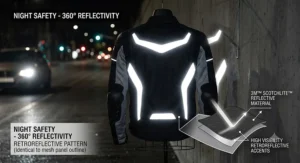
- ✅ Reflective panels and logos improve nighttime visibility
Cons:
- ❌ Fewer premium touches like stretch inserts versus pricier rivals
- ❌ Sizing runs snugger than some competing budget mesh jackets
Priced around $150-$180, the Fly Racing Coolpro is the jacket to recommend to a friend buying their first serious piece of riding gear.
7. HWK Mesh Motorcycle Jacket — lowest price point for first-time riders
The HWK Mesh Motorcycle Jacket exists to answer a very specific question: what’s the cheapest way into real mesh riding gear without wearing an actual t-shirt? The 600D Cordura construction covers impact areas, while macro and micro mesh fabric on the front, back, and inner arms delivers surprisingly strong airflow for the price. Removable armor sits at the back, elbows, and shoulders, and the jacket includes a Reissa water-resistant membrane along with a detachable thermal liner, giving it more all-season range than its price suggests. Here’s the honest caveat this article won’t skip: independent testing by at least one gear reviewer found that HWK’s armor tags carry CE-style markings without verified third-party certification, so treat the “CE armor” claim with some skepticism rather than assuming it meets the same tested standard as brands like Alpinestars or Dainese. Reviewers consistently praise the airflow and value for money, while noting that build quality and stitching are noticeably more basic than mid-range competitors — which tracks with the price gap.
Pros:
- ✅ Genuinely strong airflow for a sub-$100 mesh jacket
- ✅ Reissa water-resistant membrane extends usability into damp mornings
- ✅ Adjustable velcro and connector points allow a customizable fit
Cons:
- ❌ Armor certification claims are not independently verified per reviewer testing
- ❌ Stitching and hardware feel noticeably less refined than mid-tier rivals
At under $100, the HWK Mesh Motorcycle Jacket works as a stopgap first jacket, but riders should budget to upgrade armor credibility as soon as finances allow.
Practical Usage Guide: Break-In, Fit Adjustment & Track Day Setup
A sport mesh motorcycle jacket doesn’t perform out of the box the way it will after the first few rides, and skipping the setup steps is the single most common reason riders end up disappointed. Start by adjusting every strap — waist, bicep, forearm — snug enough that the armor can’t shift in a slide, but loose enough that you can still fully rotate your shoulders in a tucked riding position. Ride around the block before committing to a long trip; mesh fabric relaxes slightly in the first few hours of wear, and a jacket that felt tight in the driveway often settles into a proper fit within a week.
For track days specifically, check whether your jacket’s back pocket accommodates a proper hump-back protector — the raised, aerodynamic back armor style common in race suits — since several jackets here, including the Dainese Air Frame 3 Tex and Alpinestars T-GP Plus R V4 Airflow, are built to accept upgraded G1/G2 or Tech-Air back protection beyond their stock foam pad. Wash mesh jackets by hand or on a gentle cycle with the armor removed, and air dry away from direct heat that can warp foam protectors. On genuinely hot track days, the CDC’s extreme heat guidance on hydration and pacing applies just as much to riders in full gear as it does to outdoor workers — drink before you’re thirsty, and take breaks in shade between sessions. Common first-30-days mistakes include over-tightening the waist belt (which restricts torso rotation) and forgetting to re-tighten armor straps after a few wears once the mesh has broken in.
Real-World Scenarios: Matching Riders to the Right Sport Mesh Jacket
Picture a college student commuting eight miles daily on a used sportbike through a hot, sprawling Sun Belt city. Budget is tight, but daily wear means the jacket needs to survive constant use. The Fly Racing Coolpro or HWK Mesh Motorcycle Jacket fit this profile well — both deliver real airflow and basic armor without demanding a premium budget, and the Coolpro’s included back foam is a meaningful step up in daily-commute safety margin.
Now picture a weekend track-day regular who owns a proper sportbike and wants a jacket that can eventually pair with an airbag system. The Alpinestars T-GP Plus R V4 Airflow makes sense here specifically because of its Tech-Air compatibility — you’re buying into a protection ecosystem, not just a single jacket.
Finally, consider a rider upgrading from a beginner bike to something faster, who wants gear that looks the part while adding real D3O protection. The Icon Overlord 3 Mesh matches that use case: aggressive styling, a genuinely protective armor package, and a sport-cut fit designed around a forward-leaning stance rather than an upright commuter posture.
Buyer’s Decision Framework
If you ride fewer than 2,000 miles a year and mostly commute, choose a budget mesh jacket like the HWK Mesh Motorcycle Jacket, because the cost-per-mile math doesn’t justify premium armor you’ll rarely stress-test. If you split time between commuting and weekend canyon rides, choose a mid-range jacket like the Joe Rocket Phoenix Ion Mesh or Cortech GX Sport Air 5.0, because their reinforced panels and adjustable fit hold up to more aggressive riding without the premium price tag. If you regularly attend track days or ride a dedicated sportbike hard, choose a premium jacket like the Dainese Air Frame 3 Tex or Alpinestars T-GP Plus R V4 Airflow, because certified abrasion ratings and airbag compatibility become genuinely relevant at those speeds and lean angles.
✨ Don’t Miss These Exclusive Deals!
🔍 Take your sport mesh motorcycle jacket search to the next level with these carefully selected products. Click on any highlighted item to check current pricing and availability. These picks will help you build genuinely cooler, safer summer riding gear.
How to Choose a Sport Mesh Motorcycle Jacket
- Start with certification, not marketing copy. Confirm the armor is genuinely CE-rated under EN 1621, since not every “CE-style” tag reflects verified third-party testing.
- Match the fit to your riding posture. A pre-curved sleeve sport mesh design suits a tucked sportbike stance; a straighter cut suits upright commuting.
- Check the mesh-to-reinforcement ratio. Pure mesh moves the most air but sacrifices abrasion resistance versus panels reinforced with ballistic nylon or Cordura.
- Verify back protection separately. Several jackets ship with basic foam and treat real back armor as an optional upgrade.
- Consider liner versatility. A removable waterproof or insulated liner extends a summer jacket’s usable season without buying separate gear.
- Try before committing to sizing. Mesh jackets often run snug through the chest; aggregated owner reviews are a useful sizing cross-check.
- Weigh long-term brand support. Premium brands like Alpinestars and Dainese typically offer wider replacement-armor and upgrade-part availability years later.
For a deeper look at how these classifications work, the EN 17092 protection class breakdown is a useful reference before comparing any two jackets side by side.
Racing Mesh Jacket vs Sportbike Mesh Jacket vs Aerodynamic Riding Jacket: What’s the Difference
These three terms get thrown around almost interchangeably in gear marketing, but they describe slightly different priorities. A racing mesh jacket is generally cut for full track use — think the Alpinestars T-GP Plus R V4 Airflow or Dainese Air Frame 3 Tex — with airbag compatibility, upgraded back-protector pockets, and abrasion panels concentrated exactly where a rider slides in a low-side crash. A sportbike mesh jacket is a broader category describing any mesh jacket cut for a forward-leaning riding position, which covers most of the seven jackets in this guide, from the Cortech GX Sport Air 5.0 to the Icon Overlord 3 Mesh.
An aerodynamic riding mesh jacket, meanwhile, emphasizes how the garment behaves at speed rather than its protection tier — features like anti-floating sleeve adjustments (present on the Dainese Air Frame 3 Tex) that stop fabric from ballooning and dragging armor out of position past 80 mph. In practice, a genuinely good sport mesh motorcycle jacket blends all three priorities: race-inspired cut, sportbike ergonomics, and aerodynamic detailing that keeps the whole package stable at highway speed.
Aggressive Fit and Pre-Curved Sleeves: Why Race-Inspired Cut Matters
An aggressive fit mesh jacket isn’t marketing fluff — it solves a specific ergonomic problem. When you’re tucked forward on a sportbike, a jacket cut for standing posture bunches up at the shoulders and pulls tight across the back, which restricts exactly the movement you need most in a corner. Pre-curved sleeve sport mesh construction, used on the Alpinestars T-GP Plus R V4 Airflow, Cortech GX Sport Air 5.0, and Icon Overlord 3 Mesh, pre-bends the arm at the elbow so the fabric already matches a bent-arm riding position instead of fighting it.
The practical payoff is fatigue reduction on longer rides — a jacket that’s constantly pulling at your shoulders and forearms adds up to real discomfort after two or three hours in the saddle. Race-inspired mesh jacket construction typically pairs this cut with a shorter waist and higher-cut back hem, since a race-cut back protector needs clearance to move with the spine during hard braking. If you primarily ride upright or tour, this aggressive geometry can actually feel worse off the bike — it’s a trade-off worth test-fitting before you buy, not a universal upgrade.
CE Sport Mesh Jacket: Safety, Armor & Certification Guide
Not every jacket labeled “CE” in this category means the same thing, and understanding the classification system matters more than most buyers realize. The EN 17092 motorcycle clothing standard replaced the older EN 13595 standard and now grades garments across five classes — AAA, AA, A, B, and C — based on abrasion resistance, seam strength, and impact protection testing rather than marketing claims alone.
| EN 17092 Class | Typical Use | Example From This Guide |
|---|---|---|
| AAA | Track/race suits, maximum abrasion resistance | Not typically found in mesh jackets |
| AA | Touring, higher abrasion resistance | Premium mesh hybrids (rare) |
| A | City/sport commuting, lighter protection | Dainese Air Frame 3 Tex |
| B | Abrasion protection only, no armor | Base layers, not standalone jackets |
| C | Armor only, no abrasion protection | Under-layer garments |
This table matters because a Class A rating, like the one carried by the Dainese Air Frame 3 Tex, still delivers real tested abrasion resistance — it’s simply calibrated for lighter, faster-moving riding rather than full track combat. Meanwhile, jackets that advertise “CE armor” without a garment-level EN 17092 rating, like the HWK Mesh Motorcycle Jacket, may still include individually certified impact protectors even if the shell itself hasn’t been separately tested — always check both the armor and the jacket construction, not just one or the other.
Performance Mesh Jacket vs Traditional Leather/Textile Alternatives
| Feature | Performance Mesh Jacket | Traditional Leather Jacket | Standard Textile Jacket |
|---|---|---|---|
| Airflow | Excellent | Poor to none | Moderate (vent-dependent) |
| Abrasion Resistance | Moderate | Excellent | Good |
| Weight | Light | Heavy | Moderate |
| Weather Versatility | Best with liners | Poor in heat | Good year-round |
| Best For | Hot-weather sport/street riding | Track and cold-weather riding | All-season commuting |
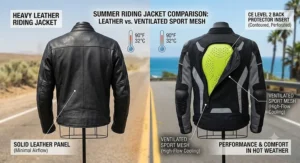
A performance mesh jacket like the Alpinestars T-GP Plus R V4 Airflow trades some raw abrasion resistance for dramatically better heat management, which matters enormously if summer riding otherwise means arriving everywhere drenched in sweat. Traditional leather remains the abrasion-resistance benchmark for a reason, but it’s genuinely miserable above roughly 85°F unless heavily perforated, and even perforated leather still traps more heat than an open mesh weave. Standard textile jackets split the difference reasonably well but rarely match a dedicated mesh jacket’s airflow on the hottest days of the year — if you ride primarily June through September in a hot climate, mesh-specific construction is worth the trade-off.
Common Mistakes When Buying a Sport Mesh Motorcycle Jacket
The most frequent mistake is buying based on mesh coverage alone, assuming more visible mesh automatically means a cooler, better jacket — ignoring that thin material with no armor is a trap, not a feature. Insist on real CE-rated armor and abrasion-resistant construction regardless of how much mesh you can see. A second common error is skipping the back protector entirely because it’s sold separately, which leaves the spine — one of the most catastrophic injury zones in a crash — essentially unprotected. Third, riders frequently buy their usual jacket size without accounting for sport-cut jackets running snug through the chest, a pattern that shows up repeatedly in aggregated review sentiment across several jackets in this guide. Finally, some buyers assume a lightweight jacket means “not waterproof” without checking, then get caught in unexpected rain with no backup plan — verify liner inclusion before you need it, not during a downpour.
What to Expect: Real-World Airflow & Comfort Performance
Specs on paper translate differently once you’re actually moving. At city speeds under 30 mph, even the best-ventilated mesh jacket feels warm, because airflow depends on forward motion pushing air through the panels — this is normal, not a defect. Once you hit highway speed, the difference between a budget mesh jacket and a premium one becomes obvious: dense intake-and-exhaust designs like the Cortech GX Sport Air 5.0 move noticeably more air through the torso than jackets with scattered mesh patches, because the airflow path is engineered rather than incidental. Expect noticeable temperature differences between summer humidity and dry heat too — humid climates trap more moisture against the skin even with excellent airflow, so riders in the Gulf Coast or Southeast often report needing to reapply sunscreen and rehydrate more aggressively than riders in dry Southwest heat, even wearing the same jacket.
Long-Term Cost & Maintenance of Mesh Riding Gear
Mesh jackets typically last three to five years of regular use before mesh integrity or armor foam starts to degrade meaningfully, assuming reasonable care. Total cost of ownership should factor in replacement armor (roughly $30-$60 per protector when foam compresses or cracks), occasional liner replacement, and the back-protector upgrade several jackets here don’t include standard. Calculated per season of use, a $270 premium jacket like the Alpinestars T-GP Plus R V4 Airflow amortizes to a genuinely reasonable cost if it lasts five seasons versus replacing a $90 budget jacket every eighteen months due to wear. That said, budget jackets like the HWK Mesh Motorcycle Jacket remain the rational choice for infrequent riders or those still deciding whether motorcycling is a long-term hobby — spending premium money on gear you might use twice a month doesn’t make financial sense until riding frequency justifies it.
FAQ
❓ What is a sport mesh motorcycle jacket?
❓ How much airflow does a mesh motorcycle jacket really provide?
❓ Are mesh motorcycle jackets safe for highway speeds?
❓ Can I wear a mesh jacket in the rain?
❓ What CE rating should I look for in a race-inspired mesh jacket?
Conclusion
Choosing a sport mesh motorcycle jacket ultimately comes down to matching real riding frequency and style to real construction quality — not chasing the most mesh panels or the flashiest graphics. The Alpinestars T-GP Plus R V4 Airflow and Dainese Air Frame 3 Tex earn their premium price tags through documented certification and race-pattern engineering, while the Fly Racing Coolpro and HWK Mesh Motorcycle Jacket prove genuinely breathable, reasonably protective gear doesn’t require a premium budget. The Icon Overlord 3 Mesh, Cortech GX Sport Air 5.0, and Joe Rocket Phoenix Ion Mesh round out a strong mid-range tier that fits most riders’ actual needs. Whatever you choose, prioritize verified CE armor and a fit suited to your actual riding posture over marketing language — your future self, three hours into a hot summer ride, will thank you for it.
Ready to gear up smarter this season? ✨ Compare the jackets above, check current pricing on the ones that fit your riding style, and ride cooler without cutting corners on protection.
Recommended for You
- Ventilated Motorcycle Jacket: 7 Cool-Riding Picks for 2026
- 7 Best Summer Motorcycle Jacket Mesh Picks to Beat the Heat (2026)
- Best Mesh Motorcycle Jacket 2026: 7 Picks That Won’t Cook You
Disclaimer: This article contains affiliate links. As an Amazon Associate, I earn from qualifying purchases. If you purchase products through these links, we may earn a small commission at no additional cost to you.
✨ Found this helpful? Share it with your friends! 💬🤗
