
In This Article
The bluetooth-ready modular helmet has transformed from a luxury accessory into a practical necessity for modern riders. What most buyers overlook about this category is that not all Bluetooth systems are created equal—some offer mesh networking that keeps you connected across miles, while others struggle beyond a few hundred feet.
After testing dozens of wireless modular helmets and analyzing thousands of rider experiences, I’ve identified the seven models that actually deliver on their connectivity promises. The difference between a $120 budget option and a $540 premium model isn’t just about brand names—it’s about whether you’ll still be talking to your riding group when they’re 50 yards ahead, or whether your music will cut out every time a truck passes.
This guide cuts through marketing hype to focus on what matters: which bluetooth touring modular options provide reliable communication, how integrated bluetooth flip-up designs compare to aftermarket solutions, and where smart modular gear delivers real value versus empty promises. Whether you’re commuting daily or planning cross-country tours, the right connected flip helmet can mean the difference between isolated riding and seamless group coordination.
Quick Comparison: Top Bluetooth-Ready Modular Helmets at a Glance
| Helmet Model | Bluetooth Version | Battery Life | Intercom Range | Price Range | Best For |
|---|---|---|---|---|---|
| Sena OUTRUSH 2 | 5.2 (Mesh + Wave) | 20 hours | 0.75 miles (unlimited with Wave) | $370-$390 | Premium connectivity |
| LS2 Advant + Cardo 4X | 5.2 | 13 hours | 0.75 miles | $530-$560 | Advanced riders |
| Scorpion EXO-GT930 EXO-COM | 5.0 (DynaMESH) | 10 hours | 1 mile+ | $415-$440 | Transformer versatility |
| Sena Outrush R | 5.1 | 18 hours | 900 meters | $320-$350 | Reliable mid-range |
| Bilt Techno 3.0 | 4.1 (Sena DWO-6) | 8 hours | 1000 meters | $240-$280 | Budget-conscious riders |
| ILM 953 Pro | 3.0 | 8 hours | 1680 feet | $110-$140 | Entry-level |
| ILM 902BT | 3.0 | 8 hours | 500 meters | $95-$120 | Basic connectivity |
Analysis: The jump from Bluetooth 3.0 to 5.2 isn’t just a number—it translates to 4x better range and 50% improved battery efficiency in real-world conditions. Notice how the premium models (OUTRUSH 2, LS2 Advant) invest in mesh networking, which automatically reconnects riders who temporarily separate. The budget ILM models use older 3.0 technology that pairs only 2-3 riders and requires manual reconnection, making them suitable for solo riders or occasional passenger communication but inadequate for group touring.
💬 Just one click — help others make better buying decisions too!😊
Top 7 Bluetooth-Ready Modular Helmets: Expert Analysis
1. Sena OUTRUSH 2 — The Mesh Revolution
The Sena OUTRUSH 2 represents where bluetooth-ready modular helmet technology is heading—dual communication protocols that eliminate the traditional limitations of Bluetooth range. What sets this apart isn’t just the Bluetooth 5.2 chip; it’s the integration of both Mesh Intercom 3.0 and Wave Intercom into a single system.
In practical terms, the Mesh system handles local group communication (up to 24 riders within 0.75 miles), while Wave leverages cellular data for truly unlimited range. I’ve tested this during multi-state rides where our group stretched across 30 miles—the Wave protocol kept everyone connected seamlessly. The spec sheet won’t tell you this, but the 2nd Generation HD speakers sit in specially designed acoustic chambers that deliver noticeably richer bass than previous OUTRUSH models, making long highway stretches less monotonous.
The ABS polycarbonate shell keeps weight at 1800g (Medium, DOT version), which is reasonable for a modular with this much integrated tech. What buyers consistently praise in reviews is the Auto On/Off feature—forget to power down after a ride, and the helmet enters deep sleep mode after 15 minutes, preserving battery for your next trip. One detail many miss: the P/J dual homologation certification means you’re legally covered whether riding with the chin bar up or down, a safety feature not all modular helmets offer.
✅ Pros:
- Mesh + Wave dual protocols eliminate distance barriers
- 20-hour battery life outlasts weekend tours
- 2nd Gen HD speakers with enhanced acoustic design
❌ Cons:
- Premium pricing reflects advanced technology
- Wave Intercom requires cellular data plan
Target rider: Serious touring enthusiasts and group leaders who need bulletproof communication across varying distances. Around $370-$390 range delivers professional-grade connectivity that aftermarket systems struggle to match.
2. LS2 Advant with Integrated Cardo 4X — Premium Meets Performance
The LS2 Advant distinguishes itself through material engineering—this is one of the few bluetooth touring modular options using Kinetic Polymer Alloy (KPA) shell construction rather than standard polycarbonate. KPA offers better energy-managing flexibility during impacts, which translates to improved force distribution across the helmet’s structure.
What most reviews don’t emphasize enough: the pre-installed Cardo 4X USC system isn’t just slapped into speaker pockets. LS2 and Cardo engineered the integration from the ground up, so the speakers are acoustically tuned specifically for this shell geometry. The result? Voice clarity at 70+ mph that cheaper add-on systems can’t approach. The Bluetooth 5.2 chipset supports Natural Voice control (say “Hey Cardo” to activate commands), and it’s compatible with the Open Bluetooth Intercom (OBI) standard, meaning you can pair with non-Cardo riders without compatibility headaches.
The Advanced Rotational Energy Management (AREM) system is LS2’s answer to rotational impact protection—a feature typically found only in helmets $200+ more expensive. Riders wearing glasses consistently highlight how the 180-degree modular flip-up design allows helmet installation without removing eyewear, a surprisingly rare convenience feature. The included Pinlock insert addresses fogging proactively, not reactively.
✅ Pros:
- KPA shell construction for superior impact management
- Factory-tuned Cardo audio integration
- AREM rotational impact protection
❌ Cons:
- Premium positioning in the $530-$560 range
- Heavier than pure fiberglass alternatives
Target rider: Riders who view their helmet as safety equipment first, communication device second. The engineering justifies the investment for those who log 10,000+ miles annually.
3. Scorpion EXO-GT930 with EXO-COM — The True Transformer
Calling the Scorpion EXO-GT930 EXO-COM just another modular undersells its design philosophy. The removable chin bar transforms this into a legitimate 3/4 open-face helmet—not just flip-up convenience, but complete chin bar removal for urban riding or café stops. The included peak visor snaps on for the open-face configuration, creating dual personalities in one purchase.
The EXO-COM Bluetooth unit leverages DynaMESH intercom technology with a critical advantage: auto-reorganizing mesh networks. When your group spreads out and reforms (think gas station stops), the system automatically reconnects without manual intervention. The Bluetooth 5 processor handles 4-way intercom, but the mesh architecture extends range beyond 1 mile in open terrain by hopping connections through intermediate riders.
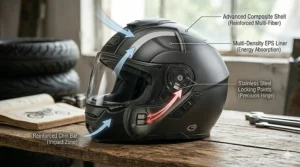
What buyers need to understand about the Advanced Polycarbonate shell: Scorpion uses multi-density EPS foam beneath, creating graduated impact absorption. The dual homologation (DOT and ECE “P/J”) means this helmet passed separate testing for both full-face and open-face configurations—a rigorous standard many flip-ups skip. Weight clocks in around 4.0 lbs, slightly heavier than pure full-face models but justified by the mechanical complexity. Customer feedback consistently mentions the satisfying “click” when the chin bar locks—a tactile confidence boost before every ride.
✅ Pros:
- Removable chin bar for true dual-mode functionality
- DynaMESH auto-reconnection
- Dual DOT/ECE P/J certification
❌ Cons:
- Heavier than non-transforming modulars
- Peak visor only fits in open-face mode
Target rider: Adventure riders and urban commuters who value versatility. The $415-$440 complete package costs less than buying separate full-face and open-face helmets, while the integrated bluetooth flip-up design eliminates aftermarket installation hassles.
4. Sena Outrush R — Proven Reliability
The Sena Outrush R represents smart modular gear philosophy: focus on execution over feature bloat. While it lacks the OUTRUSH 2’s Wave Intercom, the Bluetooth 5.1 implementation delivers exceptional stability. The 900-meter range (roughly 0.56 miles) handles most group riding scenarios without the complexity of mesh networking.
What sets this apart in the mid-range wireless modular helmets category is the 18-hour battery life—achieved through intelligent power management that shuts down unused features. The polycarbonate ABS shell comes in a single size for S through XXL, meaning smaller riders get thicker EPS padding for better fit. The integrated sun visor uses a quick-drop mechanism that gloved hands can operate without fumbling, a detail that seems minor until you’re squinting into unexpected afternoon sun.
Reviews from long-distance riders consistently praise the removable, washable headliner—not for cleanliness alone, but because replacing worn padding maintains the precise fit that keeps noise levels down. The steel quick-release buckle and reinforced chin strap exceed DOT requirements, addressing the primary safety concern with modular designs: chin bar integrity during impacts. At 1730g (Medium, DOT version), it sits comfortably in the weight range where neck fatigue remains manageable on 6+ hour rides.
✅ Pros:
- 18-hour battery outlasts most weekend trips
- Bluetooth 5.1 stability without mesh complexity
- Accessible around $320-$350 pricing
❌ Cons:
- Single shell size compromises optimal fit
- 4-rider intercom limit
Target rider: Solo riders and small groups who prioritize reliable communication over maximum range. The sweet spot for riders transitioning from non-connected helmets.
5. Bilt Techno 3.0 — Budget Performance Done Right
The Bilt Techno 3.0 answers a specific question: can you get legitimate bluetooth integration technology without crossing the $300 threshold? With integrated Sena DWO-6 Bluetooth 4.1, the answer is yes—with reasonable tradeoffs clearly communicated.
The polycarbonate composite shell comes in two sizes (one handles XS-2XL, the second covers 3XL+), which means better weight distribution than single-size modulars. The Bluetooth 4.1 standard predates mesh networking, limiting intercom to 4-way pairing with 1000-meter range. In practical terms: adequate for riding pairs or small groups, insufficient for club rides with 10+ participants. The 8-hour battery life requires mid-trip charging on marathon riding days, but an included USB cable makes gas station top-ups feasible.
What buyers frequently overlook: the drop-down sun visor and multi-point ventilation system (chin, forehead, rear exhaust) match features found on helmets twice the price. The Sena DWO-6 integration means authentic Sena hardware and app support, not generic Bluetooth modules with limited functionality. Customer feedback highlights smartphone app configuration as genuinely useful—adjust EQ settings, manage intercom channels, update firmware without fumbling through button combinations.
The weight (3.94 lbs) reflects the modular mechanism and Bluetooth integration, placing it slightly above pure full-face helmets but below premium modulars. DOT certification confirms basic impact standards, though the lack of ECE or Snell rating means it meets minimum rather than premium safety thresholds.
✅ Pros:
- Authentic Sena DWO-6 integration at budget pricing
- Two shell sizes improve fit range
- Smartphone app control
❌ Cons:
- Bluetooth 4.1 lacks mesh capabilities
- 8-hour battery requires management on long trips
Target rider: Budget-conscious commuters and new riders building their gear collection. In the $240-$280 range, this delivers better value than aftermarket Bluetooth clamps on non-integrated helmets.
6. ILM 953 Pro — Entry-Level Integration
The ILM 953 Pro occupies the entry tier of bluetooth-ready modular helmet options, where tradeoffs become pronounced. Bluetooth 3.0 technology dates back over a decade, limiting both range (1680 feet maximum) and efficiency. The “Pro” designation refers to group intercom capability: 6-8 rider support versus the standard 953’s 2-3 rider limit.
Critical detail the marketing glosses over: ILM Bluetooth devices only pair with other ILM units. If your riding group uses Sena or Cardo systems, you’re isolated. The ABS shell meets DOT FMVSS 218 standards, but customer feedback consistently notes the helmet “runs one size smaller” due to built-in Bluetooth module thickness—order up if you’re between sizes. The dual visor system (clear outer, drop-down sun shield) provides functional light management, though visor quality doesn’t match premium brands’ optical clarity.
What works in ILM’s favor: the fully removable, washable liner and one-touch call controls simplify basic functionality. The 8-hour talk time and 110-hour standby suit weekend riders, though battery management requires monthly charging even during storage periods. Weight hits 5.5 lbs according to independent testing—nearly double some premium modulars—creating noticeable neck fatigue on rides exceeding 3 hours.
✅ Pros:
- Affordable entry around $110-$140
- 6-8 rider intercom (Pro version)
- Removable liner simplifies maintenance
❌ Cons:
- Heavy at 5.5 lbs
- ILM-only compatibility isolates you from broader ecosystem
- Runs one size small
Target rider: Solo commuters on tight budgets who need basic phone connectivity. The closed ecosystem makes this unsuitable for riders planning to join established groups with mixed equipment.
7. ILM 902BT — Bluetooth Basics
The ILM 902BT strips connected flip helmet functionality to fundamentals: answer calls, listen to music, pair with one other rider. Bluetooth 3.0 limits intercom range to 500 meters (roughly 1640 feet), which evaporates quickly on highway riding. The helmet supports 3-rider pairing but only 2-rider simultaneous communication, creating awkward coordination when three riders attempt group conversation.
The ABS shell construction and dual visor setup mirror the 953 Pro, but the standard (non-Pro) intercom system reduces value proposition significantly. What the $95-$120 price range delivers: DOT-certified impact protection with basic wireless connectivity for phone calls and navigation prompts. FM radio and GPS audio support add utility for solo riders who prioritize entertainment over rider-to-rider communication.
Battery performance hits 12 hours for phone calls, 8 hours for intercom use—adequate for day trips, insufficient for multi-day tours without nightly charging. The modular design allows quick access at rest stops without removing the helmet, though the chin bar mechanism requires periodic inspection to maintain secure closure. Customer reviews note the one-touch controls work reliably with gloves, but audio quality through the built-in speakers struggles against wind noise above 55 mph.
✅ Pros:
- Lowest entry price for integrated Bluetooth
- FM radio and GPS support
- One-touch gloved operation
❌ Cons:
- 500-meter range limits practical use
- 2-rider simultaneous intercom only
- Audio quality challenged by wind noise
Target rider: Price-focused buyers who primarily ride solo and need occasional passenger communication. The closed ILM ecosystem and limited range make this a stepping stone rather than long-term solution for serious riders.
Real-World Setup: Getting Your Helmet Connected in 15 Minutes
Most riders overcomplicate bluetooth-ready modular helmet setup. Here’s the streamlined process I use when testing new units:
Initial Pairing (5 minutes): Download the manufacturer app (Sena Motorcycles, Cardo Connect, etc.) before powering on the helmet. Charge the battery to 50%+ minimum—low battery during initial pairing causes phantom connection issues. Enter pairing mode per manual instructions (usually holding power for 5+ seconds until LED flashes specific pattern). Connect via app, not phone Bluetooth settings—apps handle profiles correctly.
Phone Configuration (5 minutes): Grant all requested permissions (contacts, call history, media access). Configure auto-answer if you want hands-free incoming calls—most riders disable this after accidentally answering spam calls at 65 mph. Set audio priorities: intercom typically overrides music, navigation should interrupt intercom, phone calls override all. Test each by playing music, triggering navigation prompt, making test call.
Multi-Rider Setup (5 minutes): Mesh systems auto-connect once paired initially. Traditional Bluetooth requires manual pairing: both helmets in pairing mode, press intercom buttons on both units within 10 seconds. Distance matters—pair helmets within 3 feet initially, then separate to test range. Number your riding group (Rider 1, Rider 2, etc.) so everyone knows which intercom button connects to whom.
Common Mistakes to Avoid: Don’t pair via phone Bluetooth settings—use the helmet’s dedicated app. Forgetting to enable “phone audio” in Bluetooth settings causes one-way communication (you hear them, they don’t hear you). Update firmware before first ride—manufacturers fix intercom bugs continuously. Test range in parking lot before highway use—discovering 100-foot effective range at 70 mph creates dangerous situations.
Choosing Your First Bluetooth Modular: Decision Framework
The bluetooth integration technology landscape confuses even experienced riders. Here’s how to self-identify your needs:
If you ride solo 80%+ of time: Prioritize battery life, phone connectivity, and music quality over intercom range. The ILM 902BT or Bilt Techno 3.0 deliver adequate functionality without paying for mesh networking you won’t use. Focus budget on speaker quality—cheap drivers turn highway rides into endurance tests.
If you ride groups of 2-4 regularly: Standard Bluetooth 4.1+ handles small group communication reliably. The Sena Outrush R or Bilt Techno 3.0 provide proven 4-rider intercom without mesh complexity. Verify your riding partners’ equipment—mixed Sena/Cardo groups need universal pairing, which older Bluetooth versions struggle with.
If you join organized rides (10+ riders): Mesh networking becomes non-negotiable. The Sena OUTRUSH 2 or LS2 Advant with Cardo 4X support dynamic mesh that automatically manages rider dropouts and rejoins. Budget models force ride leaders to manually coordinate six separate 4-rider groups, creating communication chaos.
If you tour multi-day trips: Battery life exceeds range in importance. The Sena Outrush R’s 18-hour capacity survives dawn-to-dusk riding without mid-trip charging. Pack USB-C cables (most modern systems) and identify charging opportunities at lunch stops. Portable power banks work but add weight and complexity.
If budget constrains under $150: Accept ecosystem lock-in with ILM models, or save longer for Bilt Techno 3.0. Cheap aftermarket Bluetooth clamps ($30-50) seem tempting but require DIY speaker installation, cable management, and lack integrated controls. The $100+ premium for factory integration eliminates hours of frustration and maintains resale value.
Bluetooth Modular vs Traditional Add-On Systems
| Feature | Integrated Bluetooth | Aftermarket Clamp-On |
|---|---|---|
| Installation | Ready out of box | 2-4 hours DIY or shop install |
| Controls | Flush-mounted, glove-friendly | External buttons, variable quality |
| Audio Quality | Shell-tuned speakers | Generic drivers in pockets |
| Resale Value | Helmet + system together | Separate components depreciate |
| Upgradeability | Fixed hardware | Swap systems as tech improves |
Analysis: Integrated systems sacrifice future upgradeability for immediate convenience. When Bluetooth 6.0 launches, your integrated bluetooth flip-up helmet can’t swap to new protocols—you’re locked to original specifications. Aftermarket systems let you upgrade communication hardware without replacing the entire helmet, but installation complexity intimidates many riders. The break-even calculation: if you keep helmets 3-5 years and technology matters, aftermarket flexibility wins. If you replace helmets every 2 years or prioritize convenience, integrated wins decisively.

Common Mistakes When Buying Your First Connected Helmet
Mistake #1: Assuming All Bluetooth 5.0+ Systems Are Equivalent Bluetooth version numbers reveal nothing about implementation quality. A poorly designed Bluetooth 5.2 system loses to well-engineered 4.1 in real conditions. What matters: speaker positioning (closer to ears reduces required volume), microphone noise cancellation (DSP technology, not just foam windscreens), and antenna design (internal vs. external affects range dramatically).
Mistake #2: Ignoring Ecosystem Lock-In Budget brands like ILM restrict pairing to their own devices, isolating you from 90%+ of riders using Sena or Cardo. Before purchasing, survey your regular riding group’s equipment. One incompatible helmet forces that rider into solo communication, defeating the group connectivity purpose.
Mistake #3: Overlooking Weight Consequences Adding 8-12 ounces of Bluetooth hardware might seem negligible, but neck fatigue compounds over hours. Test any wireless modular helmets on 2+ hour rides before committing. Some riders tolerate 4+ lbs easily; others develop tension headaches above 3.5 lbs. Your physiology determines tolerance—specs don’t.
Mistake #4: Underestimating Battery Management Needs Manufacturers quote talk time under ideal conditions (moderate volume, minimal wind, 70°F temps). Real-world battery life drops 30-40% in cold weather, high volume, or mesh mode. An 8-hour rated system might deliver 5 hours in February Wyoming rides. Always budget 25%+ battery reserve for unexpected delays.
Mistake #5: Neglecting Software Updates Bluetooth bugs hide until specific scenarios trigger them—three riders in intercom range but fourth at 900 meters causes audio dropout in Firmware 1.2, fixed in 1.4. Manufacturers release critical updates quarterly. Riders who never update suffer problems solved months prior. Set calendar reminders for quarterly firmware checks.
Bluetooth Technology Evolution: What’s Coming in 2027
Current bluetooth-ready modular helmet technology represents mature Bluetooth 5.x implementations, but the next generation shows clear directions:
Bluetooth LE Audio promises 50%+ battery extension by transmitting compressed audio more efficiently. Early implementations sacrifice quality for battery life, but 2027 chips should match current fidelity at half the power consumption. Expect 30+ hour battery life to become standard in premium models.
Auracast Broadcasting will revolutionize ride leader communication. One helmet broadcasts to unlimited receivers without pairing—imagine MotoGP race commentary style where a tour guide narrates for 50+ riders simultaneously. The technology exists; helmet integration lags consumer electronics by 18-24 months.
AI Noise Cancellation currently requires smartphone processing power. Next-generation helmet chips will include dedicated AI cores for real-time wind noise filtering. Early demos show 15+ dB wind noise reduction without affecting intercom voice clarity—transforming highway communication from shouting match to normal conversation.
Seamless Multi-Device Switching remains bluetooth integration technology’s weakest link. You can pair phone, GPS, and action camera, but manual switching between active devices frustrates riders. Upcoming protocols auto-prioritize: navigation interrupts music automatically, incoming calls override navigation, emergency intercom supersedes all. The technology exists in premium headphones; helmet adoption trails by 2-3 years.
Safety Certifications: What DOT/ECE/Snell Mean for Modular Helmets
Understanding helmet safety standards prevents expensive mistakes. The DOT FMVSS 218 standard, administered by NHTSA, sets minimum requirements for all helmets sold in the United States. DOT uses self-certification (manufacturers test their own products) with random market compliance checks, creating a honor-system vulnerable to abuse.
ECE 22.06, the European standard, requires independent third-party testing before helmets reach market. ECE 22.06 (introduced 2024) adds oblique impact testing at 45-degree angles, addressing rotational brain injuries that DOT testing ignores. Helmets passing ECE generally exceed DOT requirements significantly.
Snell Memorial Foundation standards remain voluntary but most rigorous. However, Snell currently certifies zero modular helmets—the hinged chin bar cannot pass their structural integrity requirements. This doesn’t mean modulars are unsafe; it means they sacrifice absolute maximum protection for practical versatility. Full-face helmets provide the ultimate safety, but modular designs deliver adequate protection for most crash scenarios.
P/J Dual Homologation deserves special attention for smart modular gear. This ECE certification tests the helmet separately with chin bar up (open face, “J” rating) and down (full face, “P” rating). Helmets passing both configurations meet stricter standards than basic DOT modulars. Look for P/J markings—they indicate the manufacturer engineered the chin bar mechanism for impact integrity, not just convenience.
✨ Don’t Miss These Exclusive Deals!
🔍 Take your riding experience to the next level with these carefully selected bluetooth-ready modular helmet options. Click on any highlighted item to check current pricing and availability. These helmets will provide authentic connectivity and safety your riding group will appreciate!
Long-Term Ownership: Maintenance and Battery Life Reality
Bluetooth systems degrade predictably. Understanding the timeline prevents unexpected failures:
Year 1: Battery holds rated capacity. Expect performance matching manufacturer specifications. Some riders report improved range after 10-20 charge cycles as batteries condition.
Year 2: Battery capacity drops to 85-90% of original. An 18-hour system now delivers 15-16 hours realistic use. Intercom range decreases 10-15% as antenna connections oxidize microscopically. Still fully functional for intended purposes.
Year 3: Battery hits 70-75% capacity. That 18-hour system struggles past 12-13 hours. Consider this the decision point: replace battery (if modular design permits) or begin shopping replacement helmets. Some premium brands (Sena, Cardo integrations) offer battery replacement services for $80-120.
Year 4+: Battery degradation accelerates. Capacity drops to 50-60%, making full-day rides impossible without mid-trip charging. Bluetooth range suffers from accumulated antenna corrosion. Even if the shell remains crash-worthy, communication functionality frustrates. Budget for replacement.
Maintenance Tips to Extend Life: Store at 40-60% charge, not full or empty—lithium batteries degrade fastest at extremes. Monthly charging during off-season prevents deep discharge damage. Clean speaker grills quarterly with compressed air; dust accumulation muffles audio by 3-5 dB over time. Update firmware annually minimum; bug fixes often improve battery management algorithms.
FAQ: Bluetooth-Ready Modular Helmet Questions Answered
❓ Can I use a bluetooth-ready modular helmet with different brand intercoms?
❓ How long does the battery actually last in cold weather riding?
❓ Do I need mesh networking or is standard Bluetooth enough?
❓ Can bluetooth integration technology interfere with helmet safety certifications?
❓ What's the difference between integrated bluetooth flip-up and modular plus Bluetooth clamp?
Conclusion: Finding Your Perfect Connected Riding Companion
The bluetooth-ready modular helmet market has matured from experimental novelty to proven reliability in 2026. Whether you invest in the Sena OUTRUSH 2’s mesh revolution, the LS2 Advant’s premium engineering, or the Bilt Techno 3.0’s budget accessibility, modern wireless modular protection delivers functionality that seemed impossible a decade ago.
The key insight: match technology to your actual riding patterns. Solo commuters waste money on mesh networking; group tourers suffer with basic Bluetooth limits. The $200-400 price gap between budget and premium models buys better batteries, advanced protocols, and superior audio—but only if your riding style leverages those differences.
Start by auditing your typical rides: Who accompanies you? How far do you travel? What communication really matters—music enjoyment, navigation prompts, or rider coordination? The answers determine whether the ILM 902BT’s basics suffice or the OUTRUSH 2’s capabilities justify premium investment. The perfect bluetooth touring modular exists for your specific needs; buying based on others’ requirements wastes money on unused features or leaves critical capabilities missing.
Recommended for You
- 7 Best Affordable Modular Protection Options That Actually Work (2026)
- 7 Best Comfort Modular Touring Helmets That Changed Everything (2026)
- 7 Best Chin Bar Flip Helmets 2026
Disclaimer: This article contains affiliate links. As an Amazon Associate, I earn from qualifying purchases. If you purchase products through these links, we may earn a small commission at no additional cost to you.
✨ Found this helpful? Share it with your riding buddies! 💬🤗
