
In This Article
Here’s a scene almost every wide-footed rider knows by heart: you strap on a pair of boots that felt “fine” in the store, roll out on a 300-mile day, and by mile 80 your pinky toes are filing a formal complaint. Long distance motorcycle boots for wide feet are a genuinely different animal than the boots sold to everybody else, and pretending otherwise is how riders end up standing on gas station curbs, wincing, wiggling their toes like they’re trying to shake off static electricity.

What is long distance motorcycle boots for wide feet, really, in plain terms? It’s footwear built with a wider forefoot and toe box (typically EE or wider), reinforced ankle and shin protection rated for motorcycle use, and closures that adjust to swelling feet over an 8-hour ride — not a standard-width touring boot you happened to size up. Width, as shoe-size standards define it, is measured completely separately from length, which is exactly why simply buying a bigger size rarely solves a wide-foot problem.
This guide leans on real specs, verified retailer sizing charts, and aggregated review sentiment (never invented quotes) to walk through seven actual boots worth your money, how EE width sizing actually works, why lacing systems matter more than most riders realize, and how custom insole fitting can rescue a boot that’s almost — but not quite — right. We’ll also cover the traps: sizing up instead of sizing wider, ignoring toe box shape, and trusting a brand’s “wide” label without checking the actual last.
Quick Comparison: Wide Fit Touring Boots at a Glance
| Boot | Width Options | Price Range | Best For |
|---|---|---|---|
| Sidi Adventure 2 Gore-Tex | D (order ½ size up for wide) | $400–$460 | Waterproof ADV touring |
| Alpinestars Corozal Adventure Drystar | Roomy D, generous toe box | $280–$330 | All-around wide toe box |
| Tour Master Solution WP 2.0 | True D and Wide (9W–14W) | under $150 | Budget wide sizing |
| Forma Adventure | Roomy D, gusseted flex panels | $260–$350 | All-day walking comfort |
| Milwaukee Leather 11-Inch Harness Boot | True EEE | under $170 | Widest true fit, cruiser style |
| ICON Stormhawk | D with BOA micro-adjust | $220–$250 | Custom lace-up fit |
| REV’IT Expedition GTX | D with BOA + gusseted tongue | $800–$900 | Premium adjustable ADV |
Looking at the spread above, there’s a clear pattern: the boots offering genuine, labeled wide sizing — the Tour Master Solution WP 2.0 and the Milwaukee Leather 11-Inch Harness Boot — sit at the budget end, while premium ADV boots like the REV’IT Expedition GTX compensate for a lack of dedicated wide sizing with adjustable BOA lacing and roomy gusseted construction instead. Neither approach is “better” across the board; it depends on whether your feet need more literal width or just a more forgiving, adjustable fit. The Alpinestars Corozal Adventure Drystar splits the difference nicely, using an anatomically wide-cut toe box without ever putting a “W” on the box.
💬 Just one click — help others make better buying decisions too!😊
Top 7 Long Distance Motorcycle Boots for Wide Feet: Expert Analysis
1. Sidi Adventure 2 Gore-Tex — most protective waterproof ADV touring boot
The standout here is armor: the Sidi Adventure 2 Gore-Tex wraps a microfiber-and-TPU chassis around reinforced ankles, toes, heels, and shin, and it’s genuinely built for multi-day mileage rather than a Sunday loop.
Under the hood you get a Gore-Tex membrane sandwiched into Sidi’s proprietary microfiber upper, a lugged rubber sole that grips wet pavement and gravel alike, and cam-lock buckles paired with an elastic calf panel that flexes to fit different pant thicknesses. In practice, that Gore-Tex layer means your feet stay dry through a genuine downpour, not just a drizzle, while the half-inch heel sits securely on the peg whether you’re seated or standing on a rough trail.
Based on the spec comparison and the boot’s reputation among adventure riders, this is the pick for anyone doing long, wet, multi-day ADV tours where waterproofing and ankle protection matter more than anything else. It’s not, however, the first boot to reach for if your feet are dramatically wide — more on that below.
Reviewers consistently note that the Sidi Adventure 2 Gore-Tex fits true to size for most riders but runs narrower through the actual footbed than its roomy-looking toe box suggests; several long-term reviewers explicitly recommend going up half a size for wide feet, and at least one experienced reviewer suggests riders with very wide feet look instead at Alpinestars’ equivalent model. That’s a useful, honest data point rather than marketing copy — it tells you this boot rewards a half-size-up strategy rather than a true wide-width purchase.
Pros:
- ✅ Gore-Tex membrane keeps feet dry in sustained rain
- ✅ Heavy-duty ankle, shin, and toe box protection
- ✅ Adjustable calf shaft fits over most touring pants
Cons:
- ❌ Footbed runs narrower than the toe box implies
- ❌ Needs several weeks of break-in before it truly relaxes
Price sits in the $400–$460 range depending on retailer and color; given the waterproofing and protection on offer, it’s a strong value for riders who order a half size up and accept the break-in period.

2. Alpinestars Corozal Adventure Drystar — roomiest toe box under $350
What most buyers overlook about the Alpinestars Corozal Adventure Drystar is that its toe box was deliberately shaped to be forgiving, not just tall — it’s one of the few ADV boots that reviewers specifically call out as accommodating wider feet without any sizing workaround.
The boot pairs a hybrid waxed leather and polyurethane-coated upper with a Drystar waterproof membrane, a removable Lycra-and-EVA anatomic footbed, and a polypropylene midsole reinforced with a steel shank. Practically speaking, that footbed is doing double duty: it cushions your arch on long rides and it’s removable, which matters a lot if you plan on dropping in a custom insole later (more on that in the insole-fitting section below).
Based on the spec sheet and multiple independent reviews, this is the boot for a rider who wants CE-certified ADV protection and all-day comfort without paying premium-tier prices — reviewers specifically describe the toe box as large enough to comfortably fit wider feet, and the wide-entry aperture plus generous Velcro closure make it fast to get on over thick socks.
Aggregated reviewer sentiment is close to unanimous on comfort: riders describe the boot as immediately comfortable with little to no break-in, waterproof through sustained downpours, and surprisingly breathable even in extreme heat.
Pros:
- ✅ Toe box specifically noted as generous for wide feet
- ✅ Removable anatomic footbed for custom insole swaps
- ✅ CE-certified protection at a mid-range price
Cons:
- ❌ Upper third of the boot lacks the waterproof membrane
- ❌ Leather takes some initial break-in time
At around $280–$330, the Alpinestars Corozal Adventure Drystar is arguably the best value-to-comfort ratio on this list for wide-footed riders who don’t want to gamble on true wide sizing.
3. Tour Master Solution WP 2.0 — best budget pick with true wide sizing
Here’s the thing most touring-boot shoppers never realize: almost none of the premium Italian ADV brands actually sell a labeled wide width, but the Tour Master Solution WP 2.0 does — it’s stocked in men’s 7–15 standard and 9W–14W wide, a rarity in this category.
Specs-wise, you’re getting a water-repellent leather and PU upper, a HiPora waterproof breathable membrane, a self-locking YKK-style zipper under a Velcro flap, molded nylon shin and ankle guards, and a preformed vibration-absorbing footbed. Here’s what to weigh: this isn’t a race boot or a hardcore ADV boot, it’s a comfort-first touring boot, so the armor is lighter than the Sidi or REV’IT options above and below it on this list.
What most buyers overlook about the Tour Master Solution WP 2.0 is that the width chart isn’t a vague marketing gesture — Tour Master publishes actual forefoot measurements in inches for D versus E width across every size, so you can measure your own foot and compare rather than guessing.
Reviewers consistently describe this boot as remarkably comfortable for the price, wearable all day on commutes and multi-hour tours alike, with one long-term reviewer logging roughly 9,000 miles in a single pair before replacing them and calling the boot “better now than when new” after the leather broke in.
Pros:
- ✅ Genuine labeled wide sizing (9W–14W), not just a size-up trick
- ✅ Published forefoot width chart in inches for exact comparison
- ✅ HiPora waterproofing performs well in sustained rain
Cons:
- ❌ Lighter armor than dedicated ADV or race boots
- ❌ Zipper action can feel stiff before its first lubrication
At roughly $120–$150, the Tour Master Solution WP 2.0 is the clearest “no-brainer” on this list if dedicated wide sizing, not just a roomy cut, is your priority.
4. Forma Adventure — most walkable all-day comfort
The Forma Adventure earns its spot by solving a problem most ADV boots create: it lets you actually walk normally at a gas stop instead of goose-stepping around in stiff plastic armor.
Built from oiled full-grain leather with a Drytex waterproof-breathable liner, the boot uses gusseted concertina panels at the front and back to let your foot flex naturally through braking and shifting, plus a dual-density sole that’s firm enough on the pegs but soft enough for walking. The three-buckle, ski-boot-style closure with elastic tensioning is what makes the fit adjustable across a wider range of foot volumes than a fixed-buckle design allows.
Here’s what to weigh: this isn’t the most protective boot on the list — its heel cup and toe box trade some rigidity for comfort — so riders prioritizing hard off-road protection may want the Sidi Adventure 2 Gore-Tex instead, while riders prioritizing 800-mile weekend comfort will likely prefer the Forma Adventure.
Reviewer sentiment across multiple independent outlets is remarkably consistent: extremely comfortable straight out of the box, genuinely waterproof through heavy rain, and comfortable enough to wear all day off the bike — though several reviewers note the sole runs softer than ideal for serious off-road standing, and UK retailer reviews mention the boot fits smaller than expected, so sizing up is a common recommendation for wider or thicker-socked feet.
Pros:
- ✅ Gusseted panels flex naturally around wider forefoot volume
- ✅ Comfortable for all-day walking, not just riding
- ✅ Adjustable three-buckle ski-boot-style closure
Cons:
- ❌ Less rigid protection than hardcore ADV competitors
- ❌ Multiple reviewers suggest sizing up for wide feet
Price typically runs $260–$350 depending on retailer and open-box discounts, making the Forma Adventure a strong mid-tier pick for comfort-first long-distance riders.
5. Milwaukee Leather 11-Inch Waterproof Harness Boot — widest true fit, cruiser style
If your feet are wide enough that even “wide” boots feel snug, the Milwaukee Leather 11-Inch Waterproof Harness Boot deserves a look — it’s sold in genuine EEE widths, not just a single wide option, which is unusual even among boots that bother to offer wide sizing at all.
The boot uses a square toe last (which reviewers note adds real forefoot volume compared to a tapered engineer-style toe), a waterproof leather upper, side-zip entry for easy on/off, and a classic harness strap detail. What most buyers overlook about a square-toe harness boot like this is that the shape itself does real work: a rounded or square toe box provides meaningfully more forefoot room than a pointed toe, independent of the width label on the box.
Based on the spec sheet and its price point, this is squarely a cruiser and touring boot rather than an ADV or sport-touring option — there’s no Gore-Tex membrane or CE armor rating here, just a genuinely wide, genuinely waterproof leather boot built for highway miles on a cruiser or bagger.
Aggregated reviewer sentiment across harness-style Milwaukee and comparable wide work-boot lines is generally positive on width and comfort, with riders specifically noting that switching to an EE or EEE width from a standard size resolved forefoot pinching that persisted even after sizing up a half size.
Pros:
- ✅ True EEE width option, not just a single “wide” size
- ✅ Square toe shape adds forefoot volume independent of width label
- ✅ Genuinely waterproof leather at a budget price
Cons:
- ❌ Minimal ankle and shin armor compared to ADV boots
- ❌ Not built for off-road or high-speed sport touring
Typically priced under $170 (and often closer to $100–$130), it’s the most affordable true-wide option on this list, especially for cruiser and long-highway riders.
6. ICON Stormhawk — best lacing system for a custom, swelling-friendly fit
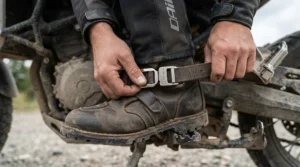
The ICON Stormhawk solves the wide-feet problem from a completely different angle: instead of stocking a wide width, it uses a BOA lacing system that lets you dial in exact tension across the whole forefoot in seconds.
Specs include a water-resistant leather upper, a breathable eVent waterproof liner, dual D3O ankle inserts for impact absorption, an open-cell polyurethane insole, and a lugged oil- and slip-resistant outsole. Here’s what to weigh: a BOA reel-and-cable closure spreads pressure evenly across the instep rather than concentrating it under two or three buckle points, which is exactly the kind of adjustability wide or swelling feet benefit from on an 8-hour ride.
Based on the spec comparison with buckle- and zipper-closure boots elsewhere on this list, the ICON Stormhawk is the strongest pick specifically for riders whose feet swell over the course of a long day, since you can loosen or tighten the BOA dial at a gas stop without removing the boot entirely.
Reviewers of BOA-equipped moto and powersports boots consistently highlight the “spin to tighten, pop to release” mechanism as faster and more evenly distributed than traditional lace-up or buckle systems, though it’s worth noting honestly that BOA components, while field-replaceable, are a mechanical part that can eventually need servicing.
Pros:
- ✅ BOA lacing distributes pressure evenly across a wide forefoot
- ✅ Dual D3O ankle inserts add real impact protection
- ✅ eVent waterproof liner keeps feet dry on long rides
Cons:
- ❌ BOA reel is a mechanical part that can eventually wear
- ❌ No dedicated wide-width option, relies on lacing adjustability
At roughly $220–$250, the ICON Stormhawk is the clearest lacing-systems pick on this list for wide or swelling feet on a moderate budget.
7. REV’IT Expedition GTX — premium pick with dial-in BOA precision
At the top of the range, the REV’IT Expedition GTX combines MX-level protection with a Dynamic Support Frame (DSF) ankle system and a BOA closure, aimed at riders who want the best available fit-and-protection combination and are willing to pay for it.
The boot’s stainless-steel BOA laces are, per REV’IT’s own engineering claims, stronger per gram than comparable webbing, and they’re paired with a gusseted tongue construction that distributes the wire’s tension evenly rather than pinching one spot. Add a Gore-Tex membrane, a Vibram Apex sole, a thermoformed toe cap and heel cup, and a removable OrthoLite X40 insole, and you’ve got a boot engineered for multi-day ADV expeditions rather than weekend rides.
What most buyers overlook about the DSF system specifically is that it’s not just armor — it’s designed to prevent hyperextension of the ankle tendons in a crash, which is a genuinely different engineering goal than simply cushioning an impact, and it’s part of why this boot carries an award-winning reputation in the ADV press.
Reviewers rate the REV’IT Expedition GTX highly overall (aggregated review scores hover around 4.5 out of 5), consistently praising the BOA precision fit and all-day comfort, though the boot’s four-figure price point is, honestly, a legitimate barrier for most riders, and it doesn’t carry a labeled wide-width option — its fit-for-wide-feet case rests entirely on the BOA adjustability and gusseted tongue rather than a genuine wide last.
Pros:
- ✅ BOA closure allows precise, even forefoot tensioning
- ✅ DSF ankle system engineered against hyperextension injury
- ✅ Removable OrthoLite insole supports custom insole upgrades
Cons:
- ❌ Premium price puts it out of reach for many riders
- ❌ No dedicated wide-width sizing, relies on BOA adjustability
Expect to pay in the $800–$900 range at full retail (occasionally less on open-box or sale listings); it’s a serious investment best justified by frequent multi-day touring rather than occasional weekend rides.
Practical Usage Guide: Breaking In, Adjusting, and Maintaining Wide Fit Touring Boots
Getting a wide-fit boot to actually feel right involves more than the purchase decision. In the first 30 days, wear new leather boots around the house in short stretches before committing to an all-day ride — this lets the leather begin conforming to your foot’s specific width without risking a blister-filled 300-mile day one. For zippered boots like the Tour Master Solution WP 2.0, a small amount of zipper lubricant applied in the first week prevents the stiff, sticky action that’s common straight out of the box.
Maintenance-wise, leather touring boots benefit from a conditioning treatment every few months, especially around flex points like the forefoot and ankle, since dried-out leather loses the slight give that wide feet depend on. For BOA-equipped boots like the ICON Stormhawk or REV’IT Expedition GTX, periodically check the cable guides for grit buildup, since dirt in the lace channels is the most common cause of uneven tightening. A common first-30-days mistake is over-tightening a new BOA or buckle system to compensate for a boot that still feels slightly loose in the toe box — resist that urge, since the leather typically closes that gap on its own within a few weeks of wear.

Real-World Scenarios: Matching Wide Fit Touring Boots to Your Riding Life
If you’re a weekend adventure rider doing 150-mile loops on fire roads and pavement, the Alpinestars Corozal Adventure Drystar or Forma Adventure make the most sense: both prioritize a roomy toe box and all-day walkability over race-level stiffness, and neither will bankrupt you if a rock chips the sole.
If you’re commuting five days a week on a cruiser and your feet swell noticeably by evening, the Milwaukee Leather 11-Inch Waterproof Harness Boot in a true EEE width solves the core problem cheaply, without paying for ADV armor you’ll never use on city streets.
If you’re planning a multi-week, multi-country ADV trip where waterproofing, ankle protection, and precise fit adjustment genuinely matter — river crossings, gravel, unpredictable weather — the REV’IT Expedition GTX or Sidi Adventure 2 Gore-Tex are the boots built for that specific brief, with the BOA-equipped REV’IT edging ahead for riders whose feet swell meaningfully over a long day in the saddle.
Custom Insole Fitting: A Problem → Solution Guide for Wide Feet
Problem: The boot’s overall width is close to right, but one specific area — usually the arch or the ball of the foot — still feels pinched or unsupported after a few hours.
Solution: Swap the stock footbed for a wide-specific or custom-molded insole rather than sizing the whole boot up, which only adds length, not width, and creates heel slop. Boots with a removable footbed — the Alpinestars Corozal Adventure Drystar and REV’IT Expedition GTX both ship with one — are the easiest candidates for this fix.
Problem: A brand-new touring boot feels fine standing still in the shop but starts aching in the arch after 100 miles.
Solution: According to foot-health specialists, a properly fitted orthotic redistributes pressure across a wider surface area of the foot rather than concentrating it on one point, which is precisely the complaint most wide-footed riders report on long rides. As orthopedic specialists explain in their guide to custom orthotics, custom-molded inserts are built from an individual gait analysis and foot cast, which lets them address arch height and pressure distribution far more precisely than an over-the-counter insert pulled off a drugstore shelf.
Problem: You’ve got a wide forefoot but a relatively narrow heel, so any insole thick enough to fill the toe box makes the heel sloppy.
Solution: Look for a dual-density insole with a firmer heel cup and a softer forefoot pad, or ask a podiatrist about a partial forefoot pad rather than a full-length insole — this targets the specific mismatch instead of over-correcting the whole boot.
Motorcycle Boots for Wide Feet Sizing Guide: How to Choose
- Measure your actual foot width, not just length. Trace your foot on paper at the end of the day (feet swell slightly by evening), and measure the widest point across the ball of your foot in inches.
- Compare that measurement against a brand’s published width chart, not just its size number — some brands, like Tour Master, publish exact forefoot measurements for D versus wide widths.
- Prioritize toe box shape over label. A round or square toe genuinely holds more forefoot volume than a tapered or pointed toe, independent of the width letter on the box.
- Check whether the boot has a removable footbed. This matters twice: once for cleaning and drying, and again if you ever want to fit a custom insole.
- Consider the closure system as a fit tool, not just a fastener. A BOA or multi-buckle system can compensate for a slightly-off width in ways a fixed zipper cannot.
- Read reviews specifically for width complaints, not overall star ratings. A boot can average 4.5 stars and still run narrow in the footbed, as reviewers note about the Sidi Adventure 2 Gore-Tex.
- When between two width options, size for width first and address length with socks or a thin insole swap, since a too-narrow boot causes ongoing pain that a slightly-long boot generally does not.
EE Width Sizing Explained: What the Letters Actually Mean
EE width sizing refers to a standardized letter system that measures shoe or boot width at the ball of the foot, separately from length. In men’s sizing, D is standard/medium, E is wide, and EE (sometimes written 2E) is extra-wide — each letter step typically adds roughly 5mm of width, according to established boot-fit charts. A rider who’s comfortable in D-width sneakers but feels pinched across the widest part of the foot in D-width boots is usually looking at an E or EE fit, not simply a longer boot.
Wide Fit Touring Boots vs Standard Touring Boots: What Actually Changes
The difference isn’t cosmetic — it’s structural. A standard touring boot built on a D-width last has a toe box and forefoot cavity sized for the average foot volume in that size run; a wide fit touring boot either uses a genuinely wider last (as with the Milwaukee Leather 11-Inch Waterproof Harness Boot‘s EEE option) or compensates with an adjustable closure and roomier toe shape (as with the ICON Stormhawk‘s BOA system). Sizing up a standard boot instead of buying true wide fit touring boots only adds length in front of the toes, which creates heel slip and doesn’t relieve pressure across the ball of the foot at all — a distinction that matters far more on a 400-mile day than on a five-minute test walk around a shop floor.

Lacing Systems Compared: BOA, Buckles, and Zippers for Wide Feet
Lacing systems matter more for wide feet than most riders assume, because the closure is what actually distributes pressure across the width of your foot once you’re moving. Traditional buckle systems, like those on the Sidi Adventure 2 Gore-Tex and Forma Adventure, apply pressure at two or three discrete points, which works fine for average feet but can create hot spots on a wider forefoot if the buckle sits directly over a pressure-sensitive area. Zippers, as on the Tour Master Solution WP 2.0, offer no width adjustability at all — what you buy is what you get, which is exactly why that boot’s true wide sizing matters so much. BOA reel-and-cable systems, used on the ICON Stormhawk and REV’IT Expedition GTX, spread tension evenly along the whole lace path and let you make micro-adjustments in seconds, which is genuinely useful for feet that swell over the course of a long ride. The tradeoff: BOA is a mechanical part, and while reels are typically field-replaceable, it’s one more component that can eventually need service compared to a simple zipper or buckle.
Common Mistakes When Buying Motorcycle Boots for Wide Feet
The single most common mistake is sizing up a half or full size to “get more room,” which mainly adds length and leaves the actual forefoot just as pinched — several long-time riders in gear forums specifically warn against this workaround. A second common mistake is trusting a brand’s general reputation for “roomy” boots without checking that specific model’s chart, since even a single brand’s lineup can vary significantly between models. A third mistake is ignoring toe shape entirely and focusing only on the width letter — a rounded or squared toe box can provide meaningfully more usable forefoot room than a narrow, tapered toe at the identical width label. Finally, many riders skip trying the boot on with the actual socks they ride in, which matters more than it sounds like it should, since a thick moisture-wicking riding sock can eat up nearly half a width size of room on its own.
Safety, Certification, and Long-Term Cost of Wide Fit Motorcycle Boots
Motorcycle-specific footwear sold as protective gear in Europe (and widely used as a quality benchmark in the U.S. market) is tested against EN 13634, a standard that covers impact abrasion, cut resistance, transverse sole rigidity, and sole delamination, among other criteria. As this detailed guide to motorcycle footwear certification explains, certified footwear is treated as Category 2 personal protective equipment — a middle tier between low-risk items like gardening gloves and high-risk gear like firefighter boots — and is literally taken apart in testing so each component can be evaluated individually.
On long-term cost, the cheaper options here aren’t necessarily the better value once you account for mileage. The Tour Master Solution WP 2.0 costs a fraction of the REV’IT Expedition GTX up front, but one long-term reviewer logged roughly 9,000 miles on a single pair before replacement, while the premium REV’IT boot’s stainless BOA components and Gore-Tex membrane are built for a longer service life under harder multi-day conditions — meaning the real cost-per-mile gap between a $130 boot and an $850 boot is smaller than the sticker prices suggest, though still real.
What to Expect: Real-World Performance on Long Rides
On paper, spec sheets promise waterproofing and comfort; in practice, riders consistently report that even a well-fitted wide boot needs roughly one to three long rides before it “settles in” to its final feel, as leather relaxes and footbeds compress to the shape of your foot. Standing on pegs for extended stretches — common on ADV routes — tests sole rigidity in a way a parking-lot walk-around never will, which is why the Sidi Adventure 2 Gore-Tex and REV’IT Expedition GTX, both built with stiffer soles, tend to outperform comfort-first boots like the Forma Adventure specifically in that scenario, even though the Forma wins on all-day walkability at rest stops.
It’s also worth planning for a genuinely physical reality of long-distance riding: feet swell during extended periods of sitting still, the same mechanism researchers describe behind ankle swelling on long flights. That’s a strong practical argument for boots with adjustable closures — BOA or multi-buckle — over fixed zippers on rides longer than a few hours, since you can loosen the fit mid-ride as swelling sets in rather than tolerating discomfort until you stop for the night.
Frequently Asked Questions
❓ What is the best motorcycle boot brand for wide feet?
❓ Do motorcycle boots run wide or narrow?
❓ How do I know if I need EE or EEE width boots?
❓ Can standard motorcycle boots be stretched for wide feet?
❓ Are wide motorcycle boots more expensive than standard width?
Conclusion
Long distance motorcycle boots for wide feet aren’t a single product category so much as a set of tradeoffs: true wide sizing versus adjustable closures, budget-friendly leather versus premium Gore-Tex and BOA precision, ADV-grade armor versus all-day walkability. The Tour Master Solution WP 2.0 and Milwaukee Leather 11-Inch Waterproof Harness Boot solve the problem most directly and cheaply through genuine wide-width sizing. The Alpinestars Corozal Adventure Drystar and Forma Adventure split the difference with roomy toe boxes and real comfort at a mid-range price. And the ICON Stormhawk, REV’IT Expedition GTX, and Sidi Adventure 2 Gore-Tex show that a BOA lacing system or a half-size-up strategy can solve the same problem from a completely different angle.
Whichever route fits your riding life and budget, the sizing guide, EE width explainer, and insole-fitting section above should help you buy with actual data instead of guessing in a store aisle. Comfort compounds over hundreds of miles — get the width right, and the rest of the ride takes care of itself.
Recommended for You
- Affordable Touring Boots: 7 Budget Picks That Actually Last (2026)
- 7 Best Touring Boots For Long Distance Comfort In 2026
- 7 Best Waterproof Touring Boots for Rain Riding in 2026
Disclaimer: This article contains affiliate links. As an Amazon Associate, I earn from qualifying purchases. If you purchase products through these links, we may earn a small commission at no additional cost to you.
✨ Found this helpful? Share it with your friends! 💬🤗
