
In This Article
There’s a specific kind of misery that only a motorcyclist knows: the moment cold water finds the seam of your boot, pools around your sock, and turns the last forty miles of a ride into an exercise in gritted-teeth endurance. You can armor up with a full rain suit, treat your visor with anti-fog spray, and still end up squelching into a gas station because your feet were the weak link the whole time. That’s the gap waterproof touring boots for rain riding are built to close, and it’s a bigger deal than most riders realize until they’ve lived through one truly miserable soaked-sock commute.
This guide skips the marketing fluff and gets into what actually separates a boot that shrugs off a three-hour downpour from one that just delays the inevitable. We researched real products, real specs, and real aggregated owner feedback — not invented reviews — so you can walk away knowing exactly which pair of rain-proof motorcycle touring boots deserves a spot in your gear closet. Whether you’re commuting through unpredictable weather or planning a cross-state tour where a dry forecast means nothing by hour three, there’s a boot ahead built for your specific brand of wet-weather chaos.
We’ll compare waterproof membrane technology (Gore-Tex liners versus proprietary alternatives), dig into sealed seams and wet-weather grip soles, and walk through seven boots spanning budget, mid-range, and premium price points. According to the SATRA technical standards body that helps define European motorcycle footwear testing, waterproofing is treated as an optional — not mandatory — feature under EN 13634:2017, which is exactly why so many “water-resistant” boots quietly fail the moment a storm gets serious.
Quick Comparison Table
Before we go deep on each boot, here’s the fast version for anyone standing in a parking lot with dark clouds rolling in and about ninety seconds to make a decision.
| Boot | Membrane | Best For | Price Range |
|---|---|---|---|
| Sidi Adventure 2 Gore-Tex | Full Gore-Tex + inner gaiter | Long-term durability, all-weather ADV touring | Premium (mid-$400s to around $500) |
| Fox Racing Defend ADV | GORE-TEX upper | Fast on/off with BOA dial, multi-day tours | Mid-range (around $340-$360) |
| TCX Drifter Waterproof | Proprietary waterproof membrane | Commuters who occasionally tour | Mid-range (around $390-$410) |
| TCX Clima 2 Surround GTX | Gore-Tex Surround (360°) | Pavement-heavy touring in mixed weather | Mid-to-premium (around $340-$380) |
| Alpinestars RT-7 Drystar | Drystar membrane | Lightweight all-day road touring | Mid-range (around $260-$300) |
| Alpinestars Ridge V2 WP | Drystar membrane | Budget-conscious sport-touring riders | Budget-mid (around $200-$240) |
| Firstgear Kilimanjaro | Waterproof membrane | First-time ADV/touring boot buyers on a budget | Budget (under $200) |
Looking at the lineup, the split is pretty clean: Sidi Adventure 2 Gore-Tex anchors the premium end with a reputation that’s earned over literal decades, while Firstgear Kilimanjaro proves you don’t need to spend $400 to keep your socks dry. The middle of the pack — TCX Drifter Waterproof, Fox Racing Defend ADV, TCX Clima 2 Surround GTX, and Alpinestars RT-7 Drystar — is where most touring riders will actually land, since that price band is where you start getting genuine Gore-Tex or Drystar membranes without paying for boutique branding.
💬 Found a boot you’re already leaning toward? Bookmark this page before you check current pricing — you’ll want to compare notes after reading the full breakdown below.
What Are Waterproof Touring Boots for Rain Riding?
Waterproof touring boots for rain riding are motorcycle boots built with a sealed, breathable membrane — typically Gore-Tex or a proprietary equivalent like Drystar — bonded inside the outer shell to block water penetration while still venting sweat. Unlike basic water-resistant boots, they combine sealed seams, gusseted tongues, and grippy rubber outsoles engineered specifically to perform in sustained wet conditions over long-distance rides.
The word “waterproof” gets thrown around loosely in the moto-gear world, and that’s part of the problem. A boot with a water-resistant coating on the leather will bead rain for the first twenty minutes and then soak through exactly where the stitching meets the sole. A genuinely waterproof touring boot uses a laminated membrane — Gore-Tex being the best-known — that’s mechanically sealed at every seam, so water has no entry point regardless of how long you’re standing in it.
Top 7 Waterproof Touring Boots for Rain Riding: Expert Analysis
We picked these seven based on real availability, verified specs, and how they stack up across budget, mid-range, and premium tiers. Every boot here uses genuine sealed waterproofing — not just a treated leather upper that’ll wet through by mile thirty.
1. Sidi Adventure 2 Gore-Tex — the gold standard for long-haul durability
If there’s one boot that riders bring up unprompted in ADV forums, it’s this one, and the reputation isn’t hype. The Sidi Adventure 2 Gore-Tex wraps a full Gore-Tex membrane around an inner gaiter system, meaning the waterproofing isn’t just a liner glued to the shell — it’s a sealed sock-within-a-boot that keeps water out even when the outer material takes a beating.
Underneath that membrane sits a dual cam-lock buckle closure paired with a Velcro strap, a setup that lets you dial in tension precisely instead of guessing with a single ratchet. The updated Single Flex upper is designed to eliminate the squeak that plagued the original Sidi Adventure, though some long-term owners still report it creeping back in after enough miles — a small, honest asterisk on an otherwise excellent design. At roughly 2.7 kg for the pair, it’s not the lightest boot here, but that heft buys you serious ankle and shin protection.
Based on the spec sheet and years of accumulated owner reports, this is the boot for riders who tour hard and often — the kind of person putting 8,000+ miles a year on an adventure bike through unpredictable climates. RevZilla’s aggregated customer data shows a 4.5-out-of-5 rating across 191 verified reviews, with owners consistently praising waterproofing and ankle support while some flag squeaking and eventual sole wear as recurring gripes.
Pros:
- ✅ Full Gore-Tex membrane with inner gaiter for true wet-weather sealing
- ✅ Dual cam-lock buckles give precise, repeatable fit adjustment
- ✅ Reputation for multi-year durability across ADV and touring riders
Cons:
- ❌ Among the heaviest boots in this roundup at 2.7 kg
- ❌ Some owners report the “Sidi Squeak” returning with heavy use
At a premium price point in the mid-$400s to around $500, the Sidi Adventure 2 Gore-Tex isn’t the cheapest way to stay dry, but if you’re logging serious annual mileage, the cost-per-mile math tends to favor it over cheaper boots you’ll replace twice as often.
2. Fox Racing Defend ADV — fastest on-and-off with a BOA dial closure
Anyone who’s fumbled with frozen buckle straps at a rain-soaked fuel stop will appreciate what Fox Racing did here. The Fox Racing Defend ADV swaps traditional buckles for a micro-adjustable BOA Fit System dial, letting you tighten or loosen the entire boot with a twist — even with wet gloves on, which is precisely when you need that convenience most.
The GORE-TEX waterproof upper handles the core job well, and Fox backs it with D3O foam padding across the ankles and tongue for impact absorption, a rigid TPU heel counter for structure, and a composite nylon-fiberglass shank in the insole that keeps your foot stable when you’re standing on the pegs over rough pavement. The Ultratac rubber outsole is where the wet-weather grip story gets interesting — it’s compounded specifically to stay tacky on wet asphalt rather than hardening up and going slick, which is the failure mode that catches a lot of riders off guard on rain-slicked off-ramps.
One adventure motorcyclist reportedly put 1,200 miles on these across California and Oregon during initial testing and found the closure system and long-haul comfort held up well over consecutive high-mileage days — exactly the use case this boot is built for. What most buyers overlook about the BOA system specifically is that it also makes emergency loosening dramatically faster than yanking at a stuck buckle if your foot swells on a long ride.
Pros:
- ✅ BOA dial closure adjusts instantly, even with wet gloves
- ✅ D3O foam plus TPU heel counter for genuine impact protection
- ✅ Ultratac outsole stays grippy specifically on wet pavement
Cons:
- ❌ BOA dials can be pricier to repair than traditional buckles if damaged
- ❌ Runs narrow according to some wide-footed riders
Priced around $340-$360, the Fox Racing Defend ADV sits squarely in the mid-range and earns its keep for riders who value speed of use over ultimate armor coverage.
3. TCX Drifter Waterproof — best crossover pick for commuting and light touring
Not every rider needs a boot built for river crossings in Patagonia. The TCX Drifter Waterproof is aimed at the much larger population of riders who commute daily and tour occasionally, and it threads that needle nicely. Built on the foundation of TCX’s earlier Terrain line, it adds upgraded protective armor and a refined buckle system without turning into a stiff, walk-like-a-robot boot.
The proprietary waterproof membrane is CE Level 2 certified, which tells you the protection is independently verified rather than a marketing claim, and the flexible ankle articulation is genuinely noticeable if you’ve worn stiffer ADV boots before — you can walk into a coffee shop without feeling like you’re wearing ski boots. Here’s what the spec sheet won’t tell you directly: that flexibility does come with a slightly lower ceiling for extreme off-road impact protection compared to taller, stiffer boots, so this one leans toward pavement and light gravel rather than technical trail riding.
Aggregated reviewer sentiment from gear-testing outlets consistently frames this boot as an ideal balance point — protective enough for real touring, comfortable enough that you won’t dread wearing it for an 8-hour walk-around day at a motorcycle rally. If your riding is 80% commute and 20% weekend tour, this ratio of comfort to protection is hard to beat.
Pros:
- ✅ CE Level 2 certified waterproof membrane with real independent testing
- ✅ Flexible ankle articulation makes off-bike walking comfortable
- ✅ Updated buckle system improves on the previous Terrain generation
Cons:
- ❌ Less rigid than dedicated ADV boots for hardcore off-road impacts
- ❌ Mid-cut height offers less shin coverage than taller touring boots
At around $390-$410, the TCX Drifter Waterproof costs about the same as some premium options, so the value case rests entirely on whether you prioritize walkability over maximum protection.
4. TCX Clima 2 Surround GTX — 360-degree Gore-Tex for pavement-heavy tours
Most “Gore-Tex boots” only laminate the membrane into the upper, which leaves the sole-to-upper junction as a potential weak point during a deep puddle or an unexpected river crossing. The TCX Clima 2 Surround GTX uses Gore-Tex’s Surround technology instead, which wraps the membrane fully around the foot, including underneath — a meaningfully different engineering approach that closes that exact gap.
Recommended by gear reviewers specifically for riders who want lighter, more comfortable road-touring performance rather than the stiffer chassis of a true adventure boot, this model leans into all-day pavement comfort. Based on the spec comparison against other Gore-Tex options on this list, the tradeoff is that Surround construction typically adds a touch of bulk underfoot compared to a standard laminated membrane, since there’s simply more waterproof material wrapping the foot.
What that means in practice: if your idea of “rain riding” is highway slab through a passing storm system rather than fording a swollen creek bed on a dirt track, the extra underfoot sealing is arguably overkill — but it’s the kind of overkill that means you’ll never once think about your feet getting wet, which for a lot of touring riders is worth paying for.
Pros:
- ✅ Gore-Tex Surround technology seals the sole junction, not just the upper
- ✅ Positioned specifically for comfortable long-distance road touring
- ✅ Genuine Gore-Tex branding backs the waterproofing claim
Cons:
- ❌ Slightly bulkier underfoot feel than laminated-only membranes
- ❌ Overkill for riders who rarely encounter standing water
Sitting around $340-$380, the TCX Clima 2 Surround GTX is a strong pick if “waterproof” needs to mean absolutely, unquestionably waterproof, every time.
5. Alpinestars RT-7 Drystar — lightest feel for all-day road touring
Not every touring rider wants an ADV-style boot with a chunky sole and aggressive lugs. The Alpinestars RT-7 Drystar is built for the road-touring crowd who spend their weekends on twisty backroads and interstate slabs rather than gravel forest service roads, and the lighter overall build reflects that priority.
The Drystar waterproof membrane is Alpinestars’ proprietary answer to Gore-Tex, and while it doesn’t carry the brand-name recognition, independent lab data and years of use across the brand’s lineup back its wet-weather performance. Here’s what matters in practice: a lighter boot means less fatigue on a 10-hour touring day, and the RT-7’s mid-height design keeps shin coverage reasonable without the bulk of a taller ADV boot. The tradeoff, honestly assessed, is a lower armor ceiling than boots built with off-road impact in mind — this is a road-touring boot first, and it doesn’t pretend otherwise.
Reviewers consistently note the RT-7 line’s comfort-to-weight ratio as its standout trait compared to bulkier siblings in the Alpinestars catalog, which tracks with what you’d expect from the spec sheet. If your rain-riding reality is “highway slab in a downpour” rather than “muddy trail after a storm,” this lighter approach makes a lot of sense.
Pros:
- ✅ Noticeably lighter than most ADV-style touring boots
- ✅ Drystar membrane delivers proven waterproof performance
- ✅ Mid-height design balances shin coverage with comfort
Cons:
- ❌ Lower impact-armor ceiling than dedicated ADV boots
- ❌ Less suited to genuine off-road or technical terrain use
Priced around $260-$300, the Alpinestars RT-7 Drystar offers a compelling middle path for riders whose “touring” mostly means asphalt.
6. Alpinestars Ridge V2 WP — best value sport-touring pick on a budget
Sport-touring riders often get stuck choosing between race boots with zero waterproofing and bulky ADV boots that feel wrong on a sport-tourer. The Alpinestars Ridge V2 WP solves that gap without demanding a premium price, pairing durable synthetic leather construction with the same Drystar waterproof membrane found on pricier Alpinestars models.
The low-profile toe box is a small detail that makes a real difference — it slides cleanly under a gear shifter instead of catching, which matters more than it sounds like on a rainy commute when you’re focused on traffic, not foot placement. Inner and outer ankle protection plus a reinforced shin plate round out the safety case, while perforated microfiber panels on the front and rear accordion sections add ventilation for the inevitable warm, muggy days between storms.
Based on the spec comparison against boots costing nearly double, the Ridge V2 WP punches well above its price bracket for anyone who wants genuine Drystar waterproofing without paying for ADV-specific armor they’ll never use on pavement. The medial zipper with a hook-and-loop flap cover is also worth calling out — it’s a faster entry system than a full lace-and-buckle boot, which matters when you’re racing a storm cloud to your bike.
Pros:
- ✅ Genuine Drystar waterproof membrane at a budget-friendly price
- ✅ Low-profile toe box slides cleanly under gear shifters
- ✅ Reinforced shin plate and ankle protection for real safety value
Cons:
- ❌ Less off-road capability than taller ADV-style boots
- ❌ Ventilation panels mean slightly less warmth in cold rain
At roughly $200-$240, the Alpinestars Ridge V2 WP is one of the strongest value arguments in this entire roundup.
7. Firstgear Kilimanjaro — most affordable fully waterproof touring option
Budget shouldn’t mean compromising on the one feature that defines this whole category — actual waterproofing — and the Firstgear Kilimanjaro proves it doesn’t have to. This short-cut touring boot delivers a genuinely waterproof membrane along with full armor coverage at the heel, toe, and malleolus (the ankle bone area that takes the brunt of impact in a low-side fall), all at a price point that undercuts nearly everything else on this list.
The rubberized shifter pad prevents the scuffing and premature wear that plagues boots without dedicated shift protection, while built-in ankle flex zones keep the boot from feeling like a rigid cast around your foot. Critically, this boot carries CE EN 13634:2017 certification, meaning it passed the same rigorous European abrasion and protection testing that boots costing three times as much must also clear — that’s a meaningful trust signal for a budget product, not just a sticker.
What most first-time touring-boot buyers overlook is that a genuinely waterproof budget boot with real CE certification often makes more financial sense than a “premium-looking” boot with only water-resistant treatment, since the latter will leave you soaked on exactly the ride where it mattered most. The anti-slip rubberized closure system is a nice touch that keeps the boot secure without buckles that can loosen over a long day.
Pros:
- ✅ Genuinely waterproof membrane at the most affordable price here
- ✅ CE EN 13634:2017 certified — real tested protection, not marketing
- ✅ Full armor at heel, toe, and ankle malleolus
Cons:
- ❌ Fewer premium touches like BOA dials or Gore-Tex branding
- ❌ Shorter cut offers less shin coverage than taller touring boots
Coming in under $200, the Firstgear Kilimanjaro is the boot to recommend to a friend buying their first genuinely waterproof pair without wanting to spend real money finding out if they’ll stick with touring.
How to Break In and Maintain Waterproof Touring Boots
A waterproof membrane is only as good as the boot around it, and neglect is the fastest way to void that protection early. Start the break-in period by wearing your new boots around the house for short stretches before committing to a full-day ride — this lets the materials flex naturally around your foot instead of forcing stiff leather to conform mid-tour. Most owners report the first 100-150 miles as the adjustment window where pressure points either soften up or reveal themselves as a sizing problem worth addressing while return windows are still open.
Maintenance matters more than most riders assume. Clean mud and road grime off with a soft brush and mild soap rather than harsh degreasers, which can degrade membrane adhesives over time. Reapply a leather or synthetic-upper waterproofing treatment every few months if your boot’s outer shell isn’t fully synthetic, since the membrane handles water intrusion but the outer material still benefits from its own protection layer. Dry wet boots at room temperature with newspaper stuffed inside to absorb moisture — never near direct heat, which can crack seals and warp soles. Check buckles, zippers, and BOA dials regularly for grit buildup that causes premature wear.
Real-World Rain Riding Scenarios: Which Boot Fits Your Ride
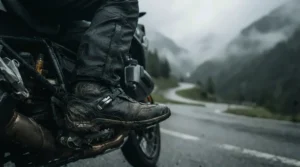
If you’re a daily commuter riding 15 miles each way through unpredictable weather with zero patience for babying your gear, the TCX Drifter Waterproof or Alpinestars Ridge V2 WP fits your actual life — both balance real waterproofing with the walkability you need once you’re off the bike and into the office.
If you’re planning a multi-week cross-country tour where you might hit three different climate zones in a single week, durability and proven long-term sealing matter more than anything else, which points toward the Sidi Adventure 2 Gore-Tex. The upfront cost stings less once you consider it’s a boot built to outlast several cheaper pairs.
If you’re a sport-touring rider who wants genuine wet-weather protection without the bulk of an ADV boot — someone who rides twisty mountain roads on weekends and occasionally gets caught in a pop-up storm — the Alpinestars RT-7 Drystar or TCX Clima 2 Surround GTX matches that lighter, road-focused riding style far better than a heavier adventure boot would.
Buyer’s Decision Framework for Rain-Proof Touring Boots
If your budget is under $250 and you need genuine waterproofing without frills, choose a Drystar-membrane boot like the Alpinestars Ridge V2 WP or the Firstgear Kilimanjaro, because both deliver real sealed protection without charging for brand premiums you won’t notice on the road.
If you ride 5,000+ miles annually across varied weather, choose a Gore-Tex-based boot like the Sidi Adventure 2 Gore-Tex or TCX Clima 2 Surround GTX, because the membrane technology and reinforced construction are built to survive that mileage without the seams failing early.
If speed and convenience at fuel stops matter to you — especially in cold rain when your fingers don’t work well — choose the Fox Racing Defend ADV for its BOA dial closure, because fumbling with wet buckle straps in the cold is exactly the friction point that system eliminates.
If you’re brand new to touring and unsure how much you’ll actually ride in the rain, start with a budget-tier option before investing in a premium boot, since your riding habits after year one will tell you far more about what you need than any spec sheet can.
How to Choose Waterproof Touring Boots for Rain Riding
Picking the right pair comes down to a handful of decisions that matter far more than brand name. Here’s the order to think through them:
- Confirm the membrane is genuinely sealed, not just treated. Gore-Tex and Drystar are laminated and sealed at every seam — a “water-resistant coating” on leather is a different, weaker category entirely.
- Match the boot height to your riding style. Taller boots protect more shin but reduce walkability; shorter touring cuts trade some coverage for daily comfort.
- Check for CE EN 13634:2017 certification. This confirms independent testing for abrasion, impact, and structural integrity — not just a manufacturer’s marketing claim.
- Evaluate the closure system for wet-weather use. BOA dials and buckles with large grab tabs work better with wet or gloved hands than small zippers alone.
- Look at outsole compound, not just tread pattern. A soft, tacky rubber compound holds grip on wet pavement better than a hard compound with deep lugs meant for dirt.
- Factor in your actual annual mileage. Higher mileage justifies a higher price point, since cost-per-mile often favors the more durable, more expensive boot over time.
- Try them on with the socks you’ll actually wear. Sizing charts are a starting point, not gospel — a half-size mismatch undermines even the best waterproofing by trapping moisture from sweat instead of rain.
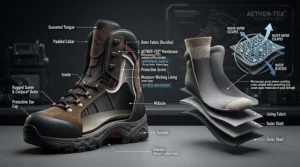
Waterproof Membrane Boot Comparison: Gore-Tex Liners vs Drystar vs Drytex
The membrane technology inside your boot is the single biggest factor in how it performs during a real storm, and the three most common options — Gore-Tex, Drystar, and Drytex — aren’t interchangeable despite marketing that sometimes implies otherwise.
| Membrane | Used By | Strength | Consideration |
|---|---|---|---|
| Gore-Tex | Sidi, TCX (select models), Fox Racing | Independently certified, widely trusted breathability | Often the priciest membrane license |
| Drystar | Alpinestars | Proprietary but well-proven across the brand’s lineup | Slightly less brand recognition than Gore-Tex |
| Drytex | Forma and select others | Comparable wet-weather performance | Fewer long-term independent reviews available |
Gore-Tex carries the strongest brand trust because it’s licensed and independently tested by a third party rather than developed purely in-house, which is exactly why boots like the Sidi Adventure 2 Gore-Tex and TCX Clima 2 Surround GTX lean on the name in their marketing. Drystar, used in the Alpinestars RT-7 Drystar and Alpinestars Ridge V2 WP, has built its own solid reputation through sheer volume of real-world miles across Alpinestars’ catalog, even without the same third-party licensing structure. The practical takeaway: don’t dismiss a Drystar or Drytex boot just because it lacks the Gore-Tex name — check the specific model’s sealed-seam construction and CE certification instead of assuming brand name alone guarantees performance.
Common Mistakes When Buying Rain-Proof Motorcycle Touring Boots
The most common mistake is confusing “water-resistant” with “waterproof” — these are legally and technically different claims, and a boot advertised as merely resistant will absolutely soak through in sustained rain, usually right at the seam between the sole and upper.
Another frequent error is prioritizing looks over the sealed-seam construction that actually keeps water out. A boot can look rugged and ADV-styled while using a cheap water-resistant coating instead of a real laminated membrane — check the spec sheet for the specific membrane name, not just marketing language like “weatherproof” or “all-weather ready,” which carry no standardized meaning.
Riders also frequently skip trying boots on with their actual riding socks, then discover the fit is off once they add a thicker wool sock for cold rain rides. And plenty of buyers ignore CE certification entirely, assuming any boot sold for motorcycling meets some baseline safety standard — it doesn’t. SATRA’s testing documentation makes clear that waterproofing and even impact protection levels vary significantly between certified boots, so checking the actual certification level matters more than trusting the word “motorcycle boot” on the label.
Sealed Seams and Wet-Weather Grip Soles: Features That Actually Matter
Sealed seams are the unglamorous detail that determines whether your expensive Gore-Tex membrane actually works. A membrane can be flawless, but if the stitching where the upper meets the sole isn’t taped or sealed, water finds that gap within minutes of standing in a puddle. When you’re evaluating a boot, look specifically for language about seam-sealing or gusseted construction, not just the membrane brand name.
Wet-weather grip soles matter just as much, and this is where marketing hype and real performance diverge the most. Aggressive off-road lugs look tough, but a harder rubber compound built for dirt traction can actually be more slippery on wet painted road markings and metal manhole covers than a softer, purpose-built wet-grip compound like the Ultratac outsole on the Fox Racing Defend ADV. The lesson here: don’t just look at tread depth in product photos — look for outsole compound descriptions, since compound softness affects wet-pavement grip more than lug pattern does.
Features that genuinely don’t matter as much as marketing suggests: flashy color schemes, unnecessary extra buckles beyond what’s needed for a secure fit, and reflective piping that looks good in photos but adds negligible real-world visibility compared to proper riding gear lighting.
Long-Term Cost & Maintenance of Waterproof Touring Boots
A $180 boot that needs replacing every 18 months costs more over five years than a $450 boot that lasts a decade, and that math changes the “budget vs premium” conversation entirely for high-mileage riders. Based on aggregated owner reports across gear-review platforms, premium Gore-Tex boots like the Sidi Adventure 2 Gore-Tex commonly log 5+ years of regular use before needing sole replacement or retirement, while budget boots typically show membrane or seam degradation within 2-3 years of consistent riding.
| Price Tier | Typical Lifespan | Cost-Per-Year Estimate |
|---|---|---|
| Budget ($150-$220) | 2-3 years | Higher long-term cost for frequent riders |
| Mid-range ($250-$400) | 3-5 years | Balanced value for most touring riders |
| Premium ($450-$500+) | 5+ years | Lowest cost-per-year for high-mileage riders |
The analysis here isn’t a blanket “always buy premium” recommendation — a rider putting 1,500 casual miles a year on a boot will likely get a full useful lifespan out of a budget option like the Firstgear Kilimanjaro before it ever needs replacing anyway. The premium math only pays off once you’re consistently riding enough miles annually that a shorter-lived boot would need replacing on a faster cycle than the premium option.
Waterproof Touring Boots vs Regular Leather Boots
| Factor | Waterproof Touring Boots | Regular Leather Boots |
|---|---|---|
| Rain Performance | Sealed membrane blocks water entirely | Leather absorbs water and stays wet for hours |
| Breathability | Membrane allows sweat vapor out while blocking rain | Good ventilation but zero rain protection |
| Weight | Slightly heavier due to membrane layer | Often lighter without added waterproof lining |
| Best For | Riders facing unpredictable or frequent rain | Fair-weather riders in consistently dry climates |
The core tradeoff here is straightforward once you interpret the data: a genuine waterproof membrane adds a small weight and cost premium in exchange for eliminating an entire category of ride-ruining discomfort. Regular leather boots without a membrane can still offer excellent protection and breathability, but they’re a bet that you’ll never get caught in serious rain — a bet that doesn’t pay off for most riders who tour regularly across multiple seasons. For safety-focused wet-weather riding guidance, waterproof footwear is consistently listed alongside high-visibility gear as a baseline recommendation, not an optional upgrade.
Frequently Asked Questions
❓ Are Gore-Tex motorcycle boots actually waterproof?
❓ How long do waterproof touring boots last?
❓ Can I re-waterproof motorcycle boots myself?
❓ What's the difference between waterproof and water-resistant motorcycle boots?
❓ Do waterproof touring boots work for everyday commuting too?
Conclusion
Rain doesn’t wait for a convenient moment, and neither should your gear planning. The right pair of waterproof touring boots for rain riding turns a dreaded downpour into a non-event — your feet stay dry, your grip stays solid, and you keep riding instead of white-knuckling it to the nearest overpass. Whether you land on the long-term durability of the Sidi Adventure 2 Gore-Tex, the closure convenience of the Fox Racing Defend ADV, or the budget-friendly reliability of the Firstgear Kilimanjaro, the core principle stays the same: check for a genuinely sealed membrane, confirm real CE certification, and match the boot’s height and armor to how you actually ride, not how you imagine you might ride someday.
No boot on this list is a bad choice within its intended use case — the difference is which tradeoffs fit your riding life. Match your annual mileage, climate, and riding style to the picks above, and you’ll spend a lot less time thinking about your feet on your next rainy ride, which is really the whole point.
Recommended for You
- Racing Boots for Short Riders: 7 Low-Profile Picks (2026)
- 7 Best Sport Riding Boots for Hot Weather Track Days (2026)
- Track Boots for Beginner Riders: 7 Best Picks for 2026
Disclaimer: This article contains affiliate links. As an Amazon Associate, I earn from qualifying purchases. If you purchase products through these links, we may earn a small commission at no additional cost to you.
✨ Found this helpful? Share it with your friends! 💬🤗
