
In This Article
Shopping for off-road motorcycle boots for trail riding sounds easy until you meet the wall of near-identical pairs, each shouting “maximum protection.” Here’s the catch. A boot built for a motocross track can feel like a ski boot on a rocky creek crossing. A soft adventure boot that’s lovely at the gas station may fold when a heavy bike lands on your foot. The best off-road motorcycle boots for trail riding live in a narrow sweet spot: an armored shin, a controlled ankle, a lugged sole, and buckles that shrug off mud.
The stakes are real. Research summarized on Wikipedia’s motorcycle boot entry notes that lower-limb injuries are among the most common injuries riders suffer in crashes, and that fractures of the tibia are a frequent result. Your legs sit closest to the rocks, the roots, and the bike itself.
So this guide does the heavy lifting. It compares seven real boots, from a wallet-friendly Alpinestars entry point to a flagship enduro design. The analysis draws on published spec sheets and independent editorial testing, including GearJunkie’s 2026 boot guide and MotoDomains’ enduro roundup. Nobody here claims to have worn every pair. The specs and tester reports are translated into plain English, with honest trade-offs. You’ll also get a buying framework, break-in advice, and fixes for the most common boot headaches. Let’s get your feet sorted.
Quick Comparison: Best Off-Road Motorcycle Boots for Trail Riding at a Glance
Short on time? This table sorts the seven picks by tier, closure style, sole design, and ideal rider. Think of it as the cheat sheet. The full breakdowns follow right after.
| Boot | Tier | Closure | Sole | Best For |
|---|---|---|---|---|
| Alpinestars Tech 3 Enduro | Budget | 3 polymer buckles | Replaceable lugged enduro sole | New riders on a budget |
| TCX Drifter WP | Mid-range | 3 aluminum lever buckles | Deep-lug, rebuildable sole | Trail-plus-pavement crossovers |
| Alpinestars Corozal V2 Adventure Drystar | Mid-range | 2 ratchet buckles + hook-and-loop flap | Vulcanized all-terrain rubber | Dual-sport rides with dirt detours |
| Alpinestars Tech 7 Enduro | Upper-mid | Aluminum memory buckles | Dual-compound enduro sole | All-round enduro and trail days |
| Leatt 5.5 FlexLock Enduro | Premium | Forged aluminum buckles + SlideLock cuff | Enduro tread, replaceable insert | Aggressive riders, ankle-injury history |
| Fox Racing Motion X Off Road | Premium | 4 forged metal buckles | Open-tread DURATEC, replaceable | Remote, long-day trail and ADV |
| Alpinestars Tech 10 Enduro | Flagship | 3 aluminum-frame ratchet buckles | Dual-compound enduro sole | Hard enduro, technical singletrack |
Looking at the table, the Alpinestars Tech 3 Enduro is the clear on-ramp for riders who want a lugged, replaceable sole without flagship pricing. The TCX Drifter WP and Alpinestars Corozal V2 Adventure Drystar suit riders who split time between trail and pavement. If your riding is steeper, rockier, and more remote, the Fox Racing Motion X Off Road, Leatt 5.5 FlexLock Enduro, and Alpinestars Tech 10 Enduro buy you hinge control and shin coverage the softer boots can’t match. Buckle material is the quiet divider here: polymer at the budget end, aluminum or forged metal as you climb.
💬 Just one click — help others make better buying decisions too!😊
Top 7 Off-Road Motorcycle Boots for Trail Riding: Expert Analysis
A quick honesty note before the boots. Verified aggregate owner scores weren’t reliably available for every model during research. The “review sentiment” line in each entry therefore reflects what published editorial testers report, not invented customer quotes. Every price below is a range, so check current price on the listing before you commit.
1. Alpinestars Tech 3 Enduro — best budget entry to real protection
Not every trail rider needs a flagship, and the Alpinestars Tech 3 Enduro proves it. It trims the frills but keeps the bones: a lugged, replaceable enduro sole, a contoured TPU shin plate, and a steel shank and toe guard.
The steel shank keeps your arch from folding when a bike lands on your foot or you stand hard on the pegs. The lugged tread bites when you’re wrestling the bike up a muddy rut. Three polymer buckles with memory ratchets replace the aluminum units on pricier Alpinestars boots. That’s a durability trade-off on paper, but every buckle is replaceable, so a smashed one is a parts-bin fix rather than a boot-ending disaster. A patented ankle brace system with padding adds lateral support. An older listing cites certification to EN 13634:2010, so confirm the current model’s rating before ordering.
This is the boot for newer riders, weekend-loop riders, and anyone still deciding how deep to go. MotoDomains named it its best budget off-road pick and noted that sizing tends to run true. Aggregated owner scores weren’t verifiable here, so treat that as editorial sentiment, not a star rating.
Pros:
- ✅ Replaceable soles and buckles extend boot life
- ✅ Steel shank and toe guard at entry-level cost
- ✅ Lug-style enduro tread for muddy bike pushes
Cons:
- ❌ Polymer buckles are less rugged than aluminum
- ❌ Fewer buckles than premium siblings
Price check: historically an entry-level tier, roughly the $200-$300 range, so check current price. For first-time buyers, the value verdict is hard to beat.
2. TCX Drifter WP — the walk-friendly CE Level 2 crossover
Some trail days end with a coffee stop, a gas station, and a half-mile bike push. That’s where the TCX Drifter WP earns its keep. A full-grain leather upper, T-Dry waterproof membrane, and polyurethane armor carry a CE Level 2 certification, and the listed weight of about 2.44 pounds is light for the category.
In practice, dedicated armor covers the shin, ankle, and Achilles, while an accordion gusset and tapered collar seal out rain and grit. Three micro-adjustable aluminum lever buckles use a stronger cam, so they hold their tension when you’re hammering through rocks. The stitched-down sole is rebuildable, which means the boot can be refreshed instead of retired.
Here’s what the spec sheet won’t tell you: forward ankle flex is the whole point. GearJunkie’s testers scored the TCX Drifter WP 9.1 out of 10, the highest in their guide, praising walkability and weather resilience. The trade-off is slightly less lateral ankle rigidity than the burlier Alpinestars Corozal V2 Adventure Drystar. Choose it for double-track and mixed-terrain days rather than hard enduro.
Pros:
- ✅ Waterproof membrane with CE Level 2 rating
- ✅ Forward ankle flex makes walking natural
- ✅ Rebuildable sole and sturdy aluminum buckles
Cons:
- ❌ Less lateral ankle rigidity than burlier boots
- ❌ Bulkier than a typical street riding boot
Price check: around $400 (the $350-$450 range). The value verdict is strong for riders who live in their boots all day.
3. Alpinestars Corozal V2 Adventure Drystar — most armor in the adventure class
If your trail riding includes highway transfers, the Alpinestars Corozal V2 Adventure Drystar deserves a look. GearJunkie rated it 8.4 out of 10 and named it its best adventure boot. The specs explain why: CE Level 2, TPU armor, a steel shank in the midsole, and a Drystar waterproof-breathable membrane.
The V2’s updated Lateral Pivot System allows front-to-back ankle motion while resisting sideways twist, which is exactly the motion that rolls ankles on off-camber trail. The low-profile polymer shin plate slides under adventure pants more easily than the bulky guards on motocross boots. That same slim profile is also why this isn’t a hard-enduro boot. Two self-aligning ratchet buckles with memory settings and a wide hook-and-loop flap make on-and-off quick. The built-in gaiter seals out water and debris but needs generous pant cuffs.
Testers also noted dependable sole grip while pushing a dead bike through woods. The cost is bulk. At a listed 2.84 pounds, it feels more cumbersome on foot than the TCX Drifter WP.
Pros:
- ✅ Overbuilt ankle with reinforced lower buckle
- ✅ Steel shank gives stable peg standing
- ✅ Slim shin plate fits under adventure pants
Cons:
- ❌ Bulkier than softer dual-sport boots
- ❌ Gaiter needs wide pant-leg openings
Price check: mid-$300s (roughly $325-$400). The value verdict is excellent if pavement is half your mileage.
4. Alpinestars Tech 7 Enduro — the enduro-tuned middle ground
The Alpinestars Tech 7 Enduro swaps the slick motocross sole for a dual-compound enduro tread. It’s softer at the instep for peg grip and firmer underfoot for walking. A retailer listing for the 2026 version still leads with that enduro outsole for rocks, roots, and uneven ground.
The details matter. A one-piece foot shell with a co-injected hard toe protector and integrated steel shank replaces the old stitched sole, giving a lower, sleeker profile. A biomechanical pivot hinge allows ankle flex for shifting and walking, and a TPU blade at the rear guards against hyperflexion. The one-piece TPU shin-and-medial panel includes a honeycomb rubber insert that grips the bike and shields your leg from engine heat. Aluminum buckles with memory settings are replaceable, and the wide entry opening accommodates knee protection.
MotoDomains named it a top pick for everything from casual trail days to enduro racing. WebBikeWorld filed it under its high-end tier for being thoroughly engineered. The recurring downside is thick upper armor that can bind under some pants, so test-fit with your riding gear.
Pros:
- ✅ Hinged pivot gives natural ankle mobility
- ✅ Replaceable sole, instep, and aluminum buckles
- ✅ Wide opening accommodates knee braces
Cons:
- ❌ Thick upper armor can bind under pants
- ❌ Costs noticeably more than entry-level boots
Price check: an upper-mid tier, but no exact figure was verified at the time of research, so check current price. The value verdict is high for riders who want enduro features short of flagship money.
5. Leatt 5.5 FlexLock Enduro — most tunable ankle control
Less famous than the Alpinestars crowd, the Leatt 5.5 FlexLock Enduro is arguably the most adjustable boot here. The FlexLock system lets you swap inserts to change sideways flex, while the LockOut feature allows ankle motion but stops hyperextension in both directions. Leatt claims up to 37% less force reaching the ankle and 35% less reaching the knee. MotoDomains’ reviewer said he wasn’t sure how that was measured, so read it as a manufacturer claim, not a lab-verified fact.
The practical parts are easier to trust. Forged aluminum buckles sit on stainless bases, the lower buckle wears a protective ramp, and a one-way SlideLock cuff tightens as the top buckle closes. The sole, buckles, inner heat shield, and upper section are replaceable on the 5.5. A steel-shanked sole extends the hard zone, so you can ride on your arches or the balls of your feet. The chunky enduro tread helps when you’re manhandling the bike over slick rock, and a listing references prEN 13634:2017 testing.
Aggressive trail riders and anyone babying an old ankle injury are the target. The reported drawback is stiffness, since some casual trail riders may find it more rigid than they’d like.
Pros:
- ✅ Adjustable flex inserts and two-way lockout
- ✅ Forged aluminum buckles and many replaceable parts
- ✅ Room to fit knee braces inside
Cons:
- ❌ Can feel stiff for casual trail riders
- ❌ Force-reduction figures remain unverified claims
Price check: a premium tier with no verified figure at the time of research, so check current price. The value verdict leans positive, since replaceable parts spread the cost across seasons.
6. Fox Racing Motion X Off Road — pro-level protection that still walks
GearJunkie’s testers named the Fox Racing Motion X Off Road their best off-road enduro boot (8.4 out of 10) after thousands of kilometers on a loaded adventure bike. The headline feature is a hinge lockout borrowed from Fox’s motocross flagships. It halts ankle motion before hyperextension while leaving room to shift.
Translated into plain English: CE Level 2 certification, TPU plating over the shin, toe, heel, and calf for all-around coverage, and a composite nylon-fiberglass cuff, hinge, and insole. Four forged metal buckles hold under strain. The open-lug DURATEC outsole grips off the bike and wraps up the medial side as a heat- and wear-resistant panel. Replaceable soles and half sizes round out the package.
The scorecard shows the trade-off honestly: protection 9.5 out of 10, walkability 6.5 out of 10. Testers also flagged that the waterproof membrane and dark colorway run warm in desert heat. If you ride a day’s travel from help, that warmth is the price of security. If you ride short summer loops close to home, it may simply annoy you.
Pros:
- ✅ Hinge lockout plus full TPU plating
- ✅ Replaceable outsole and forged metal buckles
- ✅ Waterproof membrane with CE Level 2 rating
Cons:
- ❌ Runs warm in hot weather
- ❌ Stiffer walking than adventure-style boots
Price check: around $500 (the $450-$550 range). The value verdict is strong for remote riders who can’t compromise.
7. Alpinestars Tech 10 Enduro — flagship armor with an inner ankle bootie
The Alpinestars Tech 10 Enduro adapts the armor used by top racers to technical trail terrain. A multi-density TPU shell wraps a lightweight microfiber upper. A dual-compound lugged enduro outsole, a metal shank, and a slim forefoot round it out, and the shin plate is ventilated. It’s CE certified to EN 13634:2017.
The star is the inner bootie, which works like a built-in ankle brace with a Dynamic Heel Compression Protector. A Frontal Flexion Control Frame and front and rear blade connectors stop over-compression and hyperextension. Three aluminum-frame ratchet buckles and a microfiber gaiter keep it all closed and sealed. GearJunkie scored it 8 out of 10, with protection at 9.5 and walkability at 7. Testers praised its composure through desert whoops and its shifter feel.
The costs are physical. The boot has a larger footprint than the Fox Racing Motion X Off Road, can pack out sooner than expected, and may pinch where the internal brace sits. Fit carefully. The listed weight is 4.2 pounds.
Pros:
- ✅ Inner bootie adds true ankle-brace protection
- ✅ Slim forefoot keeps shifter and brake feel
- ✅ Dual-compound enduro sole for off-bike traction
Cons:
- ❌ Larger footprint and heavier than rivals
- ❌ Packs out fast; internal brace may pinch
Price check: mid-$700s (the $700-$800 range). The value verdict is premium, best for riders who truly use every millimeter of protection.
Side-by-Side Spec Table
| Boot | Price Range | Certification | Ankle Control | GearJunkie Score | Best For |
|---|---|---|---|---|---|
| Alpinestars Tech 3 Enduro | Roughly $200-$300 (verify) | CE (older listing cites EN 13634:2010) | Patented ankle brace | Not scored | Budget starters |
| TCX Drifter WP | Around $400 | CE Level 2 | Flexible, less lateral rigidity | 9.1/10 | Trail-plus-commute |
| Alpinestars Corozal V2 Adventure Drystar | Mid-$300s | CE Level 2 | Lateral Pivot System | 8.4/10 | ADV with dirt detours |
| Alpinestars Tech 7 Enduro | Check current price | CE certified | Pivot hinge + TPU blade | Not scored | Enduro all-rounders |
| Leatt 5.5 FlexLock Enduro | Check current price | prEN 13634:2017 | FlexLock + LockOut | Not scored | Ankle-injury riders |
| Fox Racing Motion X Off Road | Around $500 | CE Level 2 | Hinge lockout | 8.4/10 | Remote backcountry |
| Alpinestars Tech 10 Enduro | Mid-$700s | EN 13634:2017 | Inner bootie + frontal flexion frame | 8.0/10 | Hard enduro |
The table makes the pattern obvious: you pay for ankle control. The Alpinestars Tech 3 Enduro and TCX Drifter WP rely on simpler flex designs, while the Alpinestars Tech 10 Enduro and Leatt 5.5 FlexLock Enduro add engineered motion limits. The Fox Racing Motion X Off Road sits in the middle, delivering hinge-style control at roughly two-thirds of the flagship price range. GearJunkie scores are only a partial yardstick, since several boots here weren’t scored in its 2026 guide.
Your First 30 Days in New Trail Boots: Break-In, Setup, and Maintenance
A new boot is a negotiation, not an instant friendship. These steps shorten the talks.
Week one: fit and set. Try boots on in the afternoon, when feet are slightly swollen, with the socks and knee protection you actually ride in. Set each buckle once and let the memory ratchet remember it. Wear the boots around the house for a few evenings, and practice shifting in the garage before the first dirt ride.
Week two: shake-down rides. Keep the first outings short and local. Watch for hot spots, heel lift, and any pinching around the ankle. A boot that slides at the heel will not protect you the way a snug one does.
Weeks three and four: maintenance habits.
- Rinse mud off buckles before it dries, then open and close each one.
- Dry boots at room temperature, never on a heater.
- Check the sole lugs and the left-toe shifter zone for wear.
- Inspect buckle hardware and gaiter stitching monthly.
- If hinges squeak, a small amount of silicone spray is the fix reviewers commonly cite.
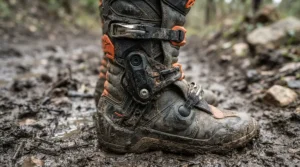
The most common first-month mistake is cranking the top buckle too tight and then blaming the boot for numb toes. Snug, not strangling, is the goal.
Real-World Scenarios: Which Boots Fit Which Trail Rider?
Specs only matter when matched to a life. Here are four hypothetical riders, with budget, terrain, and frequency spelled out.
The weekend-loop beginner. Budget is tight, around $250. Rides twice a month on dry local dirt, 25-mile loops. The Alpinestars Tech 3 Enduro gives a lugged replaceable sole, a steel shank, and CE-style protection without overspending. Upgrade later and keep the buckles as spares.
The trailhead commuter. Rides 12 miles of pavement to a gravel network three days a week in a wet climate. Walkability and waterproofing matter more than maximum armor. The TCX Drifter WP wins on comfort, while the Alpinestars Corozal V2 Adventure Drystar wins if you want a sturdier ankle.
The backcountry explorer. Budget around $500. Rides multi-day routes where help is hours away, often with a loaded bike. The Fox Racing Motion X Off Road delivers hinge protection plus a waterproof liner and walkable comfort.
The hard-enduro rider with a past injury. Rides technical singletrack weekly and has a history of ankle trouble. The Alpinestars Tech 10 Enduro brings an inner bootie, and the Leatt 5.5 FlexLock Enduro offers adjustable flex limits. Both are worth trying on with your own braces.
✨ Don’t Miss These Trail-Ready Picks!
🔍 Take your trail riding to the next level with these carefully selected boots. Click on any highlighted item to check current pricing and availability. The right pair will help you ride farther, push heavier bikes, and walk away from the rough stuff with confidence!
Problem and Solution: Fixing the Five Most Common Trail-Boot Headaches
Problem 1: Hot, sweaty feet. Waterproof membranes run warm, as reviewers noted for the Fox Racing Motion X Off Road. Solution: use moisture-wicking socks, and consider a non-waterproof boot like the Alpinestars Tech 10 Enduro for desert or summer riding.
Problem 2: Boots won’t fit under riding pants. Thick shin armor on the Alpinestars Tech 7 Enduro can bind. Solution: try boots with your actual pants, or choose the slimmer shin plate of the Alpinestars Corozal V2 Adventure Drystar.
Problem 3: Mud-caked buckles. Solution: rinse after rides, open and close buckles regularly, and replace damaged units. Replaceable buckles on the Leatt 5.5 FlexLock Enduro and Alpinestars Tech 3 Enduro make this cheap.
Problem 4: Squeaky hinges. Solution: a light silicone spray at the pivot points, per manufacturer guidance.
Problem 5: Worn left toe from shifting. Solution: look for reinforced shift pads, like those on the TCX Drifter WP, and inspect the area monthly.
What Are Off-Road Motorcycle Boots for Trail Riding?
Off-road motorcycle boots for trail riding are tall, armored riding boots built to protect the foot, ankle, shin, and calf on dirt while still allowing enough flex to shift, brake, and walk. They combine rigid shins and hinged ankles with lugged soles, metal or composite shanks, and secure buckle closures designed for mud, rocks, and rough terrain.
How do they differ from motocross boots? The big giveaway is the sole. Motocross riders want a smooth sole that skims the ground in berms, while trail and enduro riders want deeper lugs for walking and pushing. Trail boots also typically offer a bit more ankle flexibility, since you spend more time on foot.
Does footwear really matter? A Transport Accident Commission study of riders in Victoria, Australia, found that 47% of riders in inappropriate footwear suffered open wounds in crashes, versus 25% in boots. Lower-limb injuries affected 47% of those in riding boots, 55% in other boots, and 63% in other shoes. That survey isn’t trail-specific, but the direction is clear: purpose-built boots outperform improvised footwear.
How to Choose Off-Road Motorcycle Boots for Trail Riding
Use these six steps to narrow the field quickly.
- Define your terrain. Technical singletrack calls for tall shins and hinge control, while gravel and pavement mixes suit adventure-style boots.
- Check the certification. Look for CE marking to EN 13634, and know whether it’s Level 1 or Level 2. Level 2 is the stricter one.
- Inspect ankle control. Hinges, blades, or booties should limit hyperextension and sideways roll without making walking miserable.
- Examine the shin and calf. Full TPU coverage protects better, but it must fit under your pants and around any knee braces.
- Choose the sole. Lugged and replaceable beats smooth for trail use, and a shank is non-negotiable.
- Verify fit and closures. The boot should be snug with no heel lift, and buckles should be metal if you ride hard, replaceable at minimum.
Follow those six steps and most of the market eliminates itself.
Trail Riding Boot Protection: What the Armor Actually Does
Trail riding boot protection works in layers. The toe cap resists crushing. The heel counter and shank keep the foot from folding. The ankle system limits twisting. The shin plate absorbs impacts from branches, rocks, and footpegs, and the medial panel guards against engine heat.
The standard behind it all is EN 13634, which covers protective footwear for motorcycle riders on or off road, including protection, ergonomics, and mechanical properties. Level 1 is the baseline, and Level 2 demands higher performance. GearJunkie notes that Level 2 requires the sole, front, and back to survive 2.5 seconds against an abrasion belt, versus 1.5 seconds for Level 1.
Here’s the insight many buyers miss: the standard doesn’t test crush resistance at the ankle bone or the toe box. Those are two of the most vulnerable spots on your foot. A certification sticker is a floor, not a ceiling, so judge the armor you can actually see and feel.
Shin Protection Plates: How Much Is Enough?
Shin protection plates are the most visible difference between trail boots and everyday footwear. GearJunkie’s testers say shin protection is a must-have for technical off-road riding, even if street riders can debate it.
Coverage varies widely. The Fox Racing Motion X Off Road pairs TPU plating over the shin with toe, heel, and calf guards. The Alpinestars Tech 10 Enduro uses a ventilated shin plate. The Alpinestars Corozal V2 Adventure Drystar keeps the shin plate low-profile for pants compatibility. In GearJunkie’s testing, the mid-cut Fox Defend ADV left the upper shin exposed, so it suits touring better than hard enduro.
Knee braces complicate things. Some boots adjust: the Leatt 5.5 FlexLock Enduro and Alpinestars Tech 7 Enduro are described as accommodating knee protection, so check the shin plate’s fit before you buy. The rule of thumb is simple: the rockier and steeper your riding, the more shin you want.
Rock Guard Soles: Where Trail Traction Starts
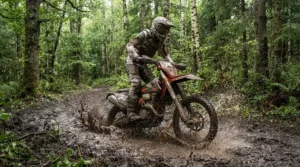
Rock guard soles combine a stiff shank, a reinforced toe, and aggressive lugs, and they are arguably the part of the boot you use most. The shank stops your foot from bending around a peg or a rock. The lugs grip when you’re off the bike.
Look at how the seven boots handle it. The Alpinestars Tech 3 Enduro pairs a steel shank and toe guard with a replaceable lugged sole. The Alpinestars Tech 7 Enduro and Alpinestars Tech 10 Enduro use dual-compound enduro soles, softer at the instep for peg grip. The Fox Racing Motion X Off Road has an open-tread DURATEC outsole that’s replaceable, and the TCX Drifter WP offers deep lugs on a rebuildable sole.
Smooth motocross soles fail on wet roots and slick rock. If you’re torn, MotoDomains notes that the Sidi Crossfire 2 SRS lets you swap soles to suit the day. The practical takeaway: pick a lugged, replaceable sole, and plan on replacing it before it’s bald.
Buckle Closures: Small Parts, Big Consequences
Buckle closures are the cheapest part of a boot to cut corners on, and the one you’ll curse first when they fail. GearJunkie warns that weak buckles are a common flaw, and that a good one must stay closed through loading, lifting, and crashes.
Aluminum and forged metal buckles, like those on the TCX Drifter WP, Fox Racing Motion X Off Road, and Leatt 5.5 FlexLock Enduro, resist impacts better. Polymer buckles, as on the Alpinestars Tech 3 Enduro and the Alpinestars Corozal V2 Adventure Drystar, save weight and cost but can crack in hard rock strikes. Memory ratchets let you set tension once, and replaceable hardware turns a broken buckle into a minor repair.
Alternatives exist. BOA dials, as on the Fox Defend ADV, allow fast micro-adjustments but are more common in adventure boots than hard-enduro models. For trail riding, buckles remain the proven choice.
Off-Road Ankle Brace Boots: Hinges, Blades, and Booties Explained
Off-road ankle brace boots come in several flavors. The Alpinestars Tech 3 Enduro uses a patented ankle brace system with padding. The Alpinestars Tech 7 Enduro adds a biomechanical pivot and rear TPU blade, and the Fox Racing Motion X Off Road uses a hinge lockout. The Alpinestars Tech 10 Enduro goes further with an internal bootie and Dynamic Heel Compression Protector, and the Leatt 5.5 FlexLock Enduro offers swappable flex inserts.
Does it work? A small biomechanics study in the ISBS Proceedings had 15 adults wear athletic shoes, work boots, and motorcycle boots in a drop task. Motorcycle boots reduced peak ankle inversion by 3.6 degrees, though they also raised vertical ground reaction forces. Authors suggested boots can protect against both crash and emergency-stop injuries. It’s a small sample, but the finding is consistent with what ankle-control designs aim to do.
The trade-off is flexibility. More ankle control means less walking comfort, so match the system to your terrain.
Off-Road Boots vs. Adventure Boots vs. Motocross Boots
| Footwear Type | Crash Protection | Walkability | Trail Traction | Best For |
|---|---|---|---|---|
| Off-road boot (Alpinestars Tech 7 Enduro) | High | Moderate | Excellent | Technical trail and enduro |
| Adventure boot (Alpinestars Corozal V2 Adventure Drystar) | Moderate-high | Good | Good | Dual-sport and touring |
| Motocross boot (Sidi Atojo SRS) | Very high | Poor | Low (smooth sole) | Track racing |
| Work boots | Low | Good | Fair | Emergencies only |
| Athletic shoes | Minimal | Excellent | Fair | Not recommended |
An off-road boot gives up some walkability for much better crash protection and traction. Adventure boots like the Alpinestars Corozal V2 Adventure Drystar flip that balance, which is ideal when miles are mostly pavement. A motocross boot like the Sidi Atojo SRS offers unmatched armor but is hard to walk in, so it makes little sense on trail. For true trail riding, the off-road category is the sweet spot.
Long-Term Cost and Maintenance: What Your Boots Really Cost Per Ride
| Tier | Boot | Price Range | Replaceable Parts | Best For |
|---|---|---|---|---|
| Budget | Alpinestars Tech 3 Enduro | Roughly $200-$300 (verify) | Sole, buckles | Beginners |
| Mid | TCX Drifter WP | Around $400 | Rebuildable sole | Hybrid riders |
| Mid | Alpinestars Corozal V2 Adventure Drystar | Mid-$300s | Buckles | ADV riders |
| Upper-mid | Alpinestars Tech 7 Enduro | Check current price | Sole, instep, buckles | Enduro riders |
| Premium | Leatt 5.5 FlexLock Enduro | Check current price | Sole, buckles, heat shield, upper | Aggressive riders |
| Premium | Fox Racing Motion X Off Road | Around $500 | Soles | Remote riders |
| Flagship | Alpinestars Tech 10 Enduro | Mid-$700s | Not verified | Hard enduro |
Run the math on a hypothetical: a $500 boot used for 30 rides a season over five seasons works out to roughly $3 per ride. A $250 boot that lasts two seasons costs about the same per ride but leaves you with less protection. Replaceable soles and buckles, as on the Alpinestars Tech 3 Enduro, Alpinestars Tech 7 Enduro, and Leatt 5.5 FlexLock Enduro, stretch that value further. Spending more up front often costs less over time, as long as you maintain the boots.

Frequently Asked Questions
❓ How much should I spend on off-road motorcycle boots for trail riding?
❓ Can I resole trail riding boots instead of replacing them?
❓ Which boots fit over a knee brace?
❓ Are waterproof boots worth it for trail riding?
❓ Do I need CE Level 2 certified boots?
Conclusion
The right pair of off-road motorcycle boots for trail riding comes down to honest self-assessment. If you’re starting out, the Alpinestars Tech 3 Enduro is a smart, replaceable first step. If your rides blend pavement and dirt, the TCX Drifter WP and Alpinestars Corozal V2 Adventure Drystar balance walkability with serious armor. For aggressive enduro and technical singletrack, the Alpinestars Tech 7 Enduro, Leatt 5.5 FlexLock Enduro, Fox Racing Motion X Off Road, and Alpinestars Tech 10 Enduro deliver stronger ankle control and fuller shin coverage.
Remember the fundamentals. Fit matters more than brand. Replaceable soles and buckles save money. And certifications are a floor, not a guarantee. Study the specs, try boots on with your gear, and buy the pair that you’ll actually wear on every ride.
Recommended for You
- Casual Riding Shoes For Scooter Commuters: 7 Best Picks 2026
- Motorcycle Sneakers That Look Like Normal Shoes: 7 Best (2026)
- 7 Best Commuter Motorcycle Shoes 2026: Affordable & Tested Picks
Disclaimer: This article contains affiliate links. As an Amazon Associate, I earn from qualifying purchases. If you purchase products through these links, we may earn a small commission at no additional cost to you.
✨ Found this helpful? Share it with your friends! 💬🤗
