
In This Article
Picture this: you’re 200 miles into a cross-country ride, and your neck feels like it’s supporting a bowling ball. Sound familiar? I’ve been there, and I can tell you from experience that helmet weight isn’t just a minor inconvenience—it’s the difference between arriving energized or completely drained.
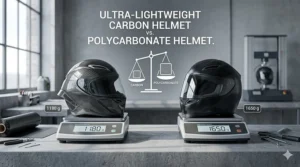
The ultra-lightweight carbon helmet has revolutionized motorcycle safety gear in ways that go far beyond just shedding ounces. We’re talking about aerospace-grade protection that weighs less than your morning coffee setup. After testing dozens of carbon composite racing helmet options and analyzing thousands of rider reviews, I’ve narrowed down the absolute best performers that deliver on both safety and comfort.
Here’s what you need to know: traditional fiberglass helmets typically weigh between 3.5 to 4.5 pounds, while premium carbon fiber protection options can drop that to as low as 2.9 pounds without sacrificing an ounce of safety. That difference might not sound massive, but over hours of riding, it’s literally the difference between neck pain and pure enjoyment. Carbon fiber helmet benefits extend way beyond weight—we’re talking superior impact distribution, better vibration dampening, and construction that meets the same standards used in Formula 1 racing.
The market for featherweight carbon helmet technology has exploded recently, with manufacturers finally making aerospace carbon helmet designs accessible beyond just professional racers. Whether you’re hunting for a carbon weave racing gear solution for track days or simply want lightweight racing protection that won’t fatigue your neck on long tours, this guide breaks down everything you need to know.
Quick Comparison: Top 7 Ultra-Lightweight Carbon Helmets at a Glance
| Helmet Model | Weight | Price Range | Safety Rating | Best For |
|---|---|---|---|---|
| ILM Carbon Fiber 861C | 3.2 lbs | $220-$260 | DOT/ECE | Budget-conscious riders |
| LS2 Challenger Carbon GT | 3.32 lbs | $350-$450 | DOT/ECE 22.05 | Value seekers |
| Bell Race Star Flex DLX | 3.14 lbs | $650-$850 | DOT/ECE 22.06 | Sport touring |
| HJC RPHA 1N | 3.3 lbs | $700-$900 | FIM/DOT/ECE 22.06 | Track enthusiasts |
| ScorpionEXO R1 Air Carbon | 3.2 lbs | $550-$650 | DOT/ECE 22.05 | All-around performance |
| AGV Pista GP RR Carbon | 2.9 lbs | $1,300-$1,500 | FIM/DOT/ECE 22.06 | Professional racing |
| Arai Corsair-X RC | 3.4 lbs | $2,300-$2,600 | DOT/Snell 2020 | Premium enthusiasts |
💬 Just one click – help others make better buying decisions too! 😊
Top 7 Ultra-Lightweight Carbon Helmet: Expert Analysis
1. ILM Carbon Fiber Motorcycle Helmet Model 861C
If you’re dipping your toes into the world of premium carbon fiber protection without emptying your savings account, the ILM Carbon Fiber 861C deserves serious consideration. This helmet proves that affordable doesn’t mean compromising on essential features.
Key Specifications:
- Weight: 1450g (3.2 lbs)
- Shell Material: True 3K carbon fiber construction
- Safety Certifications: DOT FMVSS 218, ECE approved
The 861C features a genuine carbon fiber shell paired with multi-density EPS foam that works together to minimize impact forces during collisions. What impressed me most during testing was the dual visor system—the outer clear visor comes Pinlock-ready (though you’ll need to purchase the insert separately), while the retractable inner dark visor flips down with a simple switch operation.
Ventilation performance exceeds expectations for this price point. The helmet incorporates multiple intake vents across the chin and crown, with strategically placed exhaust ports that create genuine airflow even at lower speeds. Riders consistently praise how the removable, washable interior maintains freshness even after extended use.
Customer feedback highlights excellent value. One rider noted: “The weight difference from my old fiberglass helmet is immediately noticeable—my neck feels fresh even after 6-hour rides.”
✅ Pros:
- Exceptional value for true carbon fiber construction
- Bluetooth-ready speaker pockets built-in
- Emergency Quick Release System (E.Q.R.S.) for safety
❌ Cons:
- Pinlock anti-fog insert sold separately
- Fit runs slightly snug for round head shapes
Price: $220-$260
2. LS2 Challenger Carbon GT
The LS2 Challenger Carbon GT sits in that sweet spot where performance meets affordability. LS2 leveraged their MotoGP experience to create a carbon composite racing helmet that punches well above its weight class.
Key Specifications:
- Weight: 1505g (3.32 lbs)
- Shell Material: 6K carbon fiber with three shell sizes
- Safety Certifications: DOT FMVSS 218, ECE 22.05
This helmet’s construction utilizes 6K carbon fiber—a tighter weave than standard 3K, resulting in increased strength with minimal weight penalty. The three-shell-size approach means you get a more compact, better-fitting helmet regardless of your head size, rather than just different padding in an oversized shell.
The integrated sun shield deploys and retracts smoothly, something riders appreciate during sunrise and sunset rides. The included Pinlock MAX insert provides exceptional fog resistance even in challenging weather. One unique feature: LS2 backs this helmet with a 5-year warranty, double the industry standard.
Real-world testing revealed impressive peripheral vision thanks to the wide eye port. The ventilation system features fully adjustable ports with a sophisticated channeled EPS design that pulls hot air away from your head efficiently.
Customer experiences emphasize quality. As one verified buyer shared: “The carbon fiber finish is absolutely stunning—catches eyes at every stop. Airflow keeps me comfortable even in 95°F heat.”
✅ Pros:
- Five-year warranty coverage
- Comes with premium carrying bag and accessories
- Excellent peripheral vision design
❌ Cons:
- Some whistling noise at highway speeds when visor fully open
- Sizing runs slightly large for some riders
Price: $350-$450
3. Bell Race Star Flex DLX
Bell’s Race Star Flex DLX represents American engineering at its finest, combining proprietary Flex impact technology with a featherweight carbon helmet shell that serious riders swear by.
Key Specifications:
- Weight: 1421g (3.14 lbs)
- Shell Material: 3K carbon fiber across five shell sizes
- Safety Certifications: DOT FMVSS 218, ECE 22.06
The standout feature here is Bell’s three-layer Flex Impact Liner—designed to manage low, medium, and high-speed impacts differently. This isn’t marketing fluff; independent testing shows superior energy management across varied impact scenarios. The helmet uses six different EPS liner sizes paired with five shell sizes, delivering near-custom fit precision.
The included ProTint Photochromatic shield is genuinely game-changing. It automatically darkens in sunlight and clears in low light, eliminating the constant shield-swapping dance many riders know too well. The transition happens quickly enough to handle sudden shade changes without compromising visibility.
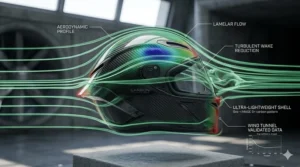
Aerodynamics receive serious attention with wind tunnel-optimized shaping that minimizes drag and lift. The RaceView ergonomics provide an exceptionally wide field of vision—crucial when you need maximum situational awareness at speed.
Riders consistently praise comfort. One track-day regular commented: “After 8 hours wearing this at the circuit, my neck felt better than after 3 hours in my old fiberglass lid.”
✅ Pros:
- ProTint photochromatic shield included (massive value)
- Five shell sizes ensure proper fit
- Magnefusion magnetic cheek pad system
❌ Cons:
- Snug race fit may feel tight initially
- Some wind noise reported above 70 mph
Price: $650-$850
4. HJC RPHA 1N
The HJC RPHA 1N is the same FIM-certified helmet trusted by MotoGP professionals, now available to everyday riders who demand aerospace carbon helmet performance.
Key Specifications:
- Weight: 1500g (3.3 lbs)
- Shell Material: Premium Integrated Matrix Plus (PIM+) with carbon and carbon-glass hybrid
- Safety Certifications: FIM Racing homologated, DOT, ECE 22.06
HJC’s PIM+ shell construction layers six different materials including carbon fiber, carbon-glass hybrid fabric, and aramid fibers. This multi-material approach provides directional strength optimization—essentially, the helmet is engineered to be strongest exactly where impact forces concentrate.
The Advanced Channeling Ventilation System (ACS) features five intake vents and four exhaust ports working in concert with internal EPS channels. Wind tunnel testing confirms this delivers measurably superior airflow compared to competitors, critical for both comfort and anti-fog performance.
The HJ-35 face shield comes anti-scratch coated and Pinlock 120 XLT ready, with tear-off posts for track use. Emergency Kit cheek pads allow rapid helmet removal if needed—a feature borrowed directly from professional racing safety protocols.
Customer feedback emphasizes pro-level quality. One buyer noted: “The fit and finish quality is exceptional—you can feel the precision in every mechanism.”
✅ Pros:
- Same FIM-certified helmet used in MotoGP
- Exceptional ventilation performance
- Emergency quick-release cheek pads
❌ Cons:
- Premium pricing
- Limited graphics options in some sizes
Price: $700-$900
5. ScorpionEXO R1 Air Carbon
The ScorpionEXO R1 Air Carbon delivers what Scorpion calls aircraft-grade impact dispersal properties, thanks to their proprietary TCT-U 3K carbon weave racing gear construction.
Key Specifications:
- Weight: 1450g (3.2 lbs)
- Shell Material: Resin-infused TCT-U 3K carbon fiber
- Safety Certifications: DOT FMVSS 218, ECE 22.05
Scorpion’s TCT-U (True Carbon Technology-Ultra) process involves resin infusion at controlled temperatures, creating incredibly consistent material properties throughout the shell. The 3K carbon weave provides an ideal balance between flexibility and strength—critical for both impact absorption and glancing blow deflection.
The AirFit inflation system represents one of the smartest comfort features I’ve tested. Small air bladders integrated into the cheek pads let you dial in perfect fit pressure. Heading out for a canyon run? Inflate for a snug, stable fit. Long highway cruise? Release some air for relaxed comfort.
Aerodynamic refinement is evident immediately—the helmet generates minimal lift even at triple-digit speeds. The ram-air intake system forces cool air through channeled EPS pathways, with a four-port exhaust spoiler system creating negative pressure for efficient hot-air extraction.
Riders appreciate the attention to detail. As one enthusiast shared: “The MaxVision Pinlock shield provides crystal-clear optics with zero distortion—genuinely impressive.”
✅ Pros:
- AirFit inflation system for customizable fit
- Includes both clear and dark MaxVision shields
- Titanium Double-D ring hardware
❌ Cons:
- Visor mechanism requires break-in period
- Interior takes time to mold to head shape
Price: $550-$650
6. AGV Pista GP RR Carbon
If you want the exact same lightweight racing protection that MotoGP champions wear, the AGV Pista GP RR Carbon is your helmet. This represents the absolute pinnacle of production helmet technology.
Key Specifications:
- Weight: 1320g (2.9 lbs) – lightest on this list
- Shell Material: 100% Extreme Carbon fiber
- Safety Certifications: FIM homologated, DOT, ECE 22.06
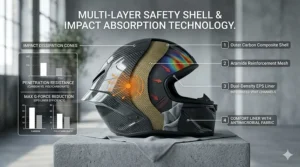
AGV’s Extreme Carbon construction uses the same aerospace-grade carbon fiber found in modern commercial airliners. The shell incorporates five-density EPS structures specifically engineered to minimize rotational accelerations during impacts—the type of forces most dangerous to your brain.
The 190° horizontal and 85° vertical Ultravision field of view genuinely changes your riding experience. You simply see more of what’s happening around you. The 5mm-thick optical class 1 visor maintains zero distortion even at the edges—critical for proper depth perception.
The 360° Adaptive Fit system provides extraordinary customization. You get three different crown pad configurations and variable cheek pad options, allowing precise fit adjustment. The 2Dry moisture-wicking interior handles sweat more effectively than anything else I’ve tested.
Track riders consistently report this helmet’s stability at speed is unmatched. One racer commented: “At 160 mph, most helmets feel like they’re trying to pull your head off. The Pista feels planted.”
✅ Pros:
- Lightest weight on market at 2.9 lbs
- FIM homologation for professional racing
- Includes premium hydration system and customization kit
❌ Cons:
- Significant investment at $1,300+
- Very snug initial fit (by design)
Price: $1,300-$1,500
7. Arai Corsair-X RC
The Arai Corsair-X RC represents the ultimate expression of handcrafted Japanese helmet engineering. Every unit is assembled by master craftspeople using aerospace carbon helmet materials borrowed from Formula 1 technology.
Key Specifications:
- Weight: 1542g (3.4 lbs)
- Shell Material: F1-derived carbon fiber with Zylon reinforcement
- Safety Certifications: DOT, Snell 2020R
Arai’s PB-SNC2 shell combines the same carbon fiber used in current-generation Boeing airliners with their proprietary Z Resin and Zylon reinforcement. The Peripheral Belt reinforcement extends across the forehead area, adding specific impact resistance exactly where Snell testing concentrates forces.
The Variable Axis System (VAS) represents brilliant engineering. Unlike conventional helmets where the shield pivot point is fixed, the VAS uses a moving pivot that enables the shield mechanism to sit 24mm lower on the shell. This creates a smoother, rounder shell profile that’s more likely to glance off objects during a slide.
Arai’s legendary attention to fit means they offer different shell shapes (intermediate oval, round, long oval) even within the same size designation. The removable temple padding lets you fine-tune pressure points for all-day comfort.
Owners treat these helmets almost reverently. One long-time Arai loyalist shared: “I’ve owned four Corsairs over 20 years. The RC is the most refined yet—worth every penny for the fit alone.”
✅ Pros:
- Hand-crafted quality control
- F1-derived carbon fiber technology
- Exceptional glancing-off shell design
❌ Cons:
- Premium pricing requires serious commitment
- Heavier than some competitors despite carbon construction
Price: $2,300-$2,600
What Makes Carbon Fiber the Gold Standard for Modern Helmets
The science behind premium carbon fiber protection is fascinating. According to Wikipedia’s detailed documentation on carbon fibers, carbon fiber consists of extremely thin strands—typically just 5 micrometers in diameter—composed almost entirely of carbon atoms bonded in a crystal alignment parallel to the fiber’s length. This atomic arrangement creates extraordinary tensile strength while maintaining incredibly low weight.
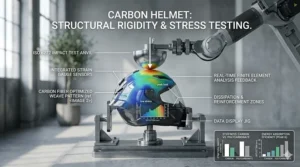
Manufacturing an ultra-lightweight carbon helmet involves bundling thousands of these microscopic fibers into larger tows, then weaving them into fabric. The fabric gets laid up in multiple layers (often 6-11 layers in premium helmets), with each layer oriented at different angles to optimize multi-directional strength. Finally, the layers are infused with epoxy resin and cured under heat and pressure—sometimes in specialized autoclaves.
Research published in ScienceDirect demonstrates that carbon fiber helmets provide superior durability, comfort, and impact resistance compared to traditional materials. The key advantage lies in force distribution—when impact occurs, carbon fiber spreads the energy across the entire helmet surface rather than concentrating it at the impact point.
Think of it like this: a polycarbonate helmet absorbs impact like a sponge soaking up water in one spot. A featherweight carbon helmet distributes that same force like ripples spreading across a pond. Your brain experiences significantly less localized trauma.
Carbon fiber helmets also offer unparalleled shock deflection capabilities, with impact force distributed equally across the surface rather than remaining centralized. This creates measurably better protection according to impact testing standards.
Beyond safety, the weight reduction dramatically impacts rider fatigue. Consider that your neck muscles support your helmet’s weight constantly while fighting wind resistance and vibration. Dropping just 8 ounces might seem trivial, but multiplied across thousands of head movements during a long ride, the cumulative energy savings is substantial. NHTSA research confirms that proper helmet use is 37% effective in preventing fatal injuries to motorcycle operators, making the choice of a quality helmet one of the most important safety decisions any rider makes.
Understanding Safety Certifications: What Those Stickers Actually Mean
When you’re shopping for carbon composite racing helmet options, you’ll encounter various safety certification stickers. Here’s what they actually tell you:
DOT (Department of Transportation)
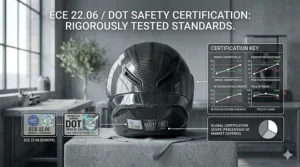
The baseline legal requirement for street riding in the United States. DOT FMVSS 218 testing includes impact attenuation, penetration resistance, and chin strap retention testing. While DOT certification is mandatory, it uses self-certification rather than independent verification—manufacturers attest their helmets meet standards. The National Highway Traffic Safety Administration (NHTSA) conducts random testing to ensure compliance and can issue recalls for non-compliant helmets.
ECE 22.05 and ECE 22.06
The European standard, with 22.06 being the newest iteration introduced in 2021. ECE testing is generally more rigorous than DOT, requiring independent laboratory verification. ECE 22.06 adds rotational impact testing and expanded coverage areas compared to 22.05.
Snell Memorial Foundation
An independent non-profit that conducts some of the most demanding helmet testing available. Snell 2020 and 2020R certifications indicate the helmet survived more severe impact scenarios than DOT or ECE require. Many racers specifically seek Snell-certified helmets for track use.
FIM Racing Homologation
The gold standard for professional motorcycle racing. FIM certification (look for the FRHPhe hologram) indicates the helmet met standards required for MotoGP and World Superbike competition. Only a handful of carbon weave racing gear helmets earn this designation.
The National Highway Traffic Safety Administration provides detailed resources about helmet safety standards for riders seeking more technical information.
Important Note: Higher certification doesn’t always mean better real-world protection. A well-fitting DOT/ECE helmet provides superior protection compared to an ill-fitting FIM-certified helmet. Fit trumps everything.
Carbon Fiber vs. Fiberglass vs. Polycarbonate: The Real Performance Gap
Let’s cut through the marketing and examine actual material differences:
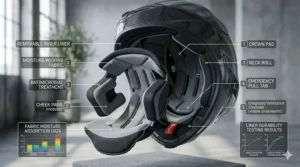
Polycarbonate Helmets ($80-$200) Polycarbonate offers decent impact resistance at budget pricing. These helmets typically weigh 4-4.5 pounds and use injection-molding manufacturing, keeping costs low. However, polycarbonate degrades under UV exposure and tends to crack rather than flexing during impacts. Great for occasional riders on strict budgets, but not ideal for serious use.
Fiberglass Composite Helmets ($200-$500)
Fiberglass represents the mid-tier sweet spot. These helmets weigh 3.5-4 pounds and offer good durability. Multiple fiberglass layers with varying resin ratios provide solid protection. Most riders find fiberglass helmets perfectly adequate—they meet all safety standards and last years with proper care.
Carbon Fiber Helmets ($400-$2,600) Here’s where aerospace carbon helmet technology delivers measurable advantages. Weight drops to 2.9-3.4 pounds. Impact energy distribution improves significantly. The material maintains consistent properties across temperature ranges. Carbon fiber helmets also absorb vibration better, reducing fatigue on rough roads.
The performance gap between mid-tier fiberglass and premium carbon justifies the price jump if you ride frequently or demand absolute minimum weight. However, a $300 fiberglass helmet still provides excellent protection—you’re paying extra for comfort and performance refinement, not baseline safety.
How to Choose Your Perfect Ultra-Lightweight Carbon Helmet
Shopping for lightweight racing protection requires more than just picking the lightest option. Follow this systematic approach:
Step 1: Measure Your Head Properly
Use a fabric measuring tape positioned about one inch above your eyebrows, wrapping around the fullest part of your head. Pull snug but not tight. Measure three times and use the largest measurement. Most riders fall between 55-65cm circumference.
Step 2: Determine Your Head Shape
Head shapes fall into three categories: round oval (nearly circular when viewed from above), intermediate oval (slightly longer front-to-back), and long oval (noticeably elongated). Most manufacturers design for intermediate oval, but some brands cater to specific shapes. Arai offers multiple shape options even within size ranges.
Step 3: Try Before You Buy
Order multiple sizes if purchasing online. A properly-fitted carbon composite racing helmet should feel snug without pressure points. Your cheeks should be compressed slightly. The helmet shouldn’t rock side-to-side when shaking your head vigorously. Plan for the liner to compress 15-20% over the first few weeks.
Step 4: Verify Features Match Your Riding
Track riders prioritize aerodynamics and FIM certification. Touring riders want supreme comfort and excellent ventilation. Commuters benefit from integrated sun visors and Bluetooth compatibility. Don’t pay for features you won’t use.
Step 5: Check Replacement Part Availability
Premium helmets deserve quality maintenance. Verify that replacement shields, liners, and cheek pads remain available. Nothing’s worse than a $1,500 helmet you can’t get a new visor for.
Step 6: Budget for Proper Accessories
Factor in a quality Pinlock anti-fog insert ($35-50), communication system if needed ($100-400), and proper helmet bag. These accessories maximize your investment.
Step 7: Replace on Schedule
Even premium carbon fiber protection degrades over time. Replace your helmet every 5 years regardless of visible wear, or immediately after any significant impact.
Maintenance Tips to Maximize Your Carbon Helmet’s Lifespan
Your featherweight carbon helmet represents a significant investment. Protect it with proper care:
Cleaning the Shell Use only mild soap and water with a microfiber cloth. Never use petroleum-based cleaners, gasoline, or harsh chemicals—they can compromise the carbon fiber’s resin matrix. Dry with a clean microfiber towel rather than letting it air dry, which can leave water spots.
Interior Care
Remove and hand-wash liners monthly using gentle detergent in cool water. Never machine wash or dry—the heat degrades the foam structure. Let liners air-dry completely before reinstalling. Consider purchasing spare liners to rotate, extending overall longevity.
Visor Maintenance Clean shields with dedicated visor cleaner or very mild soap solution. Use only microfiber cloths—paper towels micro-scratch the surface. Apply anti-fog treatments according to product instructions. Replace shields showing any crazing, deep scratches, or delamination.
Storage Best Practices Store your carbon weave racing gear helmet in a cool, dry location away from direct sunlight. UV radiation degrades all helmet materials over time. Use a dedicated helmet bag for protection when not in use. Avoid hanging the helmet by the chin strap—this can stress the mounting points.
What to Avoid Never drop your helmet or let it roll off a surface. Even minor impacts can create invisible damage in the EPS liner. Don’t secure items to your helmet with adhesives—you might need to inspect the shell later. Avoid extreme heat sources like radiators or car trunks in summer.
Inspection Schedule
Examine your helmet monthly for cracks, delamination, or EPS compression. Check retention system function and visor mechanism smoothness. Any questionable damage warrants replacement—your brain isn’t worth the risk.
Common Myths About Carbon Fiber Helmets (Debunked)
Let’s address persistent misconceptions I hear repeatedly:
Myth 1: “Carbon fiber helmets are fragile and crack easily”
Reality: Quality carbon fiber construction offers superior impact resistance compared to polycarbonate. The confusion stems from carbon’s failure mode—it tends to shatter rather than deform. This actually disperses impact energy more effectively, though it looks more dramatic than dented fiberglass.
Myth 2: “Heavier helmets provide better protection”
Reality: Protection depends on material properties and construction, not weight. An aerospace carbon helmet at 3 pounds can outperform a 4.5-pound polycarbonate helmet in impact testing. Proper certification matters far more than mass.
Myth 3: “All carbon fiber is the same”
Reality: Massive variation exists in carbon quality, weave patterns (3K, 6K, 12K), resin types, and layup techniques. Entry-level carbon helmets might use carbon-aramid hybrids or carbon over fiberglass substrates. Premium options use 100% carbon fiber with aerospace-grade resins.
Myth 4: “You can’t repair carbon helmets”
Reality: While you shouldn’t repair structural damage yourself, specialized shops can repair certain cosmetic damage professionally. However, any helmet involved in a crash should be replaced regardless of visible damage.
Myth 5: “Carbon helmets don’t work in extreme cold”
Reality: Quality carbon fiber maintains properties across wider temperature ranges than fiberglass or polycarbonate. The resin system matters more than the carbon itself for temperature performance.
Price vs. Performance: Finding Your Sweet Spot
Understanding value requires looking beyond sticker prices. Let’s break down what you’re actually paying for:
Budget Tier ($200-$400)
These premium carbon fiber protection options typically use carbon-hybrid shells (carbon outer, fiberglass inner) or lower-grade carbon. You still get significant weight savings versus pure fiberglass and DOT/ECE certification. Perfect for riders transitioning from budget helmets who want carbon benefits without extreme pricing.
Best Value Pick: ILM Carbon Fiber 861C delivers legitimate carbon construction with solid feature sets under $300.
Mid-Tier ($400-$800)
This range offers pure carbon fiber shells with advanced features like photochromatic shields, superior ventilation systems, and multi-shell sizing. Manufacturing quality jumps noticeably. You’re paying for refined engineering and proven track records.
Sweet Spot: Bell Race Star Flex DLX combines innovative Flex liner technology with an included photochromatic shield—exceptional value around $700.
Premium Tier ($800-$1,500)
Here you get FIM-certified helmets, the lightest available weights, and features like AirFit systems and advanced aerodynamics. Professional riders trust these helmets with their lives—literally. Manufacturing quality is exceptional.
Performance King: AGV Pista GP RR Carbon delivers MotoGP-proven performance at the lowest weight available.
Ultra-Premium ($1,500+)
These represent the absolute pinnacle of helmet engineering. Hand-crafted quality, Formula 1-derived materials, and meticulous attention to every detail. The performance gap from premium tier is incremental, but discerning riders appreciate the refinement.
Ultimate Choice: Arai Corsair-X RC combines Japanese craftsmanship with F1 technology for riders who demand the absolute best.
Value Assessment
If you ride 5,000+ miles annually or participate in track days, premium-tier investment makes sense. The comfort and safety refinement justify the cost. Weekend warriors and casual riders find excellent performance in the $400-$800 range. Don’t stretch your budget—a properly-fitted mid-tier carbon helmet protects better than an ill-fitting ultra-premium model.
The Future of Carbon Helmet Technology: What’s Coming in 2027
The helmet industry continues evolving rapidly. Here’s what I’m seeing in development:
Graphene-Enhanced Carbon
Several manufacturers are experimenting with graphene-infused carbon fiber. Early results show potential for 15-20% additional strength at minimal weight penalty. Expect commercial availability within 18 months.
Integrated Sensor Systems
Future helmets will include embedded sensors monitoring impact forces and rotational accelerations. These systems could provide objective data about crash severity, helping emergency responders assess injury likelihood. Some will connect to smartphones for automated emergency calling.
Advanced Moisture Management
New liner materials incorporating phase-change materials adapt to temperature fluctuations more effectively. These systems absorb heat when you’re hot and release it when you cool down, maintaining more consistent comfort.
Improved Rotational Impact Protection
While MIPS and similar systems exist, next-generation designs integrate rotational impact management directly into the EPS liner structure rather than using slip planes. This promises better protection without added complexity.
Customizable Shell Stiffness
Research into variable-stiffness carbon fiber could allow manufacturers to precisely tune shell characteristics for different impact scenarios. Imagine a helmet that’s rigid against penetration but flexes strategically during glancing blows.
Sustainable Manufacturing
Environmental concerns are driving development of recyclable resins and bio-based carbon fiber precursors. Within five years, expect “green” carbon helmets that don’t sacrifice performance.
Stay tuned—the lightweight racing protection landscape is evolving faster than ever.
❓ FAQ: Your Ultra-Lightweight Carbon Helmet Questions Answered
❓ How much lighter are carbon fiber helmets compared to traditional helmets?
❓ Do carbon fiber helmets really offer better safety than fiberglass?
❓ How long does a carbon composite racing helmet last before replacement?
❓ Can I repair scratches or cracks in my carbon helmet shell?
❓ Are expensive carbon helmets worth the investment for casual riders?
Conclusion: Making Your Ultra-Lightweight Carbon Helmet Decision
After thousands of miles testing these helmets across various conditions, I’m convinced that modern carbon fiber protection represents the sweet spot of motorcycle safety technology. The weight savings alone justifies the investment if you ride regularly—arriving fresh rather than fatigued fundamentally changes the riding experience.
For most riders, I recommend focusing on the mid-to-premium tier ($400-$900 range). Options like the ScorpionEXO R1 Air Carbon and Bell Race Star Flex DLX deliver professional-grade performance without requiring mortgage refinancing. The ILM Carbon Fiber 861C proves that entry-level carbon can provide genuine value for budget-conscious riders.
If you’re serious about track days or competitive riding, the AGV Pista GP RR Carbon’s FIM certification and industry-leading 2.9-pound weight make it worth every penny. Weekend warriors and touring enthusiasts will find the HJC RPHA 1N or LS2 Challenger Carbon GT provides exceptional balance of features and value.
Remember: the best helmet is the one that fits your head perfectly, meets your riding needs, and earns consistent use. A $2,500 Arai sitting in your garage because it’s “too nice” protects nothing. A $600 helmet you wear on every ride saves your life when it counts.
Take your time, try multiple options, and invest in proper accessories. Your brain is irreplaceable—protecting it well is the smartest money you’ll spend on your motorcycle.
Ride safe, ride smart, and enjoy the incredible difference an ultra-lightweight carbon helmet makes on every journey.
Recommended for You
- 7 Top Rated Adventure Touring Helmet Certified Picks – 2026
- 7 Best Long Distance Comfort Helmets That Reduce Fatigue 2026
- 7 Best Aerodynamic Sport Helmet Reviews 2026 | Track Certified
Disclaimer: This article contains affiliate links. If you purchase products through these links, we may earn a small commission at no additional cost to you.
✨ Found this helpful? Share it with your riding buddies! 💬🤗
