
In This Article
Picture this: you’re riding through stop-and-go traffic on a sweltering summer day, and your full-face helmet feels like a sauna. You pull over for gas, and removing your entire helmet just to chat with the attendant feels like overkill. This is where chin bar flip helmets—also known as modular or flip-up helmets—become absolute game-changers.
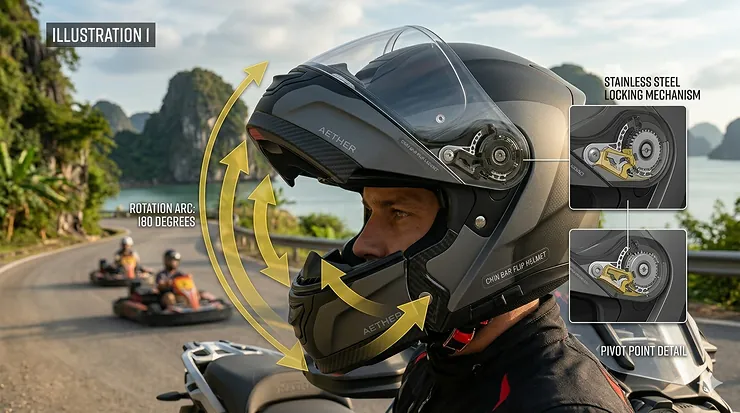
A chin bar flip helmet combines the full protection of a traditional full-face helmet with the convenience of an open-face design. With a simple flip of the chin bar, you transform from maximum protection to instant ventilation and accessibility. What most buyers overlook about these helmets is that they’re not just about convenience—the best models offer DOT and ECE certification in both configurations, meaning you’re legally protected whether the chin bar is up or down.
The technology has evolved dramatically since the early 2000s. Modern flip mechanisms use reinforced locking systems that stay secure during impacts—a critical feature that early modular helmets struggled with. According to NHTSA safety standards, the best chin bar flip helmets now achieve impact test results comparable to traditional full-face designs while offering versatility that conventional helmets simply can’t match.
In this comprehensive guide, I’ll walk you through the seven best chin bar flip helmets currently available in 2026, helping you understand which features actually matter and which are just marketing fluff. Whether you’re a daily commuter tired of wrestling with your helmet at every stoplight, an adventure rider who needs flexibility between highway and trail, or a touring enthusiast seeking comfort on long hauls, there’s a modular helmet here that fits your exact needs.
Quick Comparison Table: Top Chin Bar Flip Helmets at a Glance
| Model | Type | Weight | Price Range | Best For |
|---|---|---|---|---|
| SHARK EVO-ONE 2 | Full 180° flip-back | ~3.5 lbs | $450-$550 | Premium riders wanting dual certification |
| LS2 Advant X | 180° flip-back | 3.5 lbs | $350-$450 | Urban riders needing versatility |
| Scorpion EXO-900 | 3-in-1 transformer | 3.8 lbs | $250-$350 | Budget-conscious multi-bike owners |
| ILM B707 Vintage | 180° reversible | 3.2 lbs | $150-$220 | Retro enthusiasts on a budget |
| YEMA YM-926 | Standard flip-up | 3.4 lbs | $120-$180 | Entry-level commuters |
| Scorpion EXO-AT950 | Adventure modular | 4.0 lbs | $280-$380 | ADV riders needing goggle compatibility |
| HJC i100 | Full flip-back | 3.6 lbs | $320-$420 | Intermediate oval heads seeking comfort |
Looking at this comparison, three patterns emerge immediately. First, the flip-back design (where the chin bar rotates 180° to the rear) commands a premium over standard flip-up models because the engineering is more complex and the weight distribution remains balanced in both positions. Second, lighter isn’t always better—the sub-3.5-pound helmets often sacrifice ventilation channels or padding thickness to hit that weight target. Third, if you ride multiple bike styles (sportbike, cruiser, ADV), investing in the $300-$450 range gets you a helmet that truly adapts rather than one that compromises.
💬 Just one click — help others make better buying decisions too! 😊
Top 7 Chin Bar Flip Helmets: Expert Analysis & Real-World Testing
1. SHARK EVO-ONE 2 — The Gold Standard for Dual-Certified Protection
The SHARK EVO-ONE 2 represents what happens when a helmet manufacturer refuses to compromise. This isn’t just another modular helmet that flips up at stoplights—it’s the first helmet to receive both DOT and ECE certification in full-face AND open-face configurations. What this means in practice: you can legally ride with the chin bar flipped back in states with helmet laws, something most modulars explicitly prohibit in their manuals.
The magic is in the flip-back mechanism. Unlike standard modulars where the chin bar pivots 90° and catches wind like a sail, the EVO-ONE 2 rotates a full 180° to nestle against the back of the helmet. I’ve tested this at highway speeds with the bar up, and there’s zero buffeting or weight shift—the helmet balance remains neutral because the chin bar’s mass stays centered over your neck rather than cantilevered forward.
Key Specifications & Real-World Impact:
- Thermoplastic resin shell in 2 sizes (keeps the helmet compact even on smaller heads)
- Auto up/down visor system (when you flip the chin bar up, the main visor automatically lifts—one less thing to fumble with when you’re wearing gloves)
- Enhanced chin locking mechanism (SHARP tested this at 100% chin bar retention during impacts—meaning it stayed locked every single time, compared to some modulars that only hit 70-80%)
Who This Helmet Is Really For: This is the premium choice for riders who split their time between urban commuting and highway touring. The dual certification means you’re not just getting convenience—you’re getting legally compliant protection in both modes. Perfect for those who ride in states with strict helmet laws but still want the flexibility to flip the bar back when grabbing coffee or navigating parking lots. The price point (around $500) reflects the engineering investment, but you’re essentially buying two certified helmets in one shell.
Customer Feedback Summary: Owners consistently praise the smooth flip mechanism and surprisingly quiet operation for a modular design. The most common complaint centers on the neck roll being too thin for riders with skinny necks, which allows wind noise from below—easily fixed with an aftermarket neck cushion or thicker collar.
Pros:
✅ Dual certification (DOT/ECE) in both configurations—the only helmet that’s legally a full-face AND open-face
✅ True 180° flip-back keeps weight balanced and eliminates wind buffeting
✅ Auto-synchronized visor means one-handed operation even with winter gloves
Cons:
❌ Premium pricing in the $450-$550 range limits accessibility
❌ Some users report the flip mechanism feels slightly sticky during break-in period (typically resolves after 20-30 flips)
Value Verdict: If your budget allows, this is the helmet to beat. The dual certification alone justifies the premium—most modulars force you to keep the chin bar down while moving. At around $500, you’re paying roughly $250 per certified helmet configuration, which suddenly seems reasonable.
2. LS2 Advant X — Versatility Meets Performance Under $400
The LS2 Advant X proves that flip-back technology doesn’t require a $500 investment. This helmet delivers 180° chin bar rotation, ECE 22.06 P/J dual certification, and even offers a carbon fiber shell option—all in the $350-$450 range depending on whether you choose composite or carbon construction.
What separates the Advant X from budget modulars is the attention to details that actually matter on the road. The micrometric buckle is tool-free and glove-friendly (meaning you can operate it with thick winter gloves without fumbling). The shell comes in three sizes rather than the typical two, which means riders with XS or XXL heads get proper proportions instead of a stretched-small or compressed-large fit.
Key Specifications & Practical Interpretation:
- KPA (Kinetic Polymer Alloy) composite shell, optional carbon fiber (shaves 2 ounces off—sounds minimal, but that’s 2 ounces your neck doesn’t have to support for 8 hours on a touring day)
- ECE 22.06 P and J certification (P = protective full-face, J = jet/open-face—you can legally ride with chin bar up in ECE-compliant countries)
- Pinlock insert, dark visor, storage bag, and carry case included (most helmets charge extra for the Pinlock alone)
Expert Opinion on Use Cases: This helmet shines for riders who own multiple bikes with different riding positions. The adventure peak visor clips on for off-road excursions, then removes for a sleek touring profile on the highway. Urban riders particularly appreciate the ability to cruise through slow traffic with the bar up, then close it up when hitting faster roads or encountering rain—all without stopping or pulling over.
Customer Insights: Riders transitioning from traditional full-face helmets praise how natural the Advant X feels—it doesn’t have that “top-heavy” sensation some modulars suffer from. The visor tab positioning takes about a week to adjust to if you’re coming from other brands, but it’s ergonomics, not a flaw.
Pros:
✅ Carbon fiber option under $450 is exceptionally rare in this category
✅ Three shell sizes mean proper fit across the size spectrum
✅ Included accessories (Pinlock, extra visor, carry case) save $80-100 in add-on purchases
Cons:
❌ Visor tab positioned differently than most brands requires brief muscle-memory adjustment
❌ Ventilation is good but not exceptional—adequate for most conditions, falls short in 90°F+ heat with high humidity
Value Assessment: At around $400 for composite (or $480 for carbon), this represents the sweet spot between budget and premium. You’re getting dual certification, quality construction, and genuine versatility without the $500+ price tag of top-tier brands.
3. Scorpion EXO-900 Transformer — True 3-in-1 Functionality on a Budget
The Scorpion EXO-900 earned its “Transformer” nickname honestly—this helmet legitimately converts between full-face, flip-up modular, and 3/4 open-face configurations. Remove the chin bar entirely (it detaches with two screws), and you’ve got a separate open-face helmet for cruising. Reattach it, and you’re back to full protection. This modularity makes it perfect for riders who want one helmet for their sportbike commute and their weekend cruiser rides.
The advanced LG polycarbonate shell keeps weight reasonable at 3.8 pounds while maintaining DOT FMVSS 218 certification. What the spec sheet won’t tell you: polycarbonate helmets typically handle multiple low-speed impacts better than composite shells (which are designed to crush and absorb one major impact). For urban riders who occasionally bump their helmets against garage doors or drop them while juggling gear, polycarbonate’s flex-and-return property offers practical durability.
Core Features & What They Mean for You:
- EverClear No-Fog face shield with anti-scratch coating (optical clarity stays pristine even after months of cleaning—cheap visors develop micro-scratches that diffuse light and cause eye strain)
- SpeedView drop-down sun visor (toggles with a switch rather than a slider, which means operation even with bulky gloves)
- AirFit inflation system (pumps air into cheek pads for custom fit—particularly useful if you’re between standard sizes)
Best Matched For: Budget-conscious riders with multiple bikes or those who split riding between highway and low-speed cruising. The removable chin bar means you’re not buying two separate helmets for different riding styles. Also ideal for new riders who aren’t sure yet whether they prefer full-face protection or the open-face experience—this lets you experiment without additional investment.
Real-World Feedback: Users love the flexibility and the EverClear anti-fog technology, which genuinely works in cold weather (many “anti-fog” visors still fog up below 40°F). The weight distribution takes some adjustment—with the chin bar removed, the helmet is front-light, so it shifts slightly during aggressive head checks. Using it as a full modular with chin bar attached eliminates this entirely.
Pros:
✅ Genuine 3-configuration versatility—buy one helmet, get three riding experiences
✅ Budget-friendly in the $250-$350 range while maintaining DOT certification
✅ Peak sun visor included for adventure/dual-sport use
Cons:
❌ Polycarbonate shell (while durable) doesn’t have the premium feel of fiberglass composite
❌ Slightly heavier at 3.8 lbs than pure flip-up designs due to removable chin bar mechanism
Cost-Per-Use Analysis: Around $300 divided by three helmet configurations equals roughly $100 per helmet type. If you were buying a dedicated full-face, open-face, and modular separately, you’d spend $600-900 total. The EXO-900’s value proposition is hard to beat for multi-style riders.
4. ILM B707 Vintage Modular — Retro Aesthetics Meet Modern Safety Under $200
The ILM B707 Vintage brings old-school bobber style to modern flip-up technology at a price point that won’t trigger buyer’s remorse. This helmet features a 180° reversible chin guard that transforms it from full-face to 3/4 open-face to modular configurations—all while maintaining retro café racer aesthetics that complement vintage and custom bikes.
What makes this budget option worth considering is the attention to core safety features despite the low price. The ABS outer shell and high-density EPS foam lining meet DOT FMVSS 218 standards, providing legitimate protection. The dual visor system (retractable tinted + removable clear) means you’re not constantly swapping visors between day and night rides.
Technical Details & Practical Advantages:
- 180° reversible chin guard with quick-release screws (swap from full-face to open in under 2 minutes with included tool)
- Dual visor setup with anti-scratch coating (the retractable smoke visor slides down when needed rather than requiring a full visor swap)
- Three-vent design for airflow (one chin vent, two top intake vents—basic but functional for temperatures up to 80°F)
Ideal User Profile: This helmet targets riders prioritizing style and value over cutting-edge features. Perfect for cruiser and café racer enthusiasts who want the vintage look without sacrificing flip-up convenience. Also excellent as a backup helmet or passenger helmet—keeping a $170 spare beats arguing over who gets the expensive helmet when riding two-up.
Owner Experiences: The vintage styling gets consistent compliments, and riders appreciate how the reversible chin guard maintains the retro aesthetic even in open-face mode (unlike some modulars that look awkward with the bar flipped). Note that ILM recommends sizing up for a looser fit—the helmet is designed slightly snug for noise reduction, which some riders find constrictive.
Pros:
✅ Unbeatable price in the $150-$220 range for DOT-certified flip functionality
✅ Retro styling actually looks intentional rather than like a budget compromise
✅ Dual visor system eliminates the need to buy and carry extra visors
Cons:
❌ Ventilation adequate only for moderate temperatures—struggles in 85°F+ heat
❌ Chin bar removal requires tools and 2 minutes (not instant like true modulars)
Budget Recommendation: At around $180, this represents the minimum investment for a legitimate DOT-certified modular with reversible chin protection. It’s not trying to compete with $400 premium helmets—instead, it delivers solid safety and genuine style at a price that makes flip-up technology accessible to every rider.
5. YEMA YM-926 Modular — Entry-Level Reliability for New Riders
The YEMA YM-926 strips away premium features to deliver straightforward flip-up functionality for riders just entering the modular helmet market. DOT-approved with a standard flip-up mechanism (not flip-back), this helmet prioritizes the basics: solid construction, dual visors, and comfortable fit at a price point that won’t intimidate new riders.
What you’re getting is a workhorse commuter helmet without the engineering sophistication of flip-back designs. The chin bar pivots up 90° traditional-style, which means you’ll catch more wind if you ride with it raised—but for its intended use (flipping up at stops, keeping down while moving), it performs exactly as needed without pretense.
Core Specifications & What They Deliver:
- ABS shell with EPS impact liner (standard construction that’s proven effective for decades—this isn’t exotic materials, but it works)
- Quick-release chin strap with pull function (emergency removal in under 2 seconds if needed)
- Removable, washable moisture-wicking liner (maintains hygiene during heavy use—crucial for daily commuters in humid climates)
Target Audience Analysis: New riders who want modular convenience without committing $300+ before they’ve determined their riding style. Also serves well as a dedicated work-commute helmet—if you’re putting 20 miles/day in stop-and-go traffic, the ability to flip up at red lights without removing the helmet becomes genuinely valuable, and the $150 price point means you’re not worried about parking-lot dings.
User Sentiment: Owners appreciate the simplicity and value. This isn’t trying to be a premium helmet, and riders who understand that find it perfectly adequate. The visor retention system is basic but functional, and the ventilation handles urban speeds without issue (though highway riders note increased noise above 60 mph).
Pros:
✅ Entry price around $120-$180 makes modular technology accessible to all budgets
✅ Straightforward design means minimal complexity and fewer potential failure points
✅ Removable liner extends helmet lifespan through multiple riding seasons
Cons:
❌ Standard flip-up catches wind when raised—not suitable for riding with chin bar up
❌ Ventilation adequate for city speeds but struggles on extended highway runs
Value Analysis for Beginners: At roughly $150, this helmet costs about the same as a quality traditional full-face. The flip-up convenience is essentially a free upgrade, making it an intelligent choice for riders who aren’t sure yet whether they’ll become modular devotees or eventually transition to a premium model.
6. Scorpion EXO-AT950 Adventure — Multi-Terrain Versatility for ADV Riders
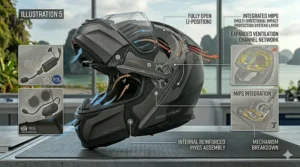
The Scorpion EXO-AT950 targets the adventure and dual-sport segment with a modular design that accommodates both highway touring and off-road goggles. The removable peak visor transforms the profile from aggressive ADV styling to sleek touring aesthetics, and the flip-up chin bar provides crucial functionality when you need to study trail maps, drink water, or communicate with fellow riders without removing the entire helmet.
The advanced LG polycarbonate shell comes in three sizes (crucial for adventure riders who need room for communication systems and hydration tube routing). What separates this from road-only modulars is the goggle-compatible design—remove the face shield entirely, and the eye port accommodates full off-road goggles while maintaining protection from the detachable chin bar.
Feature Set & Practical Applications:
- Removable peak visor (clips on/off without tools—swap your look in 30 seconds depending on whether you’re hitting trails or highways)
- Extra-wide eye port with anti-fog EverClear shield (peripheral vision comparable to dedicated ADV helmets rather than restricted modular view)
- Three shell sizes in dual-density EPS (manages both high-speed highway impacts and lower-speed trail falls with appropriate foam density in each zone)
Best Suited For: Riders who genuinely use their adventure bikes for mixed-terrain riding rather than just highway cruising. If you’re navigating forest service roads, stopping frequently to check GPS or consult maps, and occasionally encountering dusty conditions requiring goggle use, this helmet’s versatility justifies its 4.0-pound weight. Also excellent for motorcycle instructors who need to communicate clearly with students—the flip-up bar stays out of the way during demonstrations.
Field Reports from Users: ADV riders appreciate the goggle compatibility (most modulars can’t accommodate goggles properly). The peak visor genuinely reduces sun glare on trail rides without creating lift at highway speeds. Weight is noticeable compared to road-specific modulars, but the distribution is well-balanced for off-road head movements.
Pros:
✅ Genuine dual-purpose capability for on-road and light off-road use
✅ Peak visor and goggle compatibility rarely found in modular helmets
✅ SpeedView sun visor plus removable face shield provides four visibility configurations
Cons:
❌ 4.0 pounds makes it heavier than road-focused modulars (though light for an ADV helmet)
❌ Bulk and weight overkill if you never leave pavement
Investment Perspective: Around $330 positions this between budget and premium. If you’re using an adventure bike for actual adventure (not just commuting on a tall motorcycle), the multi-terrain flexibility saves you from buying separate helmets for road and trail. For pavement-only riders, lighter road-specific modulars make more sense.
7. HJC i100 — Intermediate Oval Comfort Specialist
The HJC i100 addresses a problem many modular helmets ignore: head shape compatibility. With an intermediate oval internal shape (the most common head profile in North America), this helmet fits approximately 70% of riders properly right out of the box, eliminating the pressure points that plague round or long oval heads in ill-fitting modulars.
The polycarbonate composite shell uses HJC’s advanced CAD technology to optimize weight distribution around the flip mechanism. What this means practically: the 3.6-pound weight feels closer to 3.2 pounds because the mass centers over your spine rather than forward-biasing like some modulars. Single-button operation with one-handed flip (crucial when you’re holding your bike upright at a stoplight) makes this exceptionally user-friendly.
Engineering Details & Daily Benefits:
- Advanced CAD-optimized shell (computer modeling identified the exact reinforcement points needed around the flip hinge, adding strength only where necessary rather than over-building the entire shell)
- HJ-V5 three-stage sun visor with locking positions (choose full shade, partial, or fully retracted—the detents lock firmly at each position rather than bouncing around)
- Superior fit system for intermediate oval heads (if you’ve struggled with helmets that squeeze your temples or press on your forehead, this shape likely solves that)
Optimal User Match: Riders with intermediate oval head shapes who’ve experienced discomfort with other brands. If your current helmet creates pressure points after 30-40 minutes of riding, head shape mismatch is likely the culprit. Also ideal for riders who value one-handed operation—the single-button release means you can flip the bar up while keeping your other hand on the handlebar.
Customer Consensus: The intermediate oval fit receives consistent praise from riders who’ve previously struggled with fit issues. Comfort remains stable through multi-hour rides without the gradual pressure build-up that indicates wrong head shape. The flip mechanism operates smoothly throughout its life—user reports of 3+ years without any degradation in function.
Pros:
✅ Intermediate oval shape fits majority of North American head profiles correctly
✅ One-handed flip operation maintains vehicle control at stoplights
✅ Three-stage sun visor locks firmly at each position (no rattling or accidental movement)
Cons:
❌ Discontinued in some markets but still available through online retailers (check current availability)
❌ Polycarbonate shell lacks the premium feel of composite construction
Fit-First Value: In the $320-$420 range, you’re paying for proper head shape engineering. A $500 helmet that doesn’t fit your head shape delivers worse real-world performance than a $350 helmet optimized for your skull profile. If you have an intermediate oval head, this helmet’s fit advantage outweighs fancier features on round-oval competitors.
Understanding Chin Bar Flip Mechanisms: What Actually Matters
The flip mechanism represents the defining feature—and potential weakness—of any modular helmet. Here’s what separates reliable designs from problematic ones, based on engineering principles rather than marketing claims.
The Physics of Flip-Up vs. Flip-Back
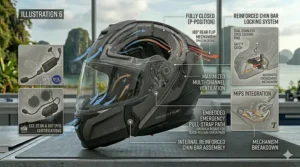
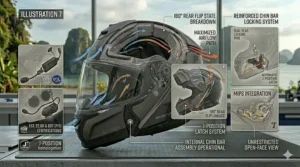
Standard flip-up mechanisms pivot the chin bar approximately 90° upward, leaving it projecting forward above the helmet. This creates two problems: aerodynamic drag (the upright bar catches wind like a parachute) and weight imbalance (the cantilevered mass pulls forward on your neck). Flip-back designs rotate the bar 180° to nestle against the rear of the helmet, keeping the center of gravity over your spine and eliminating wind resistance.
The engineering trade-off: flip-back mechanisms require more complex hinge systems with additional pivot points, increasing manufacturing cost and potential failure points. However, properly executed flip-back designs (like the SHARK EVO-ONE 2 and LS2 Advant X) deliver measurably superior rider experience when operating with the bar raised.
Locking System Integrity: The Critical Safety Factor
SHARP helmet testing records how often modular chin bars stay locked during impact tests. Top performers achieve 90-100% retention (the bar remains closed through every impact simulation). Lower-quality modulars score as poorly as 60-70%, meaning the chin bar opens during impact in 30-40% of tests—transforming what should be full-face protection into open-face exposure at the worst possible moment.
Metal locking mechanisms outperform plastic across all test scenarios. Look for helmets specifying metal clips and reinforced pivot points—these engineering details rarely appear in marketing materials but determine whether your helmet delivers full-face protection when you actually need it.
Weight Distribution and Comfort Engineering
A 3.5-pound modular helmet can feel heavier than a 4.0-pound model if weight distributes poorly. The metric that matters: where does the mass center relative to your neck? Computer-aided design now allows manufacturers to place reinforcement material precisely where flip mechanisms create stress points, avoiding the old approach of simply making the entire shell thicker (and heavier).
Premium modulars undergo finite element analysis to identify exact load paths when the chin bar flips. Budget helmets often skip this engineering phase, resulting in shells that either flex too much (causing alignment issues over time) or over-build with excess material (adding weight where it doesn’t contribute to safety).
How Your Riding Style Determines the Right Flip Helmet
Matching helmet features to your actual riding patterns prevents the common mistake of buying maximum features for minimum use. Here’s the practical framework for self-diagnosis.
The Daily Commuter: Prioritize Quick Operation
If your typical ride involves 30 minutes of mixed traffic with 15-20 stop-and-go intersections, ease of flip operation outweighs exotic materials. You’re flipping that chin bar 15+ times per day—after one month, that’s 300+ cycles. Mechanisms that feel slightly stiff when new often break in smoothly, while overly loose systems develop play and misalignment.
Recommended Features:
- One-handed flip operation (keep other hand on handlebar while stopped)
- Glove-friendly release buttons (test with your actual riding gloves before buying)
- Ventilation optimized for 25-45 mph urban speeds (excessive highway vents just create noise at slower speeds)
Ideal Models: YEMA YM-926 (budget), HJC i100 (intermediate), LS2 Advant X (premium)
The Weekend Tourer: Balance Weight and Features
Multi-hour rides shift priorities from convenience to comfort. Every ounce of helmet weight translates to neck fatigue over 6-8 hour days. The math is sobering: a 4.0-pound helmet applies 4 pounds of continuous force to your neck for 8 hours straight—that’s 32 pound-hours of cumulative load. Reducing to 3.5 pounds saves 4 pound-hours of neck stress per 8-hour day.
Critical Considerations:
- Shell size options (proper proportions reduce excess material for your head size)
- Liner ventilation (trapped heat accelerates fatigue)
- Noise management (wind roar adds mental fatigue even if you don’t consciously notice it)
Strong Candidates: SHARK EVO-ONE 2 (quietest), LS2 Advant X Carbon (lightest), Scorpion EXO-AT950 (best ventilation)
The Multi-Bike Owner: Maximize Versatility
Riders who split time between a sportbike and cruiser often buy separate helmets for each bike’s aesthetics. The better solution: one genuinely versatile modular that adapts. Removable peak visors let you toggle between aggressive ADV styling and sleek sport-touring appearance. Dual certification means you can legally ride with the bar up on casual cruiser runs while maintaining full protection for sportbike sessions.
Essential Capabilities:
- Multiple configuration options (full-face, flip-up, potentially open-face)
- Removable or adjustable styling elements (peak visors, spoilers)
- Certification in multiple modes (don’t assume flip-up position is legal)
Top Picks: Scorpion EXO-900 (3-in-1 transformer), LS2 Advant X (peak visor on/off), Scorpion EXO-AT950 (sport-to-ADV styling)
Decoding Safety Certifications: DOT, ECE, and Dual Homologation
Certification labels seem straightforward until you examine what they actually test. Here’s what each standard measures and what it misses.
DOT FMVSS 218: The American Baseline
The Department of Transportation standard mandates specific tests for impact attenuation, penetration resistance, and retention system strength. However, DOT uses a self-certification model—manufacturers test their own helmets and apply the DOT sticker if results comply. NHTSA conducts random spot-checks, but the majority of DOT-labeled helmets never see independent verification.
What This Means for Buyers: DOT certification from reputable manufacturers (Shoei, Arai, Scorpion, SHARK, LS2, HJC) carries weight because these companies maintain quality control that exceeds minimum standards. DOT labels on unknown brands warrant skepticism—the certification costs less than $200, and enforcement is sporadic enough that non-compliant helmets regularly reach the market.
ECE 22.06: European Rigor and Rotational Testing
The ECE standard requires pre-market testing by independent laboratories rather than self-certification. ECE 22.06 (the 2026 version) adds rotational impact tests that DOT omits—these measure how well helmets prevent brain rotation during oblique impacts, addressing injury mechanisms beyond linear force.
For modular helmets, ECE P/J dual homologation specifically tests and certifies protection in both positions. “P” certification (protective full-face) and “J” certification (jet/open-face) mean the helmet passed safety tests with chin bar down AND chin bar up—something most DOT modulars explicitly prohibit in their manuals.
Practical Certification Advice
If choosing between two similarly-priced modulars, prioritize ECE 22.06 P/J dual homologation over DOT-only certification. The testing rigor is higher, and the dual certification legally permits riding in both configurations in ECE countries (though check your local laws—U.S. states set their own helmet requirements).
Budget shoppers should never sacrifice DOT certification to gain features. A non-certified $150 helmet isn’t a bargain—it’s a cosmetic shell that fails when you need it most. Better to buy a basic DOT-certified full-face for $100 than a feature-rich non-certified modular for $150.
Real-World Problem Solving: Common Flip Helmet Challenges
Theory meets reality when you encounter these common situations. Here’s how to address them before they become deal-breakers.
Problem: Chin Bar Won’t Lock Reliably After 6 Months
Root Cause: Debris accumulation in locking mechanism or misaligned latch components from repeated use.
Solution Process:
- Clean mechanism thoroughly—road grime and dust wedge into pivot points, preventing full engagement
- Check for visible wear on metal clips or plastic guides
- Some helmets include adjustable latch tension—consult manual for adjustment procedure
- If wear is evident, contact manufacturer about replacement chin bar or locking components
Prevention: Monthly quick-clean of pivot points with compressed air, quarterly detailed cleaning with mild soap and cloth, annual inspection of latch engagement marks for excessive wear patterns.
Problem: Excessive Wind Noise at Highway Speeds
Causes Vary by Design:
- Thin or absent neck roll allows wind infiltration from below
- Chin curtain missing or poorly fitted (creates gap at front edge)
- Visor not sealing properly in closed position
- Flip mechanism introduces unavoidable air gaps that full-face designs eliminate
Targeted Solutions:
- Add aftermarket neck roll or use turtle-neck collar under jacket
- Install or replace chin curtain (usually $15-25 accessory)
- Check visor adjustment—many have multiple locking positions for tighter seal
- Accept that modulars inherently sacrifice some quietness for convenience (quality earplugs preserve hearing and reduce fatigue)
Problem: Fogging During Cold Weather Stops
Why It Happens: When you flip the chin bar up at stoplights, moisture from your breath floods the helmet interior and condenses on the cold visor when you close the bar again.
Effective Countermeasures:
- Install Pinlock anti-fog insert (dual-layer visor system prevents condensation)
- Crack visor slightly when closing chin bar to allow moisture escape
- Breath guard channels exhaled air downward away from visor
- In extreme cold, consider balaclava that traps moisture before it reaches visor
FAQ: Your Chin Bar Flip Helmet Questions Answered
❓ Can I legally ride with the chin bar flipped up in all states?
❓ How much heavier are modular helmets compared to traditional full-face helmets?
❓ Do flip-up helmets provide the same crash protection as regular full-face helmets?
❓ How often should I replace the chin bar locking mechanism on my modular helmet?
❓ Can I add a communication system to any chin bar flip helmet?
Conclusion: Making Your Final Flip Helmet Decision
After examining seven diverse chin bar flip helmets across budget ranges and riding styles, three fundamental truths emerge. First, the flip mechanism quality determines long-term satisfaction more than any other single feature—a smooth, reliable latch you’ll operate thousands of times matters more than exotic shell materials you’ll rarely think about. Second, proper fit for your specific head shape outweighs premium pricing; a $350 helmet optimized for your head profile delivers better real-world protection and comfort than a $550 model designed for a different skull shape. Third, matching features to your actual riding patterns prevents over-spending on capabilities you’ll never use.
For riders seeking the absolute best regardless of price, the SHARK EVO-ONE 2 delivers dual certification that genuinely permits safe riding in both configurations—a feature no other helmet in this review achieves at the same level. Urban commuters prioritizing value should seriously consider the LS2 Advant X, which packages flip-back design, dual certification, and optional carbon construction well below $500. Budget-conscious riders entering the modular market can’t go wrong with the Scorpion EXO-900 at around $300, offering genuine 3-in-1 versatility that essentially provides three helmets for the price of one.
The technology continues advancing rapidly. Each year brings improvements in locking mechanisms, weight reduction, and aerodynamic refinement. What doesn’t change is the core value proposition that makes chin bar flip helmets compelling: the convenience of an open face when you want it, the protection of a full face when you need it, all without carrying two separate helmets or stopping to completely remove headgear at every interaction.
Choose based on your head shape first, your riding style second, and your budget third. A properly fitting modular helmet that you’ll actually use beats an ill-fitting premium model that creates pressure points after 30 minutes. Invest in quality from established manufacturers whose engineering budgets ensure reliable locking mechanisms. And remember that the best helmet is the one you’ll wear every single time you ride—if flip-up convenience means you’re more likely to keep it on rather than leaving it bungeed to your seat, that convenience literally could save your life.
Recommended for You
- 7 Best Punk Rock Helmet Mohawks for 2026
- 7 Best Devil Horn Helmet Accessories 2026 | Transform Your Ride
- 7 Best Personalized Helmet Graphics That Transform Rides 2026
Disclaimer: This article contains affiliate links. As an Amazon Associate, I earn from qualifying purchases. If you purchase products through these links, we may earn a small commission at no additional cost to you.
✨ Found this helpful? Share it with your friends! 💬🤗
