
In This Article
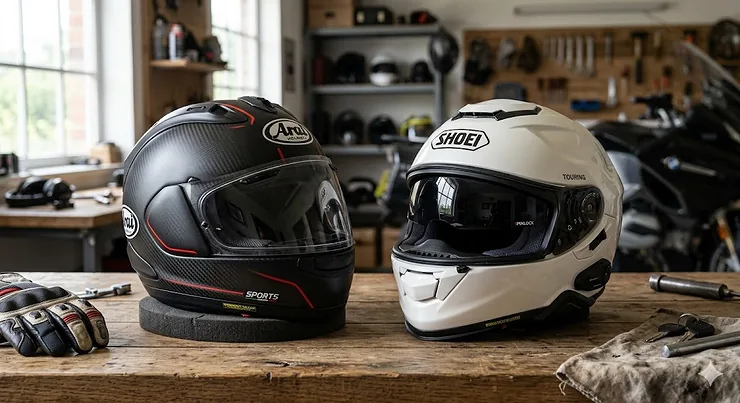
Here’s the thing nobody tells you when you’re standing in a gear shop staring at a wall of helmets: buying the wrong style of full face helmet doesn’t just mean mild discomfort on long rides. It means arriving at your destination with a headache that started somewhere around mile 80, wind fatigue that makes you feel like you fought a hurricane, or — if you went too touring when you actually rip canyons — a lid that flaps, lifts, and buffets every time you lean hard into a corner.
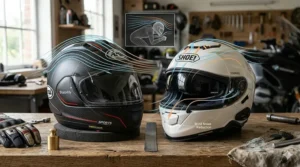
The sport vs touring full face helmet debate is one of the most misunderstood decisions in motorcycling. And it matters enormously. A sport helmet is essentially aerodynamic armor designed around an aggressive forward riding position, optimized for speed, downforce, and airflow through the face — things that feel terrible when you’re sitting upright on a BMW touring bike for seven hours. A touring full face helmet, on the other hand, prioritizes wind noise reduction, internal sun visors, and all-day comfort in a neutral head position — features you genuinely don’t need when you’re carving a mountain pass on a Ducati Panigale.
That gap between these two categories is not marketing fluff. It’s physics, ergonomics, and material science baked into the shape of your helmet. Understanding it will save you real money, real frustration, and maybe something more important.
In this guide, we break down the sport vs touring full face helmet distinction with genuine depth — no recycled spec sheets — and review 7 real helmets currently available on Amazon that represent the best of both worlds (plus a few that blur the line beautifully). Whether you’re a weekend canyon carver, a 1,000-mile iron-butt aspirant, or somewhere in between, there’s a lid here with your name on it.
Quick Comparison: Sport vs Touring Full Face Helmet at a Glance
| Feature | Sport Full Face | Touring Full Face |
|---|---|---|
| Shell Shape | Aggressive, chin bar forward | Rounder, upright-position optimized |
| Ventilation | High-flow for aggressive riding posture | Quieter, multi-zone flow for upright position |
| Internal Sun Visor | Rarely included | Almost always included |
| Wind Noise | Varies — some are loud at freeway speed | Engineered for silence |
| Weight | Often lighter | Sometimes heavier due to comfort features |
| Cheek Padding | Thinner for communication gear | Thicker, plush for all-day comfort |
| Best For | Track days, sport bikes, canyon runs | Long-distance touring, ADV, commuting |
| Price Range | $150–$700+ | $200–$700+ |
Looking at the table above, the pattern is clear: sport helmets optimize performance, while touring helmets optimize endurance. Neither is universally superior. What matters is matching the helmet to your actual riding. A budget touring helmet on a track day is genuinely dangerous — the upright-optimized shell can destabilize at speed. And a hard-core race lid on a five-hour highway grind is a recipe for exhaustion you’ll feel in your neck for a week.
💬 Just one click — help others make better buying decisions too! 😊
Top 7 Sport vs Touring Full Face Helmets: Expert Analysis
1. Shoei RF-1400 — The Sport Standard Bearer
The Shoei RF-1400 is not just a helmet. It’s an argument — a case made in fiberglass and carbon fiber that sport full face helmets don’t have to be loud, crude, or punishing. This is Shoei’s flagship sport lid, and it earns that title in quiet, confident ways.
Shell & Safety: The Multi-Ply Matrix AIM+ shell uses interwoven layers of fiberglass and organic fibers — not just stacked plies — which means it doesn’t just absorb impact, it distributes it. Practically speaking, that translates to a helmet that meets both DOT FMVSS 218 and Snell M2020D certification. Snell is the tougher of the two, and most helmets at this price won’t bother earning it. The RF-1400 does.
Ventilation: Six intake vents and four exhaust outlets sound impressive on paper, but what matters is the wind tunnel development behind them. Shoei spent serious time optimizing airflow for an aggressive, chin-down riding posture. At 70+ mph on a sport bike, that means real cooling without turbulent buffeting — which cheaper sport helmets often fail at.
Motion Energy Distribution System (M.E.D.S.): This is Shoei’s rotational impact technology, designed to reduce twisting forces on the brain during oblique impacts. It’s the kind of feature that doesn’t show up on spec sheets at the budget end, and it genuinely matters.
Who is this for? Riders on sport bikes who spend serious time at speed and refuse to compromise on safety. The RF-1400 is Shoei’s lightest SNELL-approved full face — around 3.6 lbs — which you’ll appreciate enormously on a two-hour canyon run.
What buyers say: Owners consistently highlight how quiet it is for a sport helmet and how well it fits intermediate oval head shapes. The only real complaint is price — and the interior liner running slightly warm in summer.
✅ Snell M2020D + DOT certified
✅ M.E.D.S. rotational impact protection
✅ 6 in / 4 out ventilation system
❌ No internal sun visor
❌ Premium price tag
Price range: Around $600–$700. Worth every dollar for the serious sport rider.
2. Bell Race Star Flex DLX — Track-Ready With a Street Soul
If the Shoei RF-1400 is the gentleman’s sport helmet, the Bell Race Star Flex DLX is the one that arrives at the party looking like it just got off a race grid — because it basically did. Bell engineered this lid with serious track DNA, but made it genuinely livable on the street.
Shell & Construction: Lightweight carbon fiber and fiberglass composite shell keeps weight competitive without sacrificing impact performance. The result is a helmet that doesn’t punish your neck on spirited rides where you’re constantly scanning, moving, and adjusting your head position.
Flex Technology: Bell’s proprietary Flex impact management system adds a layer of impact absorption that standard helmets omit. Think of it as an extra shock absorber between the shell and your skull — one that handles the kind of rotational and oblique impacts that pure compression EPS alone doesn’t address well.
Visibility: The race-inspired eyeport is large, giving excellent peripheral vision in the tucked position. On a street bike where you’re reading traffic rather than lap times, that extra awareness matters.
This one is best suited for the rider who occasionally does track days but spends most of their time on canyon roads or urban streets on a sport bike. It’s not built for 500-mile days — the chin bar is sport-forward and the absence of an internal sun visor will have you fumbling for sunglasses at every direction change. But for everything else? Outstanding.
Buyer feedback: Riders love the aggressive look and the Transitions photochromic shield option (available separately), which automatically darkens in sunlight. The fit runs slightly narrow — ideal for long oval head shapes.
✅ Carbon fiber shell — genuinely light
✅ Flex impact management system
✅ Large eyeport for great visibility
❌ No internal sun visor
❌ Aggressive chin position — tiring on long rides
Price range: Around $500–$600. A serious sport investment.
3. AGV K6 S — The Bridge Between Sport and Touring
Some helmets make a choice. The AGV K6 S simply refuses to. And that’s exactly what makes it fascinating. Built from a carbon and aramid fiber shell — the same materials AGV uses in MotoGP — the K6 S weighs around 1,220 grams in the smallest shell. That is not a typo. It’s the lightest helmet in its class, and it manages to feel that way the moment you pick it up.
Why it straddles the line: The K6 S was designed for sport-touring — fast enough to feel stable behind a fairing, but ergonomically neutral enough not to punish upright riders. The shell geometry respects both postures in a way that dedicated sport lids don’t.
Safety: DOT and ECE 22.06 certified, with a five-density EPS liner that manages impact forces across a wider range of impact speeds than single-density alternatives. ECE 22.06 is the newest and most demanding European standard — many helmets still carry the older 22.05.
What most buyers overlook: The K6 S has no internal sun visor. For a sport-touring lid, that’s unusual and genuinely inconvenient on variable-light days. You’ll want a photochromic shield or a separate smoke visor. Factor that into the cost.
Who it suits: The rider who commutes aggressively during the week and tours over the weekend. Also excellent for sport bike riders who want day-trip comfort without switching helmets. The D-ring chin strap is classic race pedigree — takes 30 seconds to master, but then you’ll never go back.
Buyer sentiment: Overwhelmingly positive about weight and aerodynamic stability at speed. A handful of buyers note the narrow eye port feels slightly restricted compared to Shoei’s RF-1400 at similar price points.
✅ Lightest in class at ~1,220g
✅ ECE 22.06 + DOT dual certified
✅ Carbon-aramid MotoGP-derived shell
❌ No internal sun visor
❌ D-ring closure — learning curve for new riders
Price range: Around $500–$580. Exceptional value for the weight.
4. HJC RPHA 70 Carbon — Sport DNA, Touring Heart
HJC describes the RPHA 70 Carbon as a “supreme sport-touring helmet,” and for once, that’s not marketing speak. The “70” sits between their razor-edged RPHA 11 (hardcore sport) and their comfort-focused i70 (pure touring), and the compromise it strikes is genuinely impressive.
Shell: Carbon fiber outer shell with carbon-glass hybrid reinforcement. The weight stays competitive — around 1,470 grams for a medium — without losing the structural rigidity that carbon fiber brings to impact protection.
What makes it touring-capable: Unlike pure sport helmets, the RPHA 70’s ergonomics account for a more upright rider position. Wind noise at freeway speed is measurably lower than dedicated sport lids like the RPHA 11, and the interior padding is softer and thicker — meaningful on rides over two hours.
Smart HJC Bluetooth ready: The helmet is pre-designed to accept HJC’s Smart HJC communication system (sold separately, co-developed with Sena). This matters for touring riders who want intercom without ugly external mounting hardware. Dedicated sport helmets rarely accommodate this this cleanly.
This is the helmet for the rider who owns a sport-touring bike — a Honda NT1100, a Kawasaki Versys 1000, a Yamaha Tracer 9 — and wants a lid that can keep up with spirited canyon riding without destroying them on a three-hour Interstate segment.
Buyer feedback: Customers consistently praise the fit for intermediate oval shapes and the quality of the carbon finish for the price point. A few note the shield swap mechanism requires practice to master.
✅ Carbon fiber shell at mid-range price
✅ Bluetooth-ready design
✅ Excellent sport-touring balance
❌ Shield mechanism not the smoothest
❌ No Pinlock included in base configurations
Price range: Around $450–$550. The smart pick for sport-touring riders.
5. Shoei GT-Air 3 — The Touring Standard
When the subject is touring full face helmets, the Shoei GT-Air 3 is the answer to every question. This is Shoei’s dedicated touring flagship — not a sport helmet with comfort features bolted on, but a lid engineered ground-up for the rider who measures rides in days, not hours.
Shell: AIM (Advanced Integrated Matrix) shock-absorbent composite. Lighter than you’d expect for a touring helmet at around 3.9 lbs, and aerodynamically shaped for upright stability — the shell works with highway wind rather than being destabilized by it.
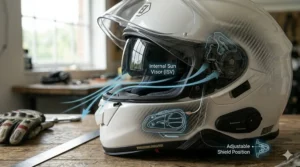
The QSV-2 internal sun visor is a game-changer that sport helmets simply don’t offer. A single thumb lever drops a tinted shield that covers your entire field of view — no reaching for sunglasses when riding into the afternoon sun, no stopping to swap shields. That convenience sounds minor until you’ve done 400 miles through variable lighting conditions.
Noise reduction: Shoei’s wind tunnel data shows the GT-Air 3 running quieter than its predecessor. For long-distance riders, noise accumulates into genuine fatigue — and the GT-Air 3 takes that seriously in a way that sport lids designed for track environments don’t need to.
SHOEI Comlink integration: Built-in intercom routing makes Sena SRL 3 installation clean and invisible. For touring riders traveling in groups or relying on GPS audio, this is the difference between a professional setup and a tangle of aftermarket brackets.
Who is this for? The premium touring rider, full stop. If you do multi-day trips, Iron Butt-style adventures, or simply value arriving at your destination feeling human — this is your helmet.
Buyer feedback: Owners consistently single out how quiet it is compared to previous lids. Most note it runs slightly large in the crown compared to the RF-1400 — try one size down if between sizes.
✅ Integrated QSV-2 sun visor
✅ Shoei Comlink for Sena SRL 3
✅ Wind-tunnel optimized for upright position
❌ No Snell certification (DOT only)
❌ Heavier than sport lids
Price range: Around $600–$700. Worth it if touring is your primary discipline.
6. Bell Qualifier DLX MIPS — The All-Around Value King
Not everyone needs a $600 helmet. Some riders — commuters, weekend explorers, newer riders building their kit — need something that delivers genuine safety, real comfort, and enough features to not feel compromised. The Bell Qualifier DLX MIPS is that helmet, and it’s exceptional at its job.
MIPS: The Multi-directional Impact Protection System adds a low-friction layer between the helmet shell and your head that allows the helmet to rotate slightly on oblique impact — reducing rotational brain forces. Until recently, MIPS appeared only in premium helmets. Finding it in a sub-$200 lid is remarkable.
Transitions shield: The photochromic face shield that automatically darkens in UV light is genuinely useful — the kind of feature that makes you wonder why every touring helmet doesn’t offer it. It solves the sun-visor problem without adding weight or mechanical complexity.
Touring orientation: The Qualifier DLX is shaped for an upright rider. It’s not trying to be a sport helmet — the wind management and comfort padding are tuned for commuters and casual touring riders who aren’t spending extended time tucked behind a fairing.
What most buyers overlook: the Qualifier DLX runs slightly louder than premium touring lids at freeway speeds. That’s a real trade-off for the price. If you’re doing 150+ mile days regularly, consider investing up to the GT-Air 3. But for sub-100 mile trips, commuting, and weekend riding? This hits harder than anything in its price bracket.
Buyer feedback: Overwhelmingly positive at the price point. Buyers consistently recommend sizing up one size. The D-ring chin strap earns mixed reviews — some love it, others want a micrometric buckle.
✅ MIPS rotational impact protection
✅ Transitions photochromic shield
✅ Excellent value under $200
❌ Louder than premium lids at speed
❌ D-ring strap — polarizing
Price range: Around $150–$200. The best safety-per-dollar ratio in this roundup.
7. Scorpion EXO-R420 — Budget Sport Done Right
The EXO-R420 is Scorpion doing something most budget helmet makers don’t: taking aerodynamics seriously at a price that actually respects your wallet. That big rear spoiler isn’t decorative. It’s there to reduce lift — the upward force that, at highway speed, tries to pull your head off your neck. Real lift reduction means less fatigue. And at under $200, that’s rare.
Shell: Advanced polycarbonate — not carbon fiber, not fiberglass, but an engineered polycarbonate that Scorpion has specifically tuned for impact dispersal. Dual safety certification covers both DOT and Snell — and yes, a sub-$200 helmet with Snell is nearly unheard of.
Ventilation: Multiple intake and exhaust ports with speaker pockets pre-cut into the liner. The airflow is designed for more aggressive riding postures, which classifies this as sport-leaning — but the shell’s upright tolerance makes it functional for shorter touring segments.
Comm-ready design: Speaker pockets and channel routing are built in, which at this price point is a thoughtful touch for commuters who want intercom without a premium helmet.
What most buyers overlook: the EXO-R420 fits closer to a sport profile than a touring one, but it’s genuinely comfortable for rides up to 2–3 hours. Beyond that, the lack of an internal sun visor and slightly aggressive chin bar orientation starts to add up. Use it as a sport/commuter hybrid, and it overperforms spectacularly.
Buyer feedback: Riders love the sport aesthetics and the surprisingly low noise levels given the price. The interior liner draws consistent praise — anti-bacterial fabric that stays fresh longer than competitors at this level.
✅ Snell + DOT dual certified — rare at this price
✅ Aerodynamic rear spoiler for reduced lift
✅ Comm-ready with speaker pockets
❌ No internal sun visor
❌ Not ideal for full-day touring
Price range: Under $190. The best budget sport full face on Amazon.
🏍️ Rider Profiles: Which Helmet Actually Suits You?
Option D: Buyer’s Decision Framework
Choosing between a sport and touring full face helmet is easier when you know exactly who you are as a rider. Here are four profiles — see which one you recognize yourself in.
The Canyon Carver: You ride a sport bike. Your weekends involve passes, elevation changes, and corners you’ve memorized. You spend most of your time in a semi-aggressive crouch. → You want the Shoei RF-1400 or Bell Race Star Flex DLX. Touring helmets will flap and buffet at the speeds and postures you’re operating at. The aerodynamics simply aren’t designed for your riding position.
The Iron Butt Aspirant: You own panniers. You’ve done 500-mile days. Your GPS has more routes saved than your contacts list has names. → You need the Shoei GT-Air 3, full stop. The integrated sun visor, noise engineering, and Comlink system aren’t extras — they’re survival gear for the long haul.
The Sport-Tourer: You own one motorcycle that does everything — maybe a Yamaha MT-10, a Ducati Multistrada, a KTM Super Duke GT. Some weekends it’s canyons; some weekends it’s five-hour highway blasts. → The AGV K6 S or HJC RPHA 70 Carbon is built for exactly your contradiction. Light enough for sport riding, comfortable enough for touring.
The Budget-Conscious Commuter: You ride to work, do occasional weekend trips, and need a lid that does everything without forcing you to choose between rent and gear. → Bell Qualifier DLX MIPS under $200, or the Scorpion EXO-R420 if your commute has any sport character. Both punch absurdly above their price.
⚙️ How to Choose the Right Full Face Helmet: A Step-by-Step Framework
Buying a full face helmet without a decision process is how people end up with the wrong lid and a receipt they can’t return. Here’s how to approach it rationally.
Step 1 — Define your primary riding style. Not your aspirational riding style. Your actual, current, most-frequent riding. Are you mostly highway? Mostly sport? Mixed? That answer determines which product category you start in.
Step 2 — Check your head shape. Most riders are intermediate oval (slightly longer front-to-back than side-to-side). Shoei and Bell tend to fit intermediate ovals well. AGV runs narrower. HJC is more rounded. Getting this wrong means pressure points that turn into migraines on long rides. Always try before buying if possible — or order from Amazon’s return-friendly listings.
Step 3 — Identify your certification needs. For street riding, DOT is the legal minimum in the US, per NHTSA motorcycle safety guidelines. For track days, most venues require Snell M2020 certification. Know which you need before filtering by price.
Step 4 — Decide on sun visor priority. If you ride in variable light — morning commutes, afternoon returns — an internal sun visor is nearly essential. That automatically steers you toward touring lids. If you’re always in controlled conditions or happy with a photochromic shield, sport helmets become viable.
Step 5 — Set a real budget. Not what you wish you could spend — what you actually will. Then add 15%. Serious safety gear has a habit of revealing its value at the worst possible moment. The Snell Memorial Foundation publishes test data on certified helmets that’s worth reviewing before committing at any price point.
Step 6 — Consider future-proofing. If you think you might want intercom integration in the next 12 months, choose a helmet with pre-built Bluetooth routing now. Retrofitting it later is expensive and ugly.
Step 7 — Verify fit at home. When your Amazon order arrives, wear the helmet for 30 minutes without riding. If any pressure points develop — temples, crown, chin bar — exchange it. A helmet that hurts at rest will be torture by mile 100.
🔬 What to Expect: Real-World Performance vs. the Spec Sheet
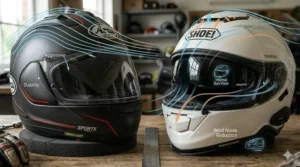
The spec sheet on any helmet will tell you it has “superior ventilation” and “advanced aerodynamics.” What it won’t tell you is that sport helmet ventilation is optimized for tucked riding positions — meaning the chin-bar vents that channel air across the face shield only work properly when you’re leaning forward. Sit upright on a cruiser or ADV bike with a sport helmet, and those vents become decorative.
Similarly, “wind noise reduction” in a touring helmet is engineered for a neutral head position. Lean hard into a sport bike’s geometry with a touring lid, and the aerodynamics work against you — air catches the upright-shaped chin bar and causes buffeting that gets worse, not better, at speed.
Ventilation and noise both behave differently at low speed vs. highway speed. A helmet that feels magnificently airy at 45 mph might become a wind tunnel at 80 mph. The helmets in this list — particularly the RF-1400, GT-Air 3, and K6 S — are products of serious wind tunnel development, which is why their performance remains consistent across a speed range.
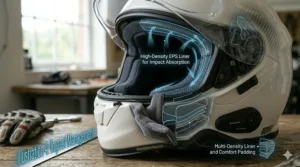
One more thing the spec sheet won’t tell you: the difference between EPS densities. Multi-density EPS foam — found in the K6 S, RPHA 70 Carbon, and RF-1400 — uses different foam densities in different zones to manage both low-speed and high-speed impacts. Single-density EPS, common in budget helmets, manages impacts less efficiently outside its narrow optimized range. Both can be DOT certified. Only one is optimized for the chaotic reality of a real crash.
🚫 Common Mistakes When Buying a Full Face Helmet
Buying on aesthetics alone. The boldest graphic in the shop might be on the helmet that fits your head shape worst. Graphics are a finish coat. Fit, certification, and construction come first — always.
Ignoring shell sizes. Premium helmets often use multiple shell sizes to ensure the EPS liner is appropriately proportioned to your actual head. Budget helmets often use one or two shell sizes for all head sizes, with the fit difference made up entirely in foam thickness. Less EPS where you need it most is not the compromise you want.
Assuming price = safety. The Snell Memorial Foundation and SHARP (UK) publish independent impact test data. A $180 Scorpion EXO-R420 with Snell certification has been tested harder than many $400 helmets with only DOT. Use the data.
Buying a sport helmet for touring, or vice versa. We’ve said this, but it bears repeating: mismatching your helmet to your riding style doesn’t just affect comfort. At extended highway speeds, a sport helmet on an upright rider can develop real aerodynamic lift. That’s a safety issue, not just a fatigue issue.
Skipping the return policy check. Helmet fit changes as the liner breaks in. Most Amazon purchases allow returns within 30 days. Make sure yours does before you commit.
❓ Frequently Asked Questions
❓ What is the main difference between a sport and touring full face helmet?
❓ Can I use a sport full face helmet for long-distance touring?
❓ Is Snell certification worth the extra cost in a full face helmet?
❓ How do I know if a full face helmet fits correctly?
❓ What does MIPS mean in a motorcycle helmet, and do I need it?
The Verdict: Making Peace With the Sport vs Touring Full Face Helmet Decision
Here’s the honest truth after all of this: the best sport vs touring full face helmet isn’t a universal answer. It’s the one that matches your actual riding — not the riding you aspire to, not the riding you did five years ago, not the riding your friend does. Yours.
If you’re a pure sport rider: the Shoei RF-1400 is the benchmark you’re measuring everything against, and the Bell Race Star Flex DLX is the serious alternative with track-day credentials. If you tour for days at a time, the Shoei GT-Air 3 is not a luxury — it’s an investment in arriving at your destination functional rather than destroyed. And if you live in that glorious middle ground of sport-touring, the AGV K6 S is an argument made in carbon fiber that you shouldn’t have to choose.
Budget constrained? The Bell Qualifier DLX MIPS at under $200 is genuinely impressive. The Scorpion EXO-R420 reminds you that DOT and Snell certification don’t require a second mortgage.
Whatever you choose — wear it, every single time.
✨ Don’t Miss These Exclusive Deals!
🔍 Take your riding to the next level with these carefully selected helmets. Click any highlighted product above to check current pricing and availability on Amazon.
🔗 Recommended for You
- 7 Best Multi-Material Composite Helmets 2026
- 7 Best Fiberglass Composite Shell Helmets for Ultimate Protection 2026
- 7 Best Ultra-Light Protection Helmets That Eliminate Neck Fatigue in 2026
Disclaimer: This article contains affiliate links. As an Amazon Associate, I earn from qualifying purchases. If you purchase products through these links, we may earn a small commission at no additional cost to you.
✨ Found this helpful? Share it with your friends! 💬🤗
