
In This Article
Affordable adventure riding boots are CE-rated, ankle-protecting, waterproof-lined boots for mixed pavement-and-dirt riding, typically priced between roughly $150 and $350. They trade a little polish and a few premium materials for solid abrasion resistance, impact protection and all-day walkability, without the four-figure bill.
Here’s the uncomfortable truth about boot shopping: your feet are the first thing a fall tends to find. Yet most riders drop four figures on a bike, another grand on a jacket, and then cheap out on the one piece of gear that lives between the footpeg and the planet.
The good news is that you don’t have to. A motorcycle boot is defined less by its price tag than by its construction: a stiff shank, ankle armor, a shin plate, a grippy sole and a rating you can verify. Plenty of sub-$350 pairs deliver those basics.
This guide ranks seven real, currently sold options. It also tackles the three questions that actually decide a purchase: the price vs protection tradeoff, which warranty terms are worth trusting, and how to judge boot longevity before you’ve put a single mile on them. Think of it as budget ADV gear picks with a spine.
One honest note up front: everything here comes from spec sheets, retailer listings and published reviews, not from us wearing the boots. Where a review pool couldn’t be verified, we say so.
Quick Comparison: Affordable Adventure Riding Boots at a Glance
| Boot | Best For | Price Range | Height | Waterproofing |
|---|---|---|---|---|
| FirstGear Timbuktu | Tightest budgets | Around $150 | Short | Waterproof membrane |
| Alpinestars Ridge V2 WP | Commuting plus gravel | $180–$200 | Short | Drystar membrane |
| TCX Drifter WP | Leather traditionalists | $240–$380 (varies with sales) | Tall | Waterproof lining |
| Forma Adventure | Best value in full-height | $250–$320 | Tall | Drytex lining |
| Alpinestars Corozal V2 Adventure Drystar | Long tours, mixed terrain | $300–$320 | Tall | Drystar membrane |
| Fox Defend ADV | Walkable ankle boot with dial closure | $300–$345 | Short | Gore-Tex |
| Sidi Adventure 2 Gore-Tex | The “spend more” benchmark | $400–$450 | Tall | Gore-Tex |
The spread tells a clear story. Below $200 you’re buying short boots with synthetic uppers, and from about $250 you start getting full-height leather. Above $300 the jump is mostly waterproofing quality and refinement, not a dramatic leap in crash protection.
If your budget is firm, the Forma Adventure and the TCX Drifter WP are the sweet spot, provided you catch the TCX Drifter WP on a discount. Prices fluctuate, so check current pricing before you commit.
💬 Just one click — help others make better buying decisions too!😊
Top 7 Affordable Adventure Riding Boots: Expert Analysis
1. FirstGear Timbuktu — the cheapest door into real ADV protection
The FirstGear Timbuktu is the “I need something CE-rated before this weekend” boot. It’s a short adventure boot with a synthetic action-leather upper, a waterproof membrane, a mesh liner, and reinforcement at the ankle, toe and heel.
Those specs matter in practice. A rubber shift guard saves the left toe box from the slow grind of upshifting, and the flex zone at the ankle makes walking to the coffee counter feel less like wearing ski gear. The boots carry CE EN 13634:2017 certification, which is the baseline you want from any riding footwear.
Our analysis: this is a commuter-meets-gravel boot, not a river-crossing boot. WebBikeWorld places it in its entry-level adventure and touring tier for packing plenty of features into a small price. We couldn’t verify a large pool of owner reviews, so treat longevity claims cautiously.
Pros:
- ✅ CE EN 13634:2017 rating at a bargain price
- ✅ Waterproof membrane and breathable liner
- ✅ Easy-entry buckle plus hook-and-loop strap
Cons:
- ❌ Synthetic upper likely wears faster than leather
- ❌ Stock can be patchy at some retailers
Price range: around $150, which makes the FirstGear Timbuktu a strong value if you ride mostly pavement and light dirt.
2. Alpinestars Ridge V2 WP — the light, brand-name commuter
The Alpinestars Ridge V2 WP is the boot you can wear all day and forget about. It’s a lightweight tech-touring boot built from abrasion-resistant microfiber, with Alpinestars’ Drystar waterproof membrane.
The details carry weight: dual-density ankle protectors, a double-layer shin plate, a TPU-injected shift pad, perforated accordion panels for ventilation, and a vulcanized rubber sole that wraps up the sides. Practically, you get proper armor in a package that rides under pant legs and walks like a sneaker.
The analysis is straightforward. This is the right call if your “adventure” is a gravel road to a trailhead, not a week of mud. One retailer’s own fine print also reminds buyers that a membrane isn’t unlimited waterproofing, which is worth remembering during creek crossings.
Review sentiment is glowing but thin: a 4.9 out of 5 average from just ten reviews on one retailer page. That’s encouraging, not conclusive.
Pros:
- ✅ Light and comfortable straight out of the box
- ✅ Real ankle and shin armor in a short boot
- ✅ Established brand with a large dealer network
Cons:
- ❌ Short shaft means less lower-leg coverage
- ❌ Not suited to deep water or heavy off-road use
Price range: $180–$200. For commuter-adventure riders, the Alpinestars Ridge V2 WP is one of the cleaner value propositions here.
3. TCX Drifter WP — full-grain leather at a discount-friendly price
The TCX Drifter WP looks like a boot your grandfather’s riding buddy would respect, and it works like one. It uses a full-grain leather upper, aluminum buckles, polyurethane shin plates, malleolus (ankle bone) inserts and a lugged sole.
That lug sole is the quiet hero: it grips wet rock and shifts without slipping, and the suede calf guard protects your leather from frame abrasion. GearJunkie’s review notes CE Level 2 certification and says the redesigned buckle system fixed the main flaw of the earlier model.
Our take is that it’s best for riders who want a boot that ages gracefully, though that leather gets heavy once soaked. A GearJunkie tester found the boots stayed dry but felt sluggish when saturated. At RevZilla, riders have collectively rated the boot 4.5 out of 5 across about 142 reviews, and sizing is described as true to size.
Pros:
- ✅ Durable full-grain leather with a vintage look
- ✅ Metal buckles hold well under strain
- ✅ Lugged sole grips on and off the bike
Cons:
- ❌ Waterlogged leather becomes heavy and slow to dry
- ❌ List price runs higher than the street price
Price range: $240–$380 depending on sales. Buy the TCX Drifter WP on a discount, not at list.
4. Forma Adventure — the full-height value benchmark
The Forma Adventure is the boot most “best value” lists keep returning to, and for good reason. WebBikeWorld highlights its oiled full-grain leather, Drytex waterproof lining and sensible armor placement as the best value in the mid-range.
Here’s what the spec list means on the road. A stainless steel shank adds sole stiffness, replaceable GH plastic buckles can be swapped when they break, and TPU ankle and shin protection sits under a CE Level 2 rating. Memory-foam padding keeps the cuff comfortable on long days.
There’s one honest caveat. Forma’s own notes warn that the lightweight sole isn’t recommended for kick-start bikes or aggressive motocross-style pegs, and an Indian test report called the soft sole awkward for standing on the pegs. Riders in a Swiss-and-US forum sample also mention the boots run a bit small.
The sentiment is strong: UK retailer Sportsbikeshop reported a 4.8 out of 5 average across its first 183 reviews, though that data is a few years old.
Pros:
- ✅ Oiled full-grain leather with CE Level 2 protection
- ✅ Replaceable buckles extend service life
- ✅ Excellent protection-per-dollar ratio
Cons:
- ❌ Soft sole is less ideal when standing on pegs
- ❌ May run a half size small
Price range: $250–$320. If you’re spending once and want a full-height boot, the Forma Adventure is a hard pick to beat.
5. Alpinestars Corozal V2 Adventure Drystar — the do-it-all touring boot
The Alpinestars Corozal V2 Adventure Drystar sits where adventure meets touring, and it plays both parts convincingly. Listings describe a polymer shin plate, lateral ankle protection, and foam padding around the ankle and collar.
In practice, that foam-and-plate combination translates to shock absorption on rough pavement and a boot that doesn’t punish your calf on day four of a trip. The Drystar membrane keeps rain out without the cost of Gore-Tex.
Our analysis: this is a “one boot for the whole trip” choice, and the extra cost over the Forma Adventure buys brand support and a waterproof membrane. Sportsbikeshop customers report that it accommodates larger calves and becomes extremely comfortable after the break-in period, though the review pool was small at 17 reviews (4.8 out of 5).
Pros:
- ✅ Roomy calf fit and comfortable once broken in
- ✅ Polymer shin plate and ankle armor
- ✅ Drystar waterproofing at a mid-range price
Cons:
- ❌ Break-in period can feel stiff
- ❌ Costs more than the budget picks above
Price range: $300–$320. The Alpinestars Corozal V2 Adventure Drystar earns its spot as the “upper end of affordable” choice.
6. Fox Defend ADV — the walkable ankle boot with a dial closure
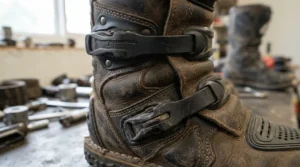
The Fox Defend ADV is for riders who want an adventure boot they can actually walk in. It’s an ankle-height design with a Gore-Tex upper, D3O impact foam in the tongue and ankle, a nylon-fiberglass insole board and a TPU heel counter.
The D3O foam is soft until impact and then stiffens, so you keep comfort without losing protection. The EVA midsole and UltraTac outsole give a confident feel on the pegs, and Fox builds the boot on the same last as its motocross boots for consistent sizing.
The analysis is mixed but honest. GearJunkie’s tester liked the comfort, weather protection and durability, but found the single BOA dial needed frequent retightening during aggressive riding and raised a redundancy concern if the dial fails. If you’re torn on price, Fox also sells a lower-priced Fox Ranger ADV with many of the same construction cues, though we couldn’t verify detailed specs.
Pros:
- ✅ Gore-Tex upper with D3O impact foam
- ✅ Walkable, snug fit with micro-adjustable closure
- ✅ Same last as Fox motocross boots for consistent sizing
Cons:
- ❌ Single BOA dial can loosen during technical riding
- ❌ Ankle height means less shin coverage
Price range: $300–$345. The Fox Defend ADV suits trail-and-travel riders who value off-bike comfort.
7. Sidi Adventure 2 Gore-Tex — the benchmark that shows what extra money buys
The Sidi Adventure 2 Gore-Tex isn’t affordable by the strictest definition, but it’s the most useful yardstick for the price vs protection tradeoff. It’s a round-toe adventure boot with Gore-Tex and all-around protection at the sides, front and toe.
What do you get for roughly $100 more than the mid-range? Gore-Tex waterproofing, a refined structure and a famous reputation. Sportsbikeshop customers rated it 4.9 out of 5 across its first 186 reviews, and a roundup of Amazon feedback pegged it near 4.5 out of 5 with praise for easy entry and ankle protection. The same UK retailer mentions the well-known “Sidi squeak.”
Our take is that this boot makes sense if you ride year-round in the rain. For most budget buyers, the Forma Adventure or Alpinestars Corozal V2 Adventure Drystar capture roughly 85% of the benefit.
Pros:
- ✅ Gore-Tex waterproofing and strong reputation
- ✅ Highly rated by a large review pool
- ✅ Solid protection across sides, front and toe
Cons:
- ❌ Costs significantly more than other picks
- ❌ Squeak noted by some owners
Price range: $400–$450. The Sidi Adventure 2 Gore-Tex is a worthwhile stretch only if you ride in serious weather.
Top 7 Comparison: Features and Review Signals
| Boot | Key Protection and Features | Review Signal | Best For |
|---|---|---|---|
| FirstGear Timbuktu | Ankle, toe and heel reinforcement; shift guard | No verified review pool | Light-duty budget riding |
| Alpinestars Ridge V2 WP | Dual-density ankle protectors; double-layer shin plate | 4.9/5 from 10 reviews (small sample) | Commuter-adventure mix |
| TCX Drifter WP | Malleolus inserts; PU shin plates; CE Level 2 | About 4.5/5 from roughly 142 reviews | Leather lovers |
| Forma Adventure | Steel shank; TPU ankle and shin; CE Level 2 | 4.8/5 from first 183 UK reviews | Best overall value |
| Alpinestars Corozal V2 Adventure Drystar | Polymer shin plate; lateral ankle protection | 4.8/5 from 17 UK reviews | Long tours |
| Fox Defend ADV | D3O foam; TPU heel counter; nylon-fiberglass insole board | Single-source tester review | Walkable ankle boot |
| Sidi Adventure 2 Gore-Tex | Gore-Tex; all-around protection | 4.9/5 from 186 UK reviews | Wet-weather riders |
Read the review column with caution: the pools differ in size and come from different regions and years. The Forma Adventure and Sidi Adventure 2 Gore-Tex have the largest verified samples, which makes their scores more trustworthy than the tiny Alpinestars Ridge V2 WP pool. If you value consensus over hype, lean on those two.
How to Choose Affordable Adventure Riding Boots
Follow these steps in order, and the shortlist tends to build itself:
- Confirm the CE rating. Look for EN 13634:2017 on the label, and prefer Level 2 where you can find it. Marketing words aren’t certification.
- Match height to your riding. Short boots suit commuters; tall boots add shin and calf coverage on long trips and dirt.
- Decide how waterproof you really need. A membrane is fine for showers, while Gore-Tex earns its money in sustained rain.
- Check the sole. Soft soles walk well but are awkward for standing on pegs, so match the sole to how much you stand.
- Choose the closure that suits your hands. Buckles are robust, hook-and-loop is quick, and a dial is neat until it slips.
- Look for replaceable parts. Swappable buckles and insoles stretch your investment.
- Verify warranty terms before checkout. More on that shortly.
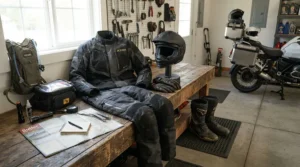
The Price vs Protection Tradeoff: What Your Money Actually Buys
The price vs protection tradeoff is less steep than marketing suggests. Crash protection, meaning abrasion resistance, impact armor and shank stiffness, is largely set by the certification test. Many budget boots pass the same EN 13634 test as pricier ones.
Where the extra money goes is comfort, waterproofing quality, refinement and brand support. The Sidi Adventure 2 Gore-Tex costs roughly twice the Alpinestars Ridge V2 WP, yet the standard tests don’t reward it twice as much.
The smart way to read the price vs protection tradeoff is to spend your first dollars on the boot’s height, rating and fit, and your extra dollars on waterproofing and comfort. The Forma Adventure shows how far a mid-range price can stretch.
What the spec sheet won’t tell you, but the standard does: the label’s four-digit code shows how a boot scored on abrasion, cut, transverse rigidity and impact absorption. Compare codes before you compare prices.
Affordable Adventure Riding Boots vs Premium Boots
| Factor | Affordable (about $150–$350) | Premium (about $600+) |
|---|---|---|
| Upfront cost | Low to moderate | High (WebBikeWorld reports some models near $900) |
| Protection standard | Typically CE-certified | CE-certified, often with extra reinforcement |
| Waterproofing | Membranes, sometimes Gore-Tex | Usually Gore-Tex |
| Comfort and refinement | Good, with a break-in period | Excellent out of the box |
| Best For | Weekend riders, newer ADV riders | Year-round riders, expedition travel |
Premium boots win on polish and wet-weather reliability, but the safety gap is narrower than the price gap. For most riders, a Forma Adventure or TCX Drifter WP delivers the same core protection at a fraction of the cost.
If you ride 100 days a year in rough weather, premium can be rational; for 20 weekend days, it rarely is.
Reading the EN 13634 Label Like a Pro
The EN 13634 standard, titled “Protective footwear for motorcycle riders,” is the benchmark behind every CE boot. It tests abrasion, cut resistance, impact and rigidity. Higher numbers mean more protection, so the more 2s on the label, the better.
Optional marks add detail: IPA and IPS indicate tested ankle and shin impact protection, and WAD shows water-absorption performance. A boot with only the basics isn’t automatically bad, but one showing IPA and IPS has proven something extra.
Here’s the practical angle. Many CE-marked boots look alike on a retailer page, so open the product’s certification details and compare codes. If a seller won’t show them, move on.
Warranty Terms: What’s Actually Covered
Warranty terms are the least glamorous part of a boot purchase and the most revealing. They tell you how confident a maker is in its stitching.
Here’s what we could verify. Alpinestars lists a one-year manufacturer’s warranty against defects in materials and workmanship on US retail listings, while its European help center describes two years. The brand’s return policy also states that it doesn’t accept returns on products bought from other retailers, so warranty claims route through its product support team.
Forma’s US retailer listings cite 12 months, a Swiss retailer lists 24 months, and the Australian distributor offered a lifetime warranty on boots bought locally from January 2017. Coverage varies by country, so confirm locally.
We couldn’t verify the warranty terms for the FirstGear Timbuktu, TCX Drifter WP or Fox Defend ADV, so ask the seller directly.
A typical warranty excludes wear and tear and accidental damage. Alpinestars’ extended terms for some apparel state this explicitly and add that the warranty isn’t a guarantee of minimum lifespan. Read the fine print before assuming protection.
Boot Longevity: How to Judge It Before You Buy
Boot longevity depends on three things: what the boot is made of, which parts can be replaced, and how you treat it.
Full-grain leather, as on the Forma Adventure and TCX Drifter WP, generally ages more gracefully than synthetic microfiber, which can crack or delaminate. That said, synthetics dry faster and need less care, so durability and convenience pull in opposite directions.
Replaceable buckles and removable insoles are the hidden longevity wins. A broken buckle on a sealed boot ends the boot; on a Forma Adventure, it ends in a small parts order.
For boot longevity in the real world, expect a membrane to fade before the upper does. Sole wear is the other early casualty, especially if you hike in your boots.
Long-term cost matters too. A $150 boot replaced every two seasons costs more per year than a $280 boot that lasts six. Calculate cost per riding season, not cost per pair.

Budget ADV Gear Picks: Where Else to Save (and Where Not To)
Boots are only one line on a long gear list, so let’s talk budget ADV gear picks with some discipline.
Spend first on the pieces that protect bone: a certified helmet, boots and gloves. Save on pieces that provide comfort, such as luggage, heated grips and tank bags. Mid-priced textile jackets can be perfectly good, but a bargain helmet isn’t a bargain.
Smart budget ADV gear picks also include good socks, which are cheap and extend the life of waterproof liners by wicking moisture. A pair of merino or technical socks lowers sweat inside a membrane boot, which keeps a “waterproof” boot from feeling wet.
Finally, put aside a little for waterproofing spray and leather conditioner. These small maintenance items protect the investment behind the rest of your budget ADV gear picks.
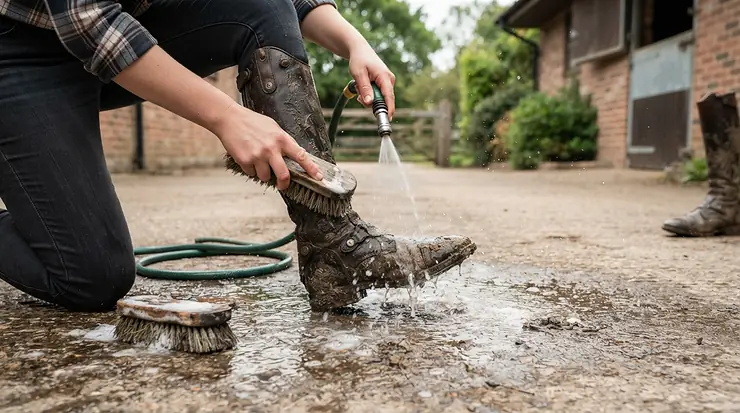
Practical Usage Guide: Break-In, Care and Waterproofing
New boots feel stiff, and that’s normal. Break them in for a week of short rides and walks before any multi-day trip.
Follow this routine:
- First 30 days: Wear them at home, adjust closures after the first hour and note pressure points before they become blisters.
- After wet rides: Let boots dry slowly at room temperature, away from heaters, which can damage leather and glue.
- Monthly: Wipe off grit, condition leather uppers, and treat synthetics with a gentle cleaner.
- Quarterly: Inspect stitching, buckles and sole edges.
Common mistakes include drying boots on a radiator, soaking them in strong solvents and skipping insole removal. Fix those, and boot longevity improves for almost no money.
For a deeper look at test-driven recommendations, GearJunkie’s motorcycle boots buyer’s guide is a useful second opinion.
Real-World Scenarios: Who Should Buy What
The commuter who explores on weekends. Eight miles of pavement daily, one gravel trail on Saturday. The Alpinestars Ridge V2 WP is light, protective and priced right.
The first-year ADV rider with a $300 ceiling. Mixed riding, some rain, a bit of mud. The Forma Adventure gives full-height protection and replaceable buckles.
The leather devotee. Want a boot that looks better at year three? Watch for a sale on the TCX Drifter WP.
The tour planner. Ten-day trip, varied weather. The Alpinestars Corozal V2 Adventure Drystar is built for long days.
The walker. Loads of off-bike time? The Fox Defend ADV favors walkability.
If you want absolute minimum spend, the FirstGear Timbuktu is your starting line.
Problem → Solution Guide: Common Boot Headaches
- Problem: Boots leak after a few months. Solution: Clean the membrane surface, re-treat the exterior, and check the tongue gusset for gaps.
- Problem: Hot spots on the shin. Solution: Adjust the closure, try thinner socks, and allow a longer break-in.
- Problem: Awkward on the pegs. Solution: If you stand often, favor a stiffer sole, because the Forma Adventure‘s soft sole isn’t ideal.
- Problem: Buckle snaps. Solution: Choose boots with replaceable hardware.
- Problem: Closure slips. Solution: With the Fox Defend ADV‘s dial, re-tighten at stops and carry a backup plan.
Frequently Asked Questions
❓ Are cheap adventure boots safe enough for off-road trips?
❓ How long do budget adventure boots usually last?
❓ Is Gore-Tex worth it in affordable adventure boots?
❓ What should I look for in boot warranty terms?
❓ Should I buy tall or short adventure boots?
Conclusion: Spend Smart, Ride Far
The best affordable adventure riding boots don’t pretend to be premium. They deliver certified protection, sensible waterproofing and honest build quality, and they let you spend the savings on things that make trips better.
Here’s the short version. For the leanest budget, go with the FirstGear Timbuktu. For a light commuter-adventure boot, choose the Alpinestars Ridge V2 WP. For the best all-round value, the Forma Adventure is hard to beat, with the TCX Drifter WP a worthy rival on sale. For long tours, the Alpinestars Corozal V2 Adventure Drystar fits, and for walkable comfort, the Fox Defend ADV delivers. The Sidi Adventure 2 Gore-Tex is the benchmark if you’d rather stretch.
Remember the three levers: the price vs protection tradeoff, the fine print of warranty terms, and the habits that drive boot longevity. Get those right, and a pair of affordable adventure riding boots will serve you for years.
✨ Ready to gear up?
🏍️ Click any highlighted boot above to check current pricing and availability, and take your next ride with confidence!
Recommended for You
- Adventure Boots For Street And Dirt: 7 Ultimate Picks (2026)
- Budget Dual Sport Motorcycle Boots: 7 Proven Picks For 2026
- Off-Road Motorcycle Boots For Trail Riding: 7 Proven Picks (2026)
Disclaimer: This article contains affiliate links. As an Amazon Associate, I earn from qualifying purchases. If you purchase products through these links, we may earn a small commission at no additional cost to you.
✨ Found this helpful? Share it with your friends! 💬🤗
