
In This Article
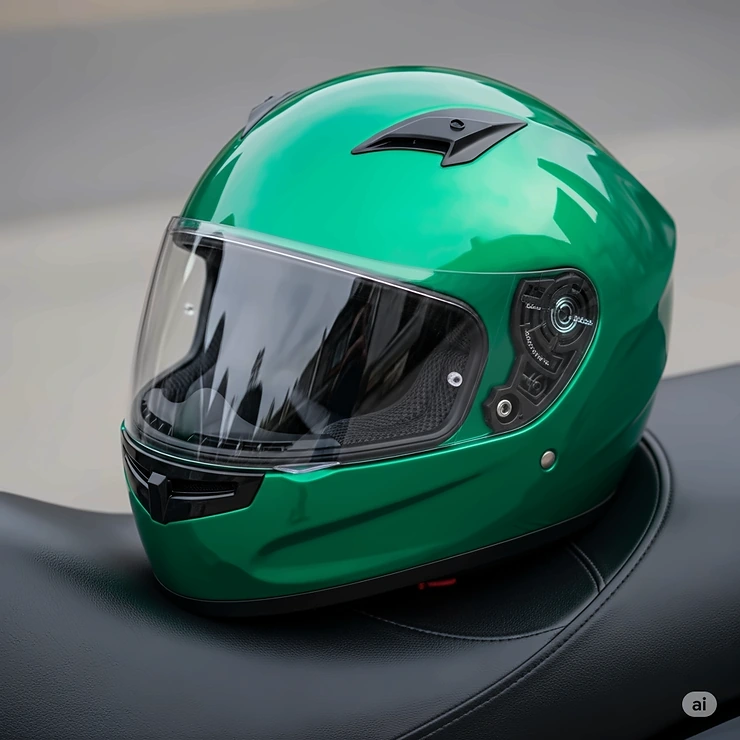
A green motorcycle helmet is any road- or trail-rated head protector finished in a shade of green. That runs from matte olive and forest to metallic British racing green and fluorescent lime. The color is cosmetic. What protects you is the certification (DOT, ECE 22.06, Snell), the shell construction, and a fit that doesn’t wobble.
Green is a wonderfully odd choice. It’s Kawasaki’s signature, the color of army-surplus adventure kit, and the shade of a certain Steve McQueen-inspired retro lid. It can shout like neon lime or whisper like moss. Retailers carry dozens of options, from budget full-face shells to four-figure race helmets.
Color does have a safety angle. A case-control study published in the BMJ found that riders in white helmets had a 24% lower crash-injury risk than riders in black ones, and light helmets beat dark ones by 19%. That study didn’t isolate green, so treat any green-specific visibility claim as informed reasoning, not proof.
A note on method: this guide is built from spec sheets, retailer listings, and aggregated reviews, not hands-on testing. Every price below is a range, because prices move constantly. Check current price and confirm the exact colorway and certification before you buy.
Quick Comparison: 7 Green Motorcycle Helmets at a Glance
| Helmet | Style | Certifications | Weight (approx.) | Price Range | Best For |
|---|---|---|---|---|---|
| HJC C10 | Full face | ECE 22.06 (verify DOT on U.S. version) | Not verified | Under $200 | New riders, pillions |
| HJC i10 | Full face | DOT + Snell | 3.6–3.8 lbs | ~$160–$195 | Budget commuters |
| Bell Custom 500 | Open face (3/4) | DOT / ECE | ~2.2 lbs (982 g, M) | ~$180–$230 | Retro cruisers |
| Bell MX-9 Adventure MIPS | Adventure | DOT + ECE 22.05 | ~3.7 lbs | ~$230–$290 | Dual-sport riders |
| Biltwell Gringo S | Retro full face, flip shield | DOT + ECE 22.06 | ~3.5 lbs | Upper-$200s | Café and cruiser looks |
| Shoei RF-1400 | Sport-touring | DOT + Snell | ~3.6 lbs | Mid-$600s to high-$700s | Long-haul comfort |
| Bell Race Star Flex DLX | Race / sport | DOT + Snell | ~3.6 lbs | ~$950–$1,000 | Track days, spirited riding |
Read the table by tier. The HJC C10 and HJC i10 are the value plays, the Bell Custom 500, Bell MX-9 Adventure MIPS and Biltwell Gringo S are the personality picks, and the Shoei RF-1400 and Bell Race Star Flex DLX are the premium end. The weights barely vary, so the price gap buys refinement (noise, ventilation, shell construction) more than lightness.
💬 Just one click — help others make better buying decisions too!😊
Top 7 Green Motorcycle Helmets: Expert Analysis
Each pick below pairs real specs with what they mean on the road, plus aggregated review sentiment from public sources. Green availability changes by size and season, so confirm the colorway you want is in stock.
1. HJC C10 — ECE 22.06 protection on a starter budget
The HJC C10 proves a budget green motorcycle helmet doesn’t have to feel like a compromise. It’s built on a polycarbonate composite shell offered in three shell sizes, so smaller heads don’t wear an oversized bucket. The wide visor opening improves your shoulder-check sightline, and the HJ-34P visor is Pinlock-ready (the insert is sold separately). Green options include Tez Green, Tez Khaki Green and black-and-green graphics.
Based on the spec comparison, this is the pick for new riders, commuters and pillions who want green without a premium bill. Check the DOT mark on the exact U.S. version before checkout, because many green listings I found were UK or European. Reviewers at a UK retailer consistently describe a comfortable, true-to-size fit, quiet motorway riding and strong value.
Pros:
- ✅ ECE 22.06 certification at a budget price
- ✅ Wide-view visor opening
- ✅ Several green colorway options
Cons:
- ❌ No built-in sun visor
- ❌ Pinlock insert sold separately
Price range: under $200, check current price. For first-time buyers, that’s excellent value.
2. HJC i10 — Snell-approved and easy on the wallet
The HJC i10 is a rare thing: a Snell-approved full-face helmet at a commuter price. It uses a polycarbonate composite shell and weighs roughly 3.6–3.8 lbs depending on size. The Snell rating means extra voluntary impact testing beyond DOT. Black/green graphics (Strix, Pitfall, Taze) have appeared in the lineup, often as closeout stock.
What the spec sheet won’t tell you: it includes glasses grooves, which matter a lot for riders in eyewear. The visor is Pinlock-compatible, but the insert isn’t in the box, per one hands-on review. Reviewers on RevZilla rate it roughly 4.5 out of 5 across several hundred reviews, praising comfort, snug fit and ventilation. One review notes it gets louder at highway speed.
Pros:
- ✅ DOT plus Snell approval
- ✅ Glasses-friendly interior
- ✅ Pinlock-compatible clear visor
Cons:
- ❌ Wind noise rises at higher speeds
- ❌ No internal sun visor
Price range: roughly $160–$195 list, with closeout green graphics sometimes near $100. Strong value if the green you want is in stock.
3. Bell Custom 500 — retro open-face style with racing-green swagger
The Bell Custom 500 is the lightweight classic, and the Steve McQueen Riverside Metallic Green edition is the one that turns heads. Bell lists it at about 982 g (±50) in a medium. That’s far lighter than a full-face and easy on the neck over a long day. It comes in five shell and EPS sizes, which keeps the profile small and the fit more tailored.
The tradeoff is physical: no chin bar means less facial protection and more wind exposure than any full-face here. The shell accepts snap-on shields, so a bubble visor helps with bugs and rain. Bell’s own review pool leans positive on style, fit and value. A few riders say sizing runs small, and one European reviewer reported the leather trim peeling after a year.
Pros:
- ✅ Very light for all-day wear
- ✅ Five shell sizes for a low-profile fit
- ✅ Authentic retro metallic green finish
Cons:
- ❌ No chin protection
- ❌ Some reports of trim wear
Price range: roughly $180–$230 for the green edition, check current price. A fair price if you value looks and low weight over coverage.
4. Bell MX-9 Adventure MIPS — green-and-orange versatility for dirt and pavement
The Bell MX-9 Adventure MIPS is the do-it-all option, and Bell has offered it in a green/orange colorway. It adds a MIPS liner, an adjustable peak that detaches with three thumb screws, and an integrated clear shield with anti-fog and anti-scratch treatment. It’s DOT and ECE 22.05 approved but not Snell-rated.
Think of it as a helmet that rewards mixed-terrain riders and punishes anyone who rides highways all day. Reviewers consistently note the weight (Bell lists about 1,698 g in a medium, and one UK reviewer found a size small close to 1,765 g) and wind noise at speed. Shoppers on RevZilla rate it around 4 out of 5 across roughly 100 reviews.
Pros:
- ✅ MIPS rotational protection included
- ✅ Goggle-friendly removable peak
- ✅ Comfortable intermediate-oval fit
Cons:
- ❌ Heavy over long rides
- ❌ Noticeable wind noise at highway speed
Price range: roughly $230–$290, check current price. A solid buy for new adventure riders.
5. Biltwell Gringo S — 70s style with modern ECE 22.06 safety
The Biltwell Gringo S takes the retro full-face look and adds a flip-up polycarbonate shield. The 22.06 version meets both DOT and ECE 22.06. It uses an injection-molded ABS shell and weighs about 3.54 lbs. A Sierra Green listing has turned up at retailers, but green availability varies, so verify the exact color on the 22.06 model.
Honest analysis: this is a style-first helmet that no longer sacrifices protection. The fit is snug, and Biltwell sells different cheek pad thicknesses to fine-tune it. Reviewers note a tight fit and tricky sizing, and a review of the SV sibling flagged a fiddly shield lock and D-ring. RevZilla shows about 4 out of 5 from roughly 40 reviews. Note that old Gringo S shields won’t fit the 22.06 version.
Pros:
- ✅ DOT plus ECE 22.06 certification
- ✅ Flip-up shield included
- ✅ Adjustable cheek pad options
Cons:
- ❌ Sizing can be tricky
- ❌ Shield and strap hardware feel fiddly
Price range: upper-$200s, check current price. Worth it if the retro look is the point.
6. Shoei RF-1400 — the sport-touring benchmark in green graphics
The Shoei RF-1400 is a premium all-rounder, and its Capriccio graphic comes in black/green/grey and grey/purple/green. It’s DOT and Snell approved, weighs about 3.62 lbs, and comes in four shell sizes. It has dual-density EPS, a Max-Dry liner, and a Pinlock-style anti-fog insert in the box.
The practical win is refinement. Shoei emphasizes noise reduction, aerodynamics and ventilation, and the benefit is less fatigue on long days. Retailers now list it as discontinued in favor of the RF-1500, so green stock may be leftover sizes and graphics. Shoppers on RevZilla rate the RF-1400 about 4.5 out of 5 across more than 800 reviews, with comfort and quietness as recurring themes.
Pros:
- ✅ DOT and Snell approved
- ✅ Anti-fog insert included
- ✅ Strong noise and aero engineering
Cons:
- ❌ Premium pricing
- ❌ Green sizes selling out as stock clears
Price range: mid-$600s to high-$700s, check current price. Expensive, but the cost per year is reasonable if you ride a lot.
7. Bell Race Star Flex DLX — race-grade protection with a carbon shell
The Bell Race Star Flex DLX is the track-day option. It has a 3K carbon shell, a three-layer Flex impact liner and a Panovision ProTint photochromic shield in the box. It’s Snell M2020 and DOT approved, and Gear Patrol’s guide notes a top 5/5 SHARP rating. Green appears in Bell’s race graphics (a white/hi-viz green/blue Race Star DLX Sector graphic turned up in an open-box listing), so availability depends on the graphic.
Here’s the surprise: at about 3.57 lbs, carbon doesn’t make it lighter than the HJC i10 or Shoei RF-1400. You’re paying for protection tech and shield quality. It’s a race-fit helmet, snug and narrower than a typical intermediate oval, and may not suit rounder heads. RevZilla shoppers rate it about 4.5 out of 5 across roughly 200 reviews.
Pros:
- ✅ Top SHARP rating reported
- ✅ Photochromic shield included
- ✅ Flex impact liner technology
Cons:
- ❌ Race fit won’t suit rounder heads
- ❌ Highest price in this list
Price range: roughly $950–$1,000 for current graphics, with closeouts lower. Only worth it if you push hard.
✨ Don’t Miss These Exclusive Deals!
🔍 Ready to upgrade your ride? Click any highlighted product name above to check current pricing and availability. These picks make it easy to find a green lid that fits your head, your bike and your budget!
How to Choose a Green Motorcycle Helmet
- Start with certification, not color. In the U.S., NHTSA’s Standard 218 covers helmets designed for highway use, so look for the DOT mark first. ECE 22.06 or Snell are upgrades, not substitutes.
- Match the helmet type to your riding. Full-face for commuting and sport, adventure for mixed terrain, open-face for slow cruising.
- Measure your head. Wrap a tape above your eyebrows and ears, use the largest reading, and compare with the brand’s chart and shape (most are intermediate oval).
- Pick the green that fits your visibility goals. Neon and lime shades stand out, while dark olive blends into scenery.
- Check weight and noise. Over a long ride, a 4-lb helmet feels very different than a 3.5-lb one, and wind noise adds fatigue.
- Budget for extras. A Pinlock insert, tinted shield or comms unit can add real cost.
- Verify the exact colorway. Certification and stock can differ by color and region, so confirm both before you order.
Is a Green Motorcycle Helmet More Visible? What the Research Says
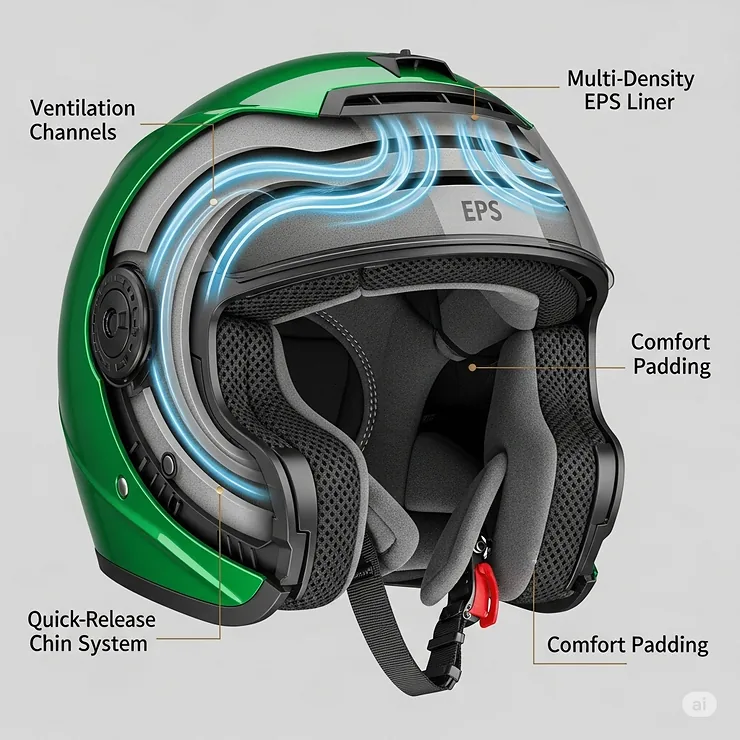
Here’s the honest answer: nobody has measured green specifically. The BMJ study compared white against black and light against dark, and it found no link between the front color of clothing or the motorcycle and injury risk. It also found that daytime headlight use was associated with a 27% lower risk.
That leaves room for reasoning. Fluorescent lime or hi-viz green sits at the bright end of the spectrum, so it likely behaves more like a light helmet in daylight traffic. Dark forest or olive green behaves more like a dark helmet, because it blends with trees, asphalt and shadows. That’s analysis, not a measurement.
What reviewers and retailers say: bright colors help drivers spot you sooner, while dark colors disappear into the background. For nighttime, white tends to outperform bright colors, so reflective decals matter more than hue.
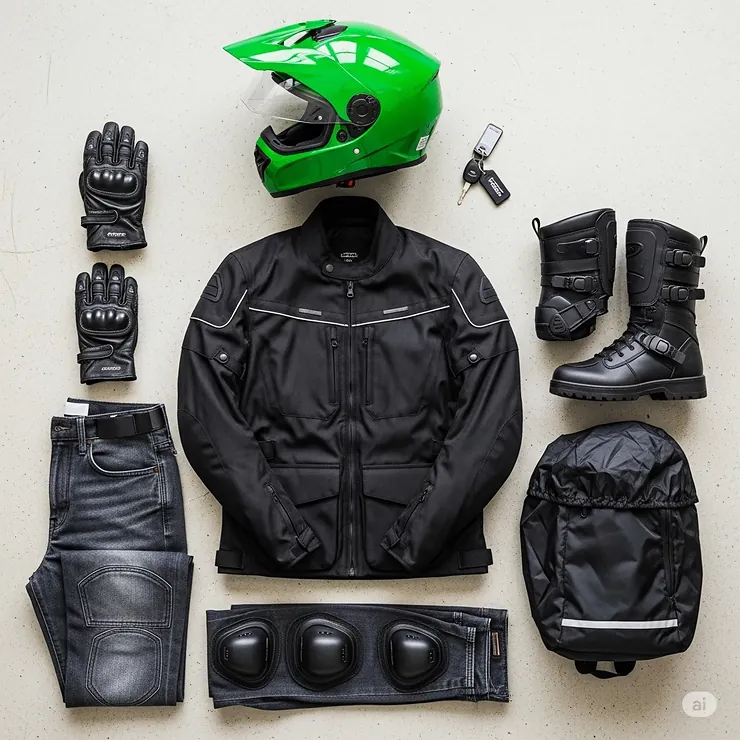
Practical takeaway: if visibility is your priority, choose a lighter or fluorescent green, run your headlight in daytime, and add reflective tape. If style is your priority, a dark green is fine, as long as the rest of your gear compensates.
Green Motorcycle Helmet vs Black, White, and Other Colors
| Helmet Color | What Research Suggests | Real-World Read | Best For |
|---|---|---|---|
| Black | Highest-risk reference in the BMJ study | Blends into pavement and shadow | Style-first riders with bright gear |
| White | 24% lower risk vs black | Strong contrast in daylight and dusk | Commuters in heavy traffic |
| Neon/lime green | Not directly measured | Likely high contrast in daylight | Visibility-minded riders |
| Olive/forest green | Not directly measured | Likely behaves like a dark helmet | Retro and adventure looks |
The research strongly favors white over black, but green sits in a gap. Neon green probably earns its place in a safety conversation, while deep green is mostly a style statement. If you love a dark green motorcycle helmet, add a hi-vis jacket or reflective strips to offset it.
DOT, ECE 22.06, Snell, and SHARP: Safety Certifications Explained
Certification labels look like alphabet soup, so here’s the short version. In the U.S., Standard 218 in the federal regulations sets minimum performance requirements for helmets designed for motorcyclists. NHTSA research published in 2004 estimated that a compliant helmet cuts the risk of dying in a crash by 37%.
- DOT (FMVSS 218): the legal baseline for U.S. road use, with direct-impact testing.
- ECE 22.06: Europe’s current standard, which adds rotational impact and visor testing.
- Snell: a voluntary standard that adds extra, higher-energy testing.
- SHARP: a UK consumer rating from 1 to 5 stars. It’s useful for comparison but isn’t a road-legal approval.
Note the combinations in this list: the HJC i10 and Shoei RF-1400 carry DOT plus Snell, the Biltwell Gringo S carries DOT plus ECE 22.06, and the Bell MX-9 Adventure MIPS carries DOT plus the older ECE 22.05. A “better” label doesn’t guarantee a better fit, and the safest helmet is the one that fits your head properly.
Features That Actually Matter (And Those That Don’t)
Matter:
- Fit: a loose helmet is a weak helmet.
- Weight: every ounce adds up on a long ride.
- Noise: the Bell MX-9 Adventure MIPS is a good example of a capable helmet that gets loud at speed.
- Visor quality: a Pinlock-ready or included anti-fog insert (the Shoei RF-1400 includes one) saves real frustration.
- Washable liner: sweat and odor build up fast.
Don’t (as much as marketing suggests):
- Exotic shell materials: carbon in the Bell Race Star Flex DLX doesn’t make it lighter than the polycarbonate HJC i10.
- Graphics: a $50 paint job won’t make a helmet safer.
- Bluetooth readiness: nice, but you can add comms later.
Spend where the benefit is felt every ride: fit, noise and shield quality. Skip the features you’ll never notice, and keep an eye on the extras that quietly raise the real price.
Common Mistakes When Buying a Green Motorcycle Helmet
- Buying the color before the certification. Novelty helmets are a real problem. NHTSA’s 2015 proposal described novelty helmets failing all or almost all of the standard’s requirements, with riders sometimes adding fake DOT-style labels. The agency withdrew that proposal in May 2025, saying new rulemaking isn’t anticipated soon, so buyer vigilance matters.
- Ignoring head shape. A race-fit Bell Race Star Flex DLX squeezes round heads, while an intermediate oval like the Bell Custom 500 suits most.
- Assuming the listing’s green is the green you’ll get. Colorways vary by size, region and season.
- Skipping the shield budget. A tinted or photochromic shield can cost real money.
- Buying used. You can’t know if it’s been dropped or damaged.
- Choosing the wrong style for your speed. An open-face Bell Custom 500 is a city-cruiser choice, not a highway one.
Long-Term Cost & Maintenance
| Pick | Price Range | Rough Cost per Year (5-year life) | Value Verdict |
|---|---|---|---|
| HJC C10 | Under $200 | Under ~$40 | Best entry value |
| HJC i10 | ~$160–$195 | ~$32–$39 | Great Snell value |
| Bell Custom 500 | ~$180–$230 | ~$36–$46 | Style-first buy |
| Bell MX-9 Adventure MIPS | ~$230–$290 | ~$46–$58 | Solid ADV value |
| Biltwell Gringo S | Upper-$200s | ~$55–$60 | Retro with real safety |
| Shoei RF-1400 | Mid-$600s to high-$700s | ~$130–$156 | Premium comfort |
| Bell Race Star Flex DLX | ~$950–$1,000 | ~$190–$200 | Performance-focused |
The rough math shows how much price matters less than you’d think when spread over years. A premium helmet costs more per year, but if it keeps you riding longer in comfort, it can earn its keep. For occasional riders, the HJC i10 or HJC C10 is the smarter buy.
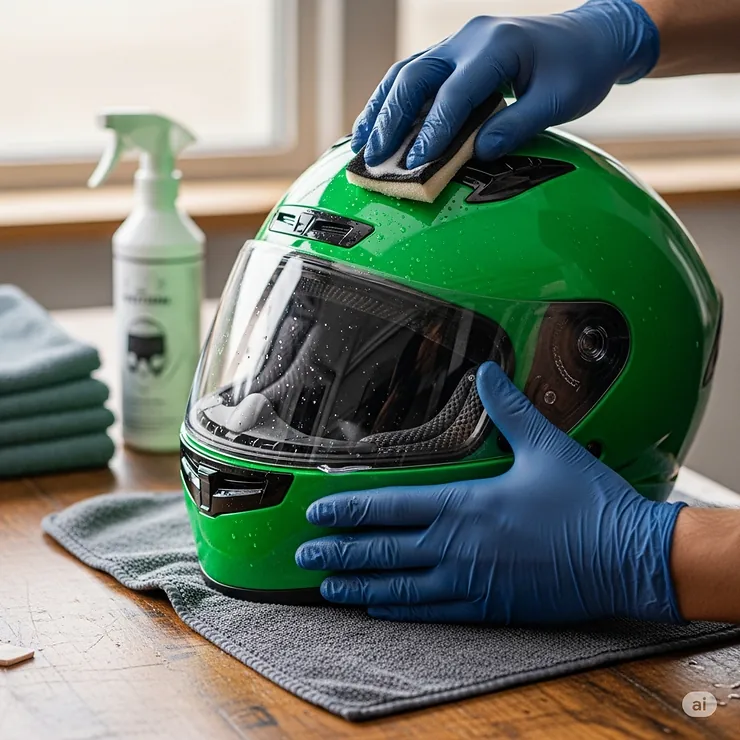
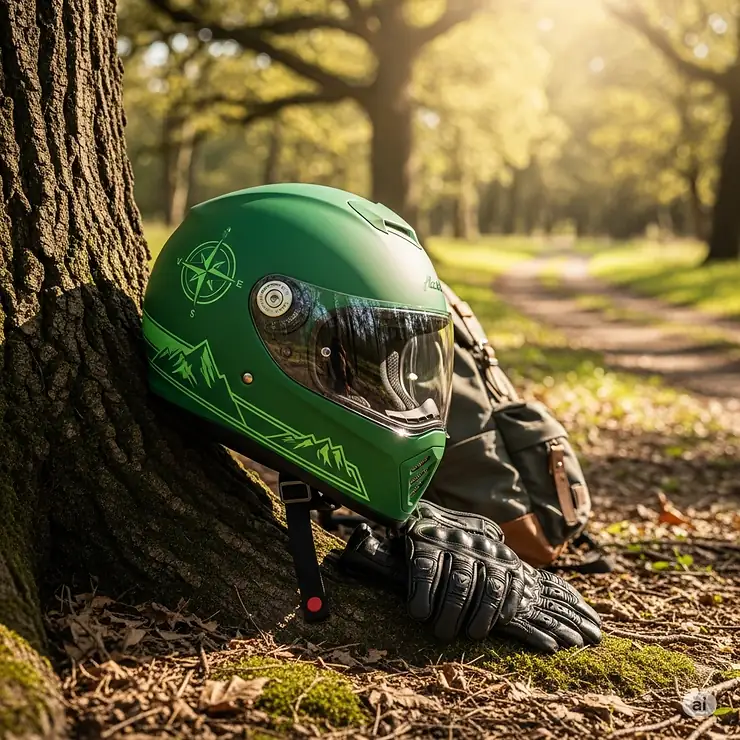
Maintenance is simple. Wash the liner with mild soap, keep solvents off the shell, and store the helmet out of direct sun to protect green paint from fading. Many manufacturers suggest replacing a helmet about every five years, and always after a significant impact.
Green Motorcycle Helmet for Every Rider: Beginners, Commuters, Retro, and ADV
Beginners: the HJC C10 and HJC i10 deliver certified protection at the lowest cost, and the C10 comes in youth sizes too.
Commuters: the HJC i10 is the budget pick, and its glasses grooves help riders in eyewear. The Biltwell Gringo S adds a flip-up shield for quick stops.
Retro and cruiser riders: the Bell Custom 500 offers the lightest, most classic look. The Biltwell Gringo S gives you full-face coverage in the same spirit.
Adventure riders: the Bell MX-9 Adventure MIPS handles mixed terrain, though heavy-duty highway riders should expect noise.
Sport and track riders: the Shoei RF-1400 for long-haul comfort, the Bell Race Star Flex DLX for aggressive riding.
Whichever you pick, match the helmet to the riding you actually do, not the riding you imagine doing.
Fit and First-30-Days Guide
A helmet only protects if it fits, so treat the first month as a break-in period.
Day 1 (the fit test). Wear it at home for 20–30 minutes. It should feel snug on the cheeks and forehead without pressure points. Shake your head side to side. The skin should move with the helmet, not slide inside it.
Week 1 (adjust). If cheek pads feel off, ask about alternative thicknesses. Biltwell, for example, sells different cheek pad thicknesses. Fit the Pinlock insert if your visor is Pinlock-ready, such as on the HJC C10 or HJC i10.
Weeks 2–4 (observe). Note any hot spots, wind noise or visor fogging. Wind noise on the Bell MX-9 Adventure MIPS is a common complaint, so test it at your usual speed.
Maintenance routine. Wipe the shield after every ride, wash the liner monthly in warm, soapy water, and check the strap hardware for wear. Common first-month mistakes include over-tightening the strap, using paper towels on the shield, and ignoring a pressure point that turns into a headache.
Real-World Scenarios: Three Riders, Three Green Helmets
Scenario 1: the college commuter. An 8-mile daily ride on city streets, a budget under $200, riding five days a week. The HJC i10 fits: Snell approval, glasses-friendly interior and a Pinlock-compatible visor for cold mornings. Add a clear Pinlock insert and reflective tape for dusk.
Scenario 2: the weekend adventure rider. A mix of gravel and highway, a budget around $250–$300, riding twice a month. The Bell MX-9 Adventure MIPS gives MIPS, a removable peak and goggle compatibility. Plan on earplugs for highway stretches, since noise is a recurring complaint.
Scenario 3: the retro city rider. Slow urban cruising, a budget around $200–$280, riding on dry days. The Bell Custom 500 is the lightest, most authentic option, while the Biltwell Gringo S gives full-face protection with a flip-up shield. If you want chin protection, take the Gringo S.
The takeaway: the right green motorcycle helmet depends less on color and more on your speed, your budget and how often you ride.
Problem → Solution: Fixing Common Green Motorcycle Helmet Headaches
Problem: the visor fogs. Use a Pinlock insert. The HJC C10 and HJC i10 are Pinlock-ready, and the Shoei RF-1400 includes an anti-fog insert in the box.
Problem: wind noise. Wear earplugs, check your neck roll, and consider a helmet with stronger noise engineering like the Shoei RF-1400. Expect more noise from the Bell MX-9 Adventure MIPS at highway speed.
Problem: hot spots or pressure. Try different cheek pad thicknesses where available, such as on the Biltwell Gringo S, or size up one step if you’re between sizes.
Problem: glare. A tinted or photochromic shield helps. The Bell Race Star Flex DLX includes a photochromic ProTint shield, and the Bell MX-9 Adventure MIPS can accept one.
Problem: a dark green helmet vanishes at dusk. Add reflective decals, wear a bright jacket, and run your headlight in daylight. The BMJ study tied daytime headlights to a 27% lower injury risk, which makes them the cheapest visibility upgrade you can buy.
FAQ
❓ Is an ECE-only green motorcycle helmet legal for U.S. road use?
❓ How much should I spend on a good green motorcycle helmet?
❓ How often should I replace a green motorcycle helmet?
❓ Can I wear glasses with a green motorcycle helmet?
❓ How do I clean a matte green motorcycle helmet?
Conclusion
A green motorcycle helmet is one of the rare gear choices where personality and protection can coexist. The real decision comes down to fit, certification and how you ride. For budget buyers, the HJC C10 and HJC i10 deliver certified protection without drama. For style-first riders, the Bell Custom 500 and Biltwell Gringo S bring retro charm. For mixed-terrain riders, the Bell MX-9 Adventure MIPS is the capable all-rounder. And for those who ride hard or far, the Shoei RF-1400 and Bell Race Star Flex DLX justify their price with refinement and protection tech.
Remember the visibility caveat: lighter and fluorescent greens likely stand out more than dark olive, but nobody has measured green directly. Pair any helmet with a daytime headlight and reflective gear, and confirm the DOT label and exact colorway before you order.
Recommended for You
- Purple Motorcycle Helmet: 7 Best Picks for 2026 (Ranked & Compared)
- Red Motorcycle Helmets: 7 Ultimate Picks for 2026
- Red and Black Motorcycle Helmet: 7 Proven Top Picks for 2026
Disclaimer: This article contains affiliate links. As an Amazon Associate, I earn from qualifying purchases. If you purchase products through these links, we may earn a small commission at no additional cost to you.
✨ Found this helpful? Share it with your friends! 💬🤗
