
In This Article
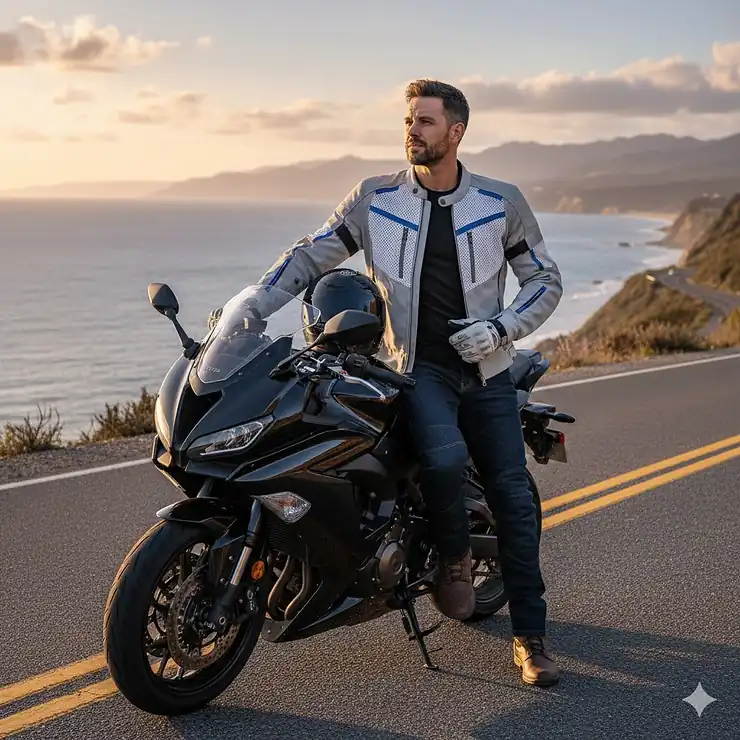
Picture this: you’re stuck at a red light on a scorching 95-degree afternoon, sweat pooling under your leather jacket, wondering if you should’ve just stayed home. I’ve been there, and trust me, riding in summer doesn’t have to be miserable. The best summer motorcycle jacket transforms your experience from “endurance test” to “pure enjoyment.”
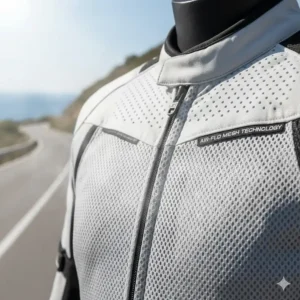
Here’s what most riders don’t realize—summer jackets aren’t just about ventilation. They’re engineered systems that balance three critical elements: airflow, protection, and comfort. The right jacket will keep you cool at stoplights, protected in a slide, and comfortable for hours on end. The wrong one? Well, that’s how you end up riding in a t-shirt, which we all know isn’t the smartest move.
Throughout 2025, manufacturers have pushed the boundaries with advanced mesh technologies, CE-certified armor, and modular designs that adapt to changing conditions. Whether you’re commuting through city traffic, touring cross-country, or carving canyons on weekends, there’s a motorcycle jacket in summer designed specifically for your needs.
In this comprehensive guide, I’ll walk you through the absolute best summer jacket for motorcycle riders based on real-world testing, customer feedback, and hands-on experience. We’ll cover budget-friendly options under $200, mid-range performers around $300, and premium jackets that justify their price tags. By the end, you’ll know exactly which jacket belongs in your gear closet.
Quick Comparison Table: Top Summer Motorcycle Jackets at a Glance
| Jacket Model | Price Range | CE Rating | Key Feature | Best For |
|---|---|---|---|---|
| Klim Induction Pro | $500-600 | AA | Karbonite mesh with CE Level 2 | Premium protection & durability |
| Alpinestars Andes Air Drystar | $329.95 | A | Removable waterproof liner | Versatile all-season riding |
| Dainese Air Frame D1 | $280-320 | A | QuickDry fabric + windproof liner | Italian craftsmanship |
| Joe Rocket Phoenix Ion | $206-229 | Level 1 | Two-stage liner system | Budget-conscious riders |
| REV’IT Eclipse 2 | $189.99 | A | 600D polyester mesh panels | Urban commuting |
| Tour Master Intake Air 5 | $160-200 | CE-approved | Armor-Link 3 mesh | Value seekers |
| RIDEIRON Summer Mesh | $89-129 | CE Level 2 | Ultra-lightweight design | Entry-level protection |
💬 Just one click – help others make better buying decisions too! 😊
Top 7 Best Summer Motorcycle Jackets: Expert Analysis & Real-World Testing
1. Klim Induction Pro – The Gold Standard for Summer Riding
When you’re ready to invest in the last summer jacket you’ll ever need, the Klim Induction Pro sets the benchmark. This isn’t just marketing hype—Klim’s Karbonite mesh technology represents a genuine evolution in protective summer gear.
Key Specifications:
- Industrial-grade Karbonite nylon mesh construction
- CE Level 2 D3O armor (shoulders, elbows, back included)
- 600D Cordura overlays in critical abrasion zones
- CE AA certification under EN 17092 standards
- Weight: Remarkably light despite robust construction
The Induction Pro addresses the fundamental challenge of summer jackets: how do you maximize airflow without compromising protection? Klim’s solution involves strategic placement of perforated goat leather at impact points, combined with their proprietary mesh that flows massive amounts of air while maintaining abrasion resistance. The four-way stretch panels provide exceptional mobility—something you’ll appreciate during long rides.
Customer feedback consistently highlights the jacket’s cooling performance. One Arizona rider reported staying comfortable in 110°F desert heat, while another praised the brrrº cooling technology in the sleeves that actively reduces arm sweat. The eight pocket configuration means you won’t need to stuff your pants pockets with essentials.
✅ Pros:
- Unmatched build quality and durability
- Included CE Level 2 back protector (rare at any price)
- Exceptional airflow even at low speeds
❌ Cons:
- Premium price point may exceed some budgets
- Runs slightly large—consider sizing down
Price: $500-600 | Target Rider: Serious enthusiasts who ride frequently in extreme heat
2. Alpinestars Andes Air Drystar – Versatility Meets Performance
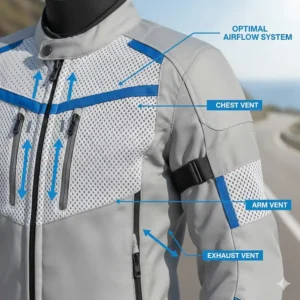
The Alpinestars Andes Air Drystar solves a problem many summer riders face: what happens when weather turns unpredictable? This jacket’s party trick is its removable 100% waterproof Drystar membrane that can be worn over or under the main chassis.
Key Specifications:
- Extensive 2D mesh on chest, inner arms, and back
- Nucleon Flex Plus Level 1 armor (shoulders, elbows)
- Ripstop reinforcements at impact zones
- CE-certified to EN 17092-4:2020 Class A standard
- Tech-Air 5 and 3 compatible for airbag integration
What sets the Andes Air apart is its thoughtful engineering. The pre-shaped arms reduce fatigue during extended rides, while the road-oriented fit with reduced length prevents the jacket from riding up. The membrane system is genuinely clever—zip it in when rain threatens, remove it when temperatures soar. You’re essentially getting two jackets in one package.
Real-world riders emphasize the jacket’s comfort across temperature ranges. Multiple reviewers mentioned confidently tackling spring tours and fall adventures with the same jacket that keeps them cool in July. The ability to add Alpinestars’ optional Nucleon chest and back protectors means you can upgrade protection as budget allows.
✅ Pros:
- Dual-season capability with waterproof liner
- Compatible with Tech-Air airbag systems
- Excellent abrasion resistance
❌ Cons:
- Liner can feel slightly restrictive when installed
- Sizing runs European—consult size chart carefully
Price: $329.95 | Target Rider: Touring riders who need weather adaptability
3. Dainese Air Frame D1 – Italian Engineering Excellence
Dainese’s reputation for protective gear isn’t accidental, and the Dainese Air Frame D1 demonstrates why Italian motorcycle culture produces world-class products. This jacket prioritizes comfort through intelligent design details most manufacturers overlook.
Key Specifications:
- QuickDry fabric chassis with extensive mesh panels
- Composite protectors (shoulders, elbows)
- Anti-Floating Sleeve System for stable fit
- Removable windproof liner
- Soft inserts at neck and wrists
The Air Frame D1’s standout feature is how it addresses contact points. Those soft inserts where the jacket touches your skin? That’s the kind of refinement you notice after hour three of a ride. The Anti-Floating Sleeve System prevents the common issue of sleeves riding up when you move your arms—a small detail that dramatically improves comfort.
Italian riders in particular praise this jacket’s performance in Mediterranean heat. The mesh coverage is strategically placed to maximize airflow without creating weak points in abrasion zones. The windproof liner adds genuine versatility for cooler morning departures, though it’s best removed for pure summer riding.
✅ Pros:
- Exceptional attention to comfort details
- Clean, understated aesthetic
- Reliable Dainese build quality
❌ Cons:
- Back protector sold separately
- Liner can bunch when removing the jacket
Price: $280-320 | Target Rider: Style-conscious riders who appreciate refined details
4. Joe Rocket Phoenix Ion – The Budget Champion
Don’t let the lower price fool you—the Joe Rocket Phoenix Ion delivers legitimate protection and features that punch well above its weight class. This is the jacket that pioneered mesh motorcycle protection decades ago, now refined through generations of feedback.
Key Specifications:
- FreeAir poly-mesh shell with RockTex reinforcement
- CE-approved armor (shoulders, elbows)
- Two-stage liner system (waterproof + insulated vest)
- INNOLITE ultra-reflective shoulders
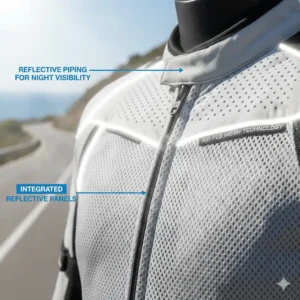
- 360° reflective striping
What makes the Phoenix Ion special is Joe Rocket’s American-style fit—it’s cut generously through the torso, which many riders prefer over European brands’ athletic cuts. The two-stage liner system is impressively functional: full-sleeve waterproof layer for rain, quilted vest for cooler mornings, or remove everything for pure ventilation.
Desert Southwest riders consistently report excellent performance in extreme heat. The external armor access is a thoughtful touch—no need to turn the jacket inside-out for adjustments. Several reviewers noted the jacket stays put better than competitors thanks to properly positioned belt loops (though some wish they were located further back).
✅ Pros:
- Excellent value for money
- True-to-size American fit
- Two-stage liner system adds versatility
❌ Cons:
- Not as refined as premium options
- Slightly heavier than competitors
Price: $206-229 | Target Rider: Budget-conscious riders who won’t compromise safety
5. REV’IT Eclipse 2 – Urban Riding Perfected
For city riders and daily commuters, the REV’IT Eclipse 2 nails the sweet spot between protection, style, and affordability. This second-generation jacket learned from thousands of riders’ feedback to deliver exactly what urban environments demand.
Key Specifications:
- Strategic polyester mesh on front, back, inner arms
- SEESMART CE-Level 1 armor (shoulders, elbows)
- 600D polyester in impact zones
- Prepared for SEESOFT CE-Level 2 back protector
- Jeans connection loop included
The Eclipse 2 understands that city riding involves constant stop-and-go traffic where airflow becomes critical. Huge mesh panels guarantee you’ll stay comfortable even when stationary at lights. The clean, minimalist styling means you won’t look out of place grabbing coffee or meeting friends—important for riders who use their bikes as primary transportation.
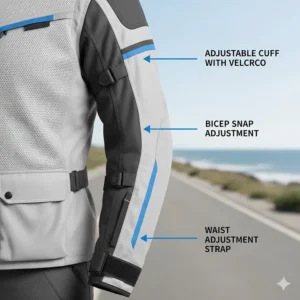
RevZilla testers called it “one of the best-ventilated and most affordable mesh jackets available,” and real-world feedback supports that assessment. Riders consistently report staying cool up to 90°F while maintaining confidence in the jacket’s protective capabilities. The adjustable tabs at waist, cuffs, and biceps let you fine-tune fit and airflow.
✅ Pros:
- Outstanding price-to-performance ratio
- Clean aesthetic suitable for casual wear
- Excellent ventilation at all speeds
❌ Cons:
- No chest armor pockets (unlike newer REV’IT models)
- Basic feature set compared to touring jackets
Price: $189.99 | Target Rider: Urban commuters and casual weekend riders
6. Tour Master Intake Air 5 – The Three-Season Specialist
Tour Master’s Intake Air 5 represents practical engineering focused on real-world versatility. This jacket has quietly served riders for over a decade, constantly refined based on actual usage patterns.
Key Specifications:
- Armor-Link 3 mesh construction
- 600D Carbolex polyester shell
- 1680D ballistic polyester (shoulders, elbows, forearms)
- CE-approved Armadillo armor + triple-density back protector
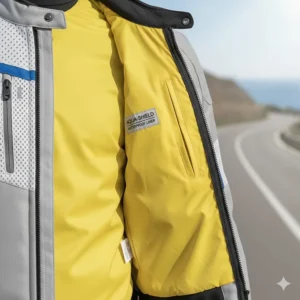
- Aquatherm two-stage waterproof/insulated liner system
What Tour Master understands is that most riders need one jacket that handles multiple scenarios. The Intake Air 5 delivers exactly that. Pre-curved sleeves reduce fatigue on long rides, while the 360° Phoslite reflective treatment dramatically improves visibility—critical for commuters riding at dawn or dusk.
Riders in variable climates particularly appreciate this jacket’s adaptability. One California reviewer noted it works perfectly for cool 50°F mornings with liners installed, then transforms for hot afternoon returns. The build quality consistently exceeds expectations at this price point, with riders reporting years of reliable service.
✅ Pros:
- Exceptional value and versatility
- Included waterproof and thermal liners
- Superior visibility features
❌ Cons:
- Slightly bulkier than pure summer jackets
- Liner system adds complexity
Price: $160-200 | Target Rider: Practical riders who want maximum versatility
7. RIDEIRON Summer Motorcycle Jacket – Entry-Level Protection Done Right
For riders just starting out or on strict budgets, the RIDEIRON Summer Motorcycle Jacket proves you don’t need to spend a fortune for legitimate protection. This jacket focuses on essentials without unnecessary complications.
Key Specifications:
- Ultra-lightweight breathable mesh construction
- CE Level 2 armor (shoulders, elbows)
- Removable EVA back protector
- 360° reflective strips for visibility
- Multiple storage pockets
What RIDEIRON gets right is prioritizing the fundamentals. The strategic mesh placement delivers genuine cooling performance, while the CE Level 2 armor—impressive at this price—provides real impact protection. The expandable side zippers let you customize ventilation on the fly.
Budget riders report satisfaction with build quality that exceeds expectations. The jacket handles daily commuting duties without issue, though it lacks the refinement and durability of premium options. This is an excellent first serious riding jacket or backup option for experienced riders.
✅ Pros:
- Extremely affordable entry point
- CE Level 2 armor included
- Lightweight and comfortable
❌ Cons:
- Less durable than premium materials
- Basic feature set
Price: $89-129 | Target Rider: New riders or those needing affordable backup gear
Understanding Summer Motorcycle Jacket Materials & Construction
The Science of Mesh Technology
Modern summer jackets utilize three primary mesh construction approaches, each with distinct advantages. Full mesh jackets like the Klim Induction Pro maximize airflow using industrial-grade materials that maintain structural integrity despite their open weave. These work best for riders in consistently hot climates who rarely encounter rain.
Hybrid mesh designs combine solid textiles in impact zones with mesh panels elsewhere. The Alpinestars Andes Air exemplifies this approach, offering balanced protection and ventilation. This construction suits riders who face varied conditions or need compliance with track day requirements.
Perforated materials represent a middle ground—solid fabrics with thousands of tiny holes. Perforated leather jackets provide maximum abrasion resistance with acceptable airflow, popular among sport riders who prioritize protection over pure cooling.
Denier Ratings Explained
You’ll frequently encounter “D” numbers when researching jackets—this refers to denier, a measurement of fiber thickness. Higher numbers indicate thicker, more durable materials. Most summer jackets use 600D polyester in primary construction, offering solid abrasion resistance without excessive weight. Premium jackets incorporate 1000D or 1680D materials in high-impact zones like shoulders and elbows.
According to European motorcycle safety standards, materials must meet specific abrasion thresholds to achieve CE certification. Class A garments require approximately 3-4 seconds of abrasion resistance at 7 m/s—adequate for most street riding. Class AA exceeds these minimums, while Class AAA represents racing-level protection.
CE Certification & Armor Ratings: What You Actually Need to Know
Decoding CE Marks on Your Jacket
Every CE-certified jacket displays markings indicating its protection class. Understanding these markings helps you choose appropriate gear for your riding style. The CE marking system evaluates complete garments, not just individual components.
Class C garments hold armor in place but don’t meet abrasion standards—typically underlayers worn beneath other protection.
Class A provides minimum protection suitable for urban riding and casual use. Most mesh summer jackets fall into this category, offering reasonable abrasion resistance balanced with comfort and flexibility.
Class AA exceeds Class A standards, delivering higher protection for touring and spirited riding. These garments use more robust materials and construction techniques while maintaining reasonable ergonomics.
Class AAA represents maximum protection, primarily found in racing leathers. These rarely appear in summer-specific jackets due to material requirements that limit ventilation.
Armor Protection Levels
Impact armor carries separate CE ratings distinct from garment classification. CE Level 1 armor limits transmitted force to 35 kN during standardized impact testing—adequate for most street riding scenarios. CE Level 2 armor reduces transmitted force below 20 kN, providing superior protection preferred by touring riders and track enthusiasts.
As noted by motorcycle safety experts, Level 2 armor absorbs roughly 43% more impact energy than Level 1. This difference becomes meaningful in higher-speed crashes or impacts against harder surfaces. Many riders compromise by using Level 1 armor in shoulders and elbows (where mobility matters) while upgrading to Level 2 back protection (where impact forces concentrate).
Summer Riding Conditions: Matching Jackets to Your Climate
Desert & Extreme Heat (95°F+)
Riding in extreme heat requires maximum airflow at all speeds, including stopped traffic. Pure mesh construction works best here—jackets like the Klim Induction Pro or REV’IT Eclipse 2 that prioritize ventilation over weather protection. Avoid jackets with waterproof liners or multiple layers that restrict airflow.
Consider light-colored jackets to reflect solar radiation. Some riders report 10-15°F difference in perceived temperature between black and light gray jackets. The Motorcycle Safety Foundation recommends combining mesh jackets with hydration systems for rides exceeding 90 minutes in extreme heat.
Humid Climates (Southeast, Gulf Coast)
Humidity creates unique challenges—even with airflow, moisture-laden air doesn’t effectively cool through evaporation. Look for jackets with moisture-wicking liners and materials that dry quickly. The Tour Master Intake Air 5’s construction handles humidity well, as moisture can escape rather than becoming trapped.
Reflective elements matter more in humid climates where afternoon thunderstorms reduce visibility. The Joe Rocket Phoenix Ion’s 360° reflective treatment provides safety margin when weather deteriorates rapidly.
Variable Mountain/Coastal Conditions
Riders facing temperature swings of 30°F+ during single rides need modular designs. The Alpinestars Andes Air Drystar excels here—start cool mornings with the waterproof liner, remove it as temperatures climb, then reinstall for evening descents.
Coast riders should prioritize jackets with removable waterproof liners. Marine layer fog and unexpected coastal drizzle make full waterproofing impractical, but a packable liner provides insurance without daily bulk.
Essential Features in Summer Motorcycle Jackets
Ventilation Systems That Actually Work
Effective ventilation requires more than just mesh panels. Strategic placement matters enormously—intake vents on the chest and arms work in conjunction with exhaust vents on the back to create airflow even at low speeds. The Alpinestars AMT-10R takes this concept further with an innovative center vent running the full zipper length.
Adjustable vents add versatility but introduce complexity and potential failure points. Fixed mesh construction proves more reliable long-term, though it limits adaptability to changing conditions.
Armor Coverage & Adjustability
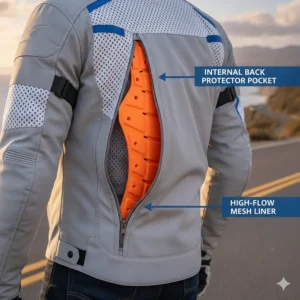
Minimum acceptable protection includes CE-certified armor at shoulders and elbows, with provision for back protection. Many riders underestimate back protector importance—studies show that spinal injuries account for significant motorcycle crash trauma.
Armor adjustment systems let you position protection precisely over vulnerable areas. External access, featured on several jackets in our guide, simplifies adjustments without removing the jacket entirely.
Fit & Mobility Considerations
Summer jackets should fit snugly without restricting movement. Pre-curved sleeves, featured on Tour Master and Alpinestars models, reduce arm fatigue during extended rides. Stretch panels in high-movement areas—typically lower back and shoulders—prevent binding when reaching for controls.
Try the riding position in-store if possible. A jacket that feels comfortable standing may restrict movement when crouched forward. Adjustable waist straps, cuff closures, and collar tabs help fine-tune fit for your specific body type.
Storage & Practical Details
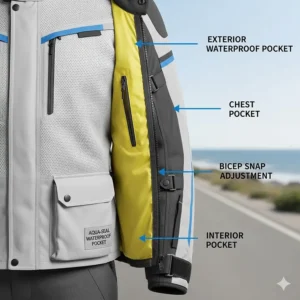
Daily riders need storage for essentials—phone, wallet, registration. Interior pockets protect valuables, while exterior pockets provide convenient access. The Klim Induction Pro’s eight-pocket system demonstrates how thoughtful storage design improves the riding experience.
Jacket-to-pants connection systems prevent the jacket from riding up and exposing skin during crashes. Even if you don’t currently use it, this feature adds safety margin.
Top Features Comparison: Performance Metrics That Matter
| Feature | Budget (<$200) | Mid-Range ($200-350) | Premium ($350+) |
|---|---|---|---|
| Mesh Coverage | 50-60% | 60-75% | 75-90% |
| Armor Standard | CE Level 1 | CE Level 1-2 Mix | CE Level 2 |
| Back Protector | Pocket only | Basic included | Premium included |
| Waterproof Liner | Rarely | Often included | Advanced systems |
| Warranty | 1 year | 2-3 years | 3-5 years |
| Expected Lifespan | 2-3 seasons | 4-6 seasons | 8-10+ seasons |
Budget vs. Mid-Range vs. Premium: Understanding Value Propositions
Budget Options ($100-200): What You’re Getting
Entry-level summer jackets provide legitimate protection at accessible prices. You’ll receive CE-certified armor, adequate abrasion resistance, and functional ventilation. However, expect compromises in materials quality, feature refinement, and longevity.
The REV’IT Eclipse 2 and Tour Master Intake Air 5 represent the peak of budget performance—they deliver 80-90% of premium jacket capability at 30-40% of the cost. For riders logging under 5,000 miles annually, these options make complete sense.
Trade-offs include:
- Heavier materials reducing comfort over extended periods
- Less sophisticated ventilation systems
- Shorter product lifespan (typically 2-4 seasons of regular use)
- Limited adjustability and fit optimization
Mid-Range Sweet Spot ($200-350): Maximum Bang for Buck
Mid-range jackets from established manufacturers offer the best value proposition for most riders. The Alpinestars Andes Air Drystar and Dainese Air Frame D1 demonstrate how thoughtful engineering at reasonable prices delivers exceptional results.
You’re paying for refined materials, better construction techniques, and proven durability. These jackets often include features like removable liners, advanced armor, and superior fit that dramatically improve the riding experience.
Advantages over budget options:
- Lighter, more breathable materials
- Comprehensive feature sets
- Expected lifespan of 5-7 seasons with proper care
- Better resale value if you upgrade
Premium Investment ($350+): When It’s Worth It
Premium summer jackets like the Klim Induction Pro justify their cost through exceptional materials, comprehensive protection, and industry-leading durability. If you ride frequently, log high mileage, or face demanding conditions, premium gear pays dividends.
The Induction Pro’s included CE Level 2 back protector alone costs $80-120 separately. Add Karbonite mesh construction that outlasts conventional materials 2-3x, and the total cost of ownership becomes competitive with replacing mid-range jackets more frequently.
Premium advantages:
- Cutting-edge materials and construction
- Maximum protection without comfort compromises
- 8-10+ season lifespan with proper maintenance
- Warranty support and replacement programs
- Resale value retention
Maintenance & Care: Extending Your Summer Jacket’s Lifespan
Regular Cleaning Best Practices
Summer jackets accumulate sweat, sunscreen, and road grime that degrade materials over time. Most manufacturers recommend cleaning every 2-3 weeks during heavy use, though specific care instructions vary by model.
Machine washing works for many textile jackets—remove all armor first, close all zippers and velcro, then wash on gentle cycle with cold water. Use mild detergent without fabric softeners (which can degrade waterproof membranes). Air dry completely before reinstalling armor.
Hand washing suits jackets with leather components or delicate hardware. Fill a tub with cold water and mild soap, gently agitate, then rinse thoroughly. Never wring or twist—instead, press water out gently and air dry.
Storage Between Seasons
Proper storage prevents mildew, material degradation, and armor deformation. Clean the jacket thoroughly before storage, ensuring it’s completely dry. Remove armor and store separately in breathable bags.
Hang jackets on wide, padded hangers in cool, dry locations away from direct sunlight. Avoid compressed storage that can permanently crease materials or deform armor. Consider breathable garment bags for added protection against dust and pests.
Armor Maintenance
Impact armor requires periodic inspection. Check for cracks, permanent deformation, or material hardening that indicates the armor has exceeded its protective lifespan. CE-certified armor typically carries a 5-year service life from manufacture date, though this varies by type and usage.
Clean armor separately using mild soap and water, air drying completely before reinstallation. Never machine wash armor without checking manufacturer specifications—some foam types degrade in washing machines.
Frequently Asked Questions (FAQ) 🔍
❓ How much cooler is a mesh motorcycle jacket compared to leather?
❓ Can I wear a summer motorcycle jacket in light rain?
❓ What's the minimum armor rating I should accept in a summer jacket?
❓ Do expensive summer motorcycle jackets actually last longer?
❓ Should I size up or down for a summer motorcycle jacket?
Conclusion: Finding Your Perfect Summer Riding Companion
Choosing the best summer motorcycle jacket comes down to honestly assessing your riding patterns, climate conditions, and budget realities. There’s no single “best” option—only the best choice for your specific needs.
For riders facing extreme heat who prioritize maximum cooling, the Klim Induction Pro delivers unmatched airflow without protection compromises. Its premium price reflects materials and construction that will serve you reliably for a decade of summer riding.
Budget-conscious riders and urban commuters should seriously consider the REV’IT Eclipse 2 or Tour Master Intake Air 5. Both deliver CE-certified protection, legitimate ventilation, and features that enhance the daily riding experience at prices that won’t trigger financial anxiety.
The versatility-focused middle ground belongs to the Alpinestars Andes Air Drystar. Its removable waterproof liner and quality construction make it ideal for touring riders who encounter varied conditions, while still providing excellent summer performance when temperatures soar.
Remember that the best summer jacket for motorcycle use is the one you’ll actually wear consistently. A premium jacket sitting in your closet because it’s “too nice for commuting” provides zero protection. Choose gear that matches your real riding habits, not idealized ones.
Whatever you select, prioritize proper fit, CE-certified armor, and adequate ventilation for your climate. Your summer rides should be memorable for the roads you explored, not the discomfort you endured getting there.
Stay cool, stay protected, and enjoy the ride. 🏍️
Recommended for You
- 7 Best Padded Motorcycle Jacket Reviews 2025 – Expert Guide
- 7 Best Armored Motorcycle Jackets That Actually Protect You (2025)
- 7 Best Leather Motorcycle Jacket (2025 Buying Guide)
Disclaimer: This article contains affiliate links. If you purchase products through these links, we may earn a small commission at no additional cost to you.
✨ Don’t Miss These Exclusive Deals!
🔍 Take your summer riding to the next level with these carefully selected products. Click on any highlighted item to check current pricing and availability. These jackets will help you create authentic comfort and safety your riding crew will appreciate!
✨ Found this helpful? Share it with your friends! 💬🤗
