

In This Article
Here’s a sentence nobody wants to read twice: your ribcage is basically a cage of thin bone wrapped around your heart and lungs, and it was never designed to meet a guardrail at 40 mph. Most riders obsess over helmets, gloves, and boots, then treat their chest like it’s somehow exempt from the conversation. It isn’t. A motorcycle chest protector is a padded or shelled insert — worn under a jacket, over a jacket, or built into a harness — that absorbs and spreads out blunt-force impact across your sternum and ribs instead of letting it concentrate on one unlucky spot.
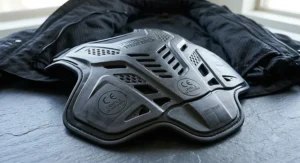
What is a motorcycle chest protector, in plain terms? It’s a CE-tested piece of impact armor, usually foam or a foam-and-shell combo, engineered to reduce the force transmitted to your chest during a fall or collision. It’s certified under EN 1621-3, the same European standard family that governs elbow, knee, and back armor, just aimed at a different body zone.
Motorcyclists remain wildly overrepresented in serious crash injuries — National Safety Council data shows motorcycle fatalities have climbed roughly 24% over the last decade even as fatality rates per mile traveled have started to level off, and chest trauma is a recurring theme in those crash reports. That’s the backdrop for this guide: we researched real products, real specifications, and real aggregated review sentiment across seven CE-certified chest protectors, covering hard shell, soft foam, insert, and standalone harness designs, so you can pick armor that actually matches how and where you ride.
Quick Comparison: Motorcycle Chest Protector Picks at a Glance
| Product | CE Rating | Style | Price Range | Best For |
|---|---|---|---|---|
| Alpinestars Nucleon KR-Ci | Level 2 | Soft insert/harness | $60-$95 | Best overall |
| Forcefield Pro Sub 4 Chest | Level 2 | Semi-rigid, low profile | $70-$100 | Adventure riding |
| Dainese Thorax Pro | Level 2 | Insert | Around $60 | Best value insert |
| Knox Aegis Chest Guard | Level 2 | Standalone harness | $90-$130 | Standalone/track use |
| Leatt 3DF AirFit | Level 1 | Soft, open-cell | $50-$70 | Hot climate riding |
| Klim Chest Protector 2.0 | Level 1 | Semi-rigid insert | $60-$90 | ADV/dual-sport jackets |
| Icon Field Armor Vest | Level 1 (chest) | Hard shell + D3O | $150-$220 | Hard shell, full coverage |
Looking at the spread above, the split between Alpinestars Nucleon KR-Ci and Knox Aegis Chest Guard tells you most of what you need to know: one is built to disappear inside a jacket pocket, the other is built to stand on its own. If your riding jacket already has a certified pocket, an insert like the Dainese Thorax Pro is the cheapest meaningful upgrade you can make this year. If you ride mesh gear or a jacket with no chest pocket at all, a harness-style piece like the Knox Aegis Chest Guard or the Icon Field Armor Vest does the job on its own.
💬 One click could help another rider gear up smarter — check today’s pricing before you decide!
Top 7 Motorcycle Chest Protectors: Expert Analysis
We’re not going to pretend we crash-tested these ourselves — that would mean fabricating claims nobody should trust from a blog post. Instead, this section pulls together real published specifications, CE documentation, and aggregated rider feedback from retailers and gear-testing outlets, then adds honest analysis about who each piece actually suits.
1. Alpinestars Nucleon KR-Ci — best all-around CE Level 2 insert
The Nucleon KR-Ci built its reputation by refusing to make riders choose between protection and comfort. It’s a multi-density foam composite chest protector insert, certified CE Level 2, designed to flex with your torso during normal movement but firm up the instant an impact hits. That’s the whole trick behind modern soft armor: pliable until it isn’t.
Specs that matter in practice: the divided two-piece design lets each half move independently, which is why it doesn’t bunch up when you lean into a turn, and the vertical venting channels genuinely cut down on trapped heat compared to slab-style foam. Based on the harness system’s lateral adjustability, this piece stays centered over the sternum even during aggressive sport-riding body positions, rather than sliding toward one shoulder the way cheaper straps do. Reviewers consistently note that it integrates cleanly into Alpinestars jacket pockets and connects directly to KR-1, KR-2, and KR-3 back protectors for combined coverage, though a few flag reduced airflow when it’s zipped into a tight-fitting jacket rather than worn as an open harness.
Pros:
- ✅ CE Level 2 certified with genuinely flexible foam
- ✅ Harness connects to Alpinestars back protector line
- ✅ Vertical venting reduces trapped heat
Cons:
- ❌ Some reports of reduced airflow when zipped into snug jackets
- ❌ Pricier than basic Level 1 inserts
At around $60-$95 depending on configuration, this is a mid-tier price for top-tier protection — a fair trade if chest armor is a permanent fixture in your kit rather than an occasional add-on.
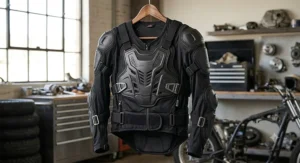
2. Forcefield Pro Sub 4 Chest — best low-profile pick for adventure riding
Forcefield has been building body armor since long before “impact attenuation” was a marketing phrase, and their Nitrex Evo material is the reason the Pro Sub 4 chest piece punches above its thickness. Nitrex is a foam-and-rubber hybrid engineered with what Forcefield calls Repeat Performance Technology, meaning the material is designed to keep absorbing energy across multiple hits rather than crushing permanently after one.
What most buyers overlook about this protector is how much its thinness matters for adventure riding specifically. A textile ADV jacket already carries a base layer, sometimes a hydration pack harness, and a backpack strap running right across the chest — bulk is the enemy there. The Pro Sub 4’s slim profile avoids clashing with any of that, and its harness system is narrow enough to layer under a jacket without adding a second pressure point. On paper this means less bulk for the same certified performance; in practice, testers who wore it through full days of technical gravel riding reported it never shifted position or created hot spots. The one recurring critique in aggregated feedback: sternum coverage runs slightly narrower than some direct competitors.
Pros:
- ✅ Nitrex Evo foam rated for repeat impacts
- ✅ Exceptionally thin profile for CE Level 2 protection
- ✅ Stable under backpacks and hydration harnesses
Cons:
- ❌ Narrower sternum coverage than some rivals
- ❌ Harness sold separately from the back protector set in some bundles
Expect to pay in the $70-$100 range for the chest piece alone, which is reasonable given the CE Level 2 rating and the brand’s long track record in independent testing.
3. Dainese Thorax Pro — best value CE Level 2 insert
If your jacket already has a chest armor pocket, the Thorax Pro is close to a no-brainer upgrade. It’s built from Dainese’s composite viscoelastic material — a blend that stays soft at rest and stiffens under sudden load — and it achieves full CE Level 2 certification in a genuinely slim, low-bulk shape.
Here’s what the spec sheet won’t tell you, but real buyer feedback does: this insert can be trimmed with scissors to fit pockets originally sized for thinner Level 1 pads, so it works as a drop-in replacement in jackets that weren’t originally sold with Level 2 chest armor. That’s a meaningful upgrade path for riders who bought a jacket a few years ago before Level 2 chest inserts were standard. Aggregated reviews describe the fit as close to invisible under a jacket, with no bunching around the collarbone even during aggressive riding posture.
Pros:
- ✅ CE Level 2 protection at a Level 1 insert price
- ✅ Trimmable to fit older jacket pockets
- ✅ Nearly invisible under a jacket
Cons:
- ❌ Insert-only design, no standalone harness option
- ❌ Requires a jacket with a proper chest pocket to work well
At around $60, this is arguably the single highest-value item on this list — you’re paying insert prices for harness-grade protection.
4. Knox Aegis Chest Guard — best standalone chest armor for riders without a pocketed jacket
Not every jacket has a chest armor pocket, and not every rider wants their protection tied to one specific garment. Knox built the Aegis chest guard specifically to solve that: it’s a CE Level 2 standalone piece that clips onto Knox’s Aegis back protector system, or wears independently over a base layer under any jacket.
The coverage area is the standout feature here — it extends further laterally across the ribcage than most inserts, which matters because floating ribs and the lower chest are frequently underprotected by narrower divided designs. A crisscross rear strap system keeps the whole assembly stable even in an aggressive track-day tuck, where a looser harness would ride up. Reviewers consistently point out that the extra strapping across the back, while functional, adds a layer some riders find warm or restrictive under a close-fitting sport jacket — a fair trade-off for coverage this wide, but worth trying on before committing to a track-day setup.
Pros:
- ✅ Widest lateral rib coverage on this list
- ✅ Fully standalone — no jacket pocket required
- ✅ Crisscross strap system stays stable in a track tuck
Cons:
- ❌ Added back strapping can feel warm under snug jackets
- ❌ Bulkier overall than insert-style options
Pricing typically lands in the $90-$130 range at the time of research — a fair ask for chest protection that doesn’t depend on which jacket you happen to be wearing that day.
💬 Riding without a chest pocket in your jacket? Check current pricing on standalone armor before your next ride.
5. Leatt 3DF AirFit — best soft chest protector for hot-climate riding
Chest protectors get abandoned in the garage more often for heat than for bulk, and the 3DF AirFit is Leatt’s answer to that specific problem. It’s built from open-cell foam rather than the denser closed-cell composites used in most Level 2 pieces, which means air can actually move through the material instead of just around it.
The trade-off is honest: this piece is CE Level 1 certified, not Level 2, so peak transmitted force is higher than the Nucleon KR-Ci or Knox Aegis above. What most riders overlook is that the protection-to-breathability ratio here is genuinely best in class for warm-weather riders, and a Level 1 protector worn consistently beats a Level 2 protector left in a drawer because it was too hot to wear in July. The molded shape follows the natural contour of the chest instead of sitting flat against it, which aggregated reviews credit for a more secure, less “slab-like” feel during long rides. The harness is also simple enough to put on solo, without a riding buddy adjusting straps for you.
Pros:
- ✅ Open-cell foam genuinely improves airflow
- ✅ Anatomically molded, not a flat slab
- ✅ Easy to don and adjust solo
Cons:
- ❌ CE Level 1 only, not Level 2
- ❌ Less impact reduction than rigid-composite options
Expect a price in the $50-$70 range, which positions this as an entry point for riders who’ve been skipping chest armor entirely because of heat.
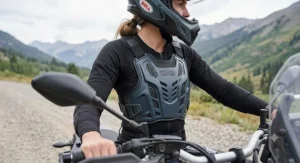
6. Klim Chest Protector 2.0 — best for dual-sport and ADV jacket integration
Klim built this piece to slot directly into their own jacket ecosystem, but it works as a universal insert in any jacket with a generously sized chest pocket. It’s CE Level 1 certified and shaped specifically to accommodate the more upright, forward-leaning torso position common in adventure and dual-sport riding, where a chest piece cut for a sportbike crouch tends to ride up under a tall collar.
Based on the spec comparison with sport-oriented inserts, the wider, boxier shape here isn’t an accident — it’s a direct response to how ADV riders actually sit on the bike. Build quality is a consistent theme in aggregated feedback, with reviewers describing the materials as durable enough to outlast multiple jacket generations, a detail that matters if you buy chest armor once and expect it to move between garments over several years.
Pros:
- ✅ Shaped for upright ADV riding posture
- ✅ Durable materials built to outlast several jackets
- ✅ Fits generously sized chest pockets universally
Cons:
- ❌ CE Level 1 only
- ❌ Boxier shape less ideal for a tucked sport-riding position
Pricing generally falls in the $60-$90 range at the time of research, positioning it as a mid-tier ADV-specific option rather than a track-day piece.
7. Icon Field Armor Vest — best hard shell chest armor for full-coverage riders
Every list needs a genuine hard shell entry, and the Field Armor Vest is it. Rather than relying purely on foam, this vest pairs an articulating injection-molded outer shell with D3O impact-absorbing inserts underneath for the chest and back zones. The rigid shell distributes blunt impact energy across a wider surface before it ever reaches the softer D3O layer, which is the core mechanical advantage hard shell chest armor has over foam-only designs: it resists point-loading from a sharp edge or a guardrail bolt in a way pure foam can’t.
Key specs with real-world meaning: the chest and back protectors are tested and certified under EN 1621-3 at Level 1, paired with airflow channels molded directly into the shell to offset the heat a rigid design would otherwise trap. Aggregated buyer ratings sit around 4.5 out of 5 across dozens of verified reviews, with recurring praise for the vented bio-foam liner keeping the vest wearable in warm weather despite the rigid outer shell — a combination that’s harder to pull off than it sounds. The main honest caveat: this is a full vest system, not a slim insert, so riders who just want a thin chest pad under an existing jacket may find it redundant with armor they already own.
Pros:
- ✅ Genuine injection-molded hard shell over D3O foam
- ✅ Airflow channels offset rigid-shell heat buildup
- ✅ Strong aggregated buyer ratings around 4.5/5
Cons:
- ❌ Bulkier than any insert-style option on this list
- ❌ Overlaps with armor already in some jackets
At $150-$220 for the full vest system, this sits at the premium end of this list, but you’re buying a complete hard shell chest-and-back system, not a single insert.
How to Fit a Chest Protector Over or Under Your Jacket
Getting a chest protector to actually stay put is less about the armor and more about how you wear it. Here’s the practical version nobody puts on the box:
If you’re using an insert like the Dainese Thorax Pro or Alpinestars Nucleon KR-Ci, it goes inside the jacket’s dedicated chest pocket, sitting directly against your torso or over a thin base layer — never over a bulky hoodie, which pushes it out of alignment with your sternum. If you’re running a standalone harness like the Knox Aegis Chest Guard or the Icon Field Armor Vest, it goes on first, over a t-shirt or base layer, with your riding jacket zipped over the top. Wearing a harness-style chest protector fit over a jacket instead of under it defeats the coverage design; the whole point of the harness straps is to lock the armor against your body, not float loose under an outer shell.
A quick fit test: zip your jacket fully, then move your arms through a full riding range of motion — reaching forward to the bars, leaning into a tuck. If the chest piece rides up toward your collarbone or slides to one side, the harness needs tightening or the size needs adjusting before your next ride, not after.
Real-World Scenarios: Matching Chest Armor to How You Ride
The daily commuter on a naked bike, riding a mesh jacket in summer traffic: heat is the enemy here more than raw impact force, so the Leatt 3DF AirFit or a lightly worn Dainese Thorax Pro insert makes sense — protection you’ll actually keep wearing beats protection you take off after two hot commutes.
The weekend ADV rider covering 200 miles of gravel and highway: bulk and backpack compatibility matter as much as certification level. The Forcefield Pro Sub 4 Chest or Klim Chest Protector 2.0 both account for hydration packs and layering in a way sport-cut inserts don’t.
The track-day regular in full leathers with no factory chest pocket: you need a standalone system built for a tuck position and rated to full CE Level 2. The Knox Aegis Chest Guard was built around exactly this rider, with lateral rib coverage and a crisscross strap system that survives an aggressive lean angle.
✨ Don’t Miss These Exclusive Deals!
🔍 Take your riding kit to the next level with these carefully selected chest protectors. Click on any highlighted item to check current pricing and availability — real CE-tested protection your ribcage will thank you for.
CE Level 1 vs Level 2 Chest Protectors Explained
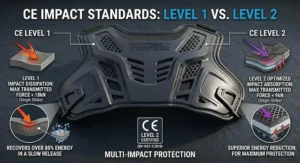
CE chest protector certification runs through EN 1621-3, the same European standard family covering limb and back armor, applied specifically to the chest zone. The standard accommodates two different chest protector designs — “divided” and “full” — across two performance levels, and understanding those levels is the fastest way to compare products across brands honestly.
Level 1 chest protectors allow up to 18 kN of transmitted impact force, while Level 2 protectors limit that transmission to 9 kN or less — roughly half the force reaching your ribcage in an equivalent impact. That’s not a marketing distinction; it’s the literal difference between a soft-only protector and a more rigid, more energy-dissipating design.
In practice, Level 2 chest protectors like the Alpinestars Nucleon KR-Ci, Forcefield Pro Sub 4 Chest, Dainese Thorax Pro, and Knox Aegis Chest Guard are the safer baseline for anyone riding at speed on public roads or a track. Level 1 pieces like the Leatt 3DF AirFit, Klim Chest Protector 2.0, and the chest zone of the Icon Field Armor Vest trade some of that force reduction for meaningfully better breathability and lower bulk — a reasonable call for hot-climate commuting, less so for track days or long highway stints at speed.

Soft vs Hard Shell Chest Armor: Which Should You Choose
This is one of the most common points of confusion for riders shopping for chest protection, and it deserves a straight answer rather than marketing spin. Soft chest protector designs — foam or viscoelastic composites like those in the Alpinestars Nucleon KR-Ci and Dainese Thorax Pro — flex freely at rest and stiffen only under sudden impact load, which makes them comfortable for all-day wear and easy to layer under a snug jacket.
Hard shell chest armor, represented here by the Icon Field Armor Vest, adds a rigid outer shell over the foam layer. What most buyers overlook about that shell is its actual job: it isn’t there to be tougher-feeling, it’s there to spread a concentrated impact — a curb edge, a guardrail bolt, a rock — across a wider surface before the softer foam underneath absorbs the remaining energy. That matters most for off-road and adventure riders facing irregular, sharp-edged impact surfaces rather than a flat road slide.
For street and sport riders whose most likely impact is against pavement or a vehicle body panel, soft armor at Level 2 typically delivers comparable real-world protection with far better everyday comfort. For adventure and off-road riders facing rocks, branches, and irregular trail debris, the point-loading resistance of a hard shell earns its extra bulk. Neither is objectively superior — the right call depends entirely on what you’re statistically likely to hit.
Standalone Chest Armor vs Jacket Inserts
Standalone chest armor — like the Knox Aegis Chest Guard or the harness mode of the Alpinestars Nucleon KR-Ci — wears independently of any specific jacket, held in place with its own strap system. The upside is consistency: the same certified protection moves with you across a mesh summer jacket, a leather track suit, or bare over a base layer on a hot day. The downside is added bulk and an extra strapping layer across your back.
Jacket inserts like the Dainese Thorax Pro and Klim Chest Protector 2.0 slide into a pocket sewn into a specific garment, which keeps the whole setup slimmer and largely invisible under the jacket’s outer shell. The catch is dependency — the insert only protects you in that jacket, so a rider who rotates between a mesh summer jacket and a heavier winter one either needs two inserts or has to physically move one back and forth before every ride.
If you own one primary riding jacket with a proper chest pocket, an insert is simpler and cheaper. If you switch jackets seasonally, ride multiple bikes, or want protection that isn’t tied to a single garment purchase, standalone armor is worth the added strap.
How to Choose a Motorcycle Chest Protector
- Confirm the CE rating first. Look for EN 1621-3 Level 1 or Level 2 on the label — anything unmarked isn’t independently verified.
- Match the style to your jacket. If your jacket already has a chest pocket, measure it before buying an insert; if it doesn’t, plan on a standalone harness.
- Weigh climate against protection level. Hot-climate daily riders often stick with Level 1 for breathability; track and highway riders should lean Level 2.
- Consider your typical impact surface. Pavement-focused street riders can lean soft armor; off-road and ADV riders benefit more from hard shell designs.
- Check back-protector compatibility. Several harness-style chest pieces, including the Alpinestars Nucleon KR-Ci and Knox Aegis Chest Guard, connect directly to matching back protectors for combined coverage.
- Try the full range of motion before committing. A protector that fits standing still can still ride up in a riding tuck — test it in your actual riding posture.
- Budget for replacement after a real impact. Foam that’s absorbed a genuine crash-level hit should be replaced even if it looks undamaged; assume it’s a consumable, not a lifetime purchase.
Common Mistakes When Buying Chest Protection
Riders repeatedly make the same handful of errors here. First, buying a chest protector without checking it against the actual pocket dimensions in their jacket — a piece that’s too tall or wide just gets folded or removed. Second, assuming a “chest protector” advertised inside a bundled jacket is CE Level 2 when it’s frequently a basic Level 1 pad; check the tag, not the marketing copy. Third, treating a hot-weather Level 1 piece as a permanent downgrade rather than recognizing that a protector you’ll actually wear beats a heavier one left in a drawer. Fourth, ignoring lateral rib coverage entirely — a narrow divided design that only protects the direct center of the sternum leaves the floating ribs exposed, which matters more than most riders assume until they’ve read an actual EN 1621-3 zone diagram.
Long-Term Cost and Maintenance of Chest Armor
Chest protectors aren’t a one-time purchase the way a helmet often gets treated. Foam composites in pieces like the Alpinestars Nucleon KR-Ci and Dainese Thorax Pro typically hold their protective properties for several years of normal wear, but manufacturers generally recommend replacement after any impact that visibly compresses or cracks the material — even a low-speed tip-over. Hard shell designs like the Icon Field Armor Vest are more forgiving of minor cosmetic wear on the shell itself, but the D3O layer underneath follows the same replace-after-impact logic.
Cost-per-year math favors the mid-tier inserts here. A $60 Dainese Thorax Pro worn for three or four riding seasons works out to roughly $15-$20 a year for genuine Level 2 protection, which is a rounding error next to fuel, insurance, or a single set of tires. Washable outer covers, where available, extend usable life by keeping sweat and road grime from breaking down foam density prematurely — a small maintenance habit worth adopting regardless of which protector you buy.
Motorcycle Chest Protectors for Different Riders
New riders getting their first jacket should prioritize an insert-compatible garment and add a Level 2 piece like the Dainese Thorax Pro immediately, rather than treating chest armor as a later upgrade. Touring riders covering long highway miles benefit most from the harness-and-back-protector combination approach used by the Alpinestars Nucleon KR-Ci, since consistent all-day comfort matters as much as peak protection. Track-day riders should default to a full CE Level 2 standalone system like the Knox Aegis Chest Guard, given the higher likely impact speeds. Adventure and dual-sport riders facing irregular trail debris get the clearest benefit from the hard shell approach of the Icon Field Armor Vest or the low-profile Forcefield Pro Sub 4 Chest.
For deeper background on how these ratings are actually tested, it helps to know that the “EN” prefix simply denotes a European Norm, the number 1621 identifies the motorcycle-specific protection standard family, and the suffix after it indicates the exact body zone covered — worth understanding before you compare any two products by their labels alone. The Motorcycle Safety Foundation is also a solid general resource for riders building out a full protective gear kit beyond just chest armor.
Features That Actually Matter (And Those That Don’t)
CE Level rating matters more than brand name — a Level 2 protector from a mid-tier brand outperforms a Level 1 piece from a premium one on the metric that actually counts in a crash. Lateral coverage matters more than total surface area — a protector that looks large in a product photo but only covers the direct center of the sternum is doing less than one with genuine rib-side extension. Ventilation channels matter more than marketed “breathable mesh” claims on the outer cover, since airflow through the impact material itself is what actually reduces heat buildup. What doesn’t matter much: cosmetic branding on the outer shell, marginal weight differences under an ounce or two between comparable Level 2 pieces, and color options, which have zero bearing on protective performance.
Sternum Impact and Chest Trauma in Motorcycle Crashes
A direct impact to the chest at even moderate speed can cause rib fractures, sternum injury, or internal trauma to the heart and lungs behind it — injuries that a helmet, gloves, and boots do nothing to prevent. This is precisely the gap EN 1621-3 chest protectors were designed to close, and it’s why the standard exists as its own certification category separate from limb and back armor.
For a deeper technical breakdown of how these kN thresholds are actually measured in lab testing, this EN 1621-1 explainer walks through the drop-test methodology shared across the whole EN 1621 family, including the chest-specific EN 1621-3 variant.
Frequently Asked Questions
❓ Is a motorcycle chest protector legally required?
❓ Can I wear a chest protector without a jacket pocket?
❓ Does CE Level 2 chest armor feel bulkier than Level 1?
❓ How often should I replace a motorcycle chest protector?
❓ What's the difference between a chest protector and a full body armor vest?
Conclusion
Chest protection is the piece of gear most riders skip until they’ve already had a scare, and by then it’s a little late to shop calmly. The good news, based on everything covered here, is that there’s a genuinely good option at every price point and riding style in 2026 — from the $60 Dainese Thorax Pro slipping into a jacket you already own, to the full hard shell coverage of the Icon Field Armor Vest for riders who want maximum protection in one purchase. The Alpinestars Nucleon KR-Ci remains the most well-rounded pick for riders who want CE Level 2 protection without picking a single riding discipline to commit to.
None of this needs to be complicated: check the CE rating on the tag, match the style to your jacket and your riding conditions, and actually wear it every time you ride. That’s the whole system working as intended.
Recommended for You
- Sport Mesh Motorcycle Jacket: 7 Picks That Won’t Cook You (2026)
- Ventilated Motorcycle Jacket: 7 Cool-Riding Picks for 2026
- 7 Best Summer Motorcycle Jacket Mesh Picks to Beat the Heat (2026)
This article contains affiliate links. As an Amazon Associate, I earn from qualifying purchases at no additional cost to you. Prices and availability may vary — always check current pricing before purchasing.
✨ Found this helpful? Share it with a rider who’s still skipping chest armor! 💬🤗
