

In This Article
Budget waterproof touring boots exist at an odd intersection: riders want dry feet, real ankle protection, and a sole that survives more than one rainy season — without paying premium-boot money for it. Here’s the 40-second version: budget waterproof touring boots are motorcycle boots priced roughly under $250-$350 that use a waterproof membrane or coating to keep rain out while still offering CE-rated impact protection for commuting, sport touring, and light adventure riding.
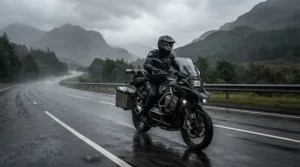
That’s a real category, not a compromise dressed up as one. You’re going to spend a lot of hours in these boots — sitting on wet pegs at 70 mph, walking around a gas station in a downpour, standing over the bike while your buddy fumbles with a rain cover. What most buyers overlook is that “waterproof” on a hang tag can mean three very different construction methods, and the difference between them shows up exactly when you need it least: three hours into a storm, forty miles from the hotel.
This guide walks through seven real, currently available boots spanning true budget picks to boots that stretch the definition of “affordable” but earn their keep. We’ll cover how waterproofing actually works, where the money goes at each price tier, and what happens two or three years down the road when the sole starts to go. If you’ve been Googling cheap waterproof riding boots at 11 PM trying to beat a weekend forecast, you’re in the right place.
Quick Comparison Table
| Boot | Style | Price Range | Best For |
|---|---|---|---|
| TCX Street 3 WP | Urban high-top | $180-$200 | Commuting & city walking |
| Richa Adventure Waterproof Boots | Adventure | $140-$160 | Tightest true budget |
| O’Neal Sierra Pro WP Boot | Adventure/dual-sport | $140-$210 | Off-road capable riders |
| MSR Adventure Boots | Adventure touring | $190-$210 | Lightweight all-rounder |
| Alpinestars Ridge V2 WP | Sport touring | $180-$200 | Everyday sport-touring |
| TCX Drifter WP | Neo-retro adventure | $230-$260 | Long-mile comfort |
| Fox Racing Defend ADV | ADV touring | $330-$360 | Stretch-budget upgrade |
Looking at the spread, there’s genuinely useful separation here — the Richa Adventure Waterproof Boots anchor the low end for riders who just need certified, waterproof protection without frills, while the Fox Racing Defend ADV sits at the top of what most people would still call “budget” thanks to its GORE-TEX membrane and quick-adjust closure. The middle cluster, including the Alpinestars Ridge V2 WP and MSR Adventure Boots, is where most commuters and weekend tourers will find their sweet spot between weight, protection, and price.
A quick heads-up before you scroll further: every price above is a snapshot, not a promise — always check current pricing before you commit.
Top 7 Budget Waterproof Touring Boots: Expert Analysis
1. TCX Street 3 WP — CE Level 2 protection hidden in a sneaker
The standout feature here is disguise: this is a high-top sneaker that happens to be CE Level 2 certified, which matters if you commute in normal clothes and don’t want to look like you’re suited up for a track day. The full-grain leather upper wraps TCX’s T-Dry waterproof membrane, and flexible D3O armor sits at the malleolus without adding bulk — on paper this means you get real ankle protection without the stiff, clunky feel that scares people away from proper boots.
Based on the spec comparison with taller adventure boots, the tradeoff is coverage: a low-cut boot lets rain sneak up under your trouser leg on longer rides, even though the boot itself is genuinely sealed. This is a boot for daily commuters and city riders who want one pair of footwear that works on and off the bike, not for six-hour highway tours in driving rain.
Reviewers consistently report that the Street 3 disappears once you forget you’re wearing motorcycle gear — it’s praised for all-day comfort and a low break-in curve, with the T-Dry lining holding up through wet commutes without the interior dampness some budget membranes develop over time.
Pros:
- ✅ CE Level 2 certified despite a casual sneaker profile
- ✅ Comfortable enough for all-day wear off the bike
- ✅ Full-grain leather resists scuffs from daily use
Cons:
- ❌ Low-cut design lets rain in during long downpours
- ❌ Less ankle coverage than a true touring boot
At around $180-$200, this is a value play for riders who commute more than they tour — the TCX Street 3 WP earns its price as a two-in-one street shoe and protective boot, not as a dedicated foul-weather tourer.
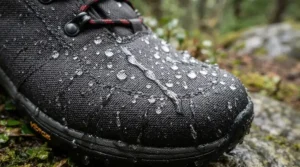
2. Richa Adventure Waterproof Boots — the tightest real budget in this list
The standout here is straightforward: this is one of the lowest-priced CE-certified waterproof adventure boots you can still call a proper motorcycle boot. The combat-style outsole and Hipora waterproof membrane are paired with a CE Level 2 rating (EN 13634:2017) for ankle protection, meaning the certification isn’t just marketing — it’s tested.
What most buyers overlook about a boot at this price is that the leather upper still needs conditioning to keep its water resistance sharp; the membrane does the heavy lifting, but a dried-out, cracked upper will eventually compromise the seal around stitch lines. Aggregated review sentiment is broadly positive: reviewers consistently praise the sturdy build and describe the boots as warm and reliably dry across multiple wet commutes, though a recurring theme in the feedback is that they run small — several buyers recommend sizing up a full size.
A handful of longer-term owners also mention insole breakdown and buckle-screw corrosion after extended exposure, which tracks with what you’d expect from budget-tier hardware. This is squarely a boot for riders who want genuine adventure-boot styling and protection without paying adventure-boot prices, especially commuters who ride through UK-style drizzle rather than tropical downpours.
Pros:
- ✅ CE Level 2 certified at one of the category’s lowest prices
- ✅ Combat-style sole grips well on wet pavement and trails
- ✅ Flexible enough to be comfortable walking around, not just riding
Cons:
- ❌ Runs small — most owners recommend sizing up
- ❌ Buckle screws reported to corrode after years of exposure
At roughly $140-$160, the Richa Adventure Waterproof Boots are hard to beat if budget gear tradeoffs matter more to you than brand recognition — you’re paying for function, not polish.
3. O’Neal Sierra Pro WP Boot — off-road capability at a street-boot price
The standout feature is the steel shank nylon insole, a detail usually reserved for pricier adventure boots, which gives real standing support on footpegs during rough sections. The TPU-molded shin plate and anatomically shaped heel cup add impact protection that goes beyond what you’d expect at this price point, and the 100% waterproof membrane is backed by a removable, anti-sweat footbed for long days.
Here’s what the spec sheet won’t tell you, but reviewers note: the robust metal buckles are genuinely easy to operate with gloved hands, which sounds minor until you’re fumbling with hook-and-loop closures in the rain at a gas stop. This boot is for riders who split time between pavement and dirt — light off-road, moto-camping trips, and green-lane exploring — rather than pure street commuters, since the rugged sole and shin armor are slight overkill for city riding.
Aggregated owner sentiment skews strongly positive, with buyers frequently praising the fit for wider feet and the comfort-to-price ratio; a smaller number of reviewers flag that break-in takes a few rides before the leather softens up around the ankle.
Pros:
- ✅ Steel shank insole gives real support on footpegs
- ✅ TPU shin and heel armor rare at this price
- ✅ Roomy fit works well for wider or flat feet
Cons:
- ❌ Requires a break-in period before it feels natural
- ❌ Bulkier than street-oriented boots for daily walking
Pricing on the O’Neal Sierra Pro WP Boot swings fairly widely by retailer and region, generally landing in the $140-$210 range — shop around, because this is one of the bigger price-to-price gaps in the category.
4. MSR Adventure Boots — the lightweight budget all-rounder
The standout advantage is weight: this boot consistently gets singled out among budget-friendly options for feeling lighter on the foot than comparably armored competitors, which matters on long touring days when boot fatigue creeps in by hour six. Based on the spec comparison with heavier leather boots, the tradeoff for that lighter feel is typically a synthetic-heavy upper rather than full-grain leather, which some riders find less durable over years of daily abrasion against a shifter.
What most buyers overlook is that lighter boots also tend to pack down smaller for travel — a real advantage if you’re flying to start a tour and need your gear to fit in a duffel. This is a boot for riders prioritizing all-day comfort on multi-day tours over maximum armor coverage; it’s not the pick for aggressive off-road riding where a stiffer, more reinforced boot would hold up better.
Reviewers consistently note that the waterproofing performs reliably through sustained rain, and the boot is often mentioned in the same breath as pricier options as a “remarkable value” pick for riders watching their budget without wanting to feel like they compromised on protection.
Pros:
- ✅ Noticeably lighter than most boots in this price tier
- ✅ Comfortable enough for full touring days without fatigue
- ✅ Waterproofing holds up through sustained rain exposure
Cons:
- ❌ Less abrasion resistance than full-leather adventure boots
- ❌ Not built for aggressive off-road terrain
At around $190-$210, the MSR Adventure Boots make the strongest case for riders whose priority is comfort and packability over maximum protection — a legitimate, honest tradeoff rather than a corner cut.
5. Alpinestars Ridge V2 WP — the everyday sport-touring crossover
The standout feature is the low-profile toe box, engineered specifically to slide under a gearshift lever without catching — a small detail that makes a real difference on bikes with tight linkage. The Drystar waterproof membrane sits between a durable microfiber upper and textile lining, and dual-density ankle protectors with poly-foam padding handle impact without adding the bulk of a full adventure boot.
Here’s what most buyers overlook: this is explicitly a “Tech Touring” boot, not a true adventure boot, so while it’s genuinely waterproof and comfortable for hours in the saddle, it’s not designed for standing on rough footpegs or taking abuse off-road. The hook-and-loop closure system with a metal ring adjuster makes it fast to get on and off, which reviewers consistently point to as a practical daily-use advantage over buckle-heavy boots.
Aggregated feedback trends positive on comfort and value, with several reviewers calling it a great-value follow-up to the original Ridge boot; the main critique that surfaces is that the microfiber upper feels less premium than leather alternatives, though it doesn’t seem to compromise the waterproofing itself.
Pros:
- ✅ Low-profile toe box shifts cleanly on sport-touring bikes
- ✅ Quick hook-and-loop closure beats fumbling with buckles
- ✅ Lightweight microfiber construction reduces all-day fatigue
Cons:
- ❌ Less structured protection than a dedicated adventure boot
- ❌ Microfiber upper feels less premium than leather rivals
Typically priced around $180-$200, the Alpinestars Ridge V2 WP is the boot to pick if your riding is mostly pavement with the occasional gravel detour, not genuine off-road.
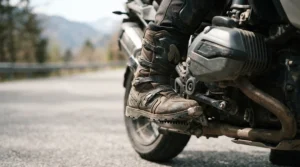
6. TCX Drifter WP — neo-retro styling with genuine mid-range substance
The standout feature is the “Ideal” hand-stitched construction technique — a traditional bootmaking method with double seams and an intermediate insole that TCX carries over from its higher-end lines, giving this boot a sturdiness that punches above its price bracket. The T-DRY waterproof membrane sits under a full-grain vintage-finish leather upper, backed by polyurethane shin plates, malleolus inserts, and an OrthoLite insole for cushioning on long rides.
What most buyers overlook about this model is that the lugged sole is genuinely trail-capable, not just styled to look rugged — it’s rated for light enduro and on/off-road use, which is more than most boots at this price attempt. This is a strong pick for riders who want one boot that handles commuting, weekend touring, and the occasional gravel road without feeling like a compromise in any direction.
Reviewers consistently describe it as a “solid mid-level” performer that holds its own against pricier adventure boots, with the suede heat guard and comfort-fit system frequently praised; the main knock is that full retail pricing edges toward the top of what most riders would call budget, so timing a sale matters.
Pros:
- ✅ Hand-stitched “Ideal” construction built for durability
- ✅ Lugged sole handles light off-road terrain confidently
- ✅ OrthoLite insole adds real cushioning on long days
Cons:
- ❌ Full retail price pushes toward the upper budget limit
- ❌ Heavier than sport-touring-focused alternatives
Prices typically run $230-$260 when discounted, climbing toward $400 at full retail — the TCX Drifter WP is best bought on sale, where its build quality becomes an outright bargain.
7. Fox Racing Defend ADV — the stretch-budget upgrade pick
The standout feature is the BOA Fit System — a micro-adjustable dial closure borrowed from cycling and hiking gear that lets you fine-tune tension in seconds, even with wet gloves on. A GORE-TEX waterproof upper handles the weather, while integrated D3O foam across the ankles and tongue, a rigid TPU heel counter, and a composite nylon-fiberglass shank deliver protection that rivals boots costing considerably more.
Based on the spec comparison with the other six boots here, this is the most technically advanced option in the lineup, and the price reflects it — it’s a stretch to call it “budget” in the strictest sense, but it undercuts most GORE-TEX competitors by a wide margin. What the spec sheet won’t tell you, but field reports suggest, is that the Ultratac rubber outsole genuinely dampens vibration on long highway stretches, reducing foot fatigue in a way that’s hard to appreciate until you’ve ridden 1,200 miles in a week and your feet still feel fine.
This boot is for riders who tour seriously and are willing to spend a bit more to get GORE-TEX-level waterproofing without jumping to $500-plus territory. Reviewers consistently call out exceptional comfort straight out of the box, with minimal hot spots even on consecutive all-day rides — a rare compliment for a boot with this much armor.
Pros:
- ✅ BOA dial closure adjusts instantly, even in wet gloves
- ✅ GORE-TEX membrane delivers premium-tier waterproofing
- ✅ D3O armor and TPU heel counter rival pricier boots
Cons:
- ❌ Pushes past what most riders consider true budget
- ❌ Overbuilt for riders who only commute short distances
At around $330-$360, the Fox Racing Defend ADV is the “buy once, cry once” pick on this list — not cheap, but a legitimate value relative to GORE-TEX competitors that often cost hundreds more.
Top 7 Products at a Glance: Specs & Value
| Boot | Waterproofing | Closure | CE Rating | Price Range |
|---|---|---|---|---|
| TCX Street 3 WP | T-Dry membrane | Zipper | Level 2 | $180-$200 |
| Richa Adventure Waterproof Boots | Hipora membrane | Buckle | Level 2 | $140-$160 |
| O’Neal Sierra Pro WP Boot | Waterproof membrane | Metal buckles | CE certified | $140-$210 |
| MSR Adventure Boots | Waterproof lining | Buckle | CE certified | $190-$210 |
| Alpinestars Ridge V2 WP | Drystar membrane | Hook-and-loop | EN 13634 | $180-$200 |
| TCX Drifter WP | T-DRY membrane | Aluminum buckles | CE Cat. II | $230-$260 |
| Fox Racing Defend ADV | GORE-TEX | BOA dial | CE certified | $330-$360 |
The pattern that jumps out here is that CE certification is now table stakes even at the lowest price points — every boot on this list is independently rated, so budget doesn’t mean unprotected. Where the money actually goes is closure precision (BOA versus buckles versus hook-and-loop), membrane brand recognition, and construction technique, not the baseline waterproofing itself. If your priority is simply staying dry and certified, the bottom three rows deliver that at half the cost of the top row.
Practical Usage Guide: Breaking In, Waterproofing Maintenance & Avoiding Rookie Mistakes
New waterproof touring boots need a short adjustment period before you trust them on a real tour. Wear them around the house or on short local rides for the first week — leather uppers especially need time to flex at the ankle crease, and pushing straight into a 400-mile day in stiff, unbroken boots is how blisters happen. During this window, apply a leather conditioner formulated for motorcycle gear (not generic shoe polish, which can clog pores and trap moisture) to keep the upper supple without compromising the membrane underneath.
Maintenance-wise, waterproof membranes degrade faster than most riders expect. Grit and road salt work into stitching and zippers, and a build-up of dirt on the outer leather can reduce the effectiveness of any factory DWR (durable water repellent) coating over the top. Wipe boots down after wet rides, let them air-dry away from direct heat, and stuff them with newspaper or a boot form to hold shape while drying. A common first-30-days mistake is drying boots on a heater or near a campfire — the sudden heat can crack leather and degrade membrane bonding faster than years of normal wear.
One optimization trick most riders never learn: rotate two pairs of socks by thickness depending on temperature rather than buying insulated boots. A thin merino liner plus a mid-weight wool sock handles a wider range than most people assume, and it keeps your boots from feeling suffocating in warmer weather while these budget waterproof touring boots stay sealed against rain regardless of sock choice underneath.
Real-World Scenarios: Which Boot Fits Your Riding Life
If you’re a college student commuting six miles to campus on a used 300cc bike in variable weather, the TCX Street 3 WP or Richa Adventure Waterproof Boots make the most sense — low cost, genuine waterproofing, and casual enough to walk into class without changing shoes.
If you’re planning a two-week cross-country tour on a mid-size ADV bike, hitting highway stretches and the occasional gravel forest road, the MSR Adventure Boots or TCX Drifter WP fit better — both balance long-day comfort with enough structure for mixed terrain, without the price jump of a full off-road boot.
If you’re a weekend green-lane rider who splits time between tarmac commuting and genuine dirt trails, the O’Neal Sierra Pro WP Boot is the strongest match here — the steel shank and shin armor earn their keep once the pavement ends, and the price stays reasonable for how much protection you’re getting.
Problem → Solution: Common Waterproof Boot Headaches, Solved
Problem: Feet stay dry but boots feel damp and clammy inside. This usually means moisture from sweat isn’t escaping, not that water is getting in. Solution: choose a boot with a breathable membrane like Drystar or GORE-TEX (the Alpinestars Ridge V2 WP and Fox Racing Defend ADV both apply here) and avoid non-breathable sock liners.
Problem: Boots leak at the seams after a year or two, not through the fabric itself. This is a stitching and DWR breakdown issue, common on budget coated boots. Solution: reapply a fabric or leather waterproofing treatment every season, focusing on seam lines and buckle stitching.
Problem: Toes get cold on long winter rides despite dry feet. Waterproofing and insulation are different specs. Solution: layer with a thicker wool sock rather than assuming a waterproof boot is automatically a warm boot.
Problem: The sole starts separating from the upper after heavy mileage. This is normal wear, not a defect, on most budget boots. Solution: look into resoling options (covered below) rather than replacing the whole boot.
Problem: New boots feel watertight but leak the first time it actually rains hard. Often this is because the boot was never tested past light drizzle before purchase. Solution: intentionally walk through a puddle or run them under a hose before a long tour, so you find out at home, not on the road.
How to Choose Budget Waterproof Touring Boots
- Confirm real CE certification, not just a waterproof label. Look specifically for EN 13634:2017 on the product page or inside the boot — this is the actual tested standard, and every boot in this guide carries it.
- Match boot height to your riding style. Low-cut boots like the TCX Street 3 WP work for commuting but let water in on long rides; taller adventure boots seal better for touring.
- Identify whether you need a membrane or a coating. Membranes (Drystar, GORE-TEX, T-Dry) generally outlast coatings and stay breathable longer — worth the small price premium if you ride in rain often.
- Check the closure system against your gloves. Buckles are durable but slow; hook-and-loop is fast but wears out; BOA dials are fastest but add cost. Try operating the closure with your actual riding gloves on before buying.
- Weigh armor level against your terrain. Steel shanks and TPU shin plates matter for off-road; sport-touring riders can save money skipping the heaviest armor.
- Read aggregated review sentiment for sizing quirks. Several boots in this category, including the Richa Adventure Waterproof Boots, consistently run small — factor that into your order.
- Decide your budget ceiling before you shop, not after. Knowing whether you’re comfortable at $150 or $350 up front prevents the common trap of creeping toward the priciest option in every comparison.
Waterproof Coating vs Membrane: What Actually Keeps Your Feet Dry
This is one of the most misunderstood specs in the entire category. A waterproof coating is a treatment applied directly to the outer material — often a DWR finish or a rubberized layer — that causes water to bead and roll off. It’s cheaper to manufacture, which is why it shows up on entry-level boots, but it wears down with abrasion, UV exposure, and repeated flexing, meaning its performance quietly declines over a season or two even if the boot looks fine.
A waterproof membrane, by contrast, is a separate layer sandwiched between the outer material and the inner lining — think GORE-TEX, Drystar, T-Dry, or Hipora. Because the membrane isn’t the surface taking abrasion damage, it tends to hold up far longer than a surface coating, and it’s usually engineered to be breathable, letting sweat vapor escape while blocking liquid water from getting in. For a deeper technical breakdown of how this vapor-permeable structure actually works, REI’s guide to how rainwear works is a genuinely useful resource.
In practice: every boot in this guide uses a membrane, not just a coating, which is exactly why they’re worth considering over ultra-cheap no-name boots that rely on coated leather alone. The Fox Racing Defend ADV‘s GORE-TEX and the Alpinestars Ridge V2 WP‘s Drystar sit at the more breathable end of this spectrum; budget membranes like Hipora on the Richa Adventure Waterproof Boots still keep water out reliably but may not breathe quite as well on hot days.
Common Mistakes When Buying Budget Waterproof Touring Boots
The single most common mistake is buying by price alone and skipping the CE rating entirely — a genuinely waterproof boot with zero certified impact protection isn’t a touring boot, it’s a rain boot that happens to look like one. Another frequent misstep is ignoring sizing feedback in reviews; several boots here, including the O’Neal Sierra Pro WP Boot, run differently than a rider’s usual shoe size, and returns eat into any money saved by buying budget. Riders also commonly assume “waterproof” and “warm” are the same claim, leading to disappointment on cold rides despite dry feet. Finally, a lot of buyers wait until a boot is actively failing before researching resoling or care options — by then, the leather upper may already be too dried out to salvage economically.
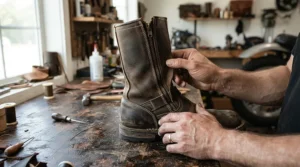
Budget Gear Tradeoffs: What You Give Up At Each Price Point
At the $140-$180 tier, represented here by the Richa Adventure Waterproof Boots and the base pricing on the O’Neal Sierra Pro WP Boot, you’re trading premium materials and closure refinement for genuinely certified protection at minimum cost — the waterproofing works, but hardware like buckle screws and insoles may need earlier replacement.
At the $180-$220 tier, boots like the Alpinestars Ridge V2 WP, TCX Street 3 WP, and MSR Adventure Boots add brand-name membranes and better closure systems, but often narrow their focus — sportier boots sacrifice off-road capability, and lighter boots sacrifice some abrasion resistance.
At the $230-$360 tier, the TCX Drifter WP and Fox Racing Defend ADV bring hand-stitched or GORE-TEX-level construction and advanced closures like BOA, but you’re paying a real premium for incremental comfort and durability gains rather than a leap in basic waterproofing performance, which — as covered above — every boot on this list already delivers.
Long-Term Cost & Maintenance: Resoling Options and Total Cost of Ownership
Leather-upper boots like the TCX Drifter WP, Richa Adventure Waterproof Boots, and O’Neal Sierra Pro WP Boot are generally strong resoling candidates because their uppers tend to outlast their soles by a wide margin — the sole and midsole take the abrasion and flex fatigue, while a well-maintained leather upper can last many years longer. A motorcycle-specific cobbler can often replace a worn sole with a Vibram unit for a fraction of the cost of a new boot; one rider’s account in Rider Magazine describes paying roughly one-sixth the price of new boots for a professional resole that left the boots looking and gripping like new.
Synthetic-heavy boots, including lighter options like the MSR Adventure Boots, are sometimes harder to resole because the sole and midsole may be molded as a single unit rather than stitched on separately — worth checking before you buy if you plan to keep a pair for five-plus years. Factoring resoling into total cost of ownership changes the math considerably: a $150 boot resoled once for roughly $60-$80 after three years still comes in well under the price of most premium boots, while extending genuine service life by several more years.
Cheap Waterproof Riding Boots & Affordable Rain Touring Gear for Every Rider
For riders searching specifically for cheap waterproof riding boots rather than full touring boots, the TCX Street 3 WP and Richa Adventure Waterproof Boots remain the strongest picks — both keep the core promise of certified protection and genuine waterproofing without chasing premium branding. If your priority shifts toward affordable rain touring gear more broadly — not just boots, but the mindset of building a wet-weather kit without overspending — pairing any of these boots with a budget rain oversuit is often smarter than buying one expensive “does everything” boot. A $180 waterproof boot plus a $60 rain cover frequently outperforms a single $400 boot in genuinely severe weather, since the layered approach lets each piece do one job well.
What to Expect: Real-World Performance in the Rain
On paper, every boot here blocks water. In practice, performance diverges based on ride duration and intensity. In light-to-moderate rain over an hour or two, all seven boots perform essentially the same — dry feet, no drama. Past the three-to-four-hour mark in sustained heavy rain, differences emerge: taller boots with membrane-backed uppers, like the TCX Drifter WP and Fox Racing Defend ADV, maintain their seal noticeably better than low-cut options like the TCX Street 3 WP, where water can work up under the ankle cuff during highway spray. Reviewers consistently note that boot height, not membrane brand, is the biggest single factor separating “fine in a shower” from “fine in a storm.”
Safety, CE Certification & Regulations Guide
Every boot in this guide carries CE certification to EN 13634:2017, the European standard covering motorcycle protective footwear, which tests factors like impact abrasion resistance, transverse rigidity, and cut resistance of the upper. In the US, motorcycle footwear isn’t federally mandated the way helmets are, but agencies including NHTSA actively encourage riders to wear proper protective gear — including sturdy, over-the-ankle boots — as part of a broader safety strategy; more detail on official guidance is available through NHTSA’s motorcyclist protective gear resources. Practically speaking, a CE Level 2 rating (shown as “2 2 2 2” on the boot’s internal label) indicates the highest tested protection tier, while a “1” in any position usually reflects boot height rather than a failure elsewhere — worth understanding before assuming a lower number means a lower-quality boot.

Frequently Asked Questions
❓ Are budget waterproof touring boots actually waterproof long-term?
❓ Can cheap waterproof riding boots be resoled instead of replaced?
❓ Is a waterproof membrane always better than a waterproof coating?
❓ What's a realistic price range for affordable rain touring gear?
❓ Do budget gear tradeoffs mean sacrificing CE safety certification?
Conclusion
Budget waterproof touring boots have quietly gotten better without getting meaningfully more expensive — CE certification, real membranes, and thoughtful closures are now standard even below $200. The right pick depends less on brand recognition and more on how you actually ride: commuters lean toward the TCX Street 3 WP or Richa Adventure Waterproof Boots, mixed-terrain riders toward the O’Neal Sierra Pro WP Boot, and serious tourers toward the TCX Drifter WP or Fox Racing Defend ADV if the budget stretches that far. Whichever you choose, treat the boots as a system — membrane, maintenance, and eventual resoling — rather than a single purchase, and you’ll get years out of gear that costs a fraction of the premium alternatives.
Recommended for You
- Adventure Touring Boots vs Street Touring Boots: 7 Best Picks (2026)
- 7 Best Long Distance Motorcycle Boots For Wide Feet In 2026
- Affordable Touring Boots: 7 Budget Picks That Actually Last (2026)
Disclaimer: This article contains affiliate links. As an Amazon Associate, I earn from qualifying purchases. If you purchase products through these links, we may earn a small commission at no additional cost to you.
✨ Found this helpful? Share it with your friends! 💬🤗
