
In This Article
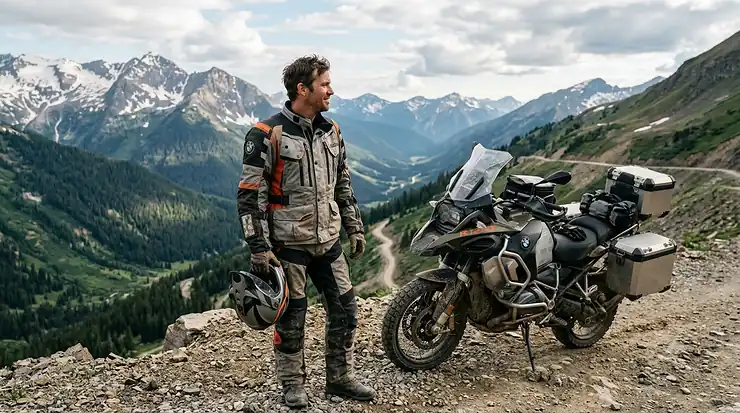
Somewhere between a stalled bike in a Wyoming hailstorm and a sweaty crawl through Baja backroads, you learn what an adventure motorcycle jacket is actually for. It isn’t a fashion statement. It’s the only thing standing between your skin and gravel, between your core temperature and whatever the sky decides to throw at you that afternoon. An adventure motorcycle jacket is a purpose-built riding garment combining abrasion-resistant textile construction, CE-rated armor, weatherproofing, and adjustable ventilation designed to handle everything from highway slabs to technical single-track.
Most riders buy their first one wrong. They grab whatever looks rugged on a shelf, ignore the armor certification printed on a tiny tag, and find out three states into a trip that the “waterproof” liner leaks at the seams. The category itself traces back to bikes like the BMW R80G/S, and understanding how adventure and dual-sport motorcycles evolved actually explains why jacket design in this segment looks so different from a standard street jacket. This guide exists so you don’t repeat that mistake. We’ve dug into real specs, verified aggregated review sentiment, and lined up seven genuine products across budget, mid-range, and premium tiers — the kind of honest comparison Amazon’s own listings simply won’t give you.
Whether you’re chasing the phrase adventure touring jacket motorcycle in your search bar or specifically hunting for an ADV motorcycle jacket built for standing on pegs over rutted trail, what follows is a grounded, no-nonsense breakdown of what actually separates a good jacket from an expensive mistake.
Quick Comparison Table
| Jacket | Price Range | Weatherproofing | Best For |
|---|---|---|---|
| Klim Badlands Pro | $950-$1,150 | Gore-Tex Pro (permanent) | Serious long-distance expedition riders |
| Alpinestars Andes V4 Air Drystar | $400-$450 | Removable Drystar liner | Value-focused three-season touring |
| REV’IT! Defender 3 GTX | $700-$800 | Gore-Tex Pro (laminated) | All-weather riders who hate bulky liners |
| Alpinestars AMT-10R Drystar XF | $500-$600 | Removable Drystar layer | Versatile do-it-all commuting and touring |
| Klim Baja S4 | $450-$500 | None (mesh, hot-climate) | Desert and tropical heat riding |
| REV’IT! Sand 4 H2O | $350-$430 | Removable H2O liner | Mid-range multi-terrain riders |
| Spada Explorer | $150-$200 | Drop-liner three-layer | First jacket, tight budget |
Based on the spread above, the gap between the Spada Explorer and the Klim Badlands Pro isn’t just price — it’s a difference in materials science, armor certification, and how many years the jacket is engineered to survive. Riders chasing three-season versatility without flagship pricing tend to land on the Alpinestars AMT-10R Drystar XF or REV’IT! Sand 4 H2O, while anyone riding through genuinely unpredictable weather for days at a stretch should weigh the laminated Gore-Tex options more heavily than the price tag alone.
💬 Bookmark this comparison now — you’ll want to come back to it before you commit to a purchase!
💬 Just one click — help others make better buying decisions too!😊
Top 7 Adventure Motorcycle Jackets: Expert Analysis
1. Klim Badlands Pro — the flagship every ADV rider eventually wants
The Klim Badlands Pro sits at the top of the ADV jacket hierarchy for a reason that goes beyond brand hype. Its Gore-Tex Pro three-layer shell is laminated rather than a drop-in liner, meaning the waterproofing never separates from the outer fabric — a detail that matters at mile 400 of a rainstorm when a lesser liner starts to sag and bunch. The 630D Karbonite ripstop panels sit exactly where crash data says impact zones concentrate, while variable-density Superfabric on the shoulders and forearms adds slide resistance without turning the jacket into a suit of armor.
Based on the spec comparison, this is a jacket built for riders doing multi-week expedition mileage, not weekend loops. The current generation carries a CE AAA rating under EN 17092-2 — the highest tier available for recreational riding gear, well above the AA rating most competitors settle for. Reviewers consistently report strong crash protection, high-quality armor, and solid cold-weather performance, though the same test notes flag inconsistent sizing across the range, a bulkier feel than lighter rivals, and ventilation that lags behind mesh-heavy competitors. That tradeoff tracks with what you’d expect from a jacket optimized more for weather-sealing than airflow.
Pros:
- ✅ CE AAA-rated protection, the top tier available
- ✅ Laminated Gore-Tex Pro shell never delaminates like liners
- ✅ Genuinely built for multi-week expedition abuse
Cons:
- ❌ Heavier and bulkier than ventilation-focused rivals
- ❌ Premium price puts it out of reach for casual riders
Prices sit in the $950-$1,150 range depending on colorway and retailer, and given the CE AAA certification alone, that’s a legitimate long-term investment rather than an impulse buy.
2. Alpinestars Andes V4 Air Drystar — the ventilated three-season workhorse
The Alpinestars Andes V4 Air Drystar earns its spot by refusing to specialize too hard in any one direction. Alpinestars has iterated on the Andes platform across several generations, and testers at Bikenrider called this the strongest version yet, pointing specifically to large chest and back vents that turn it into a genuine three-season option. That’s a meaningful upgrade over jackets that claim “adventure ready” ventilation but only deliver a single underarm zipper.
What most buyers overlook about this model is how the four-way stretch panels change the actual riding experience — one test group ranked it the most ergonomically comfortable jacket they wore, especially for riders spending hours in an upright adventure stance. The removable Drystar liner handles rain duty and reportedly held up through two unexpected downpours without leaking during testing. For a jacket landing around $420, that combination of comfort and weatherproofing punches well above its price class.
Pros:
- ✅ Exceptional ventilation for genuine three-season use
- ✅ Four-way stretch panels aid comfort in riding stance
- ✅ CE Level 2 armor with optional back protector upgrade
Cons:
- ❌ Removable liner adds bulk versus laminated designs
- ❌ Standard back protector isn’t included by default
At roughly $400-$450, this is one of the strongest value propositions in the mid-range tier for anyone who rides through genuine heat and genuine rain in the same season.
3. REV’IT! Defender 3 GTX — the laminated all-weather specialist
The REV’IT! Defender 3 GTX takes a different engineering philosophy than jackets with a zip-out liner: its Gore-Tex Pro membrane is bonded directly to the shell, eliminating the extra layer of bulk that removable systems require. What that means in practice is a jacket that stays waterproof at all times, with no risk of forgetting to zip in a liner before a surprise storm rolls through.
Reviewers consistently describe the temperature range this jacket handles as unusually broad; one long-distance tester reported complete comfort across four states over five days of riding, spanning temperatures from the mid-40s to mid-80s Fahrenheit. The predecessor Defender Pro built a reputation for durability with Teflon-coated abrasion resistance and a genuinely well-thought-out pocket layout, including waterproof inner pockets, a large dedicated map pocket, and hand-warmer pockets alongside adjustable straps at the collar, cuffs, and waist. Here’s what to weigh: this construction sacrifices the “swap liners for different seasons” flexibility that some touring riders prefer.
Pros:
- ✅ Laminated Gore-Tex Pro means constant weatherproofing
- ✅ Wide comfortable temperature range, roughly 45-85°F
- ✅ Thoughtful pocket layout including a dedicated map pocket
Cons:
- ❌ No removable liner limits cold-weather layering flexibility
- ❌ Among the pricier laminated options on the market
Expect to pay in the $700-$800 range, positioning it as a genuine rival to the Badlands Pro for riders who prioritize a lighter, less bulky laminated build.
4. Alpinestars AMT-10R Drystar XF — the versatile everyday do-it-all
The Alpinestars AMT-10R Drystar XF was built to answer a simple question: what if one jacket could reasonably handle commuting, weekend touring, and the occasional dirt detour without forcing a compromise? GearJunkie’s testing crew singled it out for its versatility, thoughtful pockets, styling, and weatherproof performance, backed by CE Level 2 armor certified to the AA protection standard. That AA rating puts it a tier below the flagship Badlands Pro’s AAA certification, but still comfortably ahead of budget-tier gear.
On paper this means a jacket that splits the difference between a dedicated ADV shell and a street-focused touring jacket — smart for riders whose “adventure” mostly means backroads and the occasional gravel logging trail rather than genuine Dakar-style terrain. The full-stretch three-layer chassis is designed to move with the rider’s shoulders rather than fighting them, and the removable thermal liner extends usability into cooler months without needing a second jacket entirely.
Pros:
- ✅ CE Level 2 armor with a certified AA protection rating
- ✅ Full-stretch chassis moves naturally with the rider
- ✅ Smart, accessible pocket layout for daily commuting
Cons:
- ❌ Not purpose-built for technical off-road abuse
- ❌ Costs noticeably more than value-tier competitors
Pricing generally lands in the $500-$600 window — reviewers note that comparable flagship laminated jackets cost roughly double this, which makes the AMT-10R Drystar XF a reasonable middle path for riders unwilling to spend flagship money.
5. Klim Baja S4 — the hot-climate mesh specialist
The Klim Baja S4 exists for a specific, honest reason: laminated waterproof jackets are miserable in genuine desert heat. This mesh-forward design nails airflow while somehow still earning a CE AA abrasion rating, which is a genuinely difficult balance to strike. Reviewers noted the jacket relies on Dynatec nylon throughout — comparable to ballistic Cordura — paired with lattice-vented D3O armor at the elbows and shoulders, reinforced further with Superfabric and Cordura overlays for slide protection.
Based on the spec comparison, this is the clear pick for riders touring through Baja California, the American Southwest, or tropical overlanding routes where a fully laminated shell would trap heat like a greenhouse. What the spec sheet won’t tell you, but reviewers note, is how much the lattice venting changes comfort at a standstill — stopped in traffic or fueling up under direct sun, mesh jackets like this one keep working where solid-shell jackets stop moving air entirely.
Pros:
- ✅ CE AA abrasion rating despite mesh-forward construction
- ✅ Genuinely exceptional airflow in high heat and humidity
- ✅ D3O armor at elbows and shoulders with lattice venting
Cons:
- ❌ Zero standard waterproofing — no liner included
- ❌ Poor fit for cold-climate or year-round single-jacket use
Expect a price range around $450-$500, positioning it as a specialist purchase rather than a do-everything jacket — buy it specifically because your riding climate demands it.
6. REV’IT! Sand 4 H2O — the mid-range multi-terrain balance
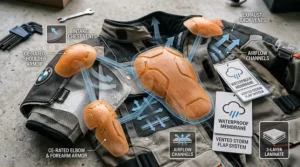
The REV’IT! Sand 4 H2O occupies a sensible middle ground for riders who need real weatherproofing and real ventilation without committing to flagship pricing. It uses a removable H2O waterproof-breathable membrane rather than a fully laminated shell, which keeps the price meaningfully lower than the Defender 3 GTX or Badlands Pro while still delivering certified CE Level 2 armor at the shoulders and elbows.
Reviewers consistently frame this tier of REV’IT! gear as targeted rather than flagship — strong on the fundamentals riders actually need, without the abrasion-resistant laminates and airbag-readiness that push flagship jackets past $900. What most buyers overlook is that a removable liner isn’t strictly a downgrade; it lets you strip the jacket down to a lighter shell on genuinely hot days, something a permanently laminated jacket can’t replicate without switching to mesh entirely.
Pros:
- ✅ Removable H2O liner adapts to a wide temperature range
- ✅ CE Level 2 armor at a meaningfully lower price point
- ✅ Adjustable fit points accommodate layering underneath
Cons:
- ❌ Lacks premium abrasion laminates of flagship rivals
- ❌ No airbag-ready compatibility at this price tier
Pricing typically runs $350-$430, making it one of the stronger multi terrain riding jacket options for riders who want genuine certified protection without flagship-level spending.
7. Spada Explorer — the honest budget entry point
The Spada Explorer deserves real credit for what it accomplishes at its price. It’s a genuine three-layer garment with a drop-out thermal liner and a separate waterproof layer, built from 600D polyester that delivers decent abrasion resistance in a fall. That construction philosophy — layers you can strip out individually — mirrors far pricier jackets, just executed with more modest materials.
Here’s what to weigh honestly: this isn’t a jacket built for Dakar-style abuse, and it shouldn’t be marketed or bought as one. Reviewers noted a generous fit in the larger sizes, with body and sleeve length running longer than competitors, which suits taller riders well but means shorter riders should size down. For a first ADV jacket, a backup jacket, or a genuinely tight budget, it delivers real CE-rated armor pockets and functional weatherproofing without the flagship price tag.
Pros:
- ✅ Genuine three-layer construction at a budget price
- ✅ Removable thermal and waterproof layers add versatility
- ✅ Generous fit accommodates taller riders comfortably
Cons:
- ❌ 600D polyester trails flagship abrasion-resistant fabrics
- ❌ Lighter-colored versions show road grime quickly
At roughly $150-$200, the Spada Explorer is the clearest value-for-money argument on this list for anyone buying their first serious ADV jacket.
Practical Usage Guide: Breaking In and Maintaining Your Adventure Jacket
A new jacket isn’t ready to ride the moment it arrives. Spend your first evening adjusting every strap — waist belts, sleeve cuffs, collar closures — while wearing your actual base layers, not a t-shirt, since fit changes dramatically once you add thermal layers underneath. Ride your first 100 miles somewhere low-stakes, like a familiar backroad loop, so you can identify pinch points or armor that shifts before you’re three hours from the nearest gear shop.
Maintenance on a textile ADV jacket is genuinely simple but frequently ignored. DWR (durable water repellent) coatings degrade with UV exposure and washing — expect noticeable fading in water-beading performance after 15-20 rides in direct sun, well before any liner failure occurs. A spray-on waterproofing treatment restores this without needing to replace the jacket. Zippers deserve a monthly wipe with a dry cloth and occasional silicone lubrication, since grit works into YKK sliders faster than most riders expect. The single most common first-30-days mistake is skipping armor position checks after each fall or even hard braking event — CE pads can migrate inside their pockets, and a shifted elbow pad does you no good in the exact moment you needed it.
Real-World Scenario: Which Rider Are You?
Picture the college-adjacent commuter riding a Kawasaki Versys 300 through variable Midwest weather, 12 miles each way, four days a week. Budget matters more than flagship specs here, and a jacket like the Alpinestars AMT-10R Drystar XF or Spada Explorer covers the realistic range of conditions without overspending on expedition-grade waterproofing that a daily commute rarely tests to its limits.
Now picture the rider planning a genuine six-week Pan-American overland trip on a loaded Yamaha Ténéré 700 — jungle humidity in Central America, freezing passes in the Andes, torrential rain somewhere in between. That rider needs the Klim Badlands Pro or REV’IT! Defender 3 GTX, full stop, because the cost of gear failure mid-trip is measured in ruined electronics and hypothermia risk, not inconvenience.
Finally, consider the weekend desert rider based in Arizona or Nevada, riding technical single-track in 100°F-plus heat where standing water is never the concern but heat exhaustion genuinely is. That’s exactly the profile the Klim Baja S4 was engineered around — certified abrasion resistance without the greenhouse effect of a laminated shell.
🔥 Ready to Gear Up for Your Next Ride?
🧭 Match your riding style to the right jacket above and check current availability before you hit the road. The right adventure motorcycle jacket turns an uncertain forecast into a non-issue — don’t let a bad jacket be the reason your next trip gets cut short!
How to Choose an Adventure Motorcycle Jacket
Picking the right jacket comes down to seven honest questions, answered in order of importance:
- What’s your dominant climate? Riders in consistently wet regions need laminated Gore-Tex; riders in consistent heat need mesh; everyone else needs a removable liner system.
- What CE class do you actually need? AAA is ideal but not mandatory for casual touring; AA is a sensible minimum for anyone riding regularly.
- How will you layer underneath it? A jacket that fits perfectly in summer may be unusable with a heated vest and thermal base layer in winter — try it on with your coldest-weather setup.
- Does it work with your pants and base layers as a system? Some ADV jackets zip directly to matching pants for extra abrasion continuity, which matters more than most riders realize until a slide.
- How much storage do you actually need? Long-distance overlanders benefit enormously from a jacket with a hydration bladder route and a large rear cargo pocket; commuters rarely need either.
- What’s your realistic budget ceiling, and what’s the cost of gear failure for your specific trips? A $200 jacket failing on a commute is annoying; a $200 jacket failing mid-expedition is dangerous.
- Have you verified the armor is actually included, or sold separately? Some budget and even mid-range jackets ship with armor pockets but no protective pads inside — a detail easy to miss when comparing price alone.
For a deeper technical breakdown of how independent testers actually score these criteria across dozens of jackets, GearJunkie’s motorcycle jacket testing coverage is a useful cross-reference before finalizing any purchase.
ADV Motorcycle Jacket vs Adventure Touring Jacket Motorcycle: What’s the Real Difference
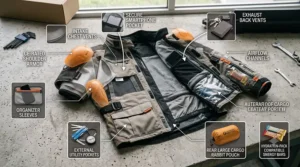
The terms get used almost interchangeably online, but there’s a meaningful distinction worth understanding before you shop. An ADV motorcycle jacket, in its strictest sense, leans toward off-road capability — a slightly shorter cut for standing on pegs, reinforced abrasion zones at the elbows and shoulders where off-road falls concentrate, and typically a looser, more adjustable fit to accommodate body armor and off-bike movement. An adventure touring jacket motorcycle, by contrast, often skews toward long highway miles with an emphasis on weatherproofing, comfort over 8-hour stretches, and storage for touring gear — think map pockets, hydration routing, and a slightly more relaxed riding position built for seated comfort rather than standing agility.
In practice, the best jackets on this list — the Klim Badlands Pro, the REV’IT! Defender 3 GTX — blur the line deliberately, since most riders don’t cleanly separate their off-road days from their highway days on the same trip. If your riding genuinely splits 80/20 toward pavement, prioritize the touring-leaning features; if you’re regularly off tarmac, prioritize the off-road cut and reinforcement zones instead.
Common Mistakes When Buying an Overlanding Jacket Motorcycle
The most frequent and costly mistake: buying based on looks rather than checking the CE certification tag. A jacket that photographs well in marketing material can still carry only a base “A” rating, the minimum tier under EN 17092. Read the actual label, not just the product description.
A close second: assuming “waterproof” and “water-resistant” mean the same thing. Many budget jackets marketed for overlanding jacket motorcycle searches use a water-resistant DWR coating on the outer shell alone, with no true waterproof-breathable membrane underneath — fine for light drizzle, useless in sustained rain. Third, riders frequently skip trying the jacket on with their intended base layers and body armor already in place, then discover at the worst possible moment that sizing up one size would have solved persistent binding at the shoulders. Fourth, many buyers ignore ventilation entirely because they’re shopping in cool weather, then suffer through the first genuinely hot ride of the season with a jacket that has no meaningful airflow options. Finally, don’t assume a higher price automatically means better armor — always confirm the specific CE Level (1 or 2) and class (A, AA, or AAA) rather than trusting the word “premium” alone.
What to Expect: Real-World Performance of an Off-Road Adventure Riding Jacket
Specs on paper rarely translate directly to lived experience, so here’s the honest translation. A jacket rated CE Level 2 at the shoulders and elbows will meaningfully reduce impact transmission in a low-to-moderate speed off-road tip-over — the kind where a rider’s arm or shoulder makes first contact with rocky or rutted ground. It will not meaningfully change the outcome of a highway-speed high-side, where energy dissipation depends far more on the full system (helmet, boots, gloves, and riding technique) than any single jacket.
Ventilation claims deserve similar scrutiny. A jacket advertising “extensive venting” that only opens underarm zips will move noticeably less air at standing-still speeds than one with chest-to-back through-flow vents, since airflow at a stop depends on convection rather than forward motion. Reviewers who tested the Alpinestars Andes V4 Air Drystar specifically praised its large chest and back vents for turning it into a genuine three-season jacket — that’s the kind of specific, verifiable claim worth trusting over generic marketing language.
GS Adventure Jacket: Why BMW Riders Have Specific Needs
Riders searching specifically for a GS adventure jacket — tailored to the BMW R 1250 GS and GS Adventure platform — are usually optimizing for a very particular riding profile: a tall, upright seating position, frequent highway slab between off-road sections, and a rider base that skews toward long-distance touring over technical enduro riding. That profile actually maps closely onto the REV’IT! Defender 3 GTX and Alpinestars AMT-10R Drystar XF covered above — jackets built around comfortable multi-hour seated positions with strong weatherproofing, rather than the more aggressive standing-position cut of dedicated enduro gear.
GS riders in particular benefit from a jacket with a hydration bladder route and rear cargo capacity, since the GS platform’s touring-focused ergonomics tend to attract riders doing genuinely long single-day stints. If your GS is loaded with panniers and a top box for multi-week travel, weight toward the laminated, higher-CE-class options; if it’s a weekend backroad bike, the mid-range picks cover the realistic demand comfortably.
Long-Term Cost & Maintenance: Expedition Motorcycle Jacket Value Analysis
Cost-per-use math changes the value conversation considerably. A $1,000 Klim Badlands Pro ridden 15,000 miles a year for eight years works out to roughly $8.30 per 100 miles in jacket cost alone — genuinely reasonable for a garment that’s also protecting you from injury and hypothermia. A $180 Spada Explorer that needs full replacement every two seasons of similar mileage due to liner wear or fabric fatigue can, over the same eight-year window, actually cost more in total dollars while delivering meaningfully less protection throughout.
That said, total cost of ownership isn’t purely about the jacket surviving longest — it’s about matching lifespan expectations to actual riding volume. A rider putting 2,000 miles a year on weekend trips doesn’t need an $1,100 jacket engineered for expedition-scale abuse; the REV’IT! Sand 4 H2O or Alpinestars Andes V4 Air Drystar will comfortably outlast that rider’s realistic usage window at less than half the upfront cost. Maintenance costs matter too — DWR reproofing sprays run $15-20 and should be budgeted roughly once a season for any textile jacket, regardless of price tier.
Features That Actually Matter (And Those That Don’t): Multi Terrain Riding Jacket Breakdown
Features that genuinely matter: CE-certified armor at shoulders, elbows, and (ideally) back; a verified waterproof-breathable membrane rather than DWR coating alone; adjustability at the waist, sleeves, and collar to accommodate seasonal layering; and reinforced abrasion zones specifically at the shoulders, elbows, and forearms, where crash data consistently shows first-contact impact concentrating.
Features that get marketed hard but matter less than the price tag suggests: reflective piping beyond a basic safety minimum, since most riders already run reflective helmet decals and high-vis vests; excessive external pocket count, since most riders use two or three pockets consistently and ignore the rest; and branded “proprietary” fabric names that, on close inspection, are simply rebranded 500D or 600D polyester — read the denier rating itself rather than the marketing name attached to it.
Adventure Jacket with Ventilation: Airflow Systems Explained
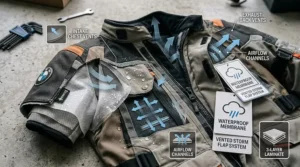
Not all “vented” jackets ventilate the same way, and understanding the mechanism helps you evaluate marketing claims critically. Underarm zip vents are the most basic system — cheap to manufacture, effective at speed, nearly useless standing still. Chest-to-back through-flow vents, like those on the Alpinestars Andes V4 Air Drystar, create a genuine convection path that moves air even at a stop, which is why testers specifically praised that model’s performance in stop-and-go conditions.
Mesh-panel construction, as seen on the Klim Baja S4, represents the maximum-airflow end of the spectrum — essentially removing the barrier between outside air and the rider entirely, sacrificing weatherproofing for cooling. The honest tradeoff: no jacket does both extremes exceptionally well simultaneously. A jacket engineered for maximum airflow will always compromise waterproofing, and vice versa, which is precisely why riders touring through genuinely mixed climates often gravitate toward removable-liner systems rather than either extreme.
Dual Sport Textile Jacket for Overlanding: Problem → Solution Guide
Problem: The jacket traps sweat on long climbs even with vents open. Solution: check that vents actually create through-flow (entry and exit points), not just a single opening; retrofit isn’t possible, so this needs verifying before purchase using specific tester feedback rather than marketing copy alone.
Problem: Liner delamination or peeling after 1-2 seasons of heavy use. Solution: prioritize laminated membranes like Gore-Tex Pro over cheaper bonded coatings, and always air-dry rather than machine-dry a wet jacket, since heat accelerates membrane breakdown.
Problem: Armor shifting out of position during multi-day rides. Solution: check pocket depth and any hook-and-loop retention inside the armor pocket before buying; some budget jackets use loose-fit pockets with no retention method at all.
Problem: Zippers seizing with trail dust and grit. Solution: monthly dry-cloth wipe-downs plus occasional silicone-based (not petroleum-based) lubrication, which won’t attract additional grit the way oil-based products do.
Problem: Jacket runs cold once the removable thermal liner is stripped for summer. Solution: pair a mid-weight base layer designed for motorcycle use rather than assuming the jacket alone should regulate temperature across a 40-degree seasonal swing.
Safety, Regulations & Compliance Guide
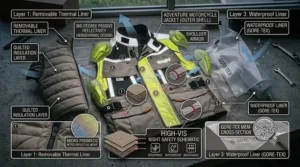
Understanding armor certification is non-negotiable before spending real money on ADV gear. The relevant standard is EN 17092, the European framework governing protective motorcycle clothing, which classifies garments from Class B (no impact protectors) through Class AAA (maximum protection). Crucially, this same standard has become the de facto global benchmark that most major manufacturers — including the U.S.-market brands featured throughout this guide — design and certify against, even for jackets sold primarily in North America.
In the United States specifically, there’s no federal mandate requiring specific armor certification for recreational riding gear the way there is for helmets under NHTSA’s motorcycle safety guidelines, which means the CE rating system remains the most reliable independent benchmark available to consumers. Always confirm both the CE Level (1 or 2, referring to impact absorption at individual joints) and the overall garment Class (A, AA, or AAA) before purchase — a jacket can carry excellent individual armor while the garment itself only earns a base classification if abrasion and seam-strength testing falls short elsewhere.
FAQ
❓ What's the difference between an ADV jacket and a regular motorcycle jacket?
❓ Is a mesh adventure jacket safe for highway speeds?
❓ How much should I budget for a decent adventure motorcycle jacket?
❓ Can I wear an adventure jacket in both winter and summer?
❓ Do I need separate body armor if my jacket already has pockets for it?
Conclusion
The right adventure motorcycle jacket isn’t the most expensive one on the shelf — it’s the one matched honestly to your climate, your mileage, and the actual terrain you ride. A weekend commuter gains little from Gore-Tex Pro expedition armor, just as a six-week overlander shouldn’t gamble a trip on a budget jacket’s DWR coating. Use the CE rating as your non-negotiable floor, match ventilation and weatherproofing to your real riding conditions, and let price follow function rather than the other way around. Whichever of the seven jackets above fits your specific riding life, the goal is the same: gear that disappears into the background of a good ride, doing its job so well you forget it’s even there.
🌍 Find Your Perfect Adventure Jacket Today
✨ Check current pricing and availability on any of the jackets above before your next ride. The right gear turns unpredictable weather and rough terrain into just another part of the adventure — not the reason it ends early!
Recommended for You
- Waterproof Motorcycle Jacket: 7 Top Picks Riders Trust in 2026
- 7 Best Textile Motorcycle Jacket Picks for 2026
- 7 Best Retro Motorcycle Leather Jacket Picks for 2026
Disclaimer: This article contains affiliate links. As an Amazon Associate, I earn from qualifying purchases. If you purchase products through these links, we may earn a small commission at no additional cost to you.
✨ Found this helpful? Share it with your friends! 💬🤗
