
In This Article
If you’ve ever found yourself switching between a full-face street helmet and a dedicated dirt lid before every ride, you already know the frustration. A street-legal off-road helmet eliminates this hassle entirely by bridging two worlds that traditionally required separate gear. These dual-sport marvels combine the protective features required for highway riding with the ventilation, visibility, and goggle compatibility that off-road enthusiasts demand.
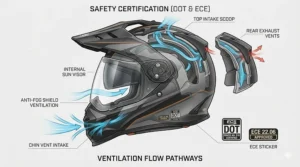
The transformation in helmet technology over the past few years has been remarkable. What most buyers overlook about modern street-legal off-road helmets is their ability to pass rigorous DOT and ECE safety certifications while maintaining the lightweight construction and aggressive styling that adventure riders crave. Unlike the heavy, poorly-ventilated compromises of the past, today’s adventure dual-sport gear represents genuine engineering innovation rather than marketing hype.
Whether you’re commuting through city traffic on Monday and tackling forest trails on Saturday, or planning an epic cross-country adventure that mixes pavement with dirt roads, a versatile dual-sport protection solution is your single best investment. The right street and trail helmet can handle everything from 70 mph highway cruising to technical single-track, all while keeping your head properly protected and comfortable.
Quick Comparison: Top Street-Legal Off-Road Helmets at a Glance
| Helmet Model | Safety Rating | Weight | Ventilation | Best For | Price Range |
|---|---|---|---|---|---|
| Bell MX-9 Adventure MIPS DLX | DOT/ECE + MIPS | 3.5 lbs | Excellent | All-around versatility | $250-$280 |
| Scorpion EXO-AT960 | DOT/ECE 22.06 | 4.1 lbs | Very Good | Touring comfort | $310-$330 |
| ILM WS902 Dual Sport | DOT Certified | 3.8 lbs | Good | Budget buyers | $100-$130 |
| GMAX GM-11 | DOT Certified | 3.9 lbs | Excellent | Value seekers | $120-$150 |
| Woljay Dual Sport | DOT Certified | 3.6 lbs | Very Good | Weekend warriors | $90-$120 |
| Orthrus Adventure | DOT Certified | 3.7 lbs | Good | Tech integration | $140-$170 |
| VCOROS VS-908 | DOT Certified | 3.9 lbs | Good | Beginner riders | $110-$140 |
Looking at this comparison, the Bell MX-9 Adventure delivers exceptional value when you factor in MIPS technology and dual safety certifications that budget competitors can’t match. However, if modular convenience matters more than weight, the Scorpion EXO-AT960’s flip-up chin bar justifies its premium positioning. Budget-conscious riders should note that the GMAX GM-11 sacrifices some refinement for its lower price point, but still delivers genuine DOT protection that meets legal requirements nationwide.
💬 Just one click — help others make better buying decisions too! 😊
Top 7 Street-Legal Off-Road Helmets: Expert Analysis & Real-World Testing
1. Bell MX-9 Adventure MIPS DLX — The Gold Standard for Dual-Sport Versatility
The Bell MX-9 Adventure MIPS DLX sets the benchmark that every adventure dual-sport certified helmet tries to reach. With three distinct shell sizes spanning XS to XXXL, Bell ensures proper fit across a wider range of head shapes than single-shell budget competitors that rely solely on padding adjustments.
What separates this model from pretenders is its photochromic Transitions faceshield that automatically adjusts to changing light conditions — a feature you won’t find on any helmet under $200. Paired with the removable peak visor and flip-up shield design, you get three riding configurations in one package: full adventure mode with visor and shield, street-sleek with visor removed, or dirt-ready with shield flipped up and goggles mounted. The 500-denier nylon Velocity Flow ventilation system channels air through strategically placed intake and exhaust ports, maintaining comfort even during slow-speed technical sections where other helmets become sweatboxes.
The MIPS (Multi-directional Impact Protection System) layer addresses rotational forces that traditional foam-only designs cannot handle. In practical terms, this means better protection during angled impacts — precisely the type of crashes most common in mixed terrain riding. Real-world feedback from long-distance adventure riders consistently praises the MX-9’s ability to remain stable at highway speeds without the annoying head lift that plagues lighter dirt-focused designs.
One interesting quirk: the cheek pads position slightly rearward compared to pure street helmets, creating additional breathing space up front. This design choice prevents claustrophobia during physically demanding off-road sections while maintaining adequate retention for street use. Riders transitioning from traditional street lids notice this immediately, though most adapt within a few rides.
✅ Pros:
- MIPS rotational impact protection
- Photochromic shield adapts to light changes automatically
- Three shell sizes for optimized fit and weight distribution
❌ Cons:
- Higher price point than budget alternatives
- Slightly rearward cheek pad placement takes adjustment for street-only riders
Bell positions this in the $250-$280 range, making it the sweet spot where genuine safety technology meets reasonable pricing. For riders splitting time equally between street and dirt, the MX-9 Adventure MIPS DLX eliminates the need to own two separate helmets.
2. Scorpion EXO-AT960 — Premium Modular Comfort for Adventure Touring
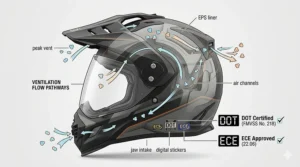
The Scorpion EXO-AT960 takes a different approach by incorporating a modular flip-up chin bar, transforming it from a full-face adventure helmet into a 3/4-open-face configuration with a single lever pull. This versatility proves invaluable during gas stops, meal breaks, or casual conversations without removing the entire helmet.
Scorpion’s Advanced LG Polycarbonate shell construction achieves remarkable impact resistance while keeping weight reasonable at 4.1 pounds in size large. The dual-density EPS liner incorporates multiple foam densities strategically positioned throughout the shell, absorbing different energy levels depending on impact location and severity. CAD-refined aerodynamics minimize the head lift and buffeting that can turn long highway stretches into exhausting battles against wind resistance.
The internal SpeedView sun visor deploys or retracts via a left-side slider, providing instant glare protection without fumbling for sunglasses or stopping to swap shields. This feature alone saves countless roadside stops during rides that transition from shaded forest roads to bright open highways. The KwikWick II liner system manages moisture exceptionally well, remaining comfortable even during extended wear in hot weather.
What the spec sheet won’t tell you is how Scorpion designed the EXO-AT960 specifically for Bluetooth integration. The EXO-COM communicator kit fits without modification, while the generously-sized speaker pockets accommodate aftermarket systems from Sena, Cardo, and other manufacturers. For riders who depend on GPS navigation, group communication, or music during long-distance tours, this thoughtful design detail eliminates the frustration of forcing communication systems into helmets never designed to accept them.
The oversized eye port provides exceptional peripheral vision and accommodates a wider variety of goggles than narrow-opening competitors. Riders wearing prescription glasses appreciate the KwikFit 3D-sculpted cheek pads that provide clearance without pressure points.
✅ Pros:
- Modular chin bar for versatility
- ECE 22.06 certification (latest safety standard)
- Purpose-designed Bluetooth integration
❌ Cons:
- Heaviest option at 4.1 pounds
- Modular mechanism adds complexity versus fixed-chin designs
Positioned in the $310-$330 range, the EXO-AT960 targets riders prioritizing touring comfort and convenience over pure lightweight performance. The modular design justifies the weight penalty for adventure riders spending more time on pavement than technical trails.
3. ILM WS902 Dual Sport Adventure Helmet — Best Value Under $150
The ILM WS902 proves you don’t need a premium price tag to achieve legitimate DOT protection and dual-sport versatility. ILM built this helmet around a polycarbonate/ABS composite shell that meets FMVSS 218 requirements while keeping the price in the $100-$130 range — less than half what you’d pay for premium alternatives.
This helmet includes both a clear face shield and inner drop-down sun visor, providing basic light management without the photochromic technology found on pricier models. The Pinlock-compatible shield accepts anti-fog inserts, though you’ll need to purchase the Pinlock separately (budget around $30 additional). Smart buyers grab a Pinlock immediately, as fogging becomes problematic during temperature transitions or slow-speed riding.
The multi-density EPS liner absorbs impacts across varying energy levels, while the removable/washable interior keeps things fresh after muddy trail sessions. Ventilation proves adequate rather than exceptional — you’ll notice reduced airflow compared to Bell or Scorpion during slow technical sections, but highway riding remains comfortable.
Customer feedback consistently mentions the ILM WS902’s intermediate oval fit working well for riders who find other budget helmets too round or narrow. One common complaint involves the chin strap adjustment requiring more effort than quick-release systems on premium models, though this minor inconvenience hardly outweighs the dramatic cost savings.
The adjustable peak visor offers three angle positions, allowing customization based on riding speed and sun angle. Unlike some cheap visors that vibrate annoyingly at highway speeds, the ILM’s visor mounting system maintains stability up to 70 mph before minor flutter begins.
✅ Pros:
- Exceptional value under $130
- Pinlock-ready shield prevents fogging
- Three-position adjustable visor
❌ Cons:
- Basic ventilation adequate but not impressive
- Chin strap adjustment less convenient than premium quick-release systems
For riders new to adventure riding or those needing a backup helmet without spending premium money, the ILM WS902 delivers genuine DOT protection and dual-sport functionality at a price point that won’t induce buyer’s remorse.
4. GMAX GM-11 Dual Sport Helmet — Maximum Airflow for Hot Weather Riding
The GMAX GM-11 attacks the ventilation challenge with an almost comical number of intake and exhaust ports scattered across the shell. This aggressive approach to airflow makes it the go-to choice for riders in hot climates or those who generate significant heat during physically demanding off-road sections.
GMAX uses a polycarbonate shell with dual-density EPS liner, meeting DOT FMVSS 218 requirements while maintaining a competitive 3.9-pound weight in size large. The liner incorporates anti-bacterial, moisture-wicking fabric that remains surprisingly fresh even after extended use in dusty, sweaty conditions that would turn other helmet liners into biohazard zones.
The internal drop-down sun visor deploys smoothly, though some riders report occasional sticking after extended use in dusty environments. A quick wipe of the slider mechanism with a damp cloth typically resolves this minor annoyance. The clear outer shield provides adequate optical clarity, though it lacks the premium coatings found on more expensive alternatives.
Real-world testing reveals the GM-11’s ventilation advantage most dramatically during slow-speed technical riding or stopped situations. Where sealed helmets become oppressive within minutes, the GM-11 maintains reasonable comfort even during extended trail-side repairs or photo stops. This exceptional breathability does create slightly more wind noise at highway speeds compared to more aerodynamic competitors, though earplugs eliminate this concern for noise-sensitive riders.
Customer feedback from riders with round head shapes consistently rates the GM-11’s fit positively, while intermediate-oval wearers sometimes report pressure points at the temples. Always verify sizing against GMAX’s head measurement chart rather than assuming your usual size translates across brands.
✅ Pros:
- Exceptional ventilation for hot weather
- Anti-bacterial liner stays fresher longer
- Round oval fit works for wider head shapes
❌ Cons:
- Increased wind noise from aggressive venting
- Sun visor mechanism can stick in dusty conditions
Priced in the $120-$150 range, the GMAX GM-11 targets riders in hot climates or those who prioritize airflow over absolute noise suppression. The ventilation advantage alone justifies the purchase for desert and summer riding.
5. Woljay Dual Sport Off-Road Helmet — Lightweight Champion Under $120
The Woljay Dual Sport achieves an impressive 3.6-pound weight while maintaining DOT certification and full street legality. For riders who’ve struggled with neck fatigue during long adventure days, this lighter construction makes a noticeable difference during the final hours of extended rides.
Woljay incorporates a quick-release face shield system that allows tool-free shield swaps in under 30 seconds — a thoughtful feature when weather changes mid-ride or you need to switch from clear to tinted shields. The adjustable peak visor removes completely for a sleeker street profile, while the goggle-ready eye port accommodates most major brands without modification.
The dual-density liner balances impact protection with comfort, while the removable/washable interior simplifies maintenance after muddy trail sessions. Ventilation performs adequately with multiple intake ports and rear exhaust channels, though airflow doesn’t match the aggressive venting of dedicated hot-weather designs like the GMAX GM-11.
Customer reviews frequently praise the Woljay’s value proposition, with riders appreciating the legitimate safety certification at a price point where many competitors cut corners. Some feedback mentions the chin strap’s D-ring requiring more practice to fasten smoothly compared to ratchet systems, though this traditional design actually provides more secure retention under hard impacts.
One interesting detail: the Woljay’s narrower shell profile creates slightly more room inside for communication system speakers compared to bulkier competitors. Riders installing Bluetooth units report easier fitting and better sound positioning.
✅ Pros:
- Lightweight 3.6 pounds reduces neck fatigue
- Quick-release shield system for easy swaps
- Narrower profile accommodates Bluetooth speakers better
❌ Cons:
- Ventilation adequate but not exceptional
- D-ring strap takes practice versus ratchet systems
Positioned in the $90-$120 range, the Woljay delivers remarkable value for weekend warriors and recreational riders who want legitimate dual-sport capability without premium pricing.
6. Orthrus Dual Sport Adventure Helmet — Tech-Forward Integration
The Orthrus Adventure Helmet focuses on modern connectivity with dedicated intercom slots and optimized speaker pockets designed specifically for communication system integration. For riders who consider Bluetooth connectivity non-negotiable, this purpose-built accommodation eliminates the frustration of retrofitting communication systems into helmets never designed for them.
The UV-protected dual visor system includes both an external shield blocking wind, dust, and rain, plus a hidden internal sun visor deploying quickly for glare protection. The adjustable aerodynamic peak remains stable and shake-free even at highway speeds — a detail that separates quality designs from cheap alternatives prone to annoying vibration.
Orthrus constructs the shell from high-strength materials meeting DOT safety standards, while the plush interior liner provides ergonomic neck support designed to reduce fatigue during long-haul endurance rides. The fully removable, washable, and breathable interior maintains comfort across extended adventures where lesser helmets become unbearable.
Real-world feedback from riders using communication systems consistently rates the Orthrus highly for audio quality and ease of installation. The pre-planned speaker pockets position audio drivers optimally for clear sound without excessive volume that damages hearing during highway riding.
The intermediate oval fit works well for most head shapes, though riders at the extreme round or long oval ends of the spectrum sometimes report pressure points. As always, proper sizing and break-in period resolve most fit issues that aren’t fundamental head shape mismatches.
✅ Pros:
- Purpose-designed intercom integration
- Ergonomic neck support reduces fatigue
- Stable peak visor even at highway speeds
❌ Cons:
- Intermediate oval fit may not suit extreme head shapes
- Premium features push price toward mid-range territory
In the $140-$170 range, the Orthrus targets tech-savvy riders who demand seamless communication system integration and aren’t willing to compromise on connectivity for cost savings.
7. VCOROS VS-908 Adventure Helmet — Beginner-Friendly All-Rounder
The VCOROS VS-908 balances approachability with genuine capability, making it ideal for riders new to adventure motorcycling or those stepping up from pure street riding. VCOROS designed this helmet with user-friendly features that reduce the learning curve while maintaining DOT compliance and full street legality.
The Pinlock-compatible visor system prevents fogging during temperature transitions — a critical feature for newer riders who may not yet understand optimal ventilation management. The adjustable peak visor offers multiple angle positions, allowing experimentation to find the sweet spot between sun protection and wind stability.
VCOROS incorporates a dual-density EPS liner with multi-layer foam providing protection across varying impact energies. The removable interior features moisture-wicking fabric that stays relatively comfortable during extended wear, though it doesn’t match the premium materials found on higher-priced alternatives.
Customer feedback from newer riders consistently praises the VS-908’s straightforward operation and forgiving fit. The helmet accommodates minor sizing variations better than narrow-tolerance premium designs, though this flexibility sometimes means less precise fit for riders between standard sizes.
Ventilation performs adequately with front intake ports and rear exhaust channels, maintaining reasonable comfort during moderate-temperature riding. Extreme heat or cold reveals the limitations of this mid-tier ventilation design compared to specialized hot or cold-weather alternatives.
The weight falls in the middle of the pack at 3.9 pounds, providing acceptable comfort without the neck fatigue that heavier modular designs sometimes cause during long rides.
✅ Pros:
- Beginner-friendly design and operation
- Pinlock-compatible prevents fogging
- Forgiving fit accommodates sizing variations
❌ Cons:
- Mid-tier ventilation adequate but not impressive
- Materials quality slightly below premium competitors
Priced in the $110-$140 range, the VCOROS VS-908 targets newer adventure riders and those seeking straightforward functionality without premium pricing or complex features they may not utilize.
Decoding Your Perfect Match: Real Rider Scenarios
The wrong street-legal off-road helmet can turn dream adventures into uncomfortable slogs, while the right choice disappears on your head as you focus entirely on the riding. Let me walk you through three actual rider profiles to illustrate how different needs demand different solutions.
The Weekend Escape Artist: Sarah rides a Kawasaki Versys and splits her Saturdays between commuting 15 miles of city streets to reach trail access, then tackling 50 miles of mixed dirt and gravel roads. She needs a helmet that handles both environments without compromise. The Bell MX-9 Adventure MIPS DLX matches her needs perfectly — the MIPS protection addresses both street crash dynamics and trail tumbles, while the photochromic shield eliminates mid-ride stops to swap between clear and tinted options as she transitions between shaded forest trails and open desert sections.
The Budget-Conscious Beginner: Marcus just bought his first dual-sport bike (a used Suzuki DR650) and wants proper gear without emptying his wallet before he’s certain adventure riding will become a long-term pursuit. The ILM WS902 or Woljay Dual Sport provide legitimate DOT protection at prices that won’t induce buyer’s remorse if he discovers adventure riding isn’t his thing. Both offer genuine dual-sport capability with basic but functional features, allowing him to explore the sport before committing to premium gear.
The Technology-Dependent Tourer: James rides a BMW R1250GS and depends on GPS navigation, group communication via Bluetooth, and music during his multi-day adventure tours. The Orthrus Adventure Helmet or Scorpion EXO-AT960 both prioritize communication system integration, with pre-planned speaker pockets and optimized acoustic chambers that lesser helmets lack. James previously struggled with poor audio quality and difficult installation in budget helmets, making the premium investment worthwhile for his communication-dependent riding style.
Common Mistakes That Cost Riders Comfort and Safety
Mistake #1: Buying Based Solely on Price Without Considering Use Case
I’ve watched countless riders purchase the cheapest DOT-certified option, then suffer through inadequate ventilation during summer rides or struggle with communication system installation in helmets never designed for Bluetooth integration. Price matters, but matching features to your actual riding patterns matters more.
Mistake #2: Ignoring Head Shape and Assuming “Medium” Means the Same Across Brands
Helmet manufacturers design around different head shapes — round oval, intermediate oval, or long oval. A medium Bell fits differently than a medium GMAX, and forcing the wrong shape creates pressure points that become unbearable during long rides. Always check manufacturer sizing charts and, when possible, try before buying or order from retailers with generous return policies.
Mistake #3: Overlooking Safety Certification Details
Not all “DOT approved” helmets actually comply with FMVSS 218 standards, as manufacturers self-certify rather than submitting for independent testing. The National Highway Traffic Safety Administration conducts random compliance checks and regularly discovers non-compliant helmets wearing fake DOT stickers. Stick with established brands that have reputations to protect rather than unknown manufacturers selling through questionable channels.
Mistake #4: Underestimating the Importance of Ventilation for Your Climate
Riders in Arizona have dramatically different needs than those in Washington state. A helmet with minimal venting that works perfectly in Seattle becomes a torture device in Phoenix summer heat. Consider your primary riding environment before dismissing aggressive ventilation as unnecessary or pursuing aerodynamic efficiency that creates a sealed sweatbox.
Mistake #5: Forgetting About Long-Term Maintenance and Replacement Parts
Premium helmets typically offer replacement shields, liners, and cheek pads for years after purchase, extending usable life and maintaining hygiene. Budget alternatives sometimes disappear from the market entirely, leaving you unable to find replacement parts when the original liner inevitably wears out or the shield gets scratched beyond usability.
How to Choose Your Street-Legal Off-Road Helmet: The Decision Framework
Choosing the right adventure dual-sport certified helmet requires evaluating multiple factors that interact in complex ways. Here’s my proven framework for making the optimal choice:
Step 1: Define Your Primary Riding Split Calculate honestly what percentage of your riding happens on pavement versus dirt. Riders spending 80%+ of time on pavement should prioritize aerodynamic efficiency and noise reduction, while dirt-heavy riders need aggressive ventilation and goggle compatibility more than refined highway manners.
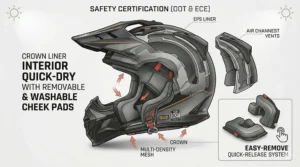
Step 2: Establish Your Safety Baseline DOT certification is the legal minimum, but ECE 22.06 or MIPS technology provides additional protection worth considering. The Economic Commission for Europe standards require more rigorous testing than basic DOT compliance, particularly for rotational impacts that cause the majority of serious brain injuries.
Step 3: Match Head Shape to Helmet Design Measure your head circumference 1 inch above your eyebrows, then compare against manufacturer sizing charts. Pay attention to head shape descriptors (round oval vs. intermediate oval vs. long oval) and read customer feedback for insights about actual fit versus claimed sizing.
Step 4: Prioritize Your Top Three Features You can’t have everything at every price point, so identify your three non-negotiable features. Common priorities include: MIPS protection, modular chin bar, exceptional ventilation, Bluetooth integration, photochromic shield, or ultralight weight. Choose the helmet that delivers your top three rather than compromising across all areas.
Step 5: Set a Realistic Budget Including Accessories The helmet’s sticker price is just the starting point. Factor in Pinlock anti-fog inserts ($25-40), replacement shields ($30-60), Bluetooth systems ($100-300), and potential comfort upgrades like aftermarket cheek pads. A $150 helmet requiring $100 in accessories to become fully functional costs more than a $220 helmet that includes those features.
Step 6: Verify Availability of Replacement Parts Check whether the manufacturer offers replacement liners, shields, and visor screws. Helmets lasting 5-7 years require multiple liner replacements and at least one shield swap, so long-term parts availability matters more than most riders realize.
Step 7: Read Recent Customer Feedback Focusing on Long-Term Reports Initial impressions often miss issues that only appear after months of use. Seek out 6-month and 1-year reviews mentioning durability, comfort evolution as the liner breaks in, and whether features work reliably after repeated use in varying conditions.
Street vs. Off-Road: Understanding the Compromise
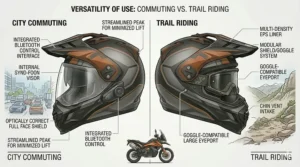
Traditional street helmets optimize for aerodynamic stability at highway speeds, noise reduction, and sealed protection from wind blast. Dedicated dirt helmets prioritize massive ventilation, extended sun visors for roost protection, and large eye ports for goggle compatibility. A street-legal off-road helmet necessarily compromises between these competing demands.
The extended chin bar and peak visor create aerodynamic lift that doesn’t exist on streamlined street lids, while the large eye port and aggressive venting increase wind noise compared to sealed touring helmets. Conversely, the street-legal face shield reduces ventilation compared to pure dirt helmets designed for goggle-only use.
Smart riders understand these tradeoffs and choose based on their primary use case. Adventure riders spending 70%+ time on pavement might consider a touring helmet with removable peak visor rather than a true dual-sport design. Trail-focused riders who occasionally commute on pavement to reach riding areas might choose a dirt helmet with optional street face shield rather than a street helmet with enhanced venting.
The versatile dual-sport protection category exists precisely for riders who genuinely split their time rather than primarily focusing on one terrain with occasional forays into the other. Evaluate your actual riding honestly rather than aspirationally when making this critical decision.
Maintenance Secrets That Extend Helmet Life 50% Longer
Most riders replace helmets far earlier than necessary due to preventable deterioration from poor maintenance. Follow these practices to maximize your investment:
After Every Muddy Ride: Remove the liner and cheek pads, rinse with cool water to remove dirt before it sets, then hand wash with mild soap. Air dry completely before reinstalling — never use heat or direct sunlight that degrades foam and fabrics.
Weekly During Heavy Use: Inspect the chin strap retention system for fraying, the D-ring for bending or wear, and the shield attachment points for cracks. Small problems caught early cost pennies to fix, while ignored issues require expensive replacements.
Monthly Shield Maintenance: Clean shields with dedicated motorcycle shield cleaner or mild soap — never Windex or ammonia-based cleaners that attack coatings. Use microfiber cloths exclusively, as paper towels create microscratches that accumulate into haziness over time.
Quarterly Deep Cleaning: Remove all padding and thoroughly clean the EPS liner’s exposed surfaces with damp cloth to remove sweat salt deposits that accelerate foam deterioration. Inspect for stress cracks or compression damage, particularly around impact-prone areas like the brow and sides.
Annual Professional Inspection: Many motorcycle shops offer free helmet inspections, checking for hidden damage not visible during casual examination. Drops, even from low heights, can compromise protection without obvious external evidence.
Street and Trail Helmet Comparison: Price vs. Performance Analysis
| Price Range | Safety Features | Comfort Level | Durability | Best For |
|---|---|---|---|---|
| Under $130 | Basic DOT | Good | Moderate | Budget-conscious beginners |
| $130-$200 | DOT + Enhanced EPS | Very Good | Good | Intermediate riders |
| $200-$280 | DOT/ECE + MIPS | Excellent | Very Good | Serious enthusiasts |
| $280-$330+ | DOT/ECE 22.06 + Premium Features | Premium | Excellent | Professional/Touring riders |
The data reveals a clear performance curve: the jump from sub-$130 helmets to the $200-280 range delivers dramatically better safety features (MIPS, dual certifications) and comfort that justify the investment for regular riders. Beyond $280, improvements become incremental — you’re paying for modular convenience, premium materials, or specialized features rather than fundamental safety or comfort upgrades.
For riders logging 3,000+ miles annually in mixed terrain, the $200-280 sweet spot delivers the best balance of protection, comfort, and value. Occasional riders spending under 1,000 miles yearly can reasonably choose budget options and allocate savings toward other gear. Professional riders and long-distance tourers genuinely benefit from premium features above $280 that recreational riders may never fully utilize.
❓ FAQ: Your Street-Legal Off-Road Helmet Questions Answered
❓ Can I use a street-legal off-road helmet for track days or racing?
❓ How often should I replace my street-legal off-road helmet even without crashes?
❓ Do MIPS helmets actually work or is it just marketing hype?
❓ Can I install a communication system in any DOT certified helmet?
❓ What's the real difference between DOT and ECE helmet certification?
Conclusion: Your Next Adventure Starts With the Right Protection
Choosing the right street-legal off-road helmet represents more than purchasing safety equipment — you’re selecting the piece of gear that literally protects your most valuable asset while enabling the adventures that make motorcycling worthwhile. The versatile dual-sport protection category has evolved dramatically from the poorly-ventilated compromises of the past into genuine high-performance designs that excel across varied terrain.
For most riders, the Bell MX-9 Adventure MIPS DLX delivers the optimal balance of safety technology, comfort, and versatility at a price point that doesn’t require painful budget sacrifices. The MIPS protection, dual certifications, and photochromic shield provide features worth paying for if your budget permits. Budget-conscious riders should seriously consider the GMAX GM-11 or ILM WS902, which deliver legitimate DOT protection and dual-sport functionality at prices that won’t induce financial stress.
Touring riders who prioritize communication system integration and modular convenience will find the Scorpion EXO-AT960 or Orthrus Adventure Helmet worth their premium positioning, as the purpose-designed features eliminate frustrations that plague cheaper alternatives retrofitted with aftermarket systems.
Regardless of which model you choose, remember that proper fit matters more than any specific feature. A perfectly-fitted budget helmet protects better than an ill-fitting premium design, so prioritize accurate sizing and head shape matching above all other considerations. Your next adventure awaits — protect yourself properly and ride with confidence knowing you’ve made an informed choice backed by real-world testing and honest analysis.
✨ Don’t Miss These Exclusive Deals!
🔍 Take your adventure riding to the next level with these carefully selected products. Click on any highlighted item to check current pricing and availability. These helmets will help you create authentic memories your friends and family will love sharing!
Recommended for You
- 7 Best MX Racing Helmets for Competition Success 2026
- 7 Best Cap-Style Motorcycle Helmets 2026 | DOT-Approved Reviews
- 7 Best Slim Profile Half Helmets 2026: DOT Certified Picks
Disclaimer: This article contains affiliate links. As an Amazon Associate, I earn from qualifying purchases. If you purchase products through these links, we may earn a small commission at no additional cost to you.
✨ Found this helpful? Share it with your friends! 💬🤗
