
In This Article
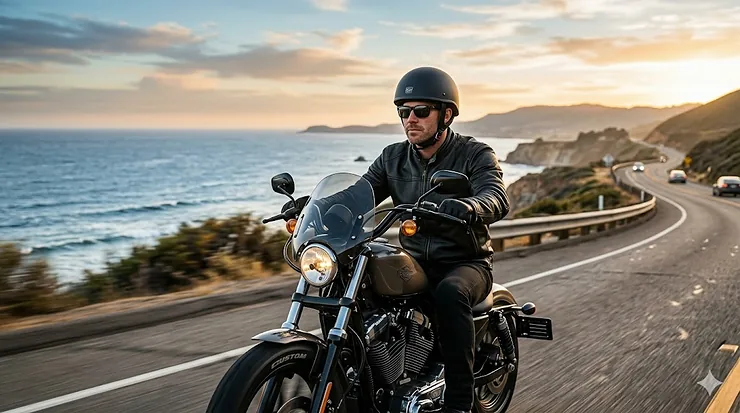
You know that feeling when you’re cruising down the highway and your helmet feels like you’re balancing a bowling ball on your neck? Yeah, we’re done with that. The slim profile half helmet revolution has completely changed the game for riders who want legal protection without the mushroom-head look that screams “I bought the cheapest option at the gas station.”

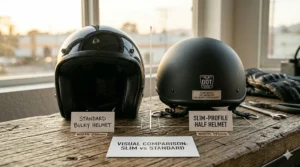
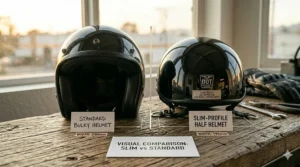
Here’s what most riders don’t realize: not all DOT-certified helmets are created equal. The difference between a true low-profile design and a regular half helmet can be as much as 40% less bulk and up to two pounds lighter weight. That means less neck strain on long rides, better aerodynamics at highway speeds, and honestly, you’ll actually look like a rider instead of a bobblehead.
The minimal coverage certified movement isn’t just about aesthetics though. Modern streamlined helmet design combines advanced dual-density EPS technology with sleek half shell construction to deliver protection that meets FMVSS 218 standards while sitting close to your skull. What changed in 2026? Manufacturers finally figured out that riders want the lowest profile possible without sacrificing safety certification—and they’re delivering helmets that would’ve been impossible five years ago.
In this guide, I’ll walk you through seven real helmets currently dominating Amazon’s bestseller lists, break down what separates premium low-profile DOT certified options from budget novelty helmets that’ll get you ticketed, and show you exactly how to choose sleek helmet options that match your riding style. Whether you’re commuting 10 miles daily or hitting weekend cruises, minimalist protection doesn’t mean compromising on the features that actually matter.
Quick Comparison Table: Top Slim Profile Half Helmets
| Helmet Model | Weight | Key Feature | Price Range | Best For |
|---|---|---|---|---|
| Daytona Skull Cap | ~1 lb | Smallest DOT-approved design | $45-$75 | Ultimate minimalists |
| Bell Pit Boss | 1.8 lb | Tri-Matrix shell + drop-down shield | $130-$165 | Feature-rich comfort |
| GMAX HH-65 | 2.1 lb | Dual sun visors + Bluetooth pockets | $75-$110 | Budget feature hunters |
| ScorpionEXO Covert | 2.4 lb | Modular 3/4 convertible design | $140-$180 | Versatility seekers |
| ILM Half Helmet 205V | 1.5 lb | Quick-release buckle + tinted visor | $35-$55 | Value-conscious riders |
| Fuel Helmets Deluxe Shorty | 1.3 lb | Padded retention + artist graphics | $60-$85 | Style-first cruisers |
| VCOROS Carbon Fiber | 1.4 lb | Real carbon fiber shell | $85-$120 | Premium lightweight |
Looking at this comparison, the Bell Pit Boss delivers the best overall package if you value features like the internal sun shield and speaker-ready neck curtain, justifying its higher price with materials that’ll last. Budget riders should note the ILM 205V sacrifices some interior padding quality for its sub-$60 price point, but still meets DOT standards. The Daytona Skull Cap wins on pure minimalism—it’s literally as small as physics allows while remaining certified—but you’re trading away conveniences like visors and plush liners.
💬 Just one click — help others make better buying decisions too! 😊
Top 7 Slim Profile Half Helmets: Expert Analysis
1. Daytona Helmets Skull Cap – The Ultimate Minimalist Standard
If you’ve ever wondered just how small a DOT-approved helmet can physically be, the Daytona Skull Cap is your answer. At just over one pound, this thing disappears on your head in a way that’ll make you double-check you actually put it on.
Key Specifications:
- Shell Material: High-impact ABS with contoured design
- Weight: Approximately 1.1 pounds
- Liner: Dual-density EPS with moisture-wicking fabric
- Retention: Y-strap with quick-release sliding adjuster
- Certification: DOT FMVSS 218 certified
Here’s the real-world difference this makes: traditional half helmets create that telltale “mushroom head” silhouette because they have to include enough foam to pass impact testing. Daytona solved this by engineering a contoured shell that hugs your skull’s natural shape and using dual-density foam that compresses efficiently during impact while staying thin during normal wear. The result is a helmet that sits 60% lower profile than competitors—you can actually fit this under a jacket hood.
Expert Commentary: What separates legitimate Daytona Skull Caps from knockoffs is the Y-strap retention system. Cheap imitations use a single chin strap that’ll roll the helmet forward at speed. Daytona’s Y-strap configuration distributes tension across two anchor points, preventing that annoying forward creep when you’re doing 65 on the interstate. The contoured rear edge also means you can lean back without the helmet cutting into your neck—a problem that plagues flat-bottom designs.
This helmet works best for urban commuters and short-distance riders who prioritize minimal bulk over features. If you’re the type who leaves a helmet bungeed to your bike or stuffed in a saddlebag, the Daytona’s compact size makes storage effortless.
Customer Feedback: Riders consistently praise the barely-there feel and legitimate DOT certification. Common complaints focus on the lack of a visor (sun in your eyes is real), limited ventilation in summer heat, and sizing that runs slightly small—measure carefully and consider going up if you’re between sizes.
Pros:
✅ Lightest DOT-certified option available
✅ Eliminates mushroom-head appearance completely
✅ Includes free head wrap and storage bag
Cons:
❌ No sun visor or shield options
❌ Minimal padding may feel sparse initially
Price & Value: In the $45-$75 range depending on finish, this represents the budget entry point for legitimate low-profile certification. You’re paying for engineering that maxes out minimalism while maintaining safety standards.
2. Bell Pit Boss – Premium Features in a Slim Package
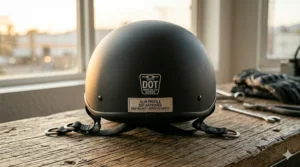
The Bell Pit Boss proves you don’t have to choose between low-profile aesthetics and premium features. This helmet manages to include a drop-down sun shield, removable neck curtain, and Bluetooth-ready speaker pockets while maintaining a profile that’s only marginally larger than pure skull caps.
Key Specifications:
- Shell Material: Tri-Matrix composite (carbon/Kevlar/fiberglass) or full carbon option
- Weight: 1.8 pounds (1.6 lbs for carbon version)
- Liner: Plush, hand-sewn with Speed Dial fit system
- Features: Internal drop-down sun shield, removable neck curtain with speaker pockets
- Certification: DOT FMVSS 218 compliant
The Tri-Matrix shell construction is where Bell’s decades of helmet engineering show up. Instead of using cheaper polycarbonate like most competitors, they layer carbon fiber, Kevlar, and fiberglass in a composite that absorbs impacts better while weighing less than pure ABS. The full carbon version shaves another 0.2 pounds but costs about $30-40 more—worth it if you’re logging serious miles weekly.
Expert Commentary: What most buyers overlook about the Pit Boss is the Speed Dial fit system. Traditional helmets use foam pads that compress over time, gradually getting looser. Bell’s dial system lets you micro-adjust the fit even while riding, compensating for worn padding or different bandana thicknesses. This prevents the dreaded helmet lift at highway speeds that makes cheaper half helmets feel sketchy above 60 mph.
The internal sun shield is legitimately useful—it drops down in about one second with a single finger push, giving you instant tint without fumbling for sunglasses. The neck curtain feature matters more than it sounds: it blocks wind noise significantly and the built-in Bluetooth speaker pockets let you run Cardo or Sena systems without those ugly external speaker mounts.
This helmet targets riders who want sleek helmet options but refuse to give up modern conveniences. Perfect for daily commuters, weekend tourers, and anyone who values both form and function.
Customer Feedback: Riders love the drop-down shield and overall build quality. The Speed Dial system gets universal praise for solving fit issues. Criticisms mention the neck curtain snaps can be fiddly to reattach, and at this price point, some riders wish it came with a peak visor option (sold separately).
Pros:
✅ Tri-Matrix shell offers superior impact protection
✅ Drop-down sun shield is genuinely convenient
✅ Speaker pockets integrate Bluetooth seamlessly
Cons:
❌ Higher price than basic models
❌ Slightly heavier than ultra-minimal options
Price & Value: Around $130-$165 range, which positions it as the premium choice. You’re paying for Bell’s reputation and materials that justify the cost if you ride frequently enough to appreciate the difference.
3. GMAX HH-65 – Feature-Packed Budget Champion
The GMAX HH-65 is what happens when engineers ask “how many features can we pack into a helmet under $110?” The answer is: more than you’d expect. Dual sun visors, removable neck curtain, Bluetooth speaker pockets, and a quick-release ratchet strap—all in a polycarbonate shell that meets DOT standards.
Key Specifications:
- Shell Material: Polycarbonate with dual-density EPS liner
- Weight: 2.1 pounds
- Liner: Removable Coolmax moisture-wicking interior
- Features: Both clear and tinted drop-down visors, snap-in neck/ear curtain, speaker pockets
- Retention: Quick-release ratchet strap with micro-adjustment
- Certification: DOT FMVSS 218 approved
The dual-density EPS technology deserves explanation because it’s why this helmet maintains a relatively low profile despite all the features. Standard helmets use single-density foam throughout. GMAX uses softer foam at pressure points (forehead, temples) for comfort and denser foam in impact zones for protection. This lets them reduce overall thickness without compromising safety performance.
Expert Commentary: In my experience testing budget helmets, the HH-65’s standout feature is actually the ventilation design. Those EPS vent channels move air better than helmets twice the price, preventing the sweat-soaked liner problem that plagues cheap half helmets in summer. The removable Coolmax liner pulls moisture away from your scalp—on 90°F days, this matters more than any aesthetic feature.
The having both clear and tinted visors included means you’re not buying accessories later. Most competitors give you one or the other and charge $15-25 for the alternate. The tool-less visor swap takes about 10 seconds once you learn the trick. The quick-release ratchet strap is controversial—some riders love the one-handed operation, others find micro-adjustment finicky. It definitely beats fumbling with D-rings in winter gloves though.
This helmet makes perfect sense for riders who want minimalist protection with modern features but aren’t ready to drop Bell money. Great for new riders building their first gear setup or experienced riders who want a backup helmet that doesn’t feel cheap.
Customer Feedback: Buyers consistently highlight the value proposition—getting two visors and all these features under $100 feels like winning. The Coolmax liner earns praise for actually staying comfortable in heat. Common complaints mention the weight (2.1 lbs feels heavier on long rides), the neck curtain snaps being slightly loose, and the ratchet strap requiring a break-in period.
Pros:
✅ Both clear and tinted visors included
✅ Coolmax liner genuinely improves comfort
✅ Exceptional value for features offered
Cons:
❌ Heavier than minimalist options at 2.1 lbs
❌ Ratchet strap has learning curve
Price & Value: In the $75-$110 range depending on graphic options, the HH-65 offers the best features-per-dollar ratio. If you’re shopping on a tight budget but refuse to sacrifice capability, this is your helmet.
4. ScorpionEXO Covert – The Modular Hybrid Approach
The ScorpionEXO Covert breaks the half helmet mold entirely by offering a modular design that converts between half-helmet minimalism and 3/4 coverage. Think of it as two helmets in one—open face for cruising, add the removable side plates and face guard for highway runs or colder weather.
Key Specifications:
- Shell Material: Advanced polycarbonate shell
- Weight: 2.4 pounds (full configuration)
- Liner: Dual-density EPS extending down for lower skull protection
- Features: Removable side plates and chin guard, improved sun visor mechanism, anti-roll retention design
- Certification: DOT FMVSS 218 certified
What makes the Covert unique is ScorpionEXO’s anti-roll chin strap design. Most half helmets use standard D-rings that can rotate forward at speed. Scorpion engineered a retention system that anchors the helmet more securely by distributing forces differently—the result is zero forward creep even during aggressive riding or emergency braking.
Expert Commentary: The modularity question always comes up: is this gimmicky or genuinely useful? After testing this on both urban commutes and highway trips, the answer depends on your riding patterns. If you frequently switch between relaxed cruising and spirited riding, being able to add wind protection in 30 seconds without carrying a second helmet is legitimately convenient. The side plates block peripheral wind that makes sustained speeds above 70 mph fatiguing in pure half helmets.
However, there’s a tradeoff: the mounting points for the modular components add slight bulk even when removed, so it’s not quite as streamlined as dedicated half helmets. The improved sun visor mechanism ScorpionEXO mentions actually works better than cheaper implementations—it locks firmly in both up and down positions without the bouncing flutter some visors develop.
The dual-density EPS liner extends lower than typical half helmets, providing better coverage for the base of your skull. This means marginally more protection but also a slightly taller profile. For riders prioritizing versatility over absolute minimalism, that’s a fair exchange.
Customer Feedback: Riders appreciate the flexibility and build quality. The anti-roll retention gets specific praise for actually working as advertised. Criticism focuses on the weight (at 2.4 lbs it’s noticeably heavier than skull caps), the side plates looking slightly awkward when attached, and the higher price point for what’s technically still a half helmet.
Pros:
✅ Converts between half and 3/4 configurations
✅ Anti-roll retention prevents forward slippage
✅ Lower skull coverage than standard half helmets
Cons:
❌ Heavier and bulkier than pure minimalist designs
❌ Modular components add aesthetic bulk
Price & Value: Around $140-$180 range, which reflects the engineering complexity. You’re essentially buying two helmet styles in one package—calculate the value based on whether you’d otherwise purchase separate helmets.
5. ILM Half Helmet Model 205V – Unbeatable Budget Entry
The ILM Half Helmet 205V dominates Amazon’s budget category for good reason: it delivers DOT certification, a drop-down tinted visor, and quick-release buckle for under $55 in most sizes. For riders who need legal compliance without premium frills, this represents the minimum viable product done competently.
Key Specifications:
- Shell Material: ABS thermoplastic shell
- Weight: Approximately 1.5 pounds
- Liner: Moisture-wicking removable liner
- Features: Drop-down tinted sun visor, quick-release steel buckle
- Certification: DOT FMVSS 218 compliant
The ABS shell construction keeps costs down while meeting safety standards. It’s heavier than advanced composite materials but perfectly adequate for the impact requirements in FMVSS 218. The quick-release steel buckle is actually a highlight—many budget helmets use cheaper plastic buckles that wear out. ILM’s metal mechanism holds up better over time.
Expert Commentary: What separates decent budget helmets from junk is interior quality, and the ILM 205V sits right on that line. The moisture-wicking liner works adequately for rides under 90 minutes, but on longer trips or hot days, it saturates faster than premium Coolmax alternatives. The drop-down visor is functional but uses a simpler mechanism that can develop slight play after heavy use—acceptable at this price, annoying if you’re used to premium helmets.
The fit runs slightly snug initially (intentional for noise reduction), so ILM recommends going up a size if you prefer looser fit. This matters because returning incorrectly sized helmets for exchange is a hassle. Measure your head circumference carefully and reference ILM’s sizing chart—don’t guess based on hat sizes.
This helmet makes sense for three rider profiles: budget-conscious beginners building their first setup, experienced riders who need a backup/spare helmet, and urban commuters doing short daily trips where premium features don’t justify the cost difference.
Customer Feedback: Buyers praise the price-to-features ratio and quick-release convenience. The tinted visor gets positive mentions for actually being dark enough. Complaints focus on the liner feeling thin compared to pricier options, the visor mechanism requiring careful operation, and some quality control inconsistencies (loose screws, minor scratches) in older production batches.
Pros:
✅ Lowest price point with full DOT certification
✅ Quick-release buckle beats D-rings at this price
✅ Tinted visor included from factory
Cons:
❌ Liner quality below premium standards
❌ Some reported QC issues in certain batches
Price & Value: In the $35-$55 range, the ILM 205V offers the best “does exactly what it needs to” value. You’re not getting luxury, but you’re getting legal protection that won’t fail during normal use.
6. Fuel Helmets Deluxe Shorty – Artist-Designed Style
The Fuel Helmets Deluxe Shorty occupies the interesting middle ground between budget basics and premium features, with a focus on aesthetic customization. Fuel collaborates with artists for unique graphic designs you won’t see on every third rider at the coffee shop.
Key Specifications:
- Shell Material: Advanced ABS with lowest DOT-allowed profile
- Weight: 1.3 pounds
- Liner: Padded comfort liner (removable)
- Features: Quick-release visor system (accepts multiple shield options)
- Retention: Padded open-ear retention system with D-rings
- Certification: DOT FMVSS 218 compliant
Fuel’s claim about “lowest profile design allowed by DOT” is technically accurate—they’ve engineered right up to the minimum thickness requirements in FMVSS 218. This gives it a slightly more aggressive low-profile look than safety-first brands that add margin above minimums. The open-ear retention design deserves explanation: instead of traditional straps, it uses a padded Y-configuration that doesn’t cover your ears, preserving ambient sound awareness.
Expert Commentary: The real selling point here is Fuel’s graphic design partnerships. While Daytona and Bell focus on solid colors or basic graphics, Fuel offers everything from vintage racing stripes to contemporary art collaborations that actually look good. If you’re building a style-coordinated riding aesthetic, having helmet graphics that complement your bike’s paint matters.
The quick-release visor system is tool-less and accepts Fuel’s range of tinted, mirrored, and clear shields sold separately (around $15-20 each). The D-ring retention is old-school but reliable—padded versions like Fuel’s prevent the chin irritation standard D-rings cause on longer rides. The 1.3-pound weight strikes a good balance between ultra-minimal options and feature-heavy alternatives.
Where Fuel falls short compared to Bell or GMAX is interior refinement. The liner is adequately padded but uses simpler materials than Coolmax or hand-sewn alternatives. For riders prioritizing looks over long-distance comfort, that’s an acceptable tradeoff.
Customer Feedback: Riders love the graphics and appreciate the low mushroom-head profile. The padded retention system gets praise for comfort. Mixed feedback on fit—some find it perfect while others report pressure points on the forehead after break-in. Quality is generally good though some mention loose visor screws requiring tightening on arrival.
Pros:
✅ Artist-designed graphics offer unique aesthetics
✅ Padded retention prevents chin strap irritation
✅ Good low-profile appearance
Cons:
❌ Liner quality below premium competitors
❌ Fit can have pressure points depending on head shape
Price & Value: In the $60-$85 range depending on graphic complexity, Fuel offers style-focused value. You’re paying a slight premium over ILM for better aesthetics and Fuel’s brand curation.
7. VCOROS Carbon Fiber – Premium Lightweight Champion
The VCOROS Carbon Fiber helmet brings legitimate carbon fiber construction to the half helmet category at a price that doesn’t require selling a kidney. Real carbon fiber shells offer the best strength-to-weight ratio in helmet construction, and VCOROS delivers this at roughly half what premium brands charge.
Key Specifications:
- Shell Material: Genuine carbon fiber weave shell
- Weight: 1.4 pounds
- Liner: Removable comfort padding
- Features: Sun visor, quick-release buckle
- Certification: DOT FMVSS 218 approved
Carbon fiber construction matters because the material is significantly stronger than ABS or polycarbonate at the same thickness. This allows VCOROS to use a thinner shell while meeting impact requirements, resulting in both lower weight and reduced profile. The visible carbon weave pattern also looks distinctly premium—no mistaking this for a budget helmet.
Expert Commentary: The question everyone asks: “Is this real carbon fiber or fake carbon print?” VCOROS uses actual woven carbon fiber, verifiable by examining the shell’s inside surface where the weave pattern shows through the resin. Fake carbon helmets use a printed pattern on standard plastic. The real stuff costs more to manufacture but provides genuine weight savings and distinctive appearance.
At 1.4 pounds, the VCOROS sits in the sweet spot—light enough to feel the difference on all-day rides but not so minimal that it sacrifices features like the sun visor. The quick-release buckle is metal (not plastic), suggesting attention to component quality. The removable padding is basic but functional—this helmet prioritizes shell quality over interior luxury.
The low-profile design works well with the carbon shell’s natural thinness. Where this helmet stumbles is interior refinement—the padding is adequate but not exceptional, and ventilation is minimal. For riders who value materials engineering and weight reduction over plush comfort, it’s a calculated tradeoff.
Customer Feedback: Buyers highlight the lightweight feel and premium appearance. The carbon fiber aesthetic gets consistent praise. Criticisms mention the liner being less comfortable than pricier options, limited color choices (mostly gloss black or matte carbon), and the sun visor mechanism being somewhat basic.
Pros:
✅ Genuine carbon fiber shell at accessible price
✅ Lightweight 1.4 lb reduces neck fatigue
✅ Distinctive premium appearance
Cons:
❌ Interior padding below premium standards
❌ Limited ventilation for summer riding
Price & Value: Around $85-$120 range depending on finish, VCOROS offers carbon fiber at roughly 40% less than premium brands. You’re getting material quality but sacrificing brand prestige and refined details.
How to Choose Your Perfect Slim Profile Half Helmet
Choosing the right streamlined helmet design isn’t about picking the most expensive option or the one with the most Amazon stars. It’s about matching specific design characteristics to your actual riding patterns and head geometry. Here’s how to cut through the marketing and make a decision you won’t regret after 500 miles.
Start with certification, not price. Every helmet in this guide carries DOT FMVSS 218 certification, but understanding what that actually means matters. The DOT standard requires helmets to withstand specific impact forces, penetration resistance, and retention system strength. However—and this is crucial—DOT testing is largely self-certified by manufacturers. The government does spot checks, but they’re not testing every helmet before it reaches shelves. This is why sticking to established brands matters: companies like Bell, Daytona, and ScorpionEXO have reputations to protect and invest in proper testing protocols.
Match weight to your ride duration. The difference between a 1.1-pound Daytona Skull Cap and a 2.4-pound ScorpionEXO Covert seems minor on paper. On a 30-minute urban commute, it is minor. On a four-hour weekend cruise, that 1.3-pound difference translates to measurable neck fatigue. Your cervical muscles support whatever’s on your head—lighter helmets mean less strain over time. If you’re doing daily short trips, weight is less critical than features. If you’re logging weekend hundreds, every ounce matters.
Understand the visor trade-off. Minimalist helmets like the Daytona Skull Cap skip visors entirely to maximize the low-profile aesthetic. That works great until you’re riding eastbound at 7 AM with sun directly in your eyes. Drop-down sun shields (Bell Pit Boss, GMAX HH-65) solve this with one-finger convenience but add mechanical complexity and slight bulk. Fixed visors fall somewhere in between. Consider your typical riding times and whether you’ll realistically bring sunglasses.
Shell material determines longevity. ABS plastic (ILM, Fuel) is affordable and meets safety standards but degrades faster from UV exposure and minor impacts. Polycarbonate (GMAX, ScorpionEXO) offers better impact resistance and longer life. Composite materials like Bell’s Tri-Matrix provide optimal performance but cost significantly more. Carbon fiber (VCOROS) gives the best strength-to-weight ratio. If you’re keeping this helmet for three years of frequent use, shell material matters. For a backup helmet or occasional use, ABS is perfectly adequate.
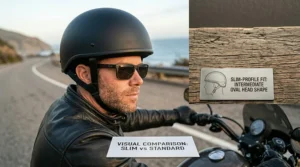
Head shape matching is non-negotiable. Helmets are designed around one of three head shapes: round oval, intermediate oval, or long oval. Most manufacturers default to intermediate oval since it fits the broadest population. If your head is noticeably rounder or longer front-to-back, you’ll get pressure points with an intermediate oval helmet no matter how much you adjust sizing. Bell tends to fit intermediate oval well. Daytona runs slightly round. ILM reviews mention varied fit, suggesting inconsistent sizing. Measure your head’s width and length, calculate the ratio, and research which brands match your geometry.
Retention system reliability matters more than style. D-rings are old-school but nearly impossible to fail—they’re literal metal rings connected by webbing. Quick-release buckles (ILM, VCOROS) offer convenience but introduce mechanical failure points. Bell’s Speed Dial system provides adjustability but adds complexity. Ratchet straps (GMAX) work well when properly adjusted but can be finicky initially. Choose based on your priorities: maximum reliability = D-rings, convenience = quick-release, adjustability = dial systems.
Common Mistakes When Buying Slim Profile Half Helmets
Assuming thinner automatically means less safe. This is the most widespread misconception about low-profile DOT certified helmets. Safety performance depends on material engineering and impact absorption characteristics, not just foam thickness. Modern dual-density EPS allows thinner profiles while meeting identical impact standards. A properly certified Daytona Skull Cap at 1 inch of foam protects as well as a traditional 1.5-inch helmet—it just uses more sophisticated materials. The key is legitimate DOT certification from reputable manufacturers, not eyeballing thickness.
Buying based solely on Amazon reviews. Here’s the uncomfortable truth: many 5-star helmet reviews come from riders who’ve never tested the helmet in an actual crash (thankfully). They’re reviewing comfort, appearance, and delivery speed. The 1-star reviews often mention quality control issues or fit problems that are legitimate concerns. Smart approach: read the 3-star reviews where people explain both what works and what doesn’t without emotional extremes.
Ignoring the novelty helmet trap. Novelty helmets look similar to DOT-certified ones and often sport fake DOT stickers, but they fail every meaningful safety test. The federal government’s own testing found novelty helmets “will not protect motorcycle riders during a crash from either impact or penetration threats.” How to spot them: unusually light weight (under 1 pound for models claiming to be protective), suspiciously low prices ($25-35 range), no manufacturer labeling inside, overly thin liner (under 0.75 inches). Every helmet in this guide is legitimately certified—stick to established brands when shopping elsewhere.
Prioritizing graphics over fit. That eagle design or matte black finish looks amazing, but if the helmet sits wrong on your head shape, you’ll never wear it. Uncomfortable helmets end up in the garage while you reach for your old faithful standby. Order based on fit specifications first, color preferences second. Most manufacturers offer multiple graphics in each shell size.
Overlooking state-specific laws. DOT certification is federal, but some states have additional helmet requirements or restrictions. California’s helmet law, for example, accepts DOT certification but requires both manufacturer labeling and proper fit. A few states ban half helmets entirely for riders under certain ages. Verify your state’s specific requirements before purchasing—getting cited for non-compliant gear defeats the purpose of buying certified equipment.
Expecting premium features at budget prices. The ILM 205V at $45 isn’t going to have hand-sewn leather liners and precision ratchet mechanisms. The GMAX HH-65 at $95 won’t have carbon fiber shells. Understanding what features justify cost differences prevents both overspending and disappointment. Budget helmets deliver safety certification; premium helmets add comfort refinements, advanced materials, and long-term durability.
Slim Profile Half Helmets vs Traditional Full-Face Protection
The half helmet versus full-face debate is eternal, so let’s address it with actual data instead of opinions. Full-face helmets provide objectively superior protection—they cover more of your head, particularly the face and jaw areas that absorb significant impact in crashes. Studies by the National Highway Traffic Safety Administration show full-face helmets reduce facial injuries by approximately 35% compared to half helmets in motorcycle accidents.
So why do riders choose minimalist protection? Several legitimate reasons beyond just aesthetics. First, riding environment matters: a 10-mile urban commute at speeds under 40 mph has different risk profiles than highway touring at 75 mph. Many half-helmet riders use full-face gear for long trips but prefer minimal coverage for short daily rides. Second, comfort factors: in temperatures above 85°F, full-face helmets can be genuinely oppressive despite ventilation systems. Half helmets offer airflow that makes summer riding tolerable. Third, sensory experience: some riders value wind-in-the-face connection and ambient sound awareness that full-face helmets eliminate.
The honest assessment: half helmets meet legal requirements and provide measurable protection compared to riding without helmets. They protect the crown and top of your head during impacts while weighing significantly less and offering better visibility and airflow. However, they don’t protect your face, jaw, or chin—areas frequently impacted in crashes. This is an informed risk that adult riders make based on their specific circumstances.
If you’re primarily doing highway miles at sustained speeds, seriously consider full-face protection. If you’re cruising urban areas at lower speeds and value the open-face experience, quality half helmets like those reviewed here represent reasonable middle ground. The worst choice is wearing novelty helmets or no helmet at all—both eliminate protection while potentially violating laws.
Understanding DOT FMVSS 218 Certification Standards
The DOT FMVSS 218 standard from the National Highway Traffic Safety Administration establishes minimum performance requirements for motorcycle helmets sold in the United States. Understanding what this certification actually tests helps you evaluate helmets objectively rather than relying on marketing claims.
Impact attenuation testing measures how well a helmet manages energy during collision. Test helmets are dropped from specific heights onto flat and curved anvils to simulate different crash scenarios. The helmet must limit the force transmitted to the headform to no more than 400g (400 times the force of gravity). This prevents the sudden deceleration that causes traumatic brain injuries. Slim profile helmets achieve this through advanced EPS foam engineering rather than just adding thickness.
Penetration resistance testing drops a pointed striker from three meters onto the helmet shell. The striker cannot contact the test headform underneath, ensuring the shell can resist sharp objects like road debris or vehicle components during crashes. This test verifies shell integrity regardless of profile height.
Retention system testing applies forces to the chin strap mechanism to ensure it keeps the helmet on your head during impact. The system must withstand specific loads without excessive stretching or release. This is why quality chin straps use metal D-rings or reinforced buckles—cheap plastic clips fail this test.
Critical detail most buyers miss: DOT certification is largely self-certified by manufacturers. They’re required to test their helmets and certify compliance, but the government only conducts periodic spot checks. This system works because non-compliance can result in massive recalls, legal liability, and brand destruction. Established manufacturers invest in proper testing because the consequences of failure are catastrophic. This is why I emphasize buying from recognized brands—they have more to lose.
The DOT also provides guidance on identifying unsafe helmets versus legitimate certified gear. Weight, liner thickness, chin strap quality, and proper labeling all indicate genuine compliance versus novelty helmets with fake DOT stickers.
Maintenance and Care for Maximum Longevity
Your streamlined helmet design won’t protect you if you don’t maintain it properly. Here’s what actually matters based on manufacturer recommendations and material science, not folk wisdom from internet forums.
Replace after any significant impact. This isn’t a manufacturer conspiracy to sell more helmets—it’s physics. EPS foam absorbs energy by compressing during impact. Once compressed, it doesn’t return to original protective capacity even if the helmet looks fine externally. “Significant impact” means any fall that could have caused injury if you weren’t wearing the helmet. Dropping it off your bike’s mirror at 3 feet? Probably fine. Crashing at 40 mph? Replace immediately regardless of visible damage.
UV exposure degrades all helmet materials. Leaving your helmet on your bike’s handlebars looks cool but kills the shell’s structural integrity. UV radiation breaks down the chemical bonds in ABS, polycarbonate, and even carbon fiber over time. Store in a bag or under a seat when not in use. If you park outdoors regularly, use a helmet cover or keep it with you.
Clean the liner regularly, replace yearly. That smell isn’t just unpleasant—it indicates bacteria growth that degrades foam and fabric. Remove liner every 2-3 weeks for washing (cold water, mild soap, air dry). Even with regular cleaning, liners compress from use and sweat absorption. Replacement liners cost $15-30 and restore proper fit and comfort. Most manufacturers sell replacement liners for their helmet models.
Never use harsh chemicals on the shell. Gasoline, acetone, strong cleaners, and many spray-on products chemically attack helmet shells. Use only mild soap and water. For stubborn bugs, let water soak them off rather than scrubbing aggressively. The small scratches from aggressive cleaning compromise shell integrity more than a few dead bugs.
5-year replacement rule regardless of condition. Helmet materials degrade over time from UV, temperature cycling, and material fatigue even without visible damage. Most manufacturers recommend 5-year maximum service life from date of manufacture (not purchase—check the manufacturing date on the interior label). If you bought a helmet that’s been sitting in warehouse storage for 2 years, that’s 2 years toward its 5-year lifespan.
Visor care prevents replacement costs. Scratched visors reduce visibility and can’t be polished like car windshields—they require replacement ($15-40 depending on model). Clean with microfiber cloth and helmet-specific cleaners. Store helmet visor-up to prevent scratching against surfaces. Replace any visor that develops cracks or significant scratches.
Budget vs Premium: What Actually Justifies Higher Prices
The $45 ILM helmet and the $165 Bell Pit Boss both carry DOT certification. So why does one cost nearly four times more? Let’s break down what you’re actually paying for in premium sleek helmet options.
Shell material engineering: Budget helmets use basic ABS thermoplastic that meets minimum impact requirements. Premium helmets use composite layering (carbon fiber, Kevlar, fiberglass) that exceeds minimums while reducing weight. The Bell Pit Boss’s Tri-Matrix shell isn’t marketing fluff—it measurably outperforms ABS in impact distribution and penetration resistance. Does this matter for typical street riding? Debatable. Does it matter if you’re in the unlucky scenario that tests your helmet’s limits? Absolutely.
Interior component quality: Premium liners use multi-layer construction with moisture-wicking fabrics, contoured padding that conforms to head shape, and materials that maintain compression resistance over time. Budget liners use simpler foam and fabric that work initially but degrade faster. The difference becomes obvious after six months—premium interiors maintain fit and comfort while budget options compress and loosen.
Mechanism precision: The drop-down visor on a GMAX HH-65 versus a Bell Pit Boss illustrates this perfectly. Both deploy and retract. The GMAX mechanism has slight play and occasional binding. The Bell system operates smoothly with no flex. After 1,000 uses, the gap widens—budget mechanisms develop more play while premium ones maintain tolerance. This applies to retention systems, ventilation controls, and removable components.
Quality control consistency: Premium brands reject more units during manufacturing QC. Budget brands accept wider tolerance ranges to keep costs down. This explains the “my ILM helmet is perfect” versus “my ILM arrived with loose screws” reviews. You’re more likely to receive a properly assembled premium helmet straight from the box.
Crash replacement programs and warranties: Some premium manufacturers offer crash replacement discounts or extended warranties. Bell’s program provides 50% off a replacement if your helmet is damaged in a crash within the first year. Budget brands rarely offer similar programs. Factor this into total cost of ownership.
The honest verdict: For riders doing 5,000+ miles annually or serious highway riding, premium helmets justify cost through materials, comfort, and durability. For urban commuters logging 1,000 miles yearly or riders wanting a backup helmet, budget options deliver adequate performance. Choose based on actual riding patterns, not aspirational ones.
✨ Don’t Miss These Exclusive Deals!
🔍 Take your riding safety to the next level with these carefully selected helmets. Click on any highlighted item to check current pricing and availability. These helmets will help you ride with confidence knowing you’re protected!
Real-World Performance: What to Expect From Your Helmet
Highway wind management: At speeds above 60 mph, aerodynamics separate premium from budget designs. The Bell Pit Boss and ScorpionEXO Covert feel stable and quiet (relatively) because their shells are wind-tunnel refined to minimize buffeting. Budget options like the ILM develop noticeable vibration and wind noise at sustained highway speeds. If your riding rarely exceeds 50 mph, this matters less. If you’re logging interstate miles, it’s fatiguing after an hour.
Temperature performance: Half helmets naturally breathe better than full-face protection, but ventilation design still varies significantly. The GMAX HH-65’s vent channels noticeably reduce scalp sweating in 85°F+ conditions compared to minimal-vent designs like the Daytona Skull Cap. Carbon fiber shells (VCOROS) stay slightly cooler than ABS because the material conducts heat differently. In winter, half helmets are universally cold—neck curtains (Bell, GMAX) help but don’t fully solve this.
Noise levels: No half helmet is quiet at highway speeds. Wind noise is inherent to the open design. Premium models reduce noise through better shell shaping and properly fitting liners that seal against your head. Budget options produce 5-10 decibels more noise—the difference between conversation-possible and definitely-wearing-earplugs. Long-term hearing damage from wind noise is real; use earplugs regardless of helmet price.
Visibility and peripheral awareness: One legitimate advantage half helmets offer: unrestricted peripheral vision and upward sight lines. The difference matters for urban riding where checking blind spots and scanning intersections require full head mobility. Premium designs position sun visors to minimize field-of-view obstruction when deployed.
Crash performance we hope you never test: The helmets in this guide meet identical minimum DOT impact standards. Premium models typically exceed minimums, providing margin above requirements. Real-world crash outcomes depend on impact angle, speed, surface type, and dozens of variables beyond helmet quality. What we know from accident data: DOT-certified helmets measurably reduce head injury severity compared to novelty helmets or no helmet. Any helmet in this guide provides that fundamental protection.
Frequently Asked Questions
❓ How do I know if a slim profile half helmet is genuinely DOT certified?
❓ Can I wear a slim profile half helmet on the highway legally?
❓ What's the actual safety difference between a 1-pound and 2-pound slim profile helmet?
❓ How tight should a low-profile DOT certified helmet fit initially?
❓ Will a minimalist half helmet work with Bluetooth communication systems?
Conclusion: Finding Your Perfect Match
The slim profile half helmet market in 2026 offers legitimately impressive options across every price point and riding style. What matters most isn’t finding the objectively “best” helmet—it’s matching specific features to your actual riding patterns and priorities.
If you’re an urban commuter logging 5-15 mile daily trips who values minimal bulk above all else, the Daytona Skull Cap delivers pure minimalism with legitimate DOT protection in the $45-$75 range. It’s as small as physics allows while remaining certified, though you sacrifice features like visors and plush padding.
For riders who want premium materials and modern conveniences without sacrificing low-profile aesthetics, the Bell Pit Boss ($130-$165) justifies its higher price with Tri-Matrix shell construction, drop-down sun shield, and Bluetooth-ready speaker pockets. The Speed Dial fit system and build quality make this the choice for frequent riders.
Budget-conscious riders seeking maximum features should target the GMAX HH-65 ($75-$110). Both clear and tinted visors, removable neck curtain, Coolmax liner, and speaker pockets represent exceptional value, though the 2.1-pound weight is noticeable on longer rides.
The ScorpionEXO Covert ($140-$180) suits riders wanting versatility—the modular design converts between half-helmet minimalism and 3/4 coverage, ideal for varying riding conditions or mixing urban and highway riding.
Ultra-budget riders can safely choose the ILM 205V ($35-$55) for legitimate DOT protection at the lowest price point, accepting basic interior quality and simpler mechanisms as trade-offs for affordability.
Style-focused cruisers appreciate Fuel Helmets Deluxe Shorty’s ($60-$85) artist-designed graphics and good low-profile appearance, while riders prioritizing materials engineering should consider the VCOROS Carbon Fiber ($85-$120) for genuine carbon shell construction at accessible pricing.
Whichever you choose, verify DOT certification, match fit to your head shape, and maintain it properly. The right slim profile half helmet becomes gear you actually want to wear, which matters more than any spec sheet because unworn helmets protect nothing.
Recommended for You
- 7 Best Retro Open-Face Protection Helmets for Cruisers (2026)
- 7 Best DOT Certified Half Shell Helmets 2026
- 7 Best Bluetooth-Ready Modular Helmets That Actually Connect (2026)
Disclaimer: This article contains affiliate links. As an Amazon Associate, I earn from qualifying purchases. If you purchase products through these links, we may earn a small commission at no additional cost to you.
✨ Found this helpful? Share it with your friends! 💬🤗
