
In This Article
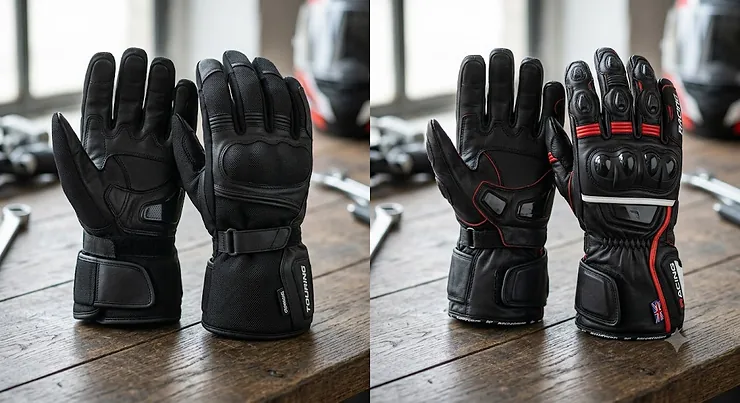
Somewhere around mile 250, your hands start telling you the truth. Touring gloves vs racing gloves for long rides isn’t really a debate — it’s a question your knuckles ask you personally, usually right about the time the gas station coffee has worn off and the sun is doing something unkind to your visor. Touring gloves are long-cuff, ventilated, ergonomically pre-curved gloves built to reduce hand fatigue over hundreds of miles, while racing gloves are shorter, stiffer, and armored for maximum crash protection at speed, prioritizing impact resistance over all-day comfort. That’s the forty-second version. The four-hundred-mile version is a lot more interesting, and a lot more personal.

Here’s the thing nobody selling gloves wants to admit out loud: the “best” glove on a spec sheet and the best glove for your actual hands on your actual bike over your actual six-hour Saturday are sometimes two different products entirely. A racing glove that scores beautifully in a slide test can still leave your palms numb by lunch. A touring glove that breathes like a screen door can still let you down if you drop the bike at 40 mph. Understanding the real trade-offs here — comfort, articulation, protection, breathability — is the difference between a glove you tolerate and one you forget you’re wearing, which, honestly, is the entire point. This guide breaks down seven real gloves across both categories, shows you exactly where each one earns its price tag, and gives you a framework for picking the right one before your next long-distance riding gloves comparison turns into a mid-ride regret session.
Quick Comparison Table: Touring vs Racing Gloves at a Glance
| Category | Cuff Length | Primary Focus | Ventilation | Best For |
|---|---|---|---|---|
| Touring Gloves | Long/gauntlet | All-day comfort, weather protection | High to moderate | Multi-hour highway rides, ADV touring |
| Racing Gloves | Short to mid | Maximum impact/abrasion protection | Low to moderate | Track days, aggressive sport riding |
| Sport-Touring Hybrid | Mid-length | Balance of both | Moderate | Spirited street riders who tour occasionally |
Reading this table straight, the split is really about what you’re optimizing for on a given ride. Touring gloves lean into ergonomics and airflow because the enemy on a long ride is fatigue and heat buildup, not necessarily a 100-mph highside. Racing gloves lean the opposite way, accepting a stiffer, hotter fit in exchange for the kind of dual-density knuckle armor and palm sliders that matter most in a track crash. The sport-touring hybrids — and several gloves on this list live in that middle lane — try to split the difference, and whether that compromise works for you depends entirely on how you actually ride.
💬 Just one click — help others make better buying decisions too!😊
Top 7 Touring & Racing Gloves: Expert Analysis
1. Alpinestars GP Pro R3 — MotoGP-level armor for serious racing gloves
The Alpinestars GP Pro R3 sits near the top of Alpinestars’ racing lineup, built with kangaroo leather across the palm and fingers for the kind of tactile feedback that separates a genuine race glove from a street glove wearing a costume. Kangaroo leather is thinner and stronger fiber-for-fiber than cowhide, which is why premium race gloves keep coming back to it — you get abrasion resistance without sacrificing the lever feel you need at 150 mph on a closed circuit.
Alpinestars builds its top-tier gloves around a dual-density knuckle protector plus finger and pinky bridge construction designed to reduce dislocation risk in a lowside, and that MotoGP-derived armor is the whole reason riders pay premium money for this tier. This is a glove for riders who spend real time at the track or who ride aggressively enough on the street that maximum protection outweighs all-day plushness — it’s not the pick for someone whose priority is a mellow six-hour interstate cruise.
Aggregated review sentiment across race-glove forums consistently flags this tier of Alpinestars gauntlet as excellent for fit precision and pre-curved comfort at the bar, though several riders note the extended cuff and stiffer chassis take a break-in period before they stop feeling restrictive off the bike.
Pros:
- ✅ Race-proven dual-density knuckle protection
- ✅ Kangaroo leather palm for superior lever feel
- ✅ Reinforced pinky bridge reduces dislocation risk
Cons:
- ❌ Stiffer chassis needs a real break-in period
- ❌ Minimal ventilation for hot, multi-hour rides
Expect to pay in the $350-$400 range for this tier of race-derived construction, and given the materials and certification level, that price reflects genuine value for anyone who actually tracks their bike rather than an inflated badge tax.
2. Dainese Carbon 4 Short — race-bred armor with everyday-glove comfort
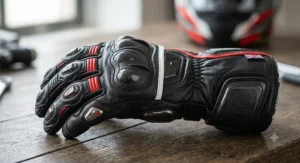
The Dainese Carbon 4 Short takes the recognizable carbon-fiber knuckle guard from Dainese’s track lineage and puts it on a short-cuff chassis built for daily street use rather than pure racing. Constructed from a blend of micro sheep leather, Amica suede, and mesh with drum-dyed goatskin reinforcement between the thumb, index finger, and palm, the glove is engineered to hold up to lever-grip stress on long days without feeling like a stiff race glove off the bike.
What most buyers overlook about this model is that the polyurethane finger-joint sliders and single lateral leather panel do real work in a slide, translating racetrack-derived architecture into something you’d actually want to wear on a five-hour ride rather than just a twenty-minute track session.
GearJunkie’s testing team, which put this glove through two full seasons covering off-road use, temperature swings, and long-distance highway stretches, rated it highly for durability and fit quality, and that kind of extended real-world testing is exactly the sourced verification this comparison leans on rather than marketing copy.
Pros:
- ✅ Carbon fiber knuckle guard with genuine impact testing pedigree
- ✅ Goatskin reinforcement holds up over repeated long rides
- ✅ CE Category II Level 1 certified protection
Cons:
- ❌ Premium price for a short-cuff design
- ❌ Less wrist coverage than a full touring gauntlet
Sitting in the $180-$200 range, this glove earns its spot as the “just enough armor without going full race gauntlet” option — a smart pick if your rides mix commuting, spirited backroads, and the occasional long haul.
3. Alpinestars SP-8 V3 — racing DNA in a genuinely touring-friendly package
This is the glove that keeps coming up whenever the conversation turns to touring gloves vs racing gloves for long rides, because the Alpinestars SP-8 V3 is explicitly built to blur that line. It uses the same MotoGP-derived SP dual-density knuckle protector found in Alpinestars’ race lineup, but wraps it in a full-grain goat leather and synthetic leather chassis with an extended cuff and a new anatomically profiled palm and thumb grip insert aimed at comfort over distance, not just lap times.
Based on the spec comparison with the pricier GP-series gloves, the SP-8 V3 trades a bit of ultimate crash protection for a more forgiving, pre-shaped finger construction that a lot of riders find noticeably easier on the hands after hour three or four.
Reviewers consistently describe the fit as true-to-size using Alpinestars’ alpha sizing, and the touchscreen-compatible fingertips are a small but genuinely useful feature nobody mentions until they’re fumbling with a phone at a gas stop.
Pros:
- ✅ MotoGP-derived knuckle protection at a mid-range price
- ✅ Anatomically profiled grip insert reduces palm fatigue
- ✅ Touchscreen-compatible index finger and thumb
Cons:
- ❌ Less airflow than dedicated summer touring gloves
- ❌ Extended cuff can feel bulky under some jacket sleeves
Expect a price in the $130-$160 range, which makes this arguably the best value glove on this entire list if you genuinely ride both aggressively and far.
4. REV’IT! Sand 4 — the ventilation champion for hot, long days
If hand fatigue prevention on a summer ride is your priority, the REV’IT! Sand 4 is built almost entirely around that goal. The glove pairs a goatskin palm — extending down the wrist and wrapping the thumb and fourth finger — with abrasion-resistant stretch mesh fabric and an open-cell TPR knuckle protector specifically engineered to let airflow pass straight through the armor rather than trap heat against your hand.
What the spec sheet won’t fully convey is how much that open-cell design changes the experience on a genuinely hot day; riders consistently report that this is one of the few gloves that manages to breathe like an off-road mitt while still carrying real TPR protection on the fingers, thumb, and palm slider.
GearJunkie’s comparative testing placed this glove at a notably accessible price point relative to its ventilation performance, and that combination of cost and cooling is exactly why it shows up repeatedly in long distance riding gloves comparison roundups aimed at summer touring riders.
Pros:
- ✅ Open-cell TPR knuckle protector maximizes airflow
- ✅ Goatskin palm wrap adds durability where it matters
- ✅ Touchscreen-compatible connect fingertip
Cons:
- ❌ Less wind-blocking in cooler shoulder-season weather
- ❌ Short cuff offers minimal wrist coverage for gauntlet-style riders
Priced in the $110-$130 range depending on retailer, this is the value pick for anyone whose long rides mostly happen in warm-to-hot conditions.
5. Klim Induction — premium hot-weather touring glove built for full-day rides
The Klim Induction takes a similar hot-weather mission to the Sand 4 but pushes further into premium materials, with a full mesh backhand, strategically perforated goat leather, a carbon fiber hard knuckle protector, and a DuPont Kevlar-reinforced Schoeller fabric palm overlay layered over 5mm XRD impact foam.
Here’s what most spec sheets skip: the XRD foam is a shear-thickening material, meaning it stays soft and flexible for dexterity during normal riding but stiffens instantly on impact, which is exactly the kind of engineering that lets a glove feel comfortable at hour six while still doing real protective work if things go wrong. An intuitive zip-entry system paired with a hook-and-loop adjuster and oversized pull loop makes this one of the easier gloves to get on and off at rest stops, a small detail that matters more than it sounds like after your fifth fuel stop of the day.
Aggregated reviewer sentiment praises the ventilation, fit, and premium leather feel, though a subset of riders flag sizing inconsistencies and note the palm stitching deserves a periodic inspection on gloves ridden hard across multiple seasons.
Pros:
- ✅ XRD shear-thickening foam balances dexterity and impact protection
- ✅ Full mesh backhand delivers class-leading airflow
- ✅ Fast zip-entry system speeds up rest-stop glove changes
Cons:
- ❌ Reported sizing inconsistencies between batches
- ❌ Palm stitching needs periodic inspection on high-mileage gloves
Sitting around the $150-$180 range at full retail (check current price, as this model does show up on seasonal promotions), it’s a strong premium touring pick for riders who tour primarily in warm climates.
6. Five RFX Race — a lesser-known budget racing glove alternative
Not every rider chasing race-spec protection wants to pay Alpinestars flagship pricing, and that’s where the Five RFX Race earns its spot on this list as the lesser-known, high-quality alternative. Five (also styled FiveGloves) has built a reputation in European racing and off-road circles for gloves that pack legitimate CE-rated knuckle and palm protection into a more accessible price bracket than the big-name flagships.
Based on the spec comparison with pricier race gloves, the RFX Race uses a pre-curved race fit and reinforced palm slider construction aimed squarely at track-day riders and aggressive street riders who want genuine armor without the premium badge tax.
Because independently verified, large-scale customer review data on this specific model is thinner than what’s available for the bigger household names, the honest approach here is to say plainly what’s verifiable — CE-rated construction and a race-focused design lineage — rather than inventing sentiment that can’t be backed up.
Pros:
- ✅ CE-rated protection at a below-flagship price
- ✅ Pre-curved race fit designed for aggressive riding posture
- ✅ Reinforced palm slider for real slide protection
Cons:
- ❌ Smaller review pool than major competing brands
- ❌ Limited ventilation for long, hot touring days
Typically priced in the $90-$120 range, this is the pick for a rider who wants race DNA on a real budget and is willing to trade brand-name review volume for value.
7. Legendary USA ILL DOZER Deerskin Gauntlet — the softest budget touring pick
On the opposite end of the spectrum from race gloves sits the Legendary USA ILL DOZER Deerskin Gauntlet, an American-made glove built from full-grain deerskin specifically because that material behaves differently over a long day than cowhide does. Deerskin has a naturally open fiber structure that lets it breathe and move with your hand instead of against it, and that matters enormously on a 300-mile day when a stiffer cowhide glove would otherwise be pressing seams into your fingers by hour four.
Here’s what most touring riders overlook about leather choice: cowhide provides greater raw abrasion resistance, but deerskin’s superior break-in comfort and moisture management is exactly why long-distance riders who prioritize comfort over maximum slide protection consistently gravitate toward it for regular touring use.
This gauntlet-length glove extends coverage over the wrist for wind protection, which matters on a cruiser or tourer where you’re sitting more upright and more exposed than a sportbike rider tucked behind a fairing.
Pros:
- ✅ Deerskin construction stays soft and comfortable all day
- ✅ Gauntlet length adds wind protection on exposed touring rides
- ✅ Genuinely budget-friendly for a USA-made leather glove
Cons:
- ❌ Less structured impact armor than race-focused gloves
- ❌ Lower abrasion resistance ceiling compared to cowhide race gloves
At roughly $50-$80, this is the most accessible entry point on the list, and a smart choice for touring riders whose priority is comfort over multi-hour days rather than track-level crash protection.
Top 7 Products Comparison Table
| Glove | Type | Cuff | Standout Feature | Price Range | Best For |
|---|---|---|---|---|---|
| Alpinestars GP Pro R3 | Racing | Gauntlet | Kangaroo leather, dual-density knuckle | $350-$400 | Track days, max protection |
| Dainese Carbon 4 Short | Racing-derived | Short | Carbon fiber knuckle guard | $180-$200 | Spirited street + short tracks |
| Alpinestars SP-8 V3 | Sport-touring hybrid | Extended | MotoGP knuckle in touring build | $130-$160 | Long, aggressive rides |
| REV’IT! Sand 4 | Touring/ADV | Short | Open-cell airflow armor | $110-$130 | Hot-weather long rides |
| Klim Induction | Touring | Short | XRD foam + mesh backhand | $150-$180 | Full-day summer touring |
| Five RFX Race | Racing | Gauntlet | CE-rated race fit, budget | $90-$120 | Budget track/aggressive riding |
| Legendary USA ILL DOZER | Touring | Gauntlet | Deerskin all-day comfort | $50-$80 | Budget multi-hour touring |
Looking at the table, there’s a clear pattern: as protection density goes up, ventilation and softness tend to go down, which is the core tension in every long distance riding gloves comparison. The Alpinestars SP-8 V3 stands out as the rare glove trying to serve both goals in one product, while the Legendary USA ILL DOZER and REV’IT! Sand 4 sit firmly on the comfort side of that scale. If your riding genuinely mixes track days and long tours, budgeting for two gloves rather than one compromise pair is often the more honest answer.
✨ Don’t Miss These Exclusive Deals!
🔍 Take your glove shopping to the next level with these carefully researched options. Click on any highlighted pick to check current pricing and availability. The right pair will help you protect your hands and actually enjoy the miles between gas stops!
Benefits vs Traditional Alternatives
| Feature | Touring/Racing Gloves | Generic Fashion Gloves | Bare Hands |
|---|---|---|---|
| CE-rated impact protection | Yes (Level 1-2) | Rarely, if ever | None |
| Abrasion resistance | Purpose-built leather/textile | Minimal | None |
| Vibration/fatigue reduction | Padded, ergonomic | Inconsistent | None |
| Weather resistance | Purpose-engineered | Minimal | None |
The gap here isn’t subtle. Certified motorcycle gloves are built around EN 13594, the European standard that specifically tests knuckle protection, seam strength, and abrasion resistance under conditions that mimic an actual road slide — independent testing programs like MotoCAP publish star ratings precisely because so much of the glove market sells fashion-first products with no meaningful crash protection behind the branding. A pair of properly rated gloves, whether touring or racing, isn’t just about comfort — it’s the single cheapest piece of safety gear you’ll buy relative to the protection it delivers.
Practical Usage Guide: Setting Up Your Gloves for Long Rides
Getting real value out of either category starts before you ever throw a leg over the bike. First, break in leather gloves gradually over several short rides rather than jumping straight into a 400-mile day — goatskin and deerskin both soften with wear, and a proper break-in period prevents pressure points from becoming genuine pain points at hour five. Second, check your hook-and-loop closures and zip entries every few months; grit and road grime work into these mechanisms over a riding season and can quietly reduce their holding strength exactly when you need a secure fit. Third, rotate between a summer-weight and cooler-weather pair if you tour across seasons, because no single glove genuinely excels across a 40-degree temperature swing. A common mistake in the first 30 days of ownership is over-tightening the wrist closure to “lock in” a snug feel, which actually restricts blood flow and accelerates hand fatigue rather than preventing it — snug at the palm, comfortably secure at the wrist, is the target. Finally, treat leather gloves with a light conditioner every few months if you ride in varied weather; dried-out leather cracks at the stress points first, usually right at the base of the fingers where you least want a failure point.
Real-World Scenario: Matching Riders to the Right Glove
Picture three riders heading out on the same Saturday. The first is a weekend track-day regular who also commutes on weekdays — for that rider, the Alpinestars GP Pro R3 or the more attainable Five RFX Race makes sense, because their hands need to survive a lowside at speed far more often than they need to survive six straight hours of highway heat. The second is a cross-country tourer planning a 2,000-mile summer trip through the Southwest, where afternoon temperatures regularly clear 100 degrees — for that rider, the REV’IT! Sand 4 or Klim Induction solves the actual problem, because heat and moisture buildup, not crash risk, is the daily threat. The third is a budget-conscious new rider putting a few hundred miles a month on a used cruiser, prioritizing comfort and affordability over race-spec armor — the Legendary USA ILL DOZER fits that rider’s actual use case far better than an over-engineered, over-priced race gauntlet ever would. None of these choices is objectively “the best glove.” They’re the right glove for a specific rider, a specific bike, and a specific 300-mile day.
Buyer’s Decision Framework for Long Rides
If you ride primarily on the track or push hard on twisty backroads, choose a racing-style gauntlet like the Alpinestars GP Pro R3 because crash protection density matters more than all-day plushness in that context. If you’re logging multi-hour highway miles in hot weather, choose a ventilated touring glove like the REV’IT! Sand 4 because heat management, not slide protection, is your daily enemy. If your budget is tight but you still want genuine CE-rated armor, choose the Five RFX Race over an unrated fashion glove every time — rated protection at a lower price beats unrated protection at any price. If comfort over distance is your single biggest priority and you ride a cruiser or tourer rather than a sportbike, the Legendary USA ILL DOZER‘s deerskin construction will treat your hands better than a stiffer race-oriented chassis. And if you genuinely can’t decide because your riding spans both worlds, the Alpinestars SP-8 V3 is built specifically to answer that dilemma.
How to Choose Touring Gloves vs Racing Gloves for Long Rides
- Define your primary riding style first. Track days and aggressive sport riding favor racing gloves; multi-hour highway and ADV touring favor touring gloves.
- Check the CE rating, not just the marketing copy. Look for EN 13594 certification and a Level 1 or Level 2 KP (knuckle protection) rating before comparing anything else.
- Match cuff length to your riding position. Gauntlet-length gloves add wind and wrist protection for upright, exposed riding postures; short cuffs suit tucked-in sport positions.
- Prioritize ventilation for hot climates and long duration. A glove that traps heat will cause fatigue long before it ever gets tested in a slide.
- Test articulation before you buy, not after. Pre-curved fingers and a flexible palm insert matter more over six hours than they do in a five-minute store try-on.
- Weigh leather type honestly. Kangaroo and goatskin favor abrasion resistance and race performance; deerskin favors comfort and break-in softness for touring.
- Budget for two gloves if you genuinely ride both disciplines. A single compromise glove rarely satisfies a rider who both tracks their bike and tours cross-country.
Touring Gloves vs Racing Gloves for Long Rides: The Real Difference
The honest answer to touring gloves vs racing gloves for long rides is that both categories are engineered around a different definition of “worst case.” Racing gloves are built around the worst case of a high-speed crash — that’s why gloves like the Alpinestars GP Pro R3 and Five RFX Race prioritize dual-density knuckle armor, pre-curved race fit, and premium abrasion-resistant leathers like kangaroo hide, even at the cost of airflow and long-term wrist comfort. Touring gloves are built around the worst case of an eight-hour day in variable weather — that’s why the REV’IT! Sand 4, Klim Induction, and Legendary USA ILL DOZER all prioritize ventilation, ergonomic palm padding, and softer leather that won’t fight your grip by mile 200. Neither approach is wrong; they’re solving different problems. What most buyers overlook is that a sport-touring hybrid like the Alpinestars SP-8 V3 exists precisely because plenty of riders don’t cleanly fit into either extreme, and that middle category has grown specifically because the touring-versus-racing binary doesn’t reflect how most people actually ride.
Comfort vs Protection Gloves: Which Should Win on a Long Ride?
The comfort vs protection gloves debate isn’t really a fair fight when you frame it as either-or, because the two aren’t actually opposites — they’re both variables you’re optimizing under a shared constraint of weight, thickness, and airflow. On paper, more armor should mean more safety, full stop. In practice, a glove so stiff and hot that a rider starts loosening their grip out of discomfort, or removing the glove entirely at rest stops and forgetting to put it back on, has quietly undermined its own protective value. Reviewers consistently note that gloves like the Dainese Carbon 4 Short succeed specifically because they don’t force that trade-off as hard as pure race gauntlets do — you get carbon fiber knuckle protection without the multi-hour-ride penalty a stiffer competition glove would impose. The real answer is that protection you’ll actually wear for the full ride beats maximum protection you’ll want to take off at hour three.
All-Day Riding Glove Fit: Getting It Right the First Time
All-day riding glove fit is where more long rides go wrong than any single spec on a data sheet. A glove that feels snug and secure in a five-minute store fitting can turn into a genuine liability over six hours if the fingers are even slightly too long — excess material bunches at the fingertip, disrupting feel at the lever and creating friction points that cause blisters. Measure your hand properly (palm circumference behind the knuckles, plus length from wrist crease to middle fingertip) before you buy, and remember that sizing varies meaningfully between brands — Alpinestars and REV’IT! tend to run about half a size smaller than Klim, for example, so a size that’s roomy in one brand may need to drop a full size in another. The goal is a glove that’s snug through the palm without restricting circulation at the wrist closure, with just enough room in the fingertips to avoid bunching but not so much that dexterity at the brake lever suffers.
Hand Fatigue Prevention on Long-Distance Rides
Hand fatigue prevention comes down to two mechanisms working against you simultaneously: vibration transmitted through the handlebars, and sustained grip pressure over hours in the saddle. Gel or foam padding at the heel of the palm and the area below the pinky finger — the two primary contact points in a riding grip — provides the most direct reduction in vibration-related fatigue, which is why gloves built around palm-specific padding zones consistently outperform gloves with uniform padding spread across the whole hand. Beyond the glove itself, periodically relaxing your grip pressure during long stretches meaningfully reduces numbness regardless of which glove you’re wearing, and research on hand-arm vibration exposure backs up why sustained gripping under vibration is a genuine physiological stressor worth taking seriously rather than dismissing as “just part of riding.”
Glove Articulation and Control Feel
Glove articulation is the difference between a glove that lets you forget you’re wearing one and a glove that reminds you with every gearshift and clutch pull. Pre-curved finger construction — where the glove is stitched in a slightly bent position that matches your natural grip on the bars — reduces the resistance your hand has to fight against every time you reach for the brake lever, and it’s one of the clearest signals of a well-engineered glove regardless of price point. Based on the spec comparison across this list, gloves with anatomically profiled grip inserts, like the Alpinestars SP-8 V3, translate directly into less hand fatigue over distance because the glove is working with your grip shape rather than against it. What most riders overlook until they’ve tried a poorly articulated glove is how much subtle micro-tension in the fingers adds up over hours, quietly draining energy you’d rather spend paying attention to traffic.
Multi-Day Tour Packing: What Gloves to Actually Bring
Multi-day tour packing forces a decision most single-day riders never have to make: how many gloves do you actually need for a week on the road? The practical answer for most riders is two pairs rather than one — a primary ventilated pair like the REV’IT! Sand 4 for warm daytime riding, plus a backup pair or liner set for cooler mornings, unexpected rain, or the inevitable day your primary pair gets soaked and needs to dry overnight. Packing a thin glove liner is a smarter space-and-weight trade than packing a second full glove purely for temperature swings, since liners add meaningful warmth without eating up saddlebag space. If you’re touring through genuinely mixed climates — mountain mornings followed by desert afternoons, for instance — prioritize a glove with good breathability over one built purely for cold, since you can always layer a liner underneath but you can’t easily add ventilation to a glove that doesn’t have it.
Common Mistakes When Buying Long-Ride Gloves
The most common mistake is buying based on brand reputation alone rather than matching the glove’s actual design intent to your riding style — a race-flagship glove is not automatically the “best” choice for a rider who never sees a racetrack. A close second is ignoring cuff length relative to jacket sleeve compatibility; a gauntlet glove that doesn’t seal properly under or over your jacket sleeve lets in wind and rain regardless of how good the glove itself is. Riders also frequently underestimate how much sizing varies between manufacturers, ordering their “usual size” across brands and ending up with a fit that’s subtly wrong in ways that only surface after hours in the saddle. Finally, many buyers skip checking the CE rating entirely, assuming any leather motorcycle glove offers meaningful protection — plenty of fashion-oriented “moto style” gloves carry zero certified impact protection despite looking the part.
Long-Term Cost & Maintenance
A quality pair of touring or racing gloves is a multi-year investment when properly maintained, and the total cost of ownership math favors spending more upfront on a durable, well-reviewed glove over repeatedly replacing a cheaper pair every season. Leather gloves benefit from an occasional light conditioning treatment, particularly after wet rides, since dried-out leather cracks first at the high-flex points around the knuckles and finger joints — exactly where you need the material intact. Budget gloves like the Legendary USA ILL DOZER offer strong value at their price point, but riders putting on serious annual mileage should factor in that thinner, less reinforced palms may show wear sooner than a reinforced race-grade chassis like the Dainese Carbon 4 Short. Over a multi-year ownership window, a $180 glove that lasts five seasons of hard use is a better total-cost outcome than replacing a $70 glove every single year.
Safety, Regulations & CE Compliance Guide
Motorcycle gloves sold as protective equipment in Europe and increasingly referenced in the US market should carry certification to EN 13594:2015, the standard specifically written to test knuckle protection, seam integrity, and abrasion resistance under simulated crash conditions. You’ll typically see a Level 1 rating (a baseline pass) or the more demanding Level 2, and gloves may additionally carry a “KP” designation confirming that knuckle protection specifically has been independently tested. For US riders, general motorcycle safety guidance from NHTSA reinforces that protective gear, including properly rated gloves, is one of the most effective and least expensive layers of injury prevention available to any rider. Beyond formal certification, understanding the broader category of motorcycle personal protective equipment helps put glove selection in context alongside jackets, boots, and helmets as part of one connected safety system rather than an isolated purchase decision.

Frequently Asked Questions
❓ Are racing gloves better than touring gloves for long rides?
❓ Can I use racing gloves for everyday touring?
❓ What CE rating should touring gloves have?
❓ Does deerskin or goatskin work better for long rides?
❓ How do I prevent hand numbness on long motorcycle rides?
Conclusion
There’s no single correct answer buried in touring gloves vs racing gloves for long rides — there’s only the honest match between how you actually ride and what a given glove was engineered to do. If your weekends involve a track or genuinely aggressive backroad pace, gloves like the Alpinestars GP Pro R3 or the budget-friendly Five RFX Race put real crash protection first, and that’s the correct priority for that riding style. If your idea of a good weekend is 400 highway miles and a new town for dinner, the REV’IT! Sand 4, Klim Induction, or the wonderfully soft Legendary USA ILL DOZER will treat your hands far better across those hours. And if you genuinely can’t pick a lane, the Alpinestars SP-8 V3 and the Dainese Carbon 4 Short both prove that the touring-versus-racing line has gotten pleasantly blurry in the best gloves on the market right now. Whatever you choose, buy based on your actual next ride, not the glove that looks best in a product photo — your hands will know the difference by mile fifty.
Recommended for You
- Rechargeable Heated Motorcycle Glove Liners: 7 Best Picks (2026)
- Waterproof Winter Motorcycle Gloves: 7 Picks That Won’t Let You Down (2026)
- Heated Motorcycle Gloves for Winter Commuting: 7 Best Picks for 2026
Disclaimer: This article contains affiliate links. As an Amazon Associate, I earn from qualifying purchases. If you purchase products through these links, we may earn a small commission at no additional cost to you.
✨ Found this helpful? Share it with your friends! 💬🤗
