
In This Article
Walk into any motorcycle gear shop — or scroll through any riding forum past midnight — and sooner or later, the modular vs full face helmet argument erupts like a campfire doused in gasoline. Everyone has an opinion. Half of them are wrong.
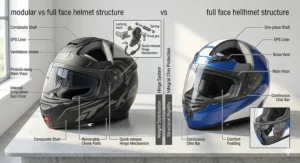
Here’s the thing: both helmet types are genuinely excellent. But “excellent” for the wrong ride, the wrong rider, or the wrong conditions? That’s when helmets let you down — not in dramatic crash-test fashion, but in the slow, grinding misery of wind noise at 75 mph, sweat pooling under a sealed chin bar on a July afternoon, or the fog-blinded fumble of flipping a visor at a tollbooth.
So let’s cut through the noise. In this guide, we’re breaking down exactly what separates modular vs full face helmet designs — structurally, practically, and in real-world riding conditions — and pairing that analysis with seven of the best helmets you can actually buy on Amazon right now.
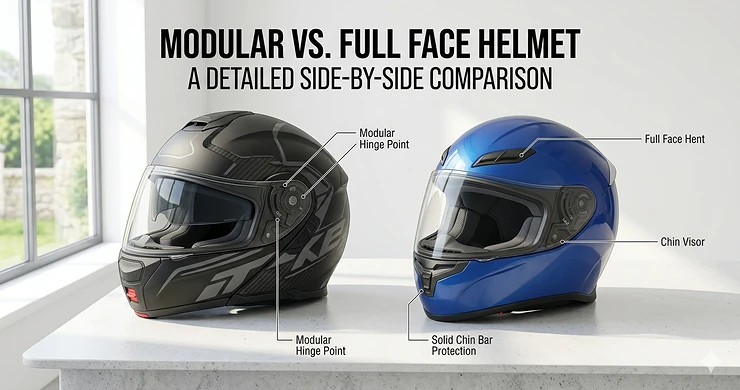
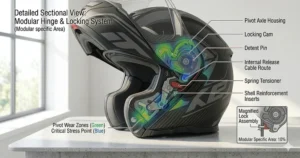
A quick working definition before we dive in: modular helmets (also called flip-up or convertible helmets) feature a hinged chin bar that rotates up, transforming the helmet into an open-face configuration at will. Full face helmets have a fixed chin bar — one solid, uninterrupted shell from crown to chin — offering maximum structural integrity at the cost of zero convertibility. Understanding which design suits your lifestyle is, frankly, more important than which brand you choose.
By the end of this article, you’ll know exactly which lid belongs on your head. Let’s ride. 🏍️
Quick Comparison: Modular vs Full Face Helmet at a Glance
| Feature | Modular Helmet | Full Face Helmet |
|---|---|---|
| Chin Bar | Hinged / flip-up | Fixed / integrated |
| Protection Level | Very good (P/J certified models = excellent) | Best in class |
| Ventilation Convenience | High (open face option) | Depends on vent design |
| Weight | Slightly heavier (~1,600–1,900g) | Generally lighter (~1,400–1,700g) |
| Noise Level | Typically louder | Typically quieter |
| Communication System Fit | Easier access | Requires external mounting |
| Ideal Rider | Touring, commuting, older riders | Sport, track, aggressive street |
| Price Range | $150–$900+ | $130–$1,000+ |
| Best For | Versatility & comfort | Pure protection & aerodynamics |
Looking at this table, one thing becomes obvious: modular helmets trade a thin slice of structural rigidity for massive convenience gains. The noise and weight disadvantages are real — but they’re shrinking with every new generation. Premium modulars like the Shoei Neotec 3 are now approaching full face noise levels, which would have been unthinkable five years ago. Budget buyers should note that cheaper modulars tend to amplify both the weight and noise disadvantages, making brand and price tier far more significant in this category than in full face helmets.
💬 Just one click — help others make better buying decisions too! 😊
Top 7 Modular vs Full Face Helmets: Expert Analysis
1. Shoei Neotec 3 Modular Motorcycle Helmet — Best Premium Modular
The Neotec 3 is the modular helmet that makes full face riders question their life choices. Seriously.
Shoei’s flagship flip-up is built on an AIM (Advanced Integrated Matrix) shell — a proprietary blend of fiberglass and organic fibers that delivers a shell lighter and stronger than standard polycarbonate at a similar volume. The real engineering story, though, is the P/J dual homologation: this helmet is certified to be worn both closed (full-face standard) and open (jet/open-face standard) under ECE 22.06. That’s not marketing fluff — it means the chin bar has been independently crash-tested in the open position, which most modulars simply haven’t. Triple certification — DOT, ECE 22.06, and Snell M2020R — means this lid has been tested harder than anything else at this price.
The QSV-2 drop-down sun visor is a masterclass in execution: large, optically correct, deploys with one finger, and doesn’t rattle. Most riders who’ve used budget sun visors know what a rattling visor sounds like at 70 mph. This isn’t that.
Who should buy it? Touring riders who log 5,000+ miles a year and can’t afford to compromise on either comfort or safety. Weekend warriors who want the versatility of a flip-up without the noisy, heavy penalty that used to come with it. In my experience, the Neotec 3’s noise reduction is so effective that first-time wearers often ask if they’ve accidentally put in earplugs.
Buyers consistently praise the fit (intermediate oval, roomier than competitors), the visor seal, and the build quality. A minority note that sizing runs slightly snug on wider heads — always try before you buy, or consult Shoei’s sizing chart carefully.
✅ Dual P/J homologation — chin bar safe open or closed
✅ QSV-2 sun visor: large, rattle-free, one-finger operation
✅ Shoei Comlink/Sena SRL3 integration pockets built in
❌ Price sits firmly in premium territory — around $900
❌ Not the widest fit for round or oval-wide head shapes
Price range: Around $880–$950 | A significant investment that pays dividends over years of riding.
2. HJC C91 Solid Modular Motorcycle Helmet — Best Budget Modular
HJC has built its empire on one simple principle: give riders 80% of the premium experience at 40% of the price. The C91 exemplifies that philosophy, and it does so without embarrassing itself.
The polycarbonate composite shell is what you’d expect at this price — not fiberglass, not carbon — but HJC’s CAD-optimized shell geometry means the weight is distributed well enough that the C91 doesn’t feel as heavy as its spec sheet suggests. The Advanced Channeling Ventilation System actually works: front-to-back airflow pulls heat out of the helmet noticeably on hot rides, which matters when you’re sitting in urban traffic and the mercury hits 90°F.
What most buyers overlook about this model is the HJ-17 Pinlock-prepared shield. A genuine Pinlock anti-fog insert eliminates the morning visor fog that plagues cheaper competitors — this is a feature that helmets at twice the price sometimes skip. The integrated dark smoke sun visor deploys quickly and sits close to the eye port without flutter. Smart HJC compatibility means you can add a 10B or 20B Bluetooth system without ugly external mounting.
The C91 is ideal for new riders who want a modular without a modular-sized hole in their wallet, commuters doing shorter urban runs where the flip-up chin bar is genuinely useful (coffee at a drive-through, conversation at a stop), and anyone who wants to test modular life before committing to a $900 Shoei.
The tradeoff? At highway speeds, it’s louder than premium options. The chin bar mechanism has less precision than a Shoei or Arai. But for the price, this is difficult to beat.
✅ Pinlock-prepared HJ-17 shield — genuine anti-fog capability
✅ Integrated dark smoke sun visor
✅ Smart HJC Bluetooth compatible
❌ Louder than premium modulars above 60 mph
❌ Polycarbonate shell — less impact energy absorption than composite alternatives
Price range: Around $200–$230 | The smartest entry point into modular riding.
3. ScorpionEXO AT960 Modular Adventure Helmet — Best for ADV & Dual-Sport Riders
Most modular helmets are really touring helmets pretending to be versatile. The AT960 is the rare exception: a genuinely dual-purpose modular that goes from highway touring to dirt-road exploration without losing its mind at either extreme.
The three-shell polycarbonate construction (with dual-density EPS) means you’re not wearing an XS-shell in a Large-size helmet — each size has appropriate structural geometry, which matters more for safety than most manufacturers advertise. The removable external peak visor is the pivotal feature: snap it on for ADV riding with its aerodynamically designed profile, pull it off for cleaner highway aerodynamics. This single design decision makes the AT960 function like two different helmets. The 11cm-tall eye port accommodates goggles when the shield is removed — a detail that separates true ADV helmets from street helmets with a peak bolted on.
DOT and ECE 22.06 certification means this has cleared the newer, more rigorous European test battery, not just the older 22.05 standard that many budget ADV helmets still carry. The EXO-COM Bluetooth integration is purpose-built — not a speaker-pocket afterthought.
The AT960 suits the rider who divides weekends between twisty tarmac and unpaved forest roads, who wants one helmet that handles both without compromise, and who doesn’t want to spend $900 to do it. At around $350–$400, it’s punching above its weight class.
✅ Removable peak visor — true ADV versatility
✅ 11cm goggle-compatible eye port
✅ DOT + ECE 22.06 dual certified
❌ Heavier than pure-street modulars (~1,858g insize medium)
❌ Peak creates some wind noise and turbulence at sustained highway speeds
Price range: Around $350–$400 | Exceptional value for ADV riders who want one helmet for everything.
4. Shoei RF-1400 Full Face Motorcycle Helmet — Best Premium Full Face
If the Neotec 3 is Shoei’s touring masterpiece, the RF-1400 is its sporting counterpart — a helmet developed entirely in Shoei’s in-house wind tunnel, refined through what the brand calls “the relentless pursuit of perfection.” It’s not marketing poetry. The results are measurable.
The AIM+ shell — Shoei’s strongest composite, layering fiberglass with organic fiber matrices — achieves a 6% reduction in aerodynamic lift and 4% reduction in drag compared to the RF-1200, its predecessor. In practice, that translates to a helmet that doesn’t try to lift off your head at 90 mph. The CWR-F2 shield system introduces Vortex Generators on the shield sides — small aerodynamic ridges that displace turbulent air before it wraps around the helmet and generates noise. Combined with all-new airtight window beading (the gasket that seals the shield to the frame), the RF-1400 is remarkably quiet — particularly impressive for a sport-geometry helmet. DOT and Snell M2020 certification makes this one of the safest helmets you can buy.
Who is this for? Track-day regulars and aggressive sport riders who need a lid that stays planted at speed. Also, any rider who’s been shopping full face helmets and has struggled with the fact that lightweight and Snell-certified is rare under $700. The RF-1400 is Shoei’s lightest Snell-certified helmet ever. That matters on a 200-mile sport ride when neck fatigue becomes a real conversation.
✅ Shoei’s lightest Snell M2020-certified helmet
✅ Vortex Generator shield reduces turbulence and noise significantly
✅ 6% lift reduction over predecessor
❌ No integrated sun visor — requires external/photochromic shield
❌ Premium price that will sting for occasional riders
Price range: Around $750–$800 | The benchmark for serious street and track riders.
5. Bell Qualifier DLX Full Face Motorcycle Helmet — Best Budget Full Face
Bell’s Qualifier DLX has been the entry-level workhorse of the full face world for years — and it’s earned that reputation through stubborn reliability rather than flashy specs. What most buyers overlook is that Bell builds this helmet on three shell sizes across six head sizes, meaning you’re not wearing a stretched-out compromise if you fall between size tiers. That’s a construction approach that costs more to manufacture and delivers meaningfully better fit precision.
The NutraFog II shield is legitimately anti-fog — not “anti-fog until the first cold morning” anti-fog, but a multi-coat treatment that holds up over time. ClickRelease shield changes are genuinely tool-free and genuinely fast; swapping shields for different lighting conditions takes about eight seconds. The polycarbonate/ABS shell won’t impress composite-snobs, but it will absorb an impact and protect your head, which is the actual job.
The elephant in the room: wind noise. Reviewers are candid about it. The Qualifier DLX isn’t the quietest helmet in any price bracket — at sustained highway speeds, you’ll want earplugs. If you ride primarily on urban streets or shorter runs, it’s a non-issue. If your typical weekend involves four-hour interstate stretches, budget another $15 for earplugs or budget more for the helmet.
The Qualifier DLX suits new riders learning their preferences, experienced riders who want a dedicated spare or track day back-up, and budget-conscious commuters who don’t need touring-level sophistication.
✅ Three shell sizes — proportional fit across size range
✅ NutraFog II shield with genuine anti-fog performance
✅ ClickRelease tool-free shield swap
❌ Wind noise is significant at sustained highway speeds
❌ No integrated sun visor
Price range: Around $150–$200 | The no-nonsense starting point for full face riding.
6. Arai Corsair-X Full Face Motorcycle Helmet — Best for Pure Protection
Arai doesn’t make flashy marketing claims. They make helmets. The Corsair-X is their flagship, and it represents a philosophy that’s quietly radical in an industry increasingly focused on features and Bluetooth: a helmet’s only job is to protect your head, and everything else is secondary.
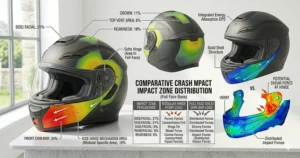
The Complex Laminate Construction (Arai’s proprietary PB shell) differs from Shoei’s approach in one significant way: Arai designs their shells to glance and distribute impact energy across a larger surface area rather than simply absorbing it at the point of contact. Whether this is definitionally superior to other approaches is debated among helmet engineers — but it’s informed by decades of racing partnership feedback, and the Corsair-X’s safety record is exceptional. DOT and Snell M2020D certification is standard.
The VAS Max Vision Shield is the largest field-of-view shield in the Arai lineup — and at the top of any comparison table when it comes to peripheral vision among premium full face helmets. For track riders where late braking and visual scanning at corner entry genuinely matter, this is not a trivial detail. The Eco-Pure liner uses plant-based materials and is fully removable and washable.
What the spec sheet won’t tell you: the Corsair-X fits a very specific head shape (intermediate oval) extremely well and fits non-intermediate-oval heads poorly. If your head tends toward round or narrow-oval, try before you buy. This caveat aside, riders who fit the Arai shape consistently describe the Corsair-X as the most comfortable helmet they’ve ever worn — an outcome that’s directly tied to how precisely it fits the design geometry.
✅ Complex Laminate Construction — glancing impact energy management
✅ VAS Max Vision shield — largest FOV in premium full face category
✅ Eco-Pure removable/washable liner
❌ Fits intermediate oval heads specifically — poor fit for round or narrow heads
❌ No integrated sun visor; premium price
Price range: Around $900–$1,000 | The choice for riders who treat helmet safety as non-negotiable.
7. HJC i80 Modular Motorcycle Helmet — Best Mid-Range Modular
The HJC i80 lives in the sweet spot that most riders should actually be shopping: above budget-tier in construction and noise control, below premium-tier in price. It’s also HJC’s clearest step toward modular maturity — a helmet that takes the lessons of the older i70 and i90 and applies them with a more refined hand.
The multi-composite shell (a step up from the C91’s pure polycarbonate) offers better energy absorption across impact scenarios and contributes to a notably better weight distribution — the i80 doesn’t have the front-heavy feel that many modulars suffer from. The HJ-44 Pinlock-ready shield is optically superior to entry-level Pinlock systems, and the integrated sun visor deploys with a smooth, single-motion slide that doesn’t require looking down from the road.
What most buyers overlook is how well the i80 handles long-distance touring loads. The moisture-wicking liner does actual moisture management (not just “moisture-wicking by virtue of being fabric”), and the ventilation layout is designed to work at highway speeds rather than just in showroom demos. Smart HJC Bluetooth compatibility is maintained — you can add the 20B unit without external mounting.
The i80 is ideal for daily commuters who do occasional long-distance rides, riders upgrading from budget modulars for the first time, and the large contingent of touring riders who want modular convenience without Shoei money.
✅ Multi-composite shell — meaningful upgrade from polycarbonate-only construction
✅ HJ-44 Pinlock-ready shield — excellent anti-fog performance
✅ Smart HJC Bluetooth compatible; smooth sun visor operation
❌ Not as quiet as the Shoei Neotec 3 at highway speeds
❌ Cheek pad fit can be inconsistent at larger sizes (2XL and up)
Price range: Around $270–$310 | The mid-range modular that gets the essentials right.
Which Helmet Type Is Right for You? A Decision Framework
This is the section that replaces a 45-minute conversation with a gear shop employee. The framework is simple: answer three questions honestly, and the right helmet type reveals itself.
🔑 Question 1: How often do you need to remove or lift the helmet mid-ride?
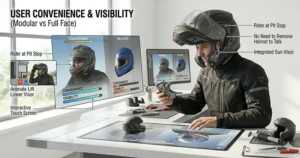
If you commute through urban environments, use drive-throughs, wear glasses, have a beard, use a CPAP machine, or frequently talk to passengers or pedestrians at stops — choose a modular. The flip-up chin bar solves these problems permanently. Full face helmets require full removal for all of these scenarios.
If you ride pure sport, track days, or dedicated highway touring where you rarely stop or interact with people while helmeted — a full face is your architecture.
🔑 Question 2: What’s your primary terrain and speed?
Full face helmets perform better at sustained high speeds. The fixed chin bar eliminates a mechanical joint from the structural equation, reduces lift, and contributes to lower wind noise at 75+ mph sustained cruising. On track or sport bikes, the aero profile matters.
Modular helmets shine on mixed-speed touring — city traffic, mountain roads, casual touring — where their versatility and ease of communication matter more than peak aerodynamic performance.
🔑 Question 3: What’s your budget tier?
This is the one nobody talks about directly: the quality gap between modular types is larger than the quality gap between full face types at the same price. A $150 full face (Bell Qualifier DLX) is a reasonable helmet. A $150 modular is a gamble — the hinge mechanism, chin bar fit, and noise control at budget price are all significantly worse than budget full face equivalents. If budget is the primary constraint, lean full face. If budget allows $300+, modulars become genuinely competitive.
Real-World Scenarios: Matching Helmet Type to Rider Profile
🏙️ The Urban Daily Commuter
Meet the rider who logs 15 miles each way through city traffic, stops at red lights, makes eye contact with crossing guards, and occasionally grabs a coffee through a drive-through window. This is the natural habitat of the modular helmet. The HJC C91 or HJC i80 at budget-to-mid range handles this beautifully — flip the chin bar, breathe the fresh air at stops, seal it back for the highway onramp. A full face here works perfectly fine, but you’ll spend your commutes doing the full-helmet-removal dance at every interaction.
Best pick for this profile: HJC C91 (budget) or HJC i80 (mid-range)
🏕️ The Weekend ADV Adventurer
This rider splits Saturdays between paved switchbacks and dirt access roads to trail systems. They need goggle compatibility, peak visor option, and enough ventilation to stay functional when the tarmac runs out. The ScorpionEXO AT960 was designed for exactly this profile — and its dual DOT/ECE 22.06 certification means it’s not cutting corners to achieve that versatility.
Best pick for this profile: ScorpionEXO AT960
🛣️ The Long-Distance Touring Rider (1,000+ miles/trip)
Multi-day touring riders need: noise control over eight-hour stints, sun visor for changing light conditions, comfortable liner that doesn’t breed bacteria over three consecutive days, and Bluetooth communication integration. Premium modulars — the Shoei Neotec 3 specifically — were engineered for this exact use case. The P/J certification means they don’t give up safety for open-face fresh air at fuel stops.
Best pick for this profile: Shoei Neotec 3
🏁 The Track-Day Sport Rider
Track riders need maximum protection, zero chin bar movement risk, aerodynamic performance at 100+ mph, and Snell certification for most track organizations. This is the one scenario where full face helmets are genuinely non-negotiable — not as personal preference, but often as track-facility policy. The Shoei RF-1400 or Arai Corsair-X deliver here.
Best pick for this profile: Shoei RF-1400 (sport/touring balance) or Arai Corsair-X (pure protection priority)
How to Choose Between Modular and Full Face: 6 Expert Criteria
Choosing between modular vs full face helmet comes down to six practical criteria. Here’s how to weight them:
1. Safety Certification — Start Here, Not at Price
Look for DOT (US minimum), ECE 22.06 (newer, more rigorous European standard), and Snell M2020 or M2020D (independent lab certification, often required at tracks). For modulars specifically, check if the helmet carries P/J certification — meaning the chin bar was crash-tested in the open position. Without P/J, flipping your modular open while riding offers diminished chin protection. The Shoei Neotec 3 and ScorpionEXO AT960 both carry this certification. The HJC C91 does not — flip it open only when stationary.
According to research from the Helmet Safety Institute, chin bar impacts account for a significant portion of motorcycle helmet contact points in real crashes — a compelling argument for not riding with a modular’s chin bar flipped up unless P/J certified.
2. Shell Material — Read Beyond “Lightweight”
Polycarbonate → multi-composite → fiberglass → carbon fiber: this is the ascending hierarchy of shell material quality, and each step represents a meaningful improvement in impact distribution and weight reduction (not just marketing). Budget helmets default to polycarbonate; premium helmets use composite or carbon. The sweet spot for most riders is multi-composite or fiberglass, which lands in the $300–$600 range.
3. Head Shape Fit — More Important Than Any Spec
No helmet is universally shaped. Research from the NHTSA (National Highway Traffic Safety Administration) consistently shows that a properly fitted helmet is the single most critical factor in helmet protection performance. Arai targets intermediate oval; HJC tends toward a slightly rounder fit; Shoei splits the middle. Order from retailers with free returns, wear the helmet for 30 minutes before deciding, and never size up for comfort — padding breaks in, and a loose helmet moves in a crash.
4. Ventilation Design — Not All Vents Work
A helmet with six vents that only two of them functionally move air is worse than a helmet with three well-designed vents. What to look for: dedicated chin vent (brings air directly up across the face shield and reduces fogging), crown vents that connect to internal channels, and exhaust ports at the rear crown. If a helmet’s marketing photos show vent holes but the internal channel system is absent, those vents are decorative.
5. Noise Management — The Sleeper Issue
Wind noise over 85 dB is associated with hearing damage on long rides, and almost no helmet review mentions this until you’ve already bought. Premium helmets invest in neck roll foam seals, visor gaskets, and aerodynamic shell profiling specifically to reduce wind noise. Budget modulars — almost categorically — are louder than budget full face helmets at the same price. If you ride frequently at highway speeds, noise management should move up your priority list.
6. Long-Term Fit and Comfort Features
Removable and washable liners aren’t luxury features — they’re hygiene necessities on any helmet you’ll wear more than twice a month. Speaker pockets and Bluetooth compatibility extend a helmet’s useful life as communication technology evolves. Look for these as baseline requirements, not upgrades.
Common Mistakes When Buying a Modular or Full Face Helmet
❌ Mistake 1: Buying on Shell Weight Alone
“Lightweight” is the single most abused word in helmet marketing. A lightweight shell with inadequate EPS liner density or thin Pinlock film provides worse protection than a slightly heavier shell with a properly engineered liner system. Always check the EPS layer count (multi-density = better energy management) alongside shell weight.
❌ Mistake 2: Assuming Modular = Lower Safety
Early modulars deserved this reputation. Modern P/J certified modular helmets — the Shoei Neotec 3, ScorpionEXO AT960 — have been tested to the same standard as full face helmets in both open and closed configurations. The gap has closed dramatically. What remains true: budget modulars without P/J certification do represent a meaningful safety compromise versus full face helmets at the same price.
❌ Mistake 3: Ignoring the Chin Bar Fit on Modulars
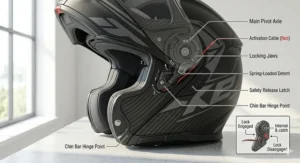
Modular chin bars have an additional fit dimension that full face helmets don’t: the chin bar needs to sit flush, lock securely, and not rattle or flex under wind pressure. Before buying any modular, physically test the chin bar closure mechanism. Push it, twist it, pull it from the sides. If it flexes or moves with moderate hand pressure when locked, the mechanism will definitely flex under highway wind loading.
❌ Mistake 4: Buying for Track Use Without Checking Policy
Most organized track days in the US require Snell certification as a minimum, and some venues specifically prohibit modular helmets entirely — regardless of certification. Check your venue’s current helmet policy before investing in a lid you won’t be allowed to wear there.
❌ Mistake 5: Overlooking the Five-Year Replacement Rule
The Snell Memorial Foundation recommends replacing motorcycle helmets every five years due to material degradation — EPS foam loses energy-absorbing capacity even without visible damage. No helmet — no matter how expensive — is designed for decade-long use. Factor this into your total cost calculation when deciding between budget and premium.
Full Face vs Modular: Real-World Performance, Year-Round Riding
Here’s what the spec sheets won’t tell you about living with each type through a full calendar year:
Summer: Full face helmets feel hotter in slow traffic — the fixed chin bar traps air. Modulars win here, especially with the chin bar cracked or open at traffic lights. Once you’re moving above 40 mph, the ventilation differential shrinks dramatically in premium helmets of both types.
Winter/Cold weather: Modular helmets are messier in cold weather because the chin bar hinge mechanism can accumulate moisture and occasionally ice in extreme cold. Full face helmets seal more completely. Modulars with good chin curtains (like the Neotec 3) close this gap significantly.
Rain: Full face helmets are definitively better. No chin bar hinge means no water infiltration point. In heavy rain, a premium full face with tight visor beading keeps your face drier. Modulars in heavy rain occasionally allow water entry at the chin bar joint.
Long-distance comfort: Modulars win on multi-day touring — the ability to crack the chin bar at gas stations, eat roadside food without full helmet removal, and manage communication at every stop adds up over hundreds of miles in ways that are impossible to fully appreciate until you’ve done it.
Modular vs Full Face: Price Ranges & Long-Term Value
| Tier | Modular Option | Full Face Option | Best Value Assessment |
|---|---|---|---|
| Budget | HJC C91 (~$200–$230) | Bell Qualifier DLX (~$150–$200) | Full face wins on noise & construction at this price |
| Mid-Range | HJC i80 (~$270–$310) | (Bell SRT, ~$300 range) | Modular closes the gap; i80 worth the extra $80 |
| Adventure/ADV | ScorpionEXO AT960 (~$350–$400) | N/A direct equivalent | AT960 stands alone in dual-purpose category |
| Premium | Shoei Neotec 3 (~$880–$950) | Shoei RF-1400 (~$750–$800), Arai Corsair-X (~$900–$1,000) | Premium tier is competitive; choose by riding style |
The total cost of ownership math is worth doing once: a $900 helmet that lasts five years with a retained Pinlock insert, washable liner, and solid hinge mechanism costs $180/year. A $200 helmet replaced at 2.5 years (due to hinge wear, liner degradation, or noise fatigue driving you to upgrade anyway) costs $80/year — but at the cost of significantly inferior protection every mile in between. For riders doing more than 3,000 miles annually, the premium tier is genuinely cost-competitive over time.
✨ Don’t Miss These Exclusive Deals!
🔍 Ready to upgrade your ride? Click on any highlighted helmet above to check current pricing and availability on Amazon. Whether you’re hunting for the best modular vs full face helmet deal or need expert specs at a glance — these are the products that will transform your riding experience.
FAQ: Modular vs Full Face Helmet
❓ Is a modular helmet as safe as a full face helmet?
❓ Can I wear a modular helmet with the chin bar up while riding?
❓ Which helmet type is better for long-distance touring?
❓ What's the difference between DOT, ECE 22.06, and Snell certification?
❓ How do I know when to replace my motorcycle helmet?
Conclusion: Choose Your Lid with Eyes Open
The modular vs full face helmet debate doesn’t have a universal winner. What it has is context — and context is everything.
Full face helmets remain the structural gold standard. If you ride sport or track, if noise reduction matters at sustained speeds, if you want the lightest possible certified lid — the Shoei RF-1400 and Arai Corsair-X represent the pinnacle of this category. The Bell Qualifier DLX makes the full face case for riders who want proven protection without premium cost.
Modular helmets have genuinely grown up. The Shoei Neotec 3 erases most of the old compromises; the ScorpionEXO AT960 opens a category that traditional full face helmets simply can’t enter; the HJC i80 and C91 make modular convenience accessible at real-world prices. The key is choosing the right tier — because the difference between a budget modular and a mid-range modular is larger than in almost any other helmet category.
Whatever you choose: verify the certifications, fit it properly, replace it on schedule, and wear it every single ride. The helmet that’s on your head is infinitely better than the perfect helmet hanging in your garage.
Ride safe. 🏍️
✨ Found Your Perfect Helmet? Don’t Forget!
🔍 Click through to any of our recommended helmets above to check current pricing and availability on Amazon. These are real helmets, real certifications, and real rider-tested performance — your best ride starts with the right lid on your head!
Recommended for You
- Sport vs Touring Full Face Helmet: 7 Best Picks in 2026
- 7 Best Multi-Material Composite Helmets 2026
- 7 Best Fiberglass Composite Shell Helmets for Ultimate Protection 2026
Disclaimer: This article contains affiliate links. As an Amazon Associate, I earn from qualifying purchases. If you purchase products through these links, we may earn a small commission at no additional cost to you.
✨ Found this helpful? Share it with your friends! 💬🤗
