
In This Article
Rain doesn’t check your riding calendar before it shows up. One minute you’re cruising under a clear sky, the next you’re squinting through a windshield of spray, wondering if that jacket you bought on a sunny afternoon was ever actually built for this. A genuine waterproof motorcycle jacket isn’t a luxury add-on — it’s the difference between a ride you shrug off and a ride that ends with you shivering at a gas station, peeling off soaked layers. This guide breaks down what “waterproof” really means on a motorcycle jacket (spoiler: not all labels are created equal), compares seven real jackets spanning budget to premium, and walks through the practical stuff — setup, maintenance, and the mistakes that turn a decent rain proof motorcycle riding jacket into a soggy disappointment by mile forty. Whether you’re commuting through unpredictable weather or planning a cross-country tour where the forecast is basically a suggestion, you’ll leave with a clear framework for choosing gear that keeps its promises.
What is a waterproof motorcycle jacket? It’s a riding jacket engineered with a sealed, water-blocking layer — typically a laminated membrane like GORE-TEX or a removable drop-liner — combined with taped or sealed seams, so rain is kept out at highway speeds rather than merely resisted for a few minutes. That distinction between “waterproof” and “water-resistant” matters more than almost any other spec on the tag.
Quick Comparison Table
| Jacket | Waterproofing Method | Best For | Price Range |
|---|---|---|---|
| Tour Master Transition 5 | Waterproof zippers + textile shell | Budget all-rounder | Under $250 |
| Joe Rocket Atomic 5.0 | Waterproof zippers, Variable Flow vents | Year-round commuting | $150-$220 range |
| Alpinestars Andes V3 Drystar | Drystar laminated membrane | Mid-range adventure riding | $250-$300 range |
| REV’IT! Sand 5 H2O | Detachable waterproof liner | Multi-season versatility | $320-$380 range |
| REV’IT! Defender 3 GTX | 3-layer detachable GORE-TEX liner | Serious touring, CE AA armor | $480-$550 range |
| Klim Badlands Pro | Tri-layer GORE-TEX Pro shell | Expedition and ADV touring | Around $850 |
| Rukka Nivala 2.0 | Laminated Gore-Tex construction | Premium all-weather benchmark | $700-$850 range |
Look at that spread for a second, because it tells its own story: waterproofing method matters more than price tier alone. A $200 jacket with well-sealed waterproof zippers can outperform a poorly maintained $600 jacket whose DWR coating gave up two seasons ago. Based on the spec comparison above, the jump from “waterproof zippers on a textile shell” to a true laminated GORE-TEX membrane is where you start paying for guaranteed, sustained waterproofing rather than good-enough water resistance — and whether that jump is worth it for you depends entirely on how many hours you spend riding in actual rain versus how many you spend hoping you won’t.
💬 Just one click — help others make better buying decisions too!😊
Top 7 Waterproof Motorcycle Jackets: Expert Analysis
Coverage here spans budget commuter jackets, mid-range all-weather textile riding jackets, and premium touring builds, because “best” depends entirely on your riding pattern, not on which jacket has the flashiest spec sheet.
1. Tour Master Transition 5 — proven budget workhorse with five generations of refinement
The Transition line has been around long enough that riders now talk about buying their second one after seventeen years with the first, which says something about how Tour Master builds these things. Constructed from 600-denier Carbolex polyester with 1680-denier ballistic reinforcement at the elbows, the shell resists abrasion while waterproof zippers handle the moisture-entry points that plague cheaper jackets — the zipper seams, not the fabric itself, are usually where water gets in first. Based on the spec comparison with other budget options, the Transition 5 earns its reputation less through any single standout feature and more through consistent execution across five iterations; this is a jacket for commuters and weekend riders who want dependable, no-drama coverage rather than the latest membrane technology. Reviewers consistently note that the jacket holds up over thousands of miles and multiple bikes, with one owner’s testimonial circulating widely describing nearly two decades of service. What most buyers overlook here is that this reliability comes from simplicity — fewer removable parts means fewer failure points down the road.
Pros:
- ✅ Exceptional long-term durability across generations of owners
- ✅ Waterproof zippers seal the most common leak points
- ✅ Genuinely affordable for the coverage and armor included
Cons:
- ❌ Lacks a true laminated membrane like premium competitors
- ❌ Ventilation is more basic than jackets twice the price
Expect this jacket to sit under $250 at most retailers, and given the multi-year track record reported by long-term owners, it represents strong value for riders who commute year-round rather than chase weather-specific gear.
2. Joe Rocket Atomic 5.0 — waterproof zippers meet genuine four-season versatility
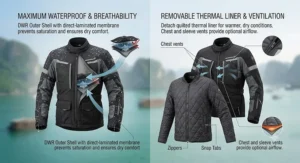
Joe Rocket built the Atomic 5.0 around its RockTex 660 and Hitena shell materials, then layered in a Variable Flow ventilation system paired with waterproof zippers — meaning the same zips that let air in on a hot day seal tight the moment you close them against rain. Here’s what to weigh: the jacket includes a removable thermal liner, so it functions as three-season gear rather than a single-purpose rain shell, which matters if your riding season swings from June heat to October drizzle. Reviewers describe it holding up through wind and rain during long-distance travel, with at least one owner specifically praising its wind- and rain-blocking performance with the liner installed during colder rides. On paper this means you’re buying flexibility rather than best-in-class waterproofing; the Atomic 5.0 won’t out-seal a GORE-TEX laminate, but it covers far more riding conditions than a dedicated summer mesh jacket ever could.
Pros:
- ✅ Removable liner extends useful range across seasons
- ✅ Waterproof zippers hold up in sustained rain per owner reports
- ✅ Strong value against similarly equipped competitors
Cons:
- ❌ Not a laminated membrane, so long soaks test its limits
- ❌ Bulkier fit with the liner in versus true GORE-TEX shells
Priced in the $150-$220 range depending on size and colorway, this is a smart pick for commuters who want one jacket to handle most of the calendar year.
3. Alpinestars Andes V3 Drystar — European engineering with a genuinely waterproof membrane
Step up to Alpinestars’ Andes V3 and you’re getting the brand’s proprietary Drystar membrane, which the company positions as fully waterproof while remaining breathable — a claim backed by Alpinestars’ Direct Ventilation System routing air through the jacket without compromising the seal. What most buyers overlook about mid-range adventure jackets is how much the small features matter on long rides: the Andes V3 includes a waterproof phone pocket, something riders specifically call out as genuinely useful rather than a marketing bullet point. Reviewers consistently praise its size accuracy and comfort even in 90-degree heat, which speaks well of the ventilation engineering doing its job without undermining the waterproofing when conditions flip. Based on the spec comparison against budget alternatives, the Andes V3 justifies its higher price primarily through the membrane technology itself — you’re paying for a genuine laminated waterproof barrier rather than sealed zippers alone, plus the adjustability (vents, straps, panels) that adventure riding demands.
Pros:
- ✅ Drystar membrane offers true laminated waterproofing
- ✅ Direct Ventilation System keeps hot-weather comfort intact
- ✅ Waterproof phone pocket is a small but real convenience
Cons:
- ❌ Costs meaningfully more than zipper-sealed budget jackets
- ❌ Adventure-oriented cut may feel boxy for pure street riders
Expect a price in the $250-$300 range, positioning it as the entry point into genuine membrane-based waterproofing rather than zipper-dependent water resistance.
4. REV’IT! Sand 5 H2O — the four-season chameleon with a detachable rain layer
REV’IT! designed the Sand 5 H2O around a single core idea: one jacket, every season. The abrasion-resistant polyester ripstop shell handles daily wear, XL zippers on the sleeves and back vent panels move serious air on hot rides, and a detachable waterproof liner slots in the moment weather turns. Reviewers appreciate the tailored fit thanks to adjustable tabs at the cuffs, upper arms, and waist — a detail that matters more than it sounds, since a baggy jacket lets cold rain-soaked wind creep up sleeves that don’t cinch properly. Here’s what to weigh against the Andes V3 above: rather than a fixed membrane, the Sand 5 H2O uses a removable barrier, which means slightly more setup time before a rainy ride but genuinely superior ventilation the rest of the year when the liner stays packed away. RevZilla’s product team specifically frames it as a multi-season option built for riders who don’t want separate summer and winter jackets cluttering the closet.
Pros:
- ✅ Detachable waterproof liner adapts to sudden weather shifts
- ✅ XL zippers and back vents deliver genuine hot-weather airflow
- ✅ Adjustable cuffs and waist tabs improve fit and seal quality
Cons:
- ❌ Removable liner adds a step versus fixed-membrane jackets
- ❌ Mid-tier pricing puts it above pure budget commuter options
Sitting in the $320-$380 range, this is the pick for riders whose year includes both scorching commutes and unexpected downpours in the same month.
5. REV’IT! Defender 3 GTX — premium adventure protection with a true three-layer GORE-TEX liner
The Defender 3 GTX moves into serious touring territory, built around a 750-denier PWR Shell and a detachable three-layer GORE-TEX waterproof liner that earns the jacket a CE AA safety rating for abrasion resistance. Based on the spec comparison with lighter mid-range jackets, the difference here isn’t subtle: a three-layer GORE-TEX construction bonds the waterproof membrane directly between outer and inner fabric layers, which typically outperforms simpler two-layer or drop-liner systems in sustained, hours-long rain rather than a quick shower. Riders specifically describe it as versatile enough to function as street, off-road, and adventure-touring gear without swapping jackets between trip types — a genuinely useful trait if your riding spans pavement and gravel in the same weekend. What most buyers overlook is that CE AA certification (rather than the baseline A) reflects a meaningfully higher abrasion-resistance standard, which matters if a slide on wet pavement is ever part of the equation you’re planning against.
Pros:
- ✅ Three-layer GORE-TEX liner built for sustained rain exposure
- ✅ CE AA certification reflects higher abrasion protection
- ✅ Versatile enough for street, off-road, and touring use
Cons:
- ❌ Priced well above mid-range textile competitors
- ❌ Heavier overall build than lighter summer-focused jackets
Expect this jacket in the $480-$550 range, positioning it as the jump-off point for riders who tour seriously and want certified protection alongside real waterproofing.
6. Klim Badlands Pro — expedition-grade waterproofing for riders who don’t turn back for weather
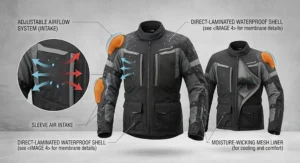
If the Defender 3 GTX is serious touring gear, the Badlands Pro is what you reach for when the destination is genuinely remote. Its tri-layer GORE-TEX Pro shell is built for maximum waterproof durability rather than everyday comfort, and testers note it handles hours of open-sky rain without the seepage that eventually finds its way into lesser jackets. Twelve adjustable vents scattered across the garment provide serious airflow for the inevitable hot stretches between storms, and the interior moisture-wicking liner helps manage the sweat that heavier, more protective shells tend to trap. On paper this means a genuine trade-off: GearJunkie’s testing notes the jacket runs warm even with all vents open, because the robust protective build that makes it expedition-rugged also makes it heavier than lighter touring alternatives. Reviewers who’ve put it through extended dual-sport and ADV trips consistently rank it among the most protective and rugged riding jackets available, which is precisely the audience Klim built it for.
Pros:
- ✅ Tri-layer GORE-TEX Pro shell built for extreme, sustained rain
- ✅ Twelve vents provide real airflow on remote, variable-climate rides
- ✅ Rugged construction suited to genuine expedition and ADV use
Cons:
- ❌ Runs warm despite ventilation due to heavy protective build
- ❌ Premium price puts it out of reach for casual commuters
At around $850, this is a specialist’s jacket — overkill for city commuting, but arguably underpriced for what expedition riders actually need from it.
7. Rukka Nivala 2.0 — the benchmark premium all-weather jacket
Independent testing from Bikenrider, which put ten pieces of rain gear through a three-month, deliberately miserable evaluation spanning drizzle commutes, highway downpours, and mountain-pass weather swings, named the Nivala 2.0 its top overall recommendation. That’s a meaningful signal, because the same test flagged real failure points in competing gear — seam failures after repeated washing, collar leaks after ninety minutes of sustained riding — problems the Nivala reportedly avoided. Reviewers consistently note that Rukka’s laminated Gore-Tex construction and finishing quality justify the premium price for riders who prioritize dry comfort above all else, treating the jacket as the gold standard other options get measured against rather than a nice-to-have upgrade. What most buyers overlook about benchmark gear like this is that the value shows up over years, not on day one: fewer seam failures and collar leaks mean fewer surprises three winters into ownership, which is exactly where cheaper waterproofing tends to quietly fail.
Pros:
- ✅ Rated top overall performer in independent multi-month testing
- ✅ Laminated Gore-Tex construction resists long-term seam failure
- ✅ Premium finishing quality built to hold up over years of use
Cons:
- ❌ Among the most expensive options in this comparison
- ❌ Premium positioning means less budget flexibility for buyers
Expect a price in the $700-$850 range — a genuine investment, but one independent testing suggests earns its keep for riders who spend serious hours in genuinely bad weather.
Practical Usage Guide: Getting the Most From Your Rain Proof Motorcycle Riding Jacket
A waterproof jacket isn’t “install and forget” gear — how you set it up and treat it in the first month determines whether it performs like new at year three or leaks like a sieve by autumn. Start by fastening every adjuster (cuffs, waist, collar) snug enough that wind-driven rain can’t work its way up your sleeves; a loose cuff is the single most common leak point riders report, more so than the actual fabric membrane failing. Before your first genuinely wet ride, do a dry run: zip everything closed, including waterproof pockets, and check that seams sit flat rather than puckered, since a twisted seam tape can start peeling early. In the first thirty days, avoid the common mistake of machine-washing with regular detergent — most manufacturers specify a technical wash (or hand wash) because standard detergents leave residue that clogs the membrane’s pores and kills breathability long before the waterproofing itself fails. Reapply DWR (Durable Water Repellent) treatment every five to ten washes, or as soon as you notice water soaking into the outer fabric instead of beading and rolling off — that visible change is the clearest signal your jacket needs reproofing, well before any membrane leak actually develops.
✨ Ready to gear up? Check current availability and pricing on these picks before your next rainy commute.
Real-World Scenarios: Matching Riders to the Right All Weather Motorcycle Jacket
Picture three different riders, because “best jacket” genuinely changes depending on who’s asking. First, the daily commuter: twelve miles each way, city traffic, unpredictable weather, budget around $200. This rider doesn’t need GORE-TEX Pro — a Tour Master Transition 5 or Joe Rocket Atomic 5.0, both leaning on well-sealed waterproof zippers, covers the actual use case without paying for expedition-grade armor that never sees a dirt road. Second, the weekend tourer who racks up 300-400 miles on a Saturday loop through changing terrain and weather fronts: this is the REV’IT! Sand 5 H2O or Alpinestars Andes V3 territory, where a genuine membrane and adjustable ventilation earn their keep across a full day rather than a forty-minute commute. Third, the multi-day adventure traveler heading into genuinely remote territory where a sudden storm isn’t an inconvenience but a real risk factor — that’s where the Klim Badlands Pro or REV’IT! Defender 3 GTX make sense, because their tri-layer construction and CE-rated armor are built for exactly the conditions where lighter gear starts to fail. Matching the jacket to the actual riding pattern, rather than to the biggest spec sheet, is the single decision that saves the most money and disappointment.
Problem → Solution: Fixing Common Wet-Weather Riding Gear Issues
Problem: water soaking through at the collar after an hour of riding. This is almost always a seal or adjustment issue rather than membrane failure — cinch the collar snug and check for a storm flap that isn’t fully closed; independent testing has specifically flagged collar leaks as a common failure point in lower-quality gear after ninety minutes of sustained rain.
Problem: DWR coating stops beading water after a season. This is expected wear, not a defect — reapply a technical DWR treatment as soon as water starts soaking into the fabric rather than rolling off, since the coating (unlike the membrane underneath) is designed to be renewed periodically.
Problem: jacket feels clammy and damp from the inside during rain. This usually signals a breathability issue rather than a leak — check that vents are fully closed during rain (open vents let moist air trade places with outside air in the wrong direction) and confirm you’re wearing a moisture-wicking base layer rather than cotton, which traps sweat against skin.
Problem: seams start peeling or bubbling after repeated washing. Independent testing has documented this exact failure mode in mid-range suits from major brands — avoid standard machine washing with regular detergent, and follow the manufacturer’s specific care instructions, since aggressive washing is a leading cause of premature seam-tape failure.
Problem: waterproof zippers stick or become hard to operate in cold weather. A light application of zipper-specific lubricant (never household oil, which can degrade the waterproof coating) keeps sealed zippers moving smoothly without compromising the seal.
How to Choose a Water Resistant Riding Jacket
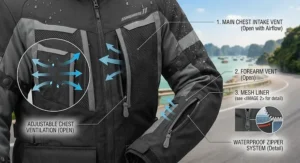
- Identify your waterproofing method first. Laminated membranes (GORE-TEX, Drystar) offer sustained protection; waterproof zippers on a textile shell offer solid protection at a lower price but rely more heavily on proper seam sealing.
- Match certification to your risk tolerance. CE Class A is baseline abrasion protection; CE Class AA reflects a meaningfully higher standard worth paying for if you ride in serious traffic or at higher speeds.
- Check the ventilation system before you check the price. A waterproof jacket with no meaningful venting will be miserable in summer, which means you’ll avoid wearing it — and unworn gear protects no one.
- Consider removable liners if your climate swings hard. A detachable waterproof or thermal layer effectively buys you two jackets in one, which matters more the more variable your regional weather actually is.
- Read aggregated review sentiment, not just marketing copy. Reviewers consistently flag real weak points — collar leaks, seam failures, sizing quirks — that spec sheets never mention.
- Try it with your gloves and base layers on. Cuff seals and collar fit change completely once you’re wearing what you’d actually ride in, so fit-testing in isolation can be misleading.
- Budget for maintenance, not just purchase price. DWR retreatment and technical washing products are an ongoing cost that keeps even a premium sealed seam motorcycle jacket performing at its rated level for years.
Common Mistakes When Buying a Sealed Seam Motorcycle Jacket
The most frequent mistake is confusing “water-resistant” with “waterproof” — independent, multi-month testing has specifically called out this blurred marketing language as a source of real disappointment, since water-resistant gear consistently falls short on longer rides even in moderate rain. A close second is buying based on price alone without checking the actual waterproofing method; a $600 jacket with a failing DWR coating and no reapplication routine can underperform a well-maintained $200 jacket with sealed zippers. Riders also commonly skip trying gear on over their intended base layers, which throws off the fit at exactly the points — cuffs, collar, waist — where seals matter most. Another overlooked error: ignoring the ventilation spec entirely because “I’m buying this for rain,” then discovering the jacket is unbearable on the 80% of rides that aren’t actually rainy. Finally, buyers frequently underestimate maintenance requirements — treating a seam-sealed, DWR-coated jacket as a “buy it once, forget it” purchase, when in reality the coating needs periodic renewal to keep performing at its original level.
Sealed Seam vs DWR Coated Motorcycle Jacket: What’s the Real Difference
These two terms get used almost interchangeably by shoppers, but they solve completely different problems. Sealed (or taped) seams address the stitching itself — every needle hole in a jacket is a potential water-entry point, so manufacturers apply waterproof tape over the seam from the inside to close those gaps. This is a structural, largely permanent feature that doesn’t wear out the way surface treatments do. DWR (Durable Water Repellent), on the other hand, is a surface coating applied to the outer fabric that makes water bead up and roll off rather than soak in — and it’s explicitly designed to be temporary, wearing down with UV exposure, abrasion, and washing. As Wikipedia’s overview of Gore-Tex technology explains, the DWR coating actually isn’t what makes a membrane jacket waterproof at its core — it protects the outer shell fabric from soaking through, which in turn protects the breathability of the waterproof membrane underneath. In practice, that means a jacket with excellent sealed seams but a worn-out DWR coating can still leak, not through the seams, but because the saturated outer fabric overwhelms the membrane’s ability to breathe and eventually push water through under sustained pressure. Treat sealed seams as a one-time construction quality marker and DWR as an ongoing maintenance item, and you’ll understand far more about your gear than most riders ever bother to learn.
What to Expect: Real-World Performance of a Waterproof Textile Riding Jacket
Spec sheets rarely translate cleanly into lived experience, so here’s the practical translation. A jacket with a genuine laminated membrane and properly sealed seams should keep you dry through hours of steady highway rain, provided the cuffs, collar, and any front zipper storm flap are properly closed — most real-world “failures” trace back to an open vent or loose cuff rather than membrane breakdown. Expect breathability to noticeably decrease the moment the outer DWR coating saturates, which is why you’ll feel clammier on ride two of a multi-day soak than you did on ride one, even in an otherwise well-performing jacket. Budget jackets relying on waterproof zippers rather than a full membrane tend to perform comparably in light-to-moderate rain but show their limits during extended, driving rain at highway speed, where water pressure finds any imperfect seal. Temperature swings matter too: a jacket that felt perfectly ventilated at 75°F can feel like a greenhouse at 90°F with the liner zipped in, which is exactly why the removable-liner jackets in this guide earn their keep for riders in variable climates.
Long-Term Cost & Maintenance of Wet Weather Riding Jacket Ownership
The sticker price is only the first payment. Budget jackets in the $150-$250 range typically need DWR reproofing every five to ten washes — treatment sprays generally run $10-$20 and take fifteen minutes to apply, a genuinely small cost against the alternative of replacing a jacket that’s started soaking through. Premium GORE-TEX jackets in the $500-$850 range are built with more durable membranes and typically need less frequent DWR renewal, but the membrane itself, while designed to outlast the jacket’s usable life, still depends on maintaining the outer fabric’s water-repellency to keep performing at its rated level. Cost-per-wear tells a more useful story than sticker price alone: a $220 Tour Master Transition 5 worn for five riding seasons works out to roughly $44 per season before maintenance, while an $800 Rukka Nivala 2.0 that lasts a documented decade or more, per the independent long-term reliability signals discussed earlier, can actually work out cheaper per year of genuine service. Factor in the NHTSA’s guidance on protective riding gear, which frames full coverage — not just waterproofing — as part of basic crash protection, and the long-term math tilts further toward buying certified, well-constructed gear once rather than replacing under-armored budget jackets repeatedly.
Safety, Regulations & Compliance Guide for Motorcycle Jacket for Rain Buyers
Waterproofing and crash protection are separate specs, and it’s worth knowing both before you buy. CE certification (Class A, AA, or AAA) measures abrasion resistance and impact protection independent of waterproofing — a jacket can be excellent at keeping you dry while offering only baseline armor, or vice versa, so check both ratings rather than assuming one implies the other. In the United States, motorcycle protective gear isn’t federally mandated the way DOT-certified helmets are, but the NHTSA specifically recommends riders keep arms and legs fully covered as part of basic crash protection, noting that appropriate gear also helps prevent dehydration on long rides — a detail that ties directly back to why ventilation matters even on a waterproof jacket. Reviewers and independent testers, including the team behind Motorcycle News’s waterproof jacket testing, consistently note that fit affects protective performance as much as waterproofing does — armor that’s shifted out of position because a jacket doesn’t fit properly won’t protect you regardless of how dry it kept you. Bottom line: treat waterproofing as one column in your decision, with CE certification and proper fit as equally weighted columns beside it, rather than the single deciding factor.
🔍 Explore these top-rated waterproof jackets and gear up before the next storm rolls in!
Frequently Asked Questions
❓ Is a waterproof motorcycle jacket the same as a water-resistant one?
❓ How often should I reproof my rain proof motorcycle riding jacket?
❓ Can I machine wash a waterproof textile riding jacket?
❓ What's the difference between a sealed seam motorcycle jacket and a DWR coated motorcycle jacket?
❓ Are premium GORE-TEX jackets worth the extra cost over budget waterproof zippers?
Conclusion
There’s no single “best” waterproof motorcycle jacket — there’s only the best jacket for how, where, and how often you actually ride. A daily commuter facing occasional showers gets more genuine value from a well-sealed Tour Master Transition 5 or Joe Rocket Atomic 5.0 than from armor built for expedition touring they’ll never do. A weekend tourer covering serious mileage across shifting weather fronts is better served by the adjustable membrane systems in the Alpinestars Andes V3 or REV’IT! Sand 5 H2O. And a rider genuinely planning multi-day trips into unpredictable, remote conditions has good reason to invest in the tri-layer GORE-TEX construction of the Klim Badlands Pro, REV’IT! Defender 3 GTX, or the independently benchmarked Rukka Nivala 2.0. What ties all seven together isn’t price — it’s that waterproofing is a system, not a single feature: the membrane, the seam sealing, the DWR coating, and your own maintenance habits all have to hold up together. Get that combination right for your actual riding pattern, and rain stops being something you dread and starts being just another kind of Tuesday.
Recommended for You
- 7 Best Textile Motorcycle Jacket Picks for 2026
- 7 Best Retro Motorcycle Leather Jacket Picks for 2026
- 7 Best Leather Touring Motorcycle Jackets in 2026
Disclaimer: This article contains affiliate links. As an Amazon Associate, I earn from qualifying purchases. If you purchase products through these links, we may earn a small commission at no additional cost to you.
✨ Found this helpful? Share it with your friends! 💬🤗
