
In This Article
Somewhere between “I’ll just wear my hoodie” and dropping four figures on a race suit sits the textile motorcycle jacket — the workhorse of modern riding gear, and honestly, the smartest purchase most riders will ever make for their torso. A textile motorcycle jacket is a riding garment built from technical woven fabrics like nylon, polyester, or Cordura instead of leather, combining CE-rated armor with waterproofing, ventilation, and adjustability that leather simply can’t match without a small fortune and a tailor. If you’ve been scrolling through gear sites at 1 a.m. trying to decode denier counts and armor letters, you’re not alone, and you’re not wrong to be confused — this category has exploded with options in the last two years alone.
Here’s the honest pitch: a good textile motorcycle jacket does three jobs simultaneously. It slows you down when you hit the pavement, it keeps you dry when the sky opens up on your commute, and it doesn’t turn your Tuesday ride into a sauna session. Cheap versions fail at all three. The best ones — and we’re about to walk through seven real, currently available models spanning budget to premium — manage a genuinely impressive balancing act between protection, comfort, and price.
We researched real products, real specs, and real aggregated rider feedback to build this guide, because a spec sheet alone won’t tell you which jacket actually earns its keep on a 300-mile day. It’s also worth noting that motorcyclists remain seriously overrepresented in traffic fatalities according to NHTSA’s road safety data, which is exactly why gear like this isn’t just a style choice. Let’s get into it.
Quick Comparison Table
| Jacket | Category | Shell Material | Armor | Best For |
|---|---|---|---|---|
| Icon Airform MIPS | Budget | Textile mesh/nylon | CE Level 1 (MIPS) | New riders, daily commuters |
| SEDICI Federico 2 | Budget-Mid | 600D mesh chassis | CE Level 2 (AXIAL) | Hot-weather commuting |
| REV’IT! Eclipse 2 | Mid | 600D polyester | CE Level 1 | Summer touring |
| Scorpion Yosemite Hi-Viz | Mid | 500D/1680D nylon | SAS-TEC (adjustable) | Visibility-focused riders |
| Alpinestars Andes V4 Air | Mid-Premium | Technical textile | CE Level 2 | 4-season adventure riding |
| REV’IT! Sand 5 H2O | Mid-Premium | Ripstop polyester | CE Level 1 (expandable) | All-weather touring |
| Klim Badlands Pro A3 | Premium | Cordura/Vectran + GORE-TEX | CE AAA | Long-distance ADV, worst-case weather |
A quick glance tells the real story here: price doesn’t rise in a straight line with protection. The SEDICI Federico 2 undercuts the REV’IT! Eclipse 2 in price while matching it on armor class, which tells you brand overhead matters as much as material cost. Meanwhile, the jump from Alpinestars Andes V4 Air to the Klim Badlands Pro A3 buys you a full CE class upgrade (AA to AAA) plus a laminated GORE-TEX membrane instead of a removable liner — a genuinely different tier of engineering, not just a logo swap.
💬 Found a jacket that fits your riding style already? Save this comparison and keep scrolling for the full breakdown below.
💬 Just one click — help others make better buying decisions too!😊
Top 7 Textile Motorcycle Jackets: Expert Analysis
1. Icon Airform MIPS — rotational-impact tech under $200
The standout here is genuinely rare at this price: Icon built MIPS (Multi-directional Impact Protection System) rotational-impact technology into a jacket that costs less than most riders spend on a tank of gas for a month. MIPS was originally developed for helmets to reduce rotational brain forces in angled impacts, and Icon adapting it to torso armor is a meaningful engineering flex for a sub-$200 jacket.
The shell uses a mesh-and-textile hybrid construction that prioritizes airflow, with CE Level 1 armor standard at the shoulders and elbows and room to drop in aftermarket Level 2 inserts later. What this means in practice is you’re not locked into entry-level protection forever — you can upgrade the guts without buying a new jacket. Based on the spec comparison against other sub-$200 jackets, the fit runs a bit generous, so most buyers report sizing down works better than sizing to your usual measurements.
This is squarely a jacket for new riders and budget-conscious commuters who need real CE certification without the premium price tag. Reviewers consistently note the ventilation punches above its price class, though the base foam back pad is a clear candidate for an aftermarket CE Level 2 upgrade if you’re riding highway miles regularly.
Pros:
- ✅ MIPS rotational-impact tech rarely seen under $200
- ✅ CE Level 1 armor standard, upgradeable to Level 2
- ✅ Ventilation performs well above its price point
Cons:
- ❌ Fit runs large — sizing down is usually necessary
- ❌ Stock back protector is basic foam, not CE-rated
Price sits comfortably under $200, and for a first “real” jacket with certified armor, it’s tough to beat on value — check current price and availability before buying, since entry-level stock moves fast.
2. SEDICI Federico 2 — CE Level 2 armor standard at a budget price
What most buyers overlook about this model is that it ships with AXIAL CE Level 2 armor at the shoulders and elbows right out of the box — a protection class many jackets twice its price still treat as a paid upgrade. That’s the standout feature, and it’s a big one for a mesh-focused commuter jacket.
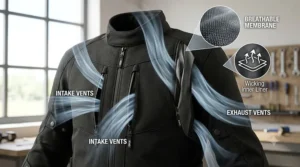
The chassis is a heavy-duty 600D textile integrated with high-flow mesh panels, which in practice means the jacket holds its shape and abrasion resistance in the high-wear zones while staying breathable everywhere else. A multi-point adjustment system at the waist and arms keeps that Level 2 armor locked over your joints even at highway speed — a detail that matters more than people realize, because armor that migrates during a slide isn’t doing its job.
SEDICI, RevZilla’s in-house brand, was built specifically to hit this mid-tier gap: European-inspired styling and real safety certification without premium brand pricing. Reviewers and long-term owners have flagged that build-to-a-price-point durability is the trade-off — stitching and zippers on SEDICI gear tend to show wear sooner than jackets from brands with decades of race-team R&D behind them.
Pros:
- ✅ AXIAL CE Level 2 armor included standard, not optional
- ✅ Multi-point adjustment keeps armor positioned at speed
- ✅ High-flow mesh construction for hot-weather commuting
Cons:
- ❌ Long-term stitching durability trails premium competitors
- ❌ Limited weatherproofing without an add-on liner
This one lands under $300, and for the armor class alone, it’s one of the strongest value arguments in the whole textile motorcycle jacket category right now.
3. REV’IT! Eclipse 2 — slim-cut summer mesh with tailored adjustability
The Eclipse 2’s standout is its silhouette — a slim, tapered cut that doesn’t billow like most mesh jackets at highway speed, paired with large mesh panels front, back, and inner-arm for serious airflow. REV’IT! built this as the spiritual successor to a fan-favorite summer jacket, and the tailoring shows.
Abrasion resistance comes from 600-denier polyester construction, and the included SEESMART CE Level 1 armor covers shoulders and elbows. Here’s what the spec sheet won’t tell you outright: there’s a dedicated rear pocket for a SEESOFT CE Level 2 back protector, but it’s sold separately — a common industry practice that catches first-time buyers off guard when they assume “comes with armor” means comprehensive coverage.
Adjustment tabs at the cuffs, upper arms, and waist let you dial in a genuinely close fit, which matters for keeping the shoulder armor where it belongs during a highside. This is a jacket built for riders who prioritize hot-weather comfort and a tailored look over maximum all-weather versatility — think summer commuters and warm-climate tourers rather than year-round riders in variable climates.
Pros:
- ✅ Slim tapered cut stays composed at highway speed
- ✅ Massive mesh panels for serious hot-weather airflow
- ✅ Multiple adjustment points for a genuinely tailored fit
Cons:
- ❌ Back protector sold separately, not included
- ❌ Minimal weatherproofing for sudden rain
Expect a price in the $300-$400 range depending on retailer promotions — solid value for the fit quality, though budget-focused riders may prefer the SEDICI above for a lower entry point.
4. Scorpion Yosemite Hi-Viz — reflective coverage across front, back, and arms
This is the jacket to reach for if visibility, not just protection, is your top priority — and that’s precisely the standout feature. The Yosemite’s NightViz reflective material wraps the front, back, arms, and elbows, meaning oncoming headlights catch reflective panels from nearly every angle a driver might see you from, not just a single reflective strip on the back.
Underneath the hi-viz treatment sits a genuinely tough shell: 500-denier nylon reinforced with 1680-denier nylon at the elbows and shoulders, the high-wear zones most likely to contact pavement in a slide. Adjustable SAS-TEC armor at the elbows and shoulders handles impact, while a removable zip-out Airguard waterproof liner and a separate EverHeat thermal liner give this jacket real four-season flexibility layered underneath the hi-viz shell. On paper, that’s a lot of systems working together, and reviewers consistently describe the fold-down vent panels and full-length arm vents as genuinely effective in hot weather despite the multi-layer construction.
Who should care about a jacket like this: commuters riding at dawn, dusk, or through unpredictable weather, where the visibility research (more on that below) actually shows a measurable safety benefit. It’s not the lightest jacket in this list, and the stock back pad is basic PE foam rather than a certified protector, so budget for an upgrade if back protection is non-negotiable for you.
Pros:
- ✅ 360-degree-style reflective coverage, not just a back strip
- ✅ Removable waterproof and thermal liners for real versatility
- ✅ Reinforced 1680D nylon at high-wear elbow and shoulder zones
Cons:
- ❌ Stock back protector is basic foam, not CE-certified
- ❌ Heavier overall than single-season mesh alternatives
Pricing typically lands in the $300-$400 range — reasonable for a jacket effectively doing the job of three seasonal jackets in one shell.
5. Alpinestars Andes V4 Air — four-way stretch panels for all-day ergonomics
Alpinestars has iterated on the Andes formula for several generations, and the V4 Air’s standout feature is genuinely felt rather than just spec’d: four-way stretch panels at the shoulders and elbows that move with your body instead of fighting it during a long day in the saddle. Reviewers who logged extended miles in an upright adventure position consistently flagged this as the most ergonomically comfortable jacket in its class.
It ships with CE Level 2 shoulder and elbow armor standard, plus an optional back protector upgrade that snaps in cleanly rather than requiring a full liner swap. Large chest and back vents transform this from a fair-weather-only piece into a genuine three-to-four-season option, and the included waterproof liner has reportedly held up through unexpected downpours without leaking — exactly the kind of unglamorous durability that matters more than a spec sheet number.
This is the jacket for adventure and dual-sport riders who want serious protection without sacrificing all-day comfort, and it’s a strong argument for anyone specifically hunting a 4 season textile motorcycle jacket that doesn’t compromise heavily in any one condition. The trade-off: it’s not built for aggressive sport-riding ergonomics, so canyon carvers in a tucked position will want a different cut entirely.
Pros:
- ✅ Four-way stretch panels genuinely improve all-day comfort
- ✅ CE Level 2 armor standard, with clean back-protector upgrade path
- ✅ Waterproof liner tested reliable through real rain exposure
Cons:
- ❌ Not designed for aggressive sport-riding body position
- ❌ Bulkier than dedicated summer mesh jackets
Sitting around the $400-$450 range, this jacket represents one of the stronger value propositions for serious adventure riders who ride through multiple seasons on one bike.
6. REV’IT! Sand 5 H2O — abrasion-resistant ripstop shell built for adventure
The Sand 5 H2O’s standout is its shell material choice: an abrasion-resistant polyester ripstop construction, which behaves differently under stress than standard woven polyester. Ripstop uses a reinforcing grid pattern woven directly into the fabric, so a tear or puncture stays contained within a small grid square instead of spreading — a meaningful durability advantage for riders who take their jacket off-pavement occasionally.
XL zippers on the sleeves and dedicated ventilation panels on the back handle airflow, and REV’IT! designed this jacket explicitly as an all-seasons adventure companion rather than a single-climate specialist. What the spec sheet won’t tell you is how that ripstop weave holds up against branches, saddlebag straps, and the general abuse of adventure riding better than a comparable non-ripstop polyester shell would over the same mileage.
This is the pick for riders whose routes mix pavement and gravel, or who simply want extra peace of mind against snags and abrasion beyond pure asphalt-slide scenarios. It’s not the cheapest jacket here, and buyers should factor in that REV’IT!’s European sizing sometimes runs slightly trim compared to American brands.
Pros:
- ✅ Ripstop weave contains tears instead of letting them spread
- ✅ XL sleeve zippers and back vents manage airflow well
- ✅ Genuinely built for mixed pavement-and-gravel adventure riding
Cons:
- ❌ Sizing runs slightly trim versus American-brand equivalents
- ❌ Premium pricing compared to standard polyester alternatives
Expect to pay in the $350-$450 range — a fair ask for genuine ripstop construction, which is still relatively uncommon in mainstream textile motorcycle jacket lineups.
7. Klim Badlands Pro A3 — first textile jacket to earn CE AAA certification
The Badlands Pro A3 isn’t just a premium jacket — it’s a genuine engineering milestone. It’s the first textile motorcycle garment to achieve a CE AAA rating, a certification level historically reserved almost exclusively for heavy track leather. That’s the standout feature, and it’s not marketing spin; AAA is the highest protection class under the EN 17092 standard.
Klim achieves this using a proprietary Vectran fiber fabric alongside Cordura-reinforced panels, delivering abrasion resistance that rivals leather while staying noticeably more supple and breathable. Weatherproofing comes from a laminated GORE-TEX 3-Layer Pro Shell rather than a removable liner, which eliminates the bulk and the failure point of a separate waterproof layer entirely. In practice, that lamination means the waterproofing can’t peel away or shift out of position the way a liner sometimes does after years of use.
Hardcore adventure riders who’ve put this jacket through harsh, cold-weather conditions describe strong crash protection and effective warmth retention, alongside a kidney-belt design that keeps the whole system anchored during long, rough days in the saddle. This is not a jacket for casual commuters — it’s engineered for riders logging serious mileage in genuinely demanding conditions, and the price reflects that specialization.
Pros:
- ✅ First textile jacket to achieve CE AAA certification
- ✅ Laminated GORE-TEX Pro Shell eliminates liner failure points
- ✅ Vectran/Cordura blend rivals leather-level abrasion resistance
Cons:
- ❌ Premium price puts it out of reach for casual riders
- ❌ Overkill protection level for short urban commutes
This one lives north of $1,000, and it’s not for everyone — but for riders who measure their trips in thousands of miles through unpredictable terrain, it’s arguably the most advanced technical fabric motorcycle jacket money can currently buy.
Technical Fabrics Decoded: Cordura, Nylon & Ripstop Motorcycle Jacket Materials
Here’s where the marketing language starts blending together, so let’s separate it out. Nylon is the base polymer family — a synthetic fiber prized for its strength-to-weight ratio and abrasion resistance, and it’s been the backbone of protective textile gear ever since Cordura entered the picture. Cordura was originally trademarked by DuPont back in 1929 as a high-tenacity rayon, and the brand didn’t shift to the nylon-based formula riders know today until the 1960s — a detail most gear marketing conveniently skips over while still leaning on that “since 1929” heritage claim. You can dig into the full material history on Wikipedia if you’re curious. The secret today is in the fiber engineering: Cordura’s molecular structure delivers exceptional abrasion resistance while staying lighter and more flexible than you’d expect from something this tough.
Ripstop, by contrast, isn’t a brand — it’s a weaving technique. A reinforcing grid thread is woven into the base fabric at regular intervals, so a small tear or puncture stops at the nearest grid line instead of spreading across the whole panel. This is why the REV’IT! Sand 5 H2O above holds up so well against branches and gear straps during adventure riding, and it’s a completely different failure mode than a standard weave.
Not every “nylon motorcycle jacket” claim means the same level of protection, either. A plain 250D nylon panel and a 1000D Cordura panel are both technically nylon, but they perform on vastly different levels — which brings us to the next question everyone eventually asks.
Cordura 500D vs 600D Durability: What the Denier Number Actually Means
Denier measures the linear mass density of the fiber — specifically, grams per 9,000 meters of thread. Higher denier generally means a thicker, heavier, more abrasion-resistant weave, but the relationship isn’t perfectly linear, and it isn’t the only variable that matters.
Here’s the practical breakdown: a 500D Cordura panel is genuinely capable protective material for street riding under normal conditions, and it’s what you’ll find in the high-wear zones of several jackets on this list, including the Scorpion Yosemite’s reinforced areas. A 600D fabric — used in the SEDICI Federico 2 and REV’IT! Eclipse 2 above — adds meaningful thickness and typically extends the slide distance a rider can survive before abrasion-through, though the gap between 500D and 600D is smaller than the jump from budget 250D fabric up to either of them.
What most buyers overlook is that denier alone doesn’t determine real-world durability — weave tightness, coating treatments, and whether the fabric is genuine Cordura brand (which uses a specific fiber-engineering process) versus a generic high-denier polyester all matter just as much. Modern textile motorcycle jacket construction generally runs anywhere from 500D up to 1000D Cordura, with that denier number telling you fiber thickness — but a well-constructed 500D Cordura panel with reinforced stitching can genuinely outperform a poorly finished 600D generic fabric panel in a real slide.
The takeaway for shopping: don’t chase the biggest denier number blindly. Check whether high-wear zones (shoulders, elbows, and the outer forearm) specifically use the higher-denier material, since manufacturers often reserve the toughest fabric for those zones while using lighter material elsewhere to save weight and improve airflow.
Motorcycle Jacket with CE Armor Textile: How the Protection Actually Works
CE certification for motorcycle jackets in the textile category runs on the EN 17092 standard, which replaced the older EN 13595 standard specifically to cover recreational riders rather than just racing professionals. The standard breaks garments into classes — AAA, AA, A, B, and C — based on abrasion resistance, seam strength, and impact protection, tested across different “risk zones” of the jacket that reflect how likely each area is to hit pavement in a fall.
Armor itself is rated separately under EN 1621-1 for limb protectors and EN 1621-2 for back protectors. In practical terms, CE Level 1 armor transmits noticeably more impact force through to your body than CE Level 2 — Level 1 caps around 35 kN of transmitted force, while Level 2 cuts that down to 20 kN or less. That’s not a small difference in a crash; it’s the gap between a bad bruise and a fracture in some impact scenarios. If you want the full technical breakdown straight from a certified apparel manufacturer, REV’IT!’s CE certification explainer covers the standard in detail.
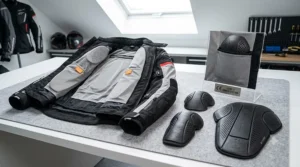
Here’s what most jacket listings gloss over: a jacket can be CE-certified as a garment (meaning the fabric and seams pass the abrasion tests) while still shipping with only a foam back pad instead of a certified back protector, exactly like the Icon Airform and Scorpion Yosemite above. Most textile jackets include a back-protector pocket in the liner specifically because upgrading that one component is the single highest-value armor purchase you can make after buying the jacket itself.
✨ Ready to Upgrade Your Protection?
🔍 Whichever jacket you’re leaning toward, don’t skip the CE Level 2 back protector upgrade — it’s a small add-on cost for a genuinely significant jump in real-world crash protection. Check current pricing on protector inserts before you finalize your jacket purchase!
Hi-Viz Textile Motorcycle Jacket: Does a High Visibility Motorcycle Jacket Actually Save Lives?
This isn’t a marketing question — it’s a documented safety research question, and the data leans one direction. Motorcyclists make up only about 3.5% of registered vehicles on U.S. roads, yet they account for roughly 14% of all motor vehicle traffic fatalities — and per mile traveled, riders are close to 24 times more likely to die in a crash than someone in a passenger car. A meaningful share of multi-vehicle motorcycle crashes trace back to a driver simply not seeing the rider in time, which is exactly the failure mode a hi-viz textile motorcycle jacket is designed to reduce.
Research from the National Highway Traffic Safety Administration backs this up directly — you can read the full breakdown of conspicuity research and rider strategies here. Fluorescent yellow-green consistently tests as the most detectable color to the human eye against nearly any background, which is why you’ll see it dominate the hi-viz category rather than orange or red.
Here’s the honest caveat, though: reviewers and riders alike consistently note that hi-viz gear doesn’t prevent every close call — it reduces the odds, it doesn’t eliminate risk. A driver who’s genuinely not looking will miss a fluorescent jacket just as easily as a black one. What hi-viz reliably does is improve detection distance and reaction time for drivers who are paying attention but simply struggle to pick a motorcycle-sized object out of visual clutter, especially at dawn, dusk, or in rain. That’s a real, measurable benefit — just not a guarantee.
Reflective Panel Placement & D-Ring Closures: The Details Nobody Talks About
Two hardware details separate a genuinely well-engineered textile jacket from one that just looks the part on a hanger, and neither shows up prominently in most product photos.
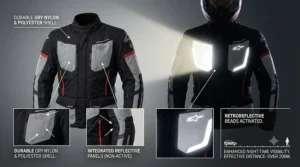
Reflective panel placement matters more than total reflective surface area. A jacket with reflective strips only across the shoulder blades helps a driver directly behind you, but does nothing for a driver approaching from a side angle at an intersection — statistically one of the highest-risk scenarios for motorcyclists. The strongest designs, like the Scorpion Yosemite above, wrap reflective material across the front, back, and both arms, so headlights catch it from nearly any approach angle. When comparing hi-viz jackets, check specifically whether reflective material appears on the sleeves and front panels, not just the back.
D-ring closures, meanwhile, show up most often on collar straps and occasionally on waist adjusters. A D-ring closure uses a metal ring that the strap threads through and folds back over, distributing tension across a wider contact area than a simple snap or hook-and-loop closure. In practice, this means less chance of the closure popping open under wind pressure at highway speed, and it holds up to repeated daily use better than hook-and-loop, which gradually loses grip as lint and debris accumulate in the fibers. The trade-off is a slightly slower on-off process compared to a magnetic or snap closure — a small inconvenience for a meaningfully more secure fit.
4 Season Textile Motorcycle Jacket: Building a Year-Round Riding Kit
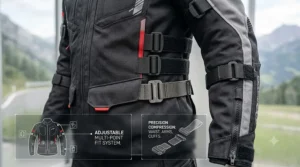
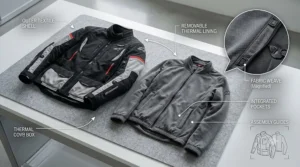
A true 4 season textile motorcycle jacket isn’t a single-material garment — it’s a system, typically built around three layers working together: an outer shell handling abrasion resistance and wind, a removable waterproof membrane or liner for wet weather, and a removable thermal liner for cold. Strip both liners out in summer and you’re left with a ventilated shell; zip both back in and the same jacket handles a 35-degree morning commute.
The Alpinestars Andes V4 Air and Scorpion Yosemite Hi-Viz above both use this layered approach, and it’s worth understanding the trade-off it involves: a true 3-in-1 system adds bulk and weight compared to a dedicated single-season jacket. What most buyers overlook is that “4-season” doesn’t mean equally comfortable in every season — it means functional across all of them, with the outer shell alone typically running warmer than a purpose-built mesh summer jacket, even with both liners removed.
For riders who own multiple bikes or multiple dedicated seasonal jackets already, a single 4-season piece can actually be false economy — you’re paying for capability you won’t fully use. But for the one-bike, one-jacket rider who commutes year-round in a climate with real seasonal swings, the math flips hard in favor of the 4-season build, since replacing three seasonal jackets individually costs significantly more over time.
Textile vs Leather Motorcycle Jacket: Which One Actually Wins
This comparison gets litigated endlessly in rider forums, and the honest answer is: it depends heavily on your riding conditions, not on which material is objectively “better.”
| Factor | Textile | Leather |
|---|---|---|
| Pure abrasion resistance | Strong with high-denier Cordura | Superior — the benchmark material |
| Weather adaptability | Excellent (liners, ventilation) | Limited without add-ons |
| Weight | Generally lighter | Heavier |
| Break-in comfort | Comfortable from day one | Requires break-in period |
| Best For | Touring, commuting, adventure | Sport riding, track days |
Competition-weight leather still leads in pure abrasion resistance — in controlled slide testing it holds up for roughly 86 feet of pavement contact before wearing through, compared to about 18 feet for Cordura — a real and significant gap on paper. But here’s the analysis that gap needs: that test measures pure friction resistance at track speeds, not real-world street riding outcomes. For street riding under roughly 80 mph, quality technical textiles combining Cordura shells, reinforcement panels, and CE armor deliver protection that’s functionally comparable for the vast majority of real-world crash scenarios, simply because most street crashes don’t involve a sustained 100+ mph slide.
Where leather unambiguously wins is dedicated track and aggressive sport riding, where sustained high-speed slides are a real possibility and every inch of slide distance matters. Where textile wins decisively is everywhere else — weather adaptability, packability, all-day comfort, and not needing a six-week break-in period before the jacket stops feeling like armor made of cardboard.
Common Mistakes When Buying a Textile Motorcycle Jacket
- Assuming “CE certified” means fully armored. As covered above, plenty of jackets are CE-certified as garments while shipping with a foam back pad instead of certified back armor.
- Chasing denier numbers without checking placement. A 1000D fabric used only on non-wear panels doesn’t protect you as well as 500D Cordura specifically placed at the shoulders and elbows.
- Buying hi-viz and assuming it replaces good riding habits. Visibility gear reduces risk; it doesn’t replace defensive riding or eliminate driver inattention.
- Ignoring fit in a riding position. A jacket that fits perfectly standing in a mirror can bunch, ride up, or expose skin at the wrists when you’re actually leaned forward on the bike.
- Skipping the waterproofing check. “Water-resistant” and “waterproof” are not interchangeable claims — a DWR coating sheds light rain, while a laminated or sealed membrane handles a genuine downpour.
Reviewers across multiple gear forums consistently flag mistake #4 as the most common — a jacket that looked great on the hanger but pulled uncomfortably tight across the shoulders the moment they leaned into an actual riding crouch.
Long-Term Cost & Maintenance: The Real ROI of a Technical Fabric Jacket
| Price Tier | Typical Range | Expected Lifespan | What You’re Trading Off |
|---|---|---|---|
| Entry-level | Under $200 | 2-4 years of regular use | Long-term stitching/zipper durability |
| Mid-range | $250-$500 range | 4-7 years of regular use | Absolute top-tier abrasion resistance |
| Premium | North of $1,000 | 7-10+ years of regular use | Nothing major — you’re paying for margin |
The math here isn’t as simple as “buy the most expensive jacket.” A rider putting on 2,000 miles a year in a mild climate will likely never stress-test a budget jacket’s limitations before it’s due for replacement anyway. But a rider logging 15,000+ annual miles through genuine seasonal extremes will find a mid-range jacket’s zippers, seam tape, and armor foam degrading well before a premium laminated construction shows equivalent wear.
Maintenance matters just as much as the initial purchase. Machine washing (when the jacket’s care label allows it) with a technical-gear detergent, removing armor before washing, and re-applying a DWR waterproofing treatment every season or two extends any jacket’s functional lifespan significantly — often more than upgrading to the next price tier would.
Practical Usage Guide: Break-In, Setup & the First 30 Days
Getting a new textile motorcycle jacket dialed in takes more than pulling it out of the box and riding off. Here’s what actually matters in the first month:
Week one: Try the jacket in your actual riding position, not standing upright. Sit on the bike (parked, engine off) and check that the sleeves don’t ride up when you reach for the grips, and that the collar doesn’t choke you when your head is tilted forward.
Weeks two through three: Adjust every strap and tab methodically — waist, bicep, forearm, and hem adjusters all affect how securely the armor stays positioned. A jacket that’s too loose lets shoulder armor shift during a fall, which defeats the purpose of buying certified protection in the first place.
Common first-month mistake: skipping the back-protector upgrade because the stock foam pad “feels fine.” Foam pads absorb almost no meaningful impact force compared to a CE Level 2 protector — this is the single highest-value upgrade you can make in the first 30 days of ownership.
Ongoing maintenance: re-check strap tension monthly, since straps loosen naturally with use, and inspect armor pockets for shifting after any hard braking or minor tip-over, even a parking-lot drop.
Real-World Scenarios: Which Jacket Fits Your Ride
The daily commuter (12-mile city ride, mixed weather): A jacket like the SEDICI Federico 2 or Icon Airform MIPS makes the most sense — CE-certified protection without paying for adventure-grade weatherproofing you’ll rarely need on short urban trips. Budget matters more here than ultimate durability, since city miles put less cumulative abrasion stress on gear than sustained highway riding.
The weekend adventure rider (mixed pavement and gravel, seasonal riding): This is where the Alpinestars Andes V4 Air or REV’IT! Sand 5 H2O earns its higher price tag — the ripstop or four-way-stretch construction and included waterproof liner handle the unpredictability of off-pavement excursions and shifting weather far better than a summer-only mesh jacket would.
The high-mileage tourer (5,000+ miles annually, variable climate, safety-conscious): Between the visibility benefits of the Scorpion Yosemite Hi-Viz and the sheer engineering ceiling of the Klim Badlands Pro A3, riders in this category should weigh whether visibility or absolute abrasion resistance matters more for their specific routes — both represent legitimate top-tier investments for very different priorities.
Buyer’s Decision Framework: If This, Choose That
- If you ride under 3,000 miles a year in a mild climate, choose a budget jacket like the Icon Airform MIPS — you won’t stress-test premium durability before replacement makes sense anyway.
- If your commute crosses genuinely variable weather, choose a layered 4-season build like the Alpinestars Andes V4 Air — the liner system pays for itself in versatility.
- If you ride at dawn, dusk, or through low-visibility conditions regularly, choose a hi-viz option like the Scorpion Yosemite — the conspicuity research supports the investment.
- If your routes mix pavement and gravel, choose a ripstop-shell jacket like the REV’IT! Sand 5 H2O — the tear-containment advantage is real off-road.
- If you’re logging serious annual mileage through demanding conditions and treat gear as a long-term investment, choose the Klim Badlands Pro A3 — the CE AAA rating and laminated GORE-TEX construction are built for exactly that use case.
Frequently Asked Questions
❓ What is a textile motorcycle jacket made of?
❓ Is a textile motorcycle jacket as safe as leather?
❓ How do I know if my textile jacket is CE certified?
❓ Do hi-viz textile motorcycle jackets actually improve safety?
❓ What's the difference between 500D and 600D Cordura?
Conclusion
There’s no single “best” textile motorcycle jacket, and honestly, anyone telling you otherwise is skipping the part where your commute, your climate, and your budget are all different from the next rider’s. What the research and the spec sheets both point to consistently is this: CE certification, thoughtful armor placement, and a fit that survives your actual riding position matter more than any single flashy feature.
Budget-conscious riders get genuinely solid protection from the Icon Airform MIPS or SEDICI Federico 2 without compromising on certified armor. Riders chasing all-weather versatility should look hard at the Alpinestars Andes V4 Air or REV’IT! Sand 5 H2O. And if visibility or maximum abrasion resistance is non-negotiable, the Scorpion Yosemite Hi-Viz and Klim Badlands Pro A3 sit at the top of their respective categories for good reason.
Whatever you land on, remember that a jacket is only as protective as its weakest component — usually the stock back pad most riders never think to upgrade. Get the fit right, get the armor right, and the rest of the ride gets a lot less stressful.
Recommended for You
- 7 Best Retro Motorcycle Leather Jacket Picks for 2026
- 7 Best Leather Touring Motorcycle Jackets in 2026
- Cruiser Motorcycle Leather Jacket: 7 Best Picks for 2026
Disclaimer: This article contains affiliate links. As an Amazon Associate, I earn from qualifying purchases. If you purchase products through these links, we may earn a small commission at no additional cost to you.
✨ Found this helpful? Share it with your friends! 💬🤗
