
In This Article
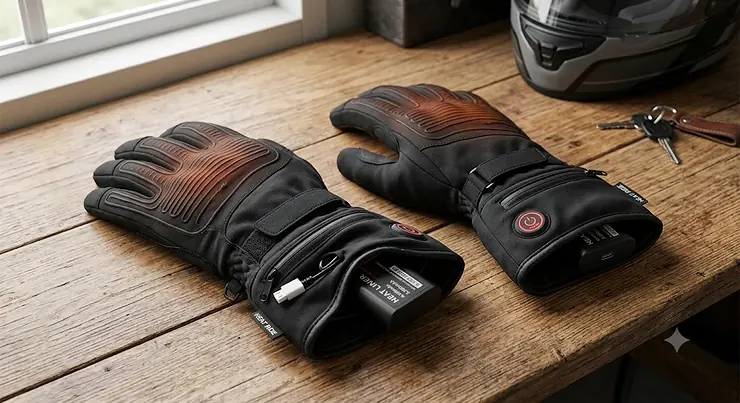
Your riding jacket is rated to negative temperatures. Your boots are lined. And somehow your hands are still the first thing to go numb at 45 mph. That’s not bad luck — it’s basic physiology. Wind chill hits exposed, blood-poor extremities harder than almost anywhere else on your body, and fingers wrapped around cold metal grips lose dexterity fast. Rechargeable heated motorcycle glove liners solve a specific, narrow problem: they slide inside your existing gloves and put a thin heating element directly against your skin, so you get warmth without buying a whole new set of bulky winter gauntlets.
This guide breaks down seven real, currently available products spanning basic battery-powered liners under $50 to premium 12-volt systems that wire straight into your bike’s electrical system. We’ll compare battery life, heat-up time, and fit, and we’ll be upfront about where the category still falls short — because glove liners are a compromise product by design, and pretending otherwise wouldn’t serve you. According to the CDC’s guidance on preventing frostbite, frostbite is a freezing injury that typically affects extremities including the fingers, which is exactly why serious cold-weather riders treat hand warmth as a safety issue, not a comfort one.
What is a rechargeable heated motorcycle glove liner? It’s a thin, glove-shaped inner layer with built-in heating wires or carbon-fiber panels, powered by a small rechargeable lithium battery or a 12V lead into your motorcycle’s harness, designed to be worn under your existing riding gloves for supplemental warmth on cold rides.
Quick Comparison Table
| Product | Power Source | Runtime (Est.) | Best For |
|---|---|---|---|
| SAVIOR HEAT Heated Glove Liners | 7.4V rechargeable battery | Up to 8 hours (low) | Budget daily commuters |
| Wind & Throttle Heated Glove Liner | 7.4V 2000mAh battery | Up to 8 hours | Slim fit under existing gloves |
| V.Step Heated Glove Liners Thin | 2x 7.4V 2200mAh batteries | Up to 7 hours | Backup battery flexibility |
| DR.PREPARE Heated Gloves Liners | 3200mAh rechargeable battery | Up to 6-9 hours | Touchscreen convenience |
| Warm & Safe Heated Glove Liners | 12V motorcycle wired | Unlimited while riding | Long-haul touring |
| Gerbing 12V Heated Glove Liners | 12V motorcycle wired | Unlimited while riding | System integration with jacket liners |
| Tourmaster Synergy Pro Plus 12V Liners | 12V motorcycle wired | Unlimited while riding | Dedicated heat-troller control |
The split here is fundamental, not cosmetic: battery-powered liners like SAVIOR HEAT and DR.PREPARE give you freedom from the bike but run out of charge, while wired systems like Gerbing and Tourmaster never die but tether you to your ignition. Neither approach is objectively better — it depends entirely on whether you’re doing a 20-minute commute or an 8-hour interstate run, a distinction we’ll unpack more in the sections ahead.
“Loved this comparison? A quick share helps other riders find gear that actually keeps them warm.” 💬
Top 7 Rechargeable Heated Motorcycle Glove Liners: Expert Analysis
1. SAVIOR HEAT Heated Glove Liners — best value for daily commuters
The SAVIOR HEAT Heated Glove Liners lean into one thing: keeping the price low without gutting the heating performance. The 7.4V rechargeable battery pack sits in a small zippered pocket on the wrist cuff, connected to a thin heating panel that runs across the back of the hand and down each finger. In practice, that placement matters more than raw wattage — heating the back of the hand keeps blood flowing to the fingertips rather than just warming a single hot spot. Expect three temperature settings, with the low setting stretching runtime toward the eight-hour mark and the high setting cutting that closer to two and a half.
Based on the spec sheet, this is a liner built for stop-and-go commuting rather than all-day touring — the thin polyester shell adds almost no bulk under a standard riding glove, but the single battery means you’re planning your ride around a known charge window. Reviewers consistently report solid warmth in the 20-35°F range and reasonably fast heat-up, though a recurring theme in user feedback is that the battery pocket zipper feels flimsy after repeated use.
Pros:
- ✅ Genuinely thin — fits under most existing gloves
- ✅ Budget-friendly entry point into heated gear
- ✅ Simple three-button temperature control
Cons:
- ❌ Single battery limits high-setting runtime
- ❌ Battery pocket zipper reported as a wear point
Priced in the $25-$40 range at the time of research, the SAVIOR HEAT Heated Glove Liners deliver solid value for riders who mainly need to survive a chilly morning commute rather than a full day in the saddle.
2. Wind & Throttle Heated Glove Liner — slimmest profile for tight-fitting gloves
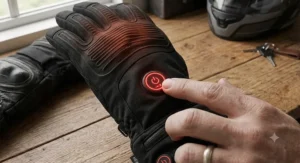
If bulk under your gloves is the dealbreaker, the Wind & Throttle Heated Glove Liner is worth a look. Built with a 4-way stretch fabric and a UL/CE-certified 7.4V 2000mAh split battery pack, it’s explicitly marketed as a slide-under layer rather than a standalone glove, and the design backs that up — heat coils wrap the fingers and thumb rather than covering the full palm, which keeps the profile low enough to still get a proper grip on the clutch lever.
What most buyers overlook about this model is the charge time: at roughly 3-4 hours using a standard USB-A wall charger, it’s slower to top off than some competitors, so it rewards riders who charge overnight rather than between rides. The touchscreen-compatible fingertips are a small but genuinely useful detail if you’re using phone-mounted navigation. On paper, the four heat settings (2+ hours on high scaling to 8+ hours on low) give you real flexibility for matching output to the actual temperature outside, rather than being stuck with a single “on” mode.
Pros:
- ✅ Slimmest fit of the battery-powered liners tested
- ✅ Touchscreen-compatible fingertips
- ✅ Four heat settings for granular control
Cons:
- ❌ Slower charge time than competitors
- ❌ Less padding means less standalone protection
At around $50-$70, the Wind & Throttle Heated Glove Liner sits in the mid-range, and the price reflects the certification and fit quality rather than raw battery capacity.
3. V.Step Heated Glove Liners Thin — best for riders who hate charging mid-trip
The V.Step Heated Glove Liners Thin solve the “what if I run out of charge halfway through the day” problem in the most straightforward way possible: it ships with two 7.4V 2200mAh lithium-polymer batteries instead of one, so you can charge a spare while the other is in use. The heating elements run to the fingertips and across the back of the hand, and the soft velvet interior is a genuinely comfortable touch that some competitors skip.
Here’s what the spec sheet won’t tell you, but user reports suggest: the extra battery adds a small amount of bulk to the wrist area compared to single-battery liners, which is a fair trade for the added runtime if you’re the type of rider who forgets to charge gear the night before. Temperature is adjusted with a long-press for on/off and short presses to cycle through heat levels — intuitive once you learn it, but not obvious out of the box. Reviewers consistently mention the stretchy polyester shell moves well with the hand, which matters for anyone who grips the throttle for long stretches.
Pros:
- ✅ Dual batteries mean built-in backup runtime
- ✅ Full hand and fingertip heating coverage
- ✅ Soft interior lining improves comfort
Cons:
- ❌ Slightly bulkier wrist area from the second battery
- ❌ Button controls aren’t intuitive at first
Expect to pay in the $30-$45 range, making the V.Step Heated Glove Liners Thin one of the better value plays if runtime anxiety is your main concern.
4. DR.PREPARE Heated Gloves Liners — best touchscreen usability
The DR.PREPARE Heated Gloves Liners pack a 3200mAh battery — a meaningful step up in capacity from several competitors in this price bracket — into a thin liner with touchscreen-compatible index fingers and thumbs on both hands. That capacity bump translates to a genuinely useful 6-9 hour runtime window depending on heat setting, which puts it closer to all-day territory than most battery-powered liners at this price.
Based on the spec comparison, the extra capacity does add a bit of weight to the battery housing, something worth noting if you’re already running a heated jacket liner and don’t want extra load on your wrists. Aggregated review sentiment points to reliable heat-up speed — most owners report warmth within 15-20 seconds of powering on — and a low failure rate for the stitching around the heating panel seams, which is often where cheaper liners fail first. If you can’t verify a specific claim about long-term durability past a year of use, that’s simply because the review pool skews toward first-season buyers, which is worth factoring into your decision if longevity is a priority.
Pros:
- ✅ Larger 3200mAh battery for longer runtime
- ✅ Touchscreen compatibility on both hands
- ✅ Fast heat-up reported across reviews
Cons:
- ❌ Slightly heavier battery housing
- ❌ Long-term durability data still limited
At a price point around $35-$50, the DR.PREPARE Heated Gloves Liners punch above their weight class on runtime alone.
5. Warm & Safe Heated Glove Liners — best for unlimited touring warmth
Stepping into 12V wired territory changes the entire value proposition. The Warm & Safe Heated Glove Liners connect directly to your motorcycle’s battery (or a portable 7.4V pack, or a heat-troller through a compatible heated jacket liner) and deliver roughly 11 watts of heat per glove — a figure that simply isn’t achievable with a coin-cell-sized rechargeable battery. Because it draws from the bike itself, runtime is a non-issue: as long as the engine’s running, the liners stay warm.
What most buyers overlook about wired systems like this one is the setup cost isn’t just the liners themselves — you’ll likely need a Y-splitter cable and, if you don’t already own one, a heat-troller to control temperature, which adds to the total investment. On paper, this makes the Warm & Safe Heated Glove Liners a poor fit for casual commuters but an excellent one for riders doing multi-hour highway stretches in genuinely cold conditions, where a battery-powered liner would tap out well before the ride does.
Pros:
- ✅ Unlimited runtime while the engine is running
- ✅ Consistent 11W of heat per glove
- ✅ Thin design fits under most winter gloves
Cons:
- ❌ Requires additional wiring/controller hardware
- ❌ Not usable off the bike without a portable pack
In the $60-$90 range for the liners alone (controller and cables sold separately), the Warm & Safe Heated Glove Liners are a serious upgrade for touring riders willing to invest in the full system.

6. Gerbing 12V Heated Glove Liners — best for integrating with a full heated riding system
Gerbing 12V Heated Glove Liners are built around the company’s microwire heating elements, which spread heat more evenly across the hand than the carbon-fiber panels found in cheaper battery liners. The extended gauntlet design is meant to layer under your primary glove with minimal bunching, and the liners plug directly into Gerbing’s broader 12V ecosystem — meaning if you already own a Gerbing heated jacket liner, these connect into the same harness rather than requiring a separate battery entirely.
Here’s what the spec sheet won’t tell you: the real value of this product isn’t the glove liner in isolation, it’s how it behaves as part of a matched system. Reviewers consistently note that Gerbing’s construction — moisture-wicking stretch lycra, reinforced stitching — holds up better over multiple winters than off-brand battery liners, which tracks with the brand’s reputation in the heated-gear space generally. The trade-off is cost and commitment: this is a liner for someone building out a full heated riding kit, not someone testing whether heated gear is worth it at all.
Pros:
- ✅ Even heat distribution via microwire technology
- ✅ Integrates with Gerbing jacket liners and controllers
- ✅ Durable stretch-lycra construction
Cons:
- ❌ Requires separate battery harness/controller purchase
- ❌ Higher total system cost than standalone liners
Expect a price in the $70-$100 range for the liners themselves, with the full harness and controller pushing total cost higher — a worthwhile ROI if you’re already invested in the Gerbing ecosystem.
7. Tourmaster Synergy Pro Plus 12V Heated Glove Liners — best dedicated heat-troller control
The Tourmaster Synergy Pro Plus 12V Heated Glove Liners round out the wired category with a design built specifically around Tourmaster’s Synergy controller line, giving riders more granular temperature control than a simple on/off battery liner. Like the other 12V options here, runtime is limited only by your ride time, not a battery charge — a real advantage for anyone who’s had a battery-powered liner die on them 90 minutes into a three-hour ride.
Based on the spec comparison, the Synergy Pro Plus trades some of the ultra-thin profile you’d get from a battery liner for a slightly more structured fit, which some riders find actually improves how it sits under a snug-fitting glove rather than bunching at the fingertips. What buyers overlook is that dialing in the right heat level takes a bit of trial and error with the controller — reviewers report the middle settings tend to be the sweet spot for most riding conditions, with the highest setting reserved for genuinely sub-freezing temperatures.
Pros:
- ✅ Precise multi-level heat control via Synergy controller
- ✅ Structured fit reduces bunching at fingertips
- ✅ No battery runtime limitations
Cons:
- ❌ Controller and wiring sold separately
- ❌ Slightly less flexible fit than thin battery liners
Priced around $65-$95 for the liners, the Tourmaster Synergy Pro Plus 12V Heated Glove Liners are a strong pick for riders already running Tourmaster’s Synergy heated gear line.
Practical Usage Guide: Charging, Setup & Your First 30 Days
Getting real value out of any heated glove liner starts before you ever hit the road. For battery-powered models like the SAVIOR HEAT Heated Glove Liners or DR.PREPARE Heated Gloves Liners, fully charge both batteries the night before first use — most manufacturers specifically recommend a full initial charge cycle to properly calibrate the battery management system. Once charged, test all three or four heat settings for a few minutes each while stationary; this is your only chance to feel the temperature difference before you’re moving at 60 mph and can’t fiddle with buttons through thick riding gloves.
For 12V wired systems like the Gerbing 12V Heated Glove Liners or Warm & Safe Heated Glove Liners, setup means routing the Y-splitter cable along your handlebars and confirming the connection doesn’t interfere with your controls before your first ride, not during it. A common first-30-days mistake is running the highest heat setting constantly out of excitement for the new gear — this drains battery-powered liners fast and, on wired systems, can occasionally cause discomfort from overheating against skin, since these panels sit closer to your hand than any jacket liner does. Start on the lowest setting and increase only as needed. Store batteries at room temperature between rides rather than leaving them in a cold garage or hot saddlebag, since lithium batteries lose efficiency and lifespan at temperature extremes in either direction.
Real-World Scenarios: Matching Riders to the Right Heated Glove Liner
If you’re a college student commuting 8 miles to campus on a budget, a single-battery liner like the SAVIOR HEAT Heated Glove Liners or V.Step Heated Glove Liners Thin covers your actual need without overspending — your ride is short enough that battery anxiety never becomes a real issue, and the lower price point matters more than maximum runtime.
If you’re a weekend tourer doing 200+ mile days on mountain roads in genuinely cold conditions, battery-powered liners will likely leave you cold on the return leg. A 12V wired option like the Warm & Safe Heated Glove Liners or Tourmaster Synergy Pro Plus 12V Heated Glove Liners removes runtime as a variable entirely, at the cost of needing your bike’s engine running to stay warm.
If you’re managing Raynaud’s phenomenon or arthritis-related cold sensitivity and ride primarily for errands and short trips, prioritize fast heat-up time and full-hand coverage over battery capacity — models like the DR.PREPARE Heated Gloves Liners, which reviewers note reach warmth within 15-20 seconds, are better matched to that use case than a liner optimized purely for long runtime. As Mayo Clinic explains in its overview of Raynaud’s disease, the condition causes areas of the body such as the fingers to feel numb and cold in response to cold temperatures, because the smaller blood vessels that supply the skin narrow and limit blood flow — which is precisely the mechanism heated liners are designed to counteract by adding external warmth before that vasospasm response kicks in.
How to Choose Rechargeable Heated Motorcycle Glove Liners
- Match power source to ride length. Short commutes favor battery liners; multi-hour tours favor 12V wired systems that never run out of charge.
- Check the heating element coverage. Liners that heat the back of the hand and fingers outperform ones that only warm the fingertips, since blood circulation runs through the whole hand.
- Confirm it fits under your existing gloves. A liner that’s too thick will compress your outer glove’s fit and actually reduce dexterity and circulation.
- Compare realistic runtime, not marketing runtime. The “up to X hours” figure is almost always the lowest heat setting — plan around the mid-setting number instead.
- Look at charge time versus your routine. A liner with a 3-4 hour charge time needs an overnight charge; one with a 1-2 hour charge time can top off between short rides.
- Weigh touchscreen compatibility if you navigate by phone. It’s a small feature that matters a lot mid-ride.
- Factor in total system cost for wired options. 12V liners often require a separately purchased controller and cable, which changes the real price comparison against battery models.
Battery Powered Glove Liners vs USB Rechargeable Heating vs 12V Wired Systems
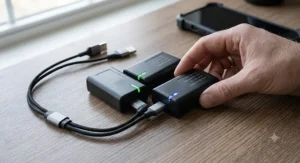
The core decision in this category isn’t really about brand — it’s about power architecture, and each approach has a genuinely different use case. Battery powered glove liners, like the SAVIOR HEAT Heated Glove Liners and V.Step Heated Glove Liners Thin, use a self-contained lithium pack that you charge separately from your bike. The appeal is independence: you can wear them walking to your bike, waiting at a gas station, or on a bicycle, since they’re not tied to any vehicle. The limitation is obvious too — once the battery’s dead, you’re cold until you find an outlet.
USB rechargeable heating, the charging method used by nearly every liner on this list including the DR.PREPARE Heated Gloves Liners and Wind & Throttle Heated Glove Liner, has become the practical standard because it lets you top off a battery from a power bank, a wall adapter, or even a USB port on some motorcycles, without needing a proprietary charger. This convenience is a real upgrade over the older barrel-plug chargers still found on some off-brand liners.
12V wired systems, represented here by the Gerbing 12V Heated Glove Liners, Tourmaster Synergy Pro Plus 12V Heated Glove Liners, and Warm & Safe Heated Glove Liners, skip the battery question entirely by drawing power straight from your motorcycle’s electrical system. The comparison table above makes clear that runtime flips from a real limitation with battery liners to a non-issue with wired ones — but that convenience is bought with reduced portability and, usually, a higher total investment once you add the required controller hardware.
“Which power source fits your ride style? Tap through to compare specs side by side.” 💬
Thin Heated Liners for Gloves: Why Slim Profile Matters for Grip and Feel
A thick liner doesn’t just feel bulky — it actively works against you on a motorcycle. Anything that separates your fingers from the texture of the clutch or brake lever reduces your feel for the controls, and that’s a genuine safety consideration, not just a comfort preference. This is why models like the Wind & Throttle Heated Glove Liner and V.Step Heated Glove Liners Thin specifically market their thin, stretch-fabric construction rather than piling on extra insulation.
What most buyers overlook is that “thin” and “warm” aren’t actually opposed goals in this category, because the heat comes from an active electrical element rather than passive insulation. A quarter-inch of down fill traps warmth passively and needs bulk to do it; a heating wire or carbon-fiber panel generates warmth actively and can do it in a layer barely thicker than a dress sock. That’s the whole mechanical advantage of heated liners over simply buying thicker winter gloves — you get warmth without sacrificing the grip and dexterity a motorcycle genuinely requires.
Glove Liner Fit: Sizing, Layering Under Gloves, and Getting It Right
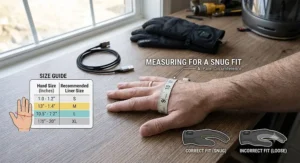
Sizing a heated glove liner is trickier than sizing a regular glove because you need room for the liner and your outer glove to fit together without either one compressing your hand. A liner that’s too snug on its own can feel fine — until you add your outer riding glove and lose circulation in your fingertips within twenty minutes, which ironically makes you colder, not warmer, since restricted blood flow undercuts the heating element’s whole purpose.
The general rule for layering under gloves: size your heated liner to your bare hand measurement, then check your outer glove’s fit with the liner already on, not against your bare hand. Most manufacturers, including the makers of the DR.PREPARE Heated Gloves Liners and SAVIOR HEAT Heated Glove Liners, offer sizing across S through XL, and it’s worth sizing up one step from your normal glove size if you’re layering under a snug sport-style riding glove rather than a roomier touring gauntlet. Reviewers consistently flag sizing as the single most common return reason across this product category — a detail worth taking seriously before you order.
Common Mistakes When Buying Heated Glove Liners
- Buying based on wattage alone. A higher-wattage liner with poor coverage can feel less warm than a lower-wattage one that heats the full hand evenly.
- Ignoring outer glove compatibility. The best liner in the world underperforms inside a glove that’s already a snug fit.
- Assuming “up to X hours” means realistic all-day use. That figure is almost always measured on the lowest heat setting.
- Skipping the initial full charge cycle. New lithium batteries need a complete first charge to perform to spec.
- Overlooking total system cost on 12V options. The liner price often excludes the controller and wiring harness you’ll also need.
Long-Term Cost & Maintenance of Heated Glove Liners
A $30 battery liner and a $180 total 12V wired system aren’t really competing products — they’re solving different cost equations over time. The battery liner has a lower upfront cost but a finite lifespan tied to its lithium cell, which typically degrades noticeably after 200-300 charge cycles, roughly two to three riding seasons of regular use for most commuters. Replacement usually means buying a new liner outright, since batteries aren’t always sold separately.
A 12V wired system like the Gerbing 12V Heated Glove Liners carries a higher upfront cost once you factor in the controller and harness, but the liner itself has no battery to degrade — it draws power fresh from your bike every ride, so its practical lifespan is limited mainly by fabric wear rather than battery chemistry. For a rider putting serious miles on in cold weather every winter, the wired system’s total cost of ownership can actually come out lower over a five-year window, even with the higher sticker price today. Maintenance for either type is straightforward: keep the heating panel dry, avoid folding the liner sharply at the wiring points, and store batteries at room temperature rather than in a freezing garage.
Safety, Battery Regulations & Compliance Guide
Because every product on this list runs on a lithium battery or a direct line to your motorcycle’s electrical system, safety habits matter as much as the gear itself. The Consumer Product Safety Commission’s battery safety resources note that potential hazards with batteries and battery chargers include overheating, fire, electrical shock, and thermal burns, and recommend only using the charger provided with the device rather than mixing cables between products. In practice, that means charging your SAVIOR HEAT Heated Glove Liners or any other battery liner with its original cord, on a hard surface away from flammable material, and never leaving it charging unattended overnight.
Cold exposure itself carries its own risk profile independent of your gear. NIOSH’s cold stress guidance notes that cold-related illnesses affecting outdoor workers include hypothermia, frostbite, trench foot, and chilblains, all of which remain possible even while wearing heated gear if the liner’s battery dies mid-ride and you’re unprepared with a backup layer. Always carry a spare pair of standard insulated gloves as backup, especially if you’re relying on a battery-powered liner for a longer ride where a dead battery could leave you exposed in genuinely dangerous conditions.
Benefits vs Traditional Hand Warmers & Bar Muffs
| Feature | Heated Glove Liners | Disposable Hand Warmers | Bar Muffs |
|---|---|---|---|
| Reusability | Rechargeable, hundreds of uses | Single-use, disposable | Reusable, no power needed |
| Heat consistency | Adjustable, steady | Declines over 4-6 hours | None — insulation only |
| Dexterity impact | Minimal (thin design) | Bulky if taped in place | None while gripping bars |
| Best For | All-condition, adjustable warmth |
Disposable hand warmers are cheap and require zero setup, but their heat output declines steadily over hours and can’t be adjusted once activated — a real downside compared to the on-demand control of a liner like the DR.PREPARE Heated Gloves Liners. Bar muffs trap warmth passively around the handlebar itself and never need charging, but they only work while your hands are on the bars, offering no warmth once you dismount, unlike a battery-powered liner you can keep wearing at a gas stop.
Price Range & Value Analysis
| Category | Typical Price Range | Value Take |
|---|---|---|
| Basic battery liners | $25-$50 | Best cost-per-use for commuters |
| Mid-tier battery liners | $35-$70 | Best balance of runtime and price |
| 12V wired liners (liner only) | $60-$100 | Best long-term value for touring riders |
| Full 12V system w/ controller | $150-$260 | Highest upfront cost, lowest long-term degradation |
Looking at the table above, the SAVIOR HEAT Heated Glove Liners deliver the lowest cost-per-warm-ride for casual riders, but frequent cold-weather tourers logging serious annual mileage will likely see better long-term value from a wired system like the Warm & Safe Heated Glove Liners, since there’s no battery to eventually replace. Mid-tier options like the DR.PREPARE Heated Gloves Liners occupy a reasonable middle ground — a modest price premium buys meaningfully longer runtime than the cheapest liners on this list.
Frequently Asked Questions
❓ Are rechargeable heated motorcycle glove liners waterproof?
❓ How long does a heated glove liner battery last per charge?
❓ Can I wear heated glove liners under any motorcycle glove?
❓ Do 12V heated glove liners drain my motorcycle battery?
❓ How often should I replace heated glove liner batteries?
Conclusion
Cold hands aren’t just uncomfortable on a motorcycle — they’re a genuine dexterity and safety issue, which is exactly why this category has grown from a niche accessory into a mainstream part of cold-weather riding kits. The right choice really does come down to how you ride: the SAVIOR HEAT Heated Glove Liners and V.Step Heated Glove Liners Thin make sense for short commutes on a budget, the DR.PREPARE Heated Gloves Liners and Wind & Throttle Heated Glove Liner hit a sensible middle ground for riders who want more runtime and touchscreen convenience, and the 12V wired options — Gerbing 12V Heated Glove Liners, Tourmaster Synergy Pro Plus 12V Heated Glove Liners, and Warm & Safe Heated Glove Liners — are built for riders logging serious cold-weather mileage who need warmth that never runs out.
Whichever direction you go, the underlying goal is the same: get your hands warm enough to stay sharp on the controls, without adding bulk that works against the grip and feel a motorcycle demands. Check current pricing and availability before you buy, since these listings shift often, and don’t skip the fit check against your existing gloves — it’s the single most common mistake buyers make in this category.
Recommended for You
- Waterproof Winter Motorcycle Gloves: 7 Picks That Won’t Let You Down (2026)
- Heated Motorcycle Gloves for Winter Commuting: 7 Best Picks for 2026
- 7 Best Track Day Gloves Under $100 For 2026
Disclaimer: This article contains affiliate links. As an Amazon Associate, I earn from qualifying purchases. If you purchase products through these links, we may earn a small commission at no additional cost to you.
✨ Found this helpful? Share it with your friends! 💬🤗
