
In This Article
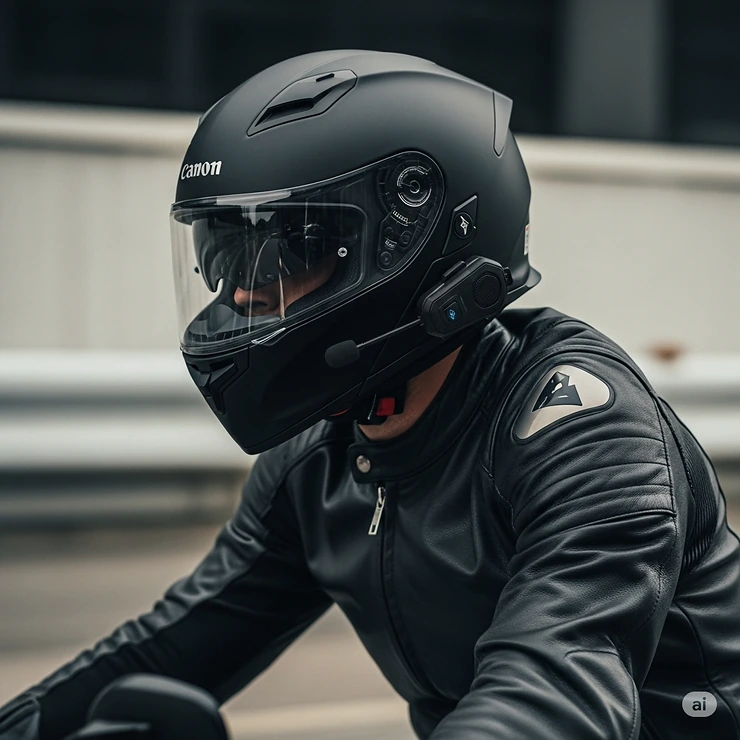
Picture a 70 mph highway at dusk. Your phone buzzes in your pocket, your GPS is whispering turn-by-turn directions you can’t hear, and your riding buddy is trying to shout something about a gas stop. Wind roar eats all of it. That’s the exact problem full face motorcycle helmets with bluetooth exist to solve, and in 2026 they solve it far better than the clip-on gadgets of five years ago.
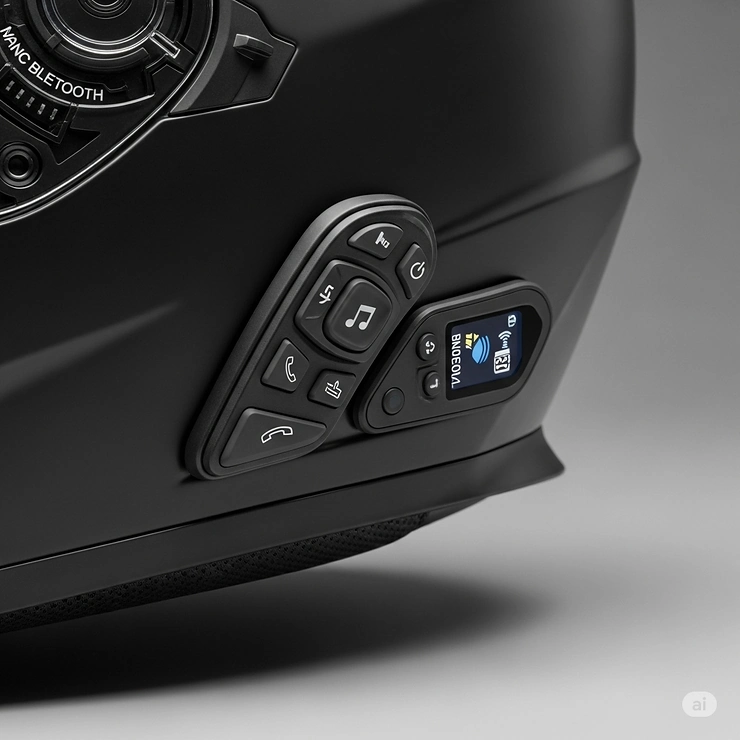
So what is the deal, really? A full face helmet gives you the most coverage a lid can offer: skull, jaw, chin, face. Add Bluetooth and you get calls, music, navigation and rider-to-rider chat without taking a hand off the bars. Roundups from outlets like Gear Patrol explain the split neatly: Bluetooth handles phone pairing, while talking to other riders usually runs through a proprietary mesh network, a bit like a walkie-talkie.
Here’s the catch, though. “Bluetooth” on a helmet listing can mean three very different things. It might be a fully integrated system, a helmet that’s merely “Bluetooth ready” (speaker pockets, no brains), or just a helmet you’ll bolt a separate communicator onto. Mix those up and you’ll overpay or end up with a helmet that can’t do what you wanted.
This guide sorts through seven real options for 2026, from premium integrated systems to budget-friendly picks. We interpret the specs instead of just reciting them, and we lean on aggregated reviewer sentiment rather than inventing experiences. Everything here is analysis, not a hands-on test report. All price figures are ranges that may shift, so check current pricing before you buy.
Quick Comparison: Full Face Motorcycle Helmets with Bluetooth at a Glance
| Helmet | Bluetooth Setup | Price Range (check current) | Best For |
|---|---|---|---|
| Sena Phantom | Fully integrated (Mesh + Bluetooth) | Premium, roughly mid-$400s to $600s | Riders who want everything built in |
| Shoei RF-1400 | Comm-ready; add a compatible unit | Premium, roughly $600s before comms | Fit-obsessed riders, long days |
| Sena OutForce | Integrated comms | Mid-to-upper range, roughly $300s-$400s | Value-minded connected riders |
| Sedici Strada II Parlare | Sena-based integrated Bluetooth | Mid-range, roughly $250-$350 | Commuters and sport-touring |
| Scorpion EXO-T520 | Bluetooth via EXO-COM | Roughly $200-$300 range | Quiet, budget-friendly touring |
| Scorpion EXO-Covert FX | Bluetooth-ready speaker pockets | Under roughly $200 range | Street-fighter style on a budget |
| FreedConn BM2-S | Built-in Bluetooth headset | Budget, under roughly $200 | First-time Bluetooth shoppers |
Look at the pattern: price tracks integration depth more than helmet shell quality. The Sena Phantom and Sena OutForce charge for mesh and polished software, while the Scorpion EXO-Covert FX and Scorpion EXO-T520 give you a solid shell and leave the electronics up to you. The Shoei RF-1400 sits in its own lane, charging for shell craftsmanship first and comms second. If you’d rather not think about wiring at all, the integrated end of the table saves you the most hassle.
💬 Just one click — help others make better buying decisions too!😊
Top 7 Full Face Motorcycle Helmets with Bluetooth: Expert Analysis
A quick honesty note before we dive in. Several of these helmets have limited verifiable independent review data, and when that’s the case, we say so instead of dressing up guesses as quotes. Where roundups agree, we report the consensus.
1. Sena Phantom — most complete integrated system
Where most helmets treat Bluetooth as an add-on, the Sena Phantom treats it as the main event. Reviewers at one 2026 roundup crowned it the most advanced Bluetooth helmet of the year: full face, fully integrated, with Sena Mesh 2.0 baked in alongside Bluetooth (reviewers cite versions 5.0 and 5.3, so confirm the exact version on the listing).
What does that mean on the road? Mesh intercom works like a self-healing network, so riders can drift in and out of range without the group chat collapsing. Because the speakers and microphone are designed into the shell, you skip the usual clamp-on pod and the wiring-into-ear-pockets dance. It also means a cleaner, quieter helmet profile, which matters at highway speed.
This one’s for riders who plan to use group comms regularly and hate tinkering. If you ride solo and only need navigation prompts, you’re paying for network features you may never use.
Reviewers consistently describe it as the benchmark for integrated full face comms in 2026, though the premium pricing keeps coming up as the main sticking point.
Pros:
- ✅ Mesh and Bluetooth built directly into the shell
- ✅ Clean look with no clamp-on pod
- ✅ Strong fit for group riding and touring
Cons:
- ❌ Premium price tier
- ❌ Electronics add cost if you never use mesh
Price range: premium, roughly mid-$400s to $600s (check current price). The value verdict is strong for group riders and merely good for solo commuters.
2. Shoei RF-1400 — the fit-first premium shell
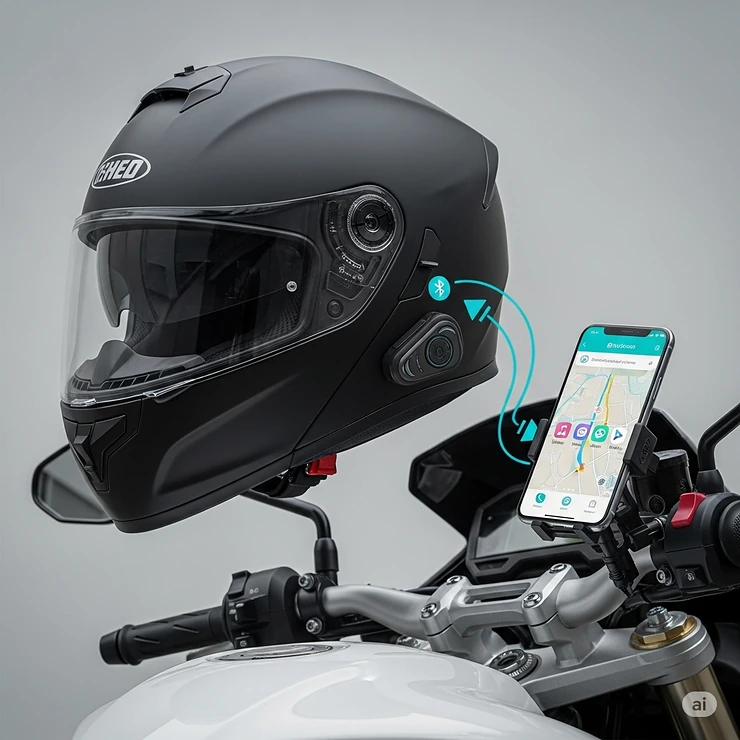
The Shoei RF-1400 is the odd one out here, in a good way. It isn’t a “Bluetooth helmet” so much as a world-class helmet that plays nicely with Bluetooth. Roundups list it as a premium SNELL and DOT certified fiberglass-composite lid, and the pairing story runs through add-on communicators like the Shoei SRL3 mesh system made by Sena.
Why would you pick a comm-ready helmet over an integrated one? Because you can upgrade the electronics later without replacing a shell you love. Comm tech ages in two or three years; helmets don’t have to. Reviewers also note that Shoei shells tend to suit intermediate oval head shapes, which is a polite way of saying try it on before you commit.
Here’s what the spec sheet won’t tell you: comfort over a 400-mile day matters more than any intercom feature. A helmet that fits right quiets the fatigue that makes you rip it off at every gas stop.
The honest trade-off is total cost. You’ll buy the helmet and a communicator separately, so budget for both.
Pros:
- ✅ Premium shell with SNELL and DOT certification
- ✅ Upgradable comms path through compatible units
- ✅ Well regarded for long-day comfort
Cons:
- ❌ Communicator sold separately
- ❌ Fit may not suit rounder head shapes
Price range: premium, roughly the $600s for the helmet alone, with comms extra (check current price). Excellent value if shell quality and fit are your priorities.
3. Sena OutForce — integrated comms without the flagship tax
The Sena OutForce appears in 2026 roundups as a full face helmet with Sena’s comms built in, positioned below the Sena Phantom on the price ladder. For riders who want integration but balk at flagship pricing, that’s a genuinely useful middle rung.
I’ll be straight about what’s verifiable: independent deep-dive data on this model was thinner than for the flagship at the time of research. What we can say from the category logic is that Sena’s integrated approach tends to deliver simpler pairing through the Sena app and fewer dangling parts than a retrofit.
Think of it as the sensible-shoes version of integration. You get the headline benefit (no clamp-on unit, one helmet, one charge cycle to remember) while skipping some of the premium features you may not touch.
If you rarely ride with a big group, this could be the best price-to-feature balance in the lineup. If mesh range is a top priority, check the specific feature list on the current listing before assuming parity with the flagship.
Pros:
- ✅ Integrated Sena comms in a full face shell
- ✅ Priced below the flagship integrated model
- ✅ Cleaner setup than aftermarket retrofits
Cons:
- ❌ Fewer independent reviews to cross-check
- ❌ Feature set may trail the flagship
Price range: roughly the $300s to $400s (check current price). Good value for connected commuters.
4. Sedici Strada II Parlare — Sena tech at a friendlier price
The Sedici Strada II Parlare has long been a quiet favorite in Bluetooth roundups, and its name explains the trick: “Parlare” is the Bluetooth-integrated variant, built around Sena technology. One roundup highlights a dual EPS crush liner and removable cheek pads, which are the unglamorous details that decide whether a helmet is livable.
Why do removable cheek pads matter for a Bluetooth helmet in particular? Sweat and electronics are enemies. Pads you can pull and wash keep the helmet fresh without forcing you to fuss around speaker pockets every time. A dual-density liner, meanwhile, generally means a more tailored impact response than a single slab of foam.
This is the pick for a rider who commutes five days a week and wants the full face protection, call handling and navigation prompts in one sensible package. It’s less about wow-factor, more about “works every morning.”
Reviewers tend to praise the integrated simplicity and value, while the main caution is that you’re buying into a specific comm generation that will age.
Pros:
- ✅ Sena-based integrated Bluetooth
- ✅ Dual EPS crush liner for impact management
- ✅ Removable cheek pads for easy cleaning
Cons:
- ❌ Comm tech may age before the shell does
- ❌ Fewer premium comfort touches than flagships
Price range: roughly $250-$350 (check current price). Strong value for daily riders.
5. Scorpion EXO-T520 — quiet touring lid with a comm path
One 2026 review summed up the Scorpion EXO-T520 as a quiet touring lid with EXO-COM Bluetooth, and flagged it as best value in its roundup. That “quiet” part deserves more attention than it gets. Wind noise is the real enemy of any helmet speaker; a quieter shell means you can run lower volume, hear clearer prompts and fight less fatigue.
The EXO-COM system is Scorpion’s own Bluetooth approach (CSR-based, according to one listing), designed to tuck in cleanly rather than hang off the side. For riders new to helmet comms, it’s a gentle on-ramp: phone, music, GPS, no mesh complexity.
Here’s the reasoning: if you’re a solo rider and ride at 55-75 mph, quiet plus clear audio beats a long feature list. You’ll use the phone-and-nav features daily and the mesh features approximately never.
The caveat is group riding. Compared with mesh-first systems, a basic Bluetooth intercom is a more limited tool for riding with a crew.
Pros:
- ✅ Quiet touring character helps audio clarity
- ✅ Scorpion EXO-COM Bluetooth integration path
- ✅ Flagged as best value in one 2026 roundup
Cons:
- ❌ Not built for large-group mesh riding
- ❌ Comm unit may be sold separately depending on listing
Price range: roughly $200-$300 (check current price). Great value for solo tourers.
6. Scorpion EXO-Covert FX — attitude first, speaker pockets ready
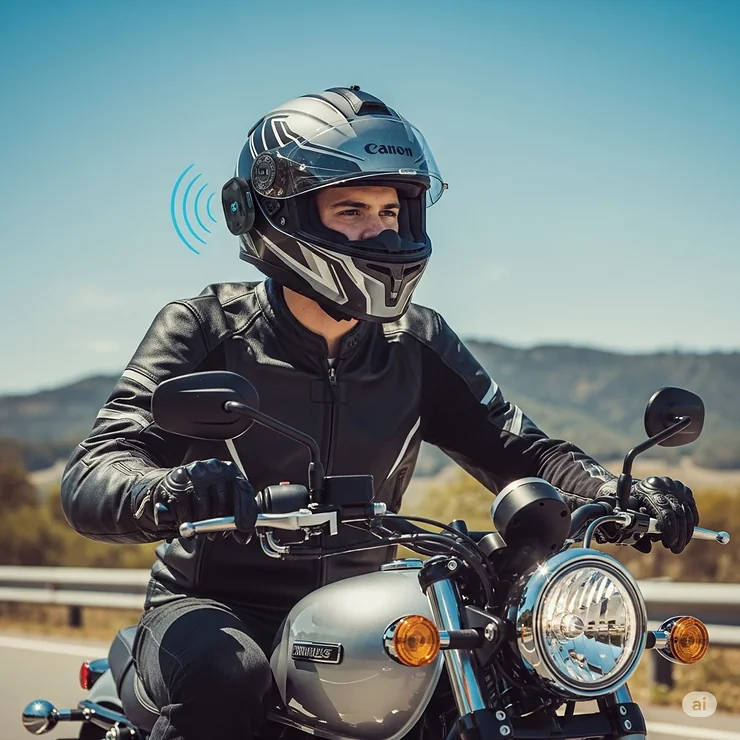
The Scorpion EXO-Covert FX is all attitude: street-fighter styling, a composite shell, DOT and ECE approval per the listing, and speaker pockets built for Bluetooth intercoms. It’s “Bluetooth ready,” which means you bring the brain.
That’s actually liberating. You can run a budget communicator today and upgrade to a Sena or Cardo unit later without touching the helmet. The built-in pockets also keep speaker placement tidy, which affects sound far more than most buyers realize: speakers sitting right over your ears beat speakers floating near your cheekbones every time.
Who should consider it? Naked-bike and streetfighter riders who want a helmet that looks like it belongs, with the flexibility to choose comms separately. It’s not the choice for someone who wants one-box simplicity.
Be clear-eyed about the trade-off: “Bluetooth ready” isn’t Bluetooth. Factor the cost of a communicator into your budget before calling it a bargain.
Pros:
- ✅ Composite shell with DOT and ECE approval
- ✅ Speaker pockets simplify aftermarket comms
- ✅ Distinctive streetfighter styling
Cons:
- ❌ Needs a separate communicator
- ❌ Style-forward shape may not suit all riders
Price range: under roughly $200 for the helmet (check current price). Good value if you’re comfortable pairing it with your own comms.
7. FreedConn BM2-S — the budget gateway to built-in Bluetooth
At the entry level, the FreedConn BM2-S shows up in full face Bluetooth roundups as a built-in Bluetooth helmet aimed at first-timers. It’s the “try before you commit” option: a lid with a headset already installed, no shopping for compatibility.
A word of calibration. Budget integrated systems typically trade away refinement: less polished apps, simpler audio tuning, and a smaller track record than Sena or Cardo. We couldn’t verify a deep pool of independent reviews at the time of research, so treat this as an economical experiment rather than a long-term system.
Even so, there’s a real use case. If you ride occasionally, commute short distances, and simply want to take calls and hear directions, a basic integrated unit does that job. Just don’t expect group-ride mesh heroics.
Always confirm the helmet’s DOT label before buying a budget Bluetooth model; certification matters more than any headset feature.
Pros:
- ✅ Built-in Bluetooth headset out of the box
- ✅ Lowest barrier to entry in the lineup
- ✅ Handy for calls and navigation prompts
Cons:
- ❌ Limited independent review data
- ❌ Less refined than Sena or Cardo ecosystems
Price range: under roughly $200 (check current price). Fair value for light-duty use.
What Are Full Face Motorcycle Helmets with Bluetooth?
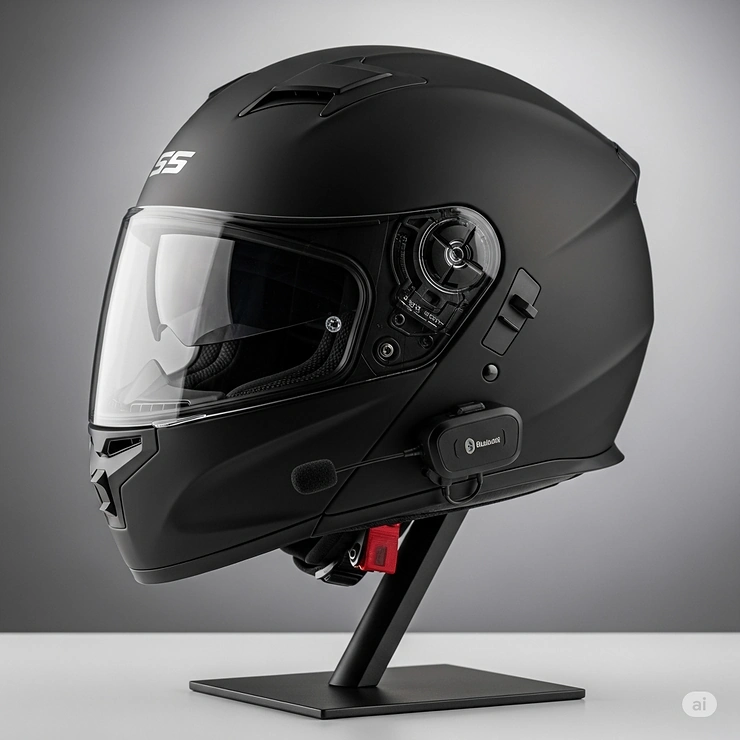
Full face motorcycle helmets with bluetooth are helmets that fully enclose the head and chin while carrying built-in or compatible wireless communication hardware. They let riders take calls, hear GPS and music, and often talk with other riders hands-free, all without compromising the protection of a full face shell.
For background on how motorcycle helmets are built and categorized, the Wikipedia entry on motorcycle helmets is a handy neutral primer. The short version: full face designs cover the most surface area, and the wireless layer sits on top of that protection rather than replacing it.

How to Choose Full Face Motorcycle Helmets with Bluetooth
- Start with certification. Look for the DOT label first. A cool comm system on a non-compliant shell is a bad trade.
- Pick your integration level. Integrated means simplest. Bluetooth ready means flexible. Add-on means maximum choice but more fiddling.
- Decide whether you need mesh. Group riders benefit; solo riders rarely do.
- Prioritize fit and noise. A quiet, comfortable shell improves audio more than any speaker upgrade.
- Check battery and charging. Reviewers cite roughly 11-12 hours of talk time on current Sena mesh units; confirm real numbers for your model.
- Plan for ecosystem lock-in. Sena and Cardo don’t natively mesh with each other, though bridging options exist.
- Budget for the whole package. Add helmet cost plus any communicator to avoid sticker shock.
Integrated vs Bluetooth-Ready vs Add-On: Which Setup Wins?
| Setup | Convenience | Flexibility | Typical Cost Pattern |
|---|---|---|---|
| Integrated (e.g., Sena Phantom) | Highest | Lowest | Higher upfront |
| Bluetooth ready (e.g., Scorpion EXO-Covert FX) | Medium | High | Moderate total |
| Add-on to a premium shell (e.g., Shoei RF-1400) | Lower | Highest | Highest total |
The table tells a simple story: you trade convenience for flexibility, and you pay either way. Integrated helmets like the Sena Phantom win for riders who value a clean, one-box solution. The Shoei RF-1400 route makes sense if you’d rather keep the same shell for years and replace comms as the technology evolves.
Gear Patrol’s roundup notes that a helmet designed around a specific comm system can integrate it more neatly and comfortably, and that for riders who truly need comms, buying a purpose-built helmet is generally the better path. That matches the logic here: retrofits work, but they rarely look or sound as tidy.
Full Face vs Modular and Open Face Bluetooth Helmets
| Style | Protection | Convenience | Best For |
|---|---|---|---|
| Full face | Highest coverage | Fewer moving parts | Speed, sport, touring |
| Modular | Good, with a hinge | Flip-up chin bar | Frequent stops, glasses wearers |
| Open face | Lower | Most airflow | Short urban trips |
Modular helmets such as the Sena Impulse or Schuberth C5 earn their fans by being easy to talk and sip coffee in. Open face designs let air in but give up face and jaw protection. Full face remains the pick for riders prioritizing crash protection, quieter rides and cleaner aerodynamics.
If your riding is highway-heavy, the sealed design of the full face is also quieter, which helps speakers punch through at lower volume. Choose modular only if you genuinely stop often.
Features That Actually Matter (And Those That Don’t)
Matter:
- 🔋 Battery life that outlasts your longest ride day
- ⚡ Fast charging for quick top-ups on the road
- 🎧 Speaker placement and noise isolation
- 📱 App stability and firmware updates
Mostly marketing:
- Extra intercom channels you’ll never use
- Ultra-long mesh range claims on a solo commute
- Gimmicky voice commands that fail with wind roar
One reviewer-style takeaway worth remembering: a sealed, quiet shell does more for audio than a pricier speaker ever will. Spend your money on fit and certification before you chase feature lists.
Safety, DOT Certification and What the Label Really Means
Here’s a fact that should reframe your shopping: NHTSA research published in 2004 found that wearing a helmet certified to FMVSS 218 reduces the risk of dying in a motorcycle crash by 37 percent. The standard covers energy attenuation, penetration resistance, chin strap integrity and labeling.
NHTSA itself explains how FMVSS 218 applies to all helmets designed for highway use by motorcyclists; see the agency’s own FMVSS 218 interpretation page for the details. It also matters because novelty helmets sold as “not DOT” fail nearly every performance test the agency runs.
What this means for Bluetooth shoppers: the electronics are secondary. Check for a permanent DOT mark, inspect it, and be wary of stickers that look tacked on. A helmet that fails the basics doesn’t become safe because it has speakers.
Also note: adding hardware to a helmet shell, especially with drilling, adhesives or aftermarket clamps, can complicate the protective design. Using manufacturer-designed mounts or purpose-built integrated helmets tends to be the safer path.
Common Mistakes When Buying Full Face Motorcycle Helmets with Bluetooth
- Buying on tech first, fit second. A helmet that squeezes your temples will end your ride early, no matter the speakers.
- Confusing “Bluetooth ready” with “Bluetooth included.” One has a brain; the other has pockets.
- Ignoring ecosystem compatibility. Sena and Cardo are the two dominant systems, and cross-brand mesh isn’t native.
- Skipping the DOT check. See above. Seriously.
- Overbuying mesh. If you ride alone, an integrated basic Bluetooth system may be all you ever need.
- Forgetting the lifespan. Helmets age out; comm tech ages out faster. Plan for replacing electronics sooner.
Practical Setup Guide: Your First 30 Days with a Bluetooth Helmet
Week 1: Fit and pairing. Wear the helmet around the house for an hour before the first ride. Pressure points show up quickly. Pair your phone in a quiet room and update firmware through the manufacturer’s app.
Speaker placement. Press speakers into the helmet’s ear pockets so they sit right over your ears. Reviewers note that exact placement drives clarity far more than volume.
Week 2: Highway test. Do a short highway run with music at a low level. Raise volume slowly; hearing damage from loud audio plus wind noise is cumulative.
Week 3: Battery habits. Charge after every long ride. For reference, one review of the Sena 50S mesh unit lists around 12 hours of Bluetooth talk time and 11 hours on mesh, which is typical of current premium units. See the full numbers in this Ultimate Motorcycling Sena 50S review.
Week 4: Maintenance. Wipe the shell with mild soap, remove and hand-wash pads, and keep charging ports dry. Avoid solvents on visors and seals.
Common first-month mistakes: overtightening clamps, leaving firmware outdated, and skipping earplugs under the speakers.
Real-World Scenarios: Matching the Right Helmet to the Right Rider
Scenario 1: The daily commuter. A rider with a 15-mile commute, mostly surface streets, wants calls and directions. The Sedici Strada II Parlare fits: integrated Bluetooth, removable pads, mid-range price.
Scenario 2: The weekend group rider. Four friends ride mountain roads every Saturday. The Sena Phantom (or the Sena OutForce if budget is tighter) keeps everyone talking through mesh without a pile of add-on gear.
Scenario 3: The long-haul tourer. Someone logging 400-mile days cares most about fit and fatigue. The Shoei RF-1400 plus a separate communicator keeps comfort the priority while leaving the comm choice open.
Scenario 4: The budget-conscious beginner. Someone riding casually wants to dip a toe in. The FreedConn BM2-S or Scorpion EXO-Covert FX with a basic communicator keeps the cost low and the upgrade path open.
Problem → Solution Guide for Bluetooth Helmet Owners
Problem: Wind noise drowns the audio. Solution: Seat the speakers properly and consider a quieter shell like the Scorpion EXO-T520. Foam wind blockers on microphones help.
Problem: Battery dies mid-trip. Solution: Top up at every long stop and carry a short charging cable. Fast charging on current units can add several hours from a short plug-in.
Problem: Pairing drops with a passenger. Solution: Re-pair devices in a quiet area, update firmware, and avoid mixing very old and very new units.
Problem: Mixed-brand group can’t connect. Solution: Use the Bluetooth bridge (Sena’s and Cardo’s cross-brand options) with reduced range and expectations.
Problem: The helmet feels heavier with electronics. Solution: Choose integrated designs where weight is balanced into the shell, and check helmet weight listings before buying.
Long-Term Cost and Maintenance: What These Helmets Really Cost
| Cost Item | Integrated (e.g., Sena Phantom) | Comm-Ready (e.g., Scorpion EXO-Covert FX) |
|---|---|---|
| Upfront | Higher | Lower helmet, plus comm unit |
| Upgrades | Replace whole helmet | Swap comm unit only |
| Replacement cycle | Helmet and tech age together | Tech replaced more often |
| Maintenance | One system to care for | Two systems to care for |
Integrated models tend to have a higher sticker price but lower total hassle, while comm-ready helmets spread the cost over time. For most riders, the sweet spot is whichever option you’ll actually use daily.
Replace any helmet after a significant impact, and consider age-based replacement as manufacturers recommend. Treat the electronics as the shorter-lived component: if the battery fades after a few years, you shouldn’t be forced to retire a perfectly safe shell. That argument quietly favors the Shoei RF-1400 approach for riders who keep gear a long time.
FAQ
❓ Are full face motorcycle helmets with bluetooth safe?
❓ What is the best full face motorcycle helmet with bluetooth for beginners?
❓ Can I add Bluetooth to a full face helmet I already own?
❓ How long does the battery last on a Bluetooth helmet?
❓ Do Bluetooth helmets work with any intercom brand?
Conclusion: Which of These Full Face Motorcycle Helmets with Bluetooth Is Right for You?
Let’s boil it down. If you want the most complete, no-fuss package, the Sena Phantom is the clear premium pick. If long-day comfort and fit rule your decisions, the Shoei RF-1400 gives you a world-class shell with a flexible comm path. Value hunters should look at the Sena OutForce and the Sedici Strada II Parlare, while solo tourers get a lot from the quiet Scorpion EXO-T520. Style-driven riders on a budget can start with the Scorpion EXO-Covert FX, and first-timers can test the waters with the FreedConn BM2-S.
The through-line is simple: certification first, fit second, comms third. Get those in order and the rest of the decision gets easy.
✨ Don’t Miss These Exclusive Deals!
🔍 Take your ride to the next level with these carefully selected helmets. Click on any highlighted item to check current pricing and availability. These picks will help you build a safer, more connected riding setup you’ll enjoy every mile!
Recommended for You
- 7 Best Open Face Motorcycle Helmet Options That Deliver Ultimate Freedom in 2025
- Bluetooth Full Face Helmet: 7 Best Picks Ranked for 2026
- 7 Best Womens Full Face Motorcycle Helmets That Actually Fit Women in 2025
Disclaimer: This article contains affiliate links. As an Amazon Associate, I earn from qualifying purchases. If you purchase products through these links, we may earn a small commission at no additional cost to you.
✨ Found this helpful? Share it with your friends! 💬🤗
