
In This Article
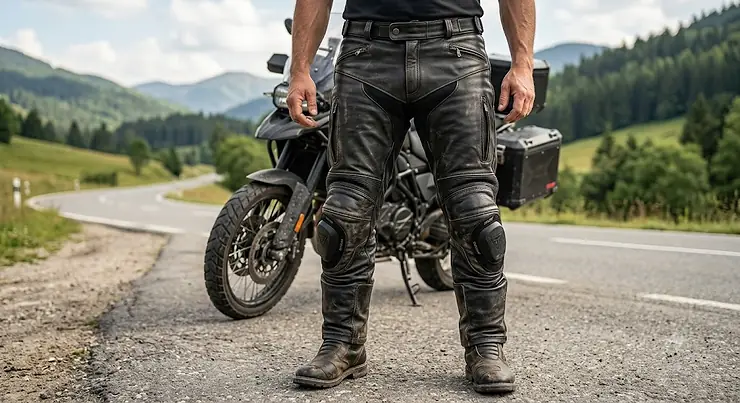
Somewhere around mile 200 of a long day in the saddle, you stop thinking about horsepower and start thinking about your legs. That’s the moment leather motorcycle pants for touring either prove their worth or reveal every corner that got cut in the design room. A great pair disappears — no hot spots, no bunching at the knee, no cold air sneaking up your ankle at 70 mph. A mediocre pair turns a scenic route into a countdown to the next gas station.
This guide skips the marketing fluff and gets into what actually matters on a real ride: abrasion protection that meets recognized safety standards, ventilation that works when the mercury climbs, and fit that survives eight hours on a bike without turning into a wrestling match. We researched seven genuine products spanning budget chaps to premium touring-ready leathers, then broke down who each one actually suits. Along the way we’ll cover comfortable leather touring pants, leather pants for all-day riding, and the ventilation tech that separates a pant you tolerate from one you forget you’re wearing.
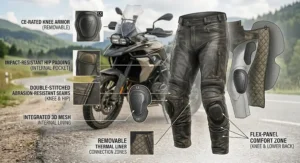
What is leather motorcycle pants for touring? It’s protective legwear made from abrasion-resistant leather (usually cowhide) engineered for multi-hour rides — combining CE-rated armor, stretch panels for movement, and airflow features so riders stay protected and comfortable across long-distance trips rather than short sport-bike stints.
Quick Comparison Table
| Product | Type | Price Range | Best For |
|---|---|---|---|
| Dainese Pony 3 Perforated Pants | Perforated leather | $470-$520 | Hot-climate touring |
| Alpinestars Missile V3 Leather Pants | Sport-touring leather | $430-$490 | Long-mileage sport-touring |
| REV’IT! Gear 2 Leather Pants | Leather/textile hybrid | $390-$450 | All-weather versatility |
| Dainese Pony 3 Pants | Standard leather | $370-$420 | Everyday touring all-rounder |
| Alpinestars Track V2 Leather Pants | Sport leather | $330-$390 | Budget-conscious sport-touring |
| Street & Steel Richmond 2 Chaps | Leather chaps | $110-$150 | Cruiser touring on a budget |
| Highway 21 Maverick Chaps | Leather chaps | $90-$130 | Entry-level cruiser protection |
Looking at this lineup, there’s a clear split between full-coverage leather pants — which wrap the entire leg in abrasion-resistant material and CE-rated armor — and chaps, which layer over jeans for a lighter, cheaper way to add protection on cruiser-style tours. If your route mixes highway slabs with twisty backroads, the full pants in the $370-$520 range earn their keep. If you’re primarily cruising and want an easy on-ramp to leather protection, the chaps at the bottom of the table get you there for a third of the cost.
💬 Just one click — help others make better buying decisions too!😊
Top 7 Leather Motorcycle Pants for Touring: Expert Analysis
1. Dainese Pony 3 Perforated Pants — best ventilation for hot-weather touring
The Dainese Pony 3 Perforated Pants take Dainese’s race-leather know-how and aim it squarely at long-distance comfort, and the perforation pattern is the headline feature here. Built from Tutu cowhide with S1 bi-elastic stretch panels, the perforated version adds a Nanofeel liner and open panels across the leg specifically to bleed heat during summer touring stints. Based on the spec comparison, the combination of perforated leather plus a moisture-managing liner puts this pant ahead of solid-leather alternatives for anyone touring through the Southwest or the Gulf Coast in July, where trapped heat is the real enemy on an eight-hour day. What most buyers overlook is that the Pro-Shape hip protectors and removable composite knee armor meet prEN 17092 certification, so you’re not trading protection for airflow — you’re getting both in the same garment. Reviewers consistently note excellent fit adjustability thanks to the double-zip calf construction, though a handful of aggregated reviews mention the perforated model runs warm-weather-only, since the open panels do little to block wind on cold mornings.
Pros:
- ✅ Perforated leather cuts heat buildup on long summer rides
- ✅ prEN 17092 certified with removable knee and hip armor
- ✅ Double-zip calf design simplifies boot-over fit
Cons:
- ❌ Minimal wind-blocking on cold-weather starts
- ❌ Premium price point compared to standard leather pants
Priced in the $470-$520 range, the Dainese Pony 3 Perforated Pants deliver strong value if your touring season skews warm — the ventilation alone justifies the premium over the non-perforated version.
2. Alpinestars Missile V3 Leather Pants — best for long-mileage sport-touring
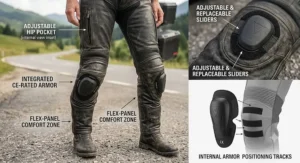
The Alpinestars Missile V3 Leather Pants were built with a “flex fit” philosophy, and that shows up immediately in how the pre-curved legs track a natural riding posture instead of fighting it mile after mile. Constructed from 1.3mm genuine bovine leather with accordion stretch zones above the knee and along the crotch and calf, these pants are Tech-Air 10 airbag-ready, meaning riders who tour with an airbag vest or jacket can integrate additional protection without switching gear systems. Here’s what to weigh: the large knee ventilation port genuinely moves air at speed, but on paper this means it’s tuned more for sport-touring pace than slow parade-route cruising, where there’s less airflow to work with. Aggregated customer sentiment around the Missile line consistently praises the close, athletic fit and the durability of the leather chassis over multi-season use, while a recurring complaint is that the CE Category II EN17092 AA-rated fit runs snug and benefits from trying a half-size up. The GP-R Lite knee protection and replaceable slider system add a track-adjacent safety margin that most pure touring pants skip entirely.
Pros:
- ✅ Tech-Air 10 airbag compatibility for layered protection
- ✅ Accordion stretch zones aid all-day mobility
- ✅ EN17092 AA-rated with replaceable knee sliders
Cons:
- ❌ Snug fit often requires sizing up
- ❌ Athletic cut less forgiving for cruiser-style seating
At around $430-$490, the Alpinestars Missile V3 Leather Pants suit sport-touring riders who log serious miles and want race-grade protection tech without a full leather suit.
3. REV’IT! Gear 2 Leather Pants — most versatile for changing weather
Touring routes rarely deliver one weather condition all day, and the REV’IT! Gear 2 Leather Pants are built around that reality with a detachable Hydratex 3L membrane that zips in for rain and zips out for airflow. The outer shell blends Monaco performance cowhide with PWR wax panels, giving riders leather’s abrasion resistance in the high-wear zones while keeping weight manageable for a full day of riding. Based on the spec comparison, this hybrid construction is the standout reason to pick the Gear 2 over a pure-leather pant: when the forecast flips from sun to rain on a multi-day trip, you’re not stuck choosing between comfort and dryness. What most buyers overlook about this model is the ProLife CE knee protection paired with a prepared pocket for an aftermarket Seesoft hip insert — the hip armor isn’t included standard, so riders prioritizing maximum protection should budget for that add-on. Reviewers on the Gear 2 and its companion Ignition jacket line frequently mention the tour-fit cut accommodates a wider range of body types comfortably than race-leg leather pants, which matters on hour six of a ride.
Pros:
- ✅ Zip-out Hydratex 3L liner adapts to changing weather
- ✅ Tour-fit cut suits long days more than race-leg pants
- ✅ Reflective calf detailing improves nighttime visibility
Cons:
- ❌ Hip armor sold separately, not included standard
- ❌ Heavier than pure perforated leather in hot climates
Expect to pay in the $390-$450 range for the REV’IT! Gear 2 Leather Pants, a fair value proposition for riders who tour across multiple weather systems rather than sticking to predictable summer routes.
4. Dainese Pony 3 Pants — best all-rounder for everyday touring
The non-perforated Dainese Pony 3 Pants are the do-everything sibling in the Pony 3 lineup, built from the same Tutu cowhide and S1 bi-elastic construction as the perforated version but without sacrificing wind protection on cooler mornings. The Nanofeel liner with silver-ion treatment still manages moisture even without open perforation panels, which on paper means a more three-season-friendly pant than the summer-only perforated model. Here’s what to weigh: this is the pant to choose if your touring calendar spans spring through fall rather than peak-summer-only riding, since the closed leather construction blocks more wind chill at highway speed. A common theme in aggregated review sentiment is praise for the jacket-to-pants zip connection system, which riders repeatedly note keeps cold air from sneaking in at the waist during long stretches — a detail that matters far more on a touring route than a short commute. Removable composite knee protectors and Pro-Shape hip padding carry over from the perforated version, so protection levels stay consistent across the whole Pony 3 family.
Pros:
- ✅ Closed leather construction blocks wind on cooler rides
- ✅ Jacket-to-pants zip connection seals out cold air
- ✅ Consistent prEN 17092 protection across the Pony 3 line
Cons:
- ❌ Runs warmer than the perforated version in summer heat
- ❌ Tall/short sizing needed for a precise inseam fit
At roughly $370-$420, the Dainese Pony 3 Pants make sense as a single do-it-all pair for riders who don’t want to own separate hot-weather and cool-weather leathers.
5. Alpinestars Track V2 Leather Pants — best budget-friendly sport-touring option
The Alpinestars Track V2 Leather Pants carry over the brand’s race-pant DNA but at a noticeably friendlier price point, thanks to large four-way stretch panels positioned in the crotch, inner thigh, and back of the leg that do double duty as both mobility zones and passive ventilation. Small perforated sections on the upper front panel supplement that stretch-material airflow, and while it’s not a purpose-built vented pant, on paper this means riders get meaningfully more breathability than a solid-leather budget option at a similar price. What most buyers overlook about this model is that the large rounded accordion panels above the knee genuinely improve long-ride comfort compared to older Alpinestars leather pants, which tended to bind up during extended seated postures. Aggregated reviewer feedback consistently flags that Track V2 pants run smaller than the listed size, so most buying guides recommend ordering up — and the sizing note showed up often enough across multiple sources that it’s worth treating as a near-certainty rather than an outlier complaint.
Pros:
- ✅ Large stretch panels aid comfort and passive airflow
- ✅ Accordion knee panels improve long-ride flexibility
- ✅ More affordable entry into Alpinestars leather protection
Cons:
- ❌ Sizing runs small — order up a size
- ❌ Less dedicated ventilation than perforated leather models
Priced around $330-$390, the Alpinestars Track V2 Leather Pants offer strong value for touring riders who want a recognizable safety-focused brand without paying flagship pricing.
6. Street & Steel Richmond 2 Chaps — best budget leather for cruiser touring
For cruiser riders who want leather’s classic look and abrasion protection without committing to a full pant, the Street & Steel Richmond 2 Chaps are drum-dyed, matte-finished black leather chaps that layer over jeans rather than replacing them entirely. A heavy-duty front belt and rear lacing let riders dial in fit, while four snaps at each leg bottom accommodate different boot styles — a practical touch for touring riders who swap between riding boots and casual footwear at rest stops. Based on the spec comparison against full leather pants, chaps like these trade some coverage (there’s no back-of-leg or crotch panel abrasion protection since they’re open-backed) for dramatically lower cost and easier on/off over regular clothes, which matters when you’re stopping every hour or two on a group ride. Reviewers consistently note that chaps like the Richmond 2 add real wind-blocking and warmth on cool mornings even before you consider crash protection, since denim alone does little against highway-speed wind chill. It’s worth being direct here: chaps are not a substitute for CE-armored pants if abrasion protection is your top priority, but they’re a legitimate step up from jeans alone for budget-conscious cruiser touring.
Pros:
- ✅ Adjustable belt and lacing dial in a custom fit
- ✅ Four-snap leg bottoms work with multiple boot styles
- ✅ Significantly cheaper than full leather touring pants
Cons:
- ❌ Open-backed design skips full-leg abrasion coverage
- ❌ No integrated CE armor like dedicated leather pants
At around $110-$150, the Street & Steel Richmond 2 Chaps are an accessible starting point for cruiser touring riders easing into leather gear.
7. Highway 21 Maverick Chaps — best entry-level classic leather protection
The Highway 21 Maverick Chaps lean into a design lineage that traces back to 1870s cowboy chaps, and that heritage shows in the simple, no-frills construction: quick-fasten closures, straightforward cowhide panels, and none of the technical bells and whistles found on sport-touring leathers. What most buyers overlook about a pant like this is that simplicity is the actual selling point for a specific rider — someone doing shorter cruiser tours who wants classic biker styling and basic wind/abrasion coverage without paying for armor systems or stretch-panel engineering they won’t use. Based on the spec comparison with the Richmond 2, the Maverick’s fastening system is even more minimal, favoring quick on/off convenience over adjustability, which suits riders who want to throw chaps on right before rolling out rather than fine-tuning fit. Reviewers in this category consistently describe the value proposition as straightforward: real cowhide, honest construction, and a price that makes leather protection accessible to riders who’d otherwise skip it entirely. Availability on classic chap styles like this has been tightening industry-wide as brands shift toward armored leather pants, so riders drawn to the traditional look shouldn’t assume this style sticks around indefinitely.
Pros:
- ✅ Classic cowhide construction at an entry-level price
- ✅ Quick-fasten design for fast on/off at stops
- ✅ Genuine leather wind and abrasion benefit over jeans alone
Cons:
- ❌ No armor system or stretch paneling
- ❌ Style availability shrinking as brands shift to armored pants
Typically priced $90-$130, the Highway 21 Maverick Chaps are the most budget-accessible way to add real leather into a cruiser touring wardrobe.
Practical Setup and First 30 Days: Getting Your Leather Touring Pants Ride-Ready
New leather touring pants need a break-in period, and skipping it is the single biggest reason riders end up uncomfortable on their first long trip. For the first few short rides, wear the pants with the armor inserts positioned correctly — knee protectors should sit directly over the kneecap when your leg is bent in riding position, not an inch below where it feels fine standing up. Adjust waist straps and calf zips before you ever hit the highway, since leather stretches slightly with wear and an initially snug fit often loosens over the first month.
Condition the leather every 4-6 weeks with a leather-specific conditioner (not generic shoe polish, which can clog the pores that let the material breathe). This matters more for touring pants than fashion leather because touring exposes the material to sun, sweat, and highway grime far more aggressively. Check zippers and snaps monthly for grit buildup, especially on chaps and pants with ventilation zips, since sand and road debris work into the teeth over long trips. A common first-30-days mistake is storing leather pants folded in a saddlebag for weeks at a time — hang them when possible to avoid permanent crease lines that can weaken the leather at stress points over a full touring season.
Real-World Scenarios: Matching Riders to the Right Leather Touring Pants
The cross-country weekend warrior: A rider planning a 600-mile weekend loop through mixed weather, budget around $400-450, needs versatility above all else. The REV’IT! Gear 2 Leather Pants fit this profile well — the zip-out liner means one pair handles both a sunny Saturday and a rainy Sunday without a gear swap.
The Sun Belt sport-tourer: Someone touring primarily through hot Southern states, covering 300+ miles a day at highway speeds, prioritizes airflow over cold-weather sealing. The Dainese Pony 3 Perforated Pants or the Alpinestars Missile V3 Leather Pants both deliver here, with the Missile edging ahead for riders who also want Tech-Air airbag compatibility.
The budget-conscious cruiser rider: A rider doing shorter regional tours on a cruiser, more interested in classic style and basic protection than race-derived tech, is well served by either the Street & Steel Richmond 2 Chaps or the Highway 21 Maverick Chaps — both get real leather on the legs for well under $150.
How to Choose Leather Motorcycle Pants for Touring
- Confirm the certification level first. Look for EN 17092 class markings (A, AA, or AAA) before evaluating anything else — this tells you the actual abrasion and impact protection you’re buying, not just the marketing copy.
- Match ventilation to your climate. Perforated leather or stretch-mesh panels matter enormously if you tour through hot states; a solid-leather pant makes more sense for cooler, mixed-season riders.
- Check armor placement and upgrade options. Some pants, like the REV’IT! Gear 2, ship without hip armor included — decide upfront whether you’ll add it.
- Consider your riding posture. Sport-touring pants with a pre-curved leg fit an aggressive lean-forward posture; cruiser touring favors a straighter, more relaxed cut.
- Factor in the jacket connection system. A zip-together jacket-and-pants combo seals out wind at the waist far better than pants worn alone — worth prioritizing for highway touring.
- Budget for break-in and maintenance. Real leather needs conditioning and a short adjustment period; factor that into your timeline before a big trip, not the week before departure.
- Decide between full pants and chaps honestly. Chaps are cheaper and easier to layer, but they skip back-of-leg coverage — full leather pants remain the safer choice if abrasion protection is the priority.
Comfortable Leather Touring Pants vs Traditional Riding Jeans
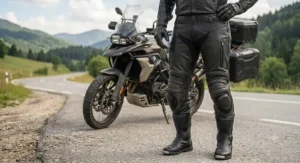
Riding jeans with aramid liners have become popular for their casual look, but comfortable leather touring pants still outperform them in a few specific ways that matter on long trips. Leather’s abrasion resistance in a slide is generally rated higher than reinforced denim at equivalent price points, since cowhide simply has more inherent friction resistance than woven fabric, even with aramid fibers added. On paper, this means leather touring pants require less overall garment thickness to hit the same EN 17092 class, which can translate to a closer, more precise armor fit than a bulkier reinforced jean.
Where riding jeans win is versatility off the bike — nobody wants to wear full leathers into a diner at a rest stop, and jeans solve that instantly. The honest answer is that neither fully replaces the other for serious touring: many experienced long-distance riders keep leather pants for the highway stretches and swap into riding jeans for multi-day trips where they’ll be walking around towns each evening. If you’re choosing just one, though, and covering serious daily mileage, comfortable leather touring pants generally deliver better abrasion protection and a snugger, less-flappy highway fit than fabric alternatives, since garments in this category are measured against the EN 17092 motorcycle clothing standard, which classifies gear by abrasion resistance, seam strength, and impact absorption.
Breathable Leather Motorcycle Pants: What Ventilation Tech Actually Does
Breathable leather motorcycle pants rely on a handful of real engineering approaches, not just marketing language. Perforation — small punched holes across the leather panel — is the most direct method, letting air pass straight through the material, as seen on the Dainese Pony 3 Perforated. Stretch-mesh insert panels, like those in the Alpinestars Track V2’s crotch and thigh zones, achieve a similar effect while adding flexibility. Moisture-wicking liners such as Dainese’s Nanofeel or REV’IT’s mesh linings don’t create airflow themselves but manage sweat once it happens, which matters just as much on a hot touring day as raw airflow does.
The real-world impact shows up on long highway stints: a non-vented leather pant can trap heat against the leg for hours at low speed in stop-and-go traffic, while a perforated or mesh-paneled pant lets that heat escape continuously. What most buyers overlook is that ventilation isn’t free — every added mesh panel or perforation is a spot with theoretically less abrasion resistance than solid leather, which is why manufacturers place vents in lower-risk zones like the inner thigh and calf rather than the outer knee or hip, where impact and slide risk run highest.
Touring Motorcycle Gear: How Pants Fit Into the Bigger Picture
Leather touring pants are one piece of a larger protective system, and understanding how they interact with the rest of your gear improves both safety and comfort. The National Highway Traffic Safety Administration’s motorcycle safety guidance recommends fully covering arms and legs while riding, ideally with leather or heavy denim, noting that this protective layer also helps prevent dehydration on long rides — a reminder that touring pants do double duty as sun and wind protection, not just crash gear. Pairing pants with a jacket that zips together at the waist (as several products above support) closes the single biggest gap in a touring outfit: the point where cold air and road spray sneak in during long highway stretches.
Boots that come up high enough to overlap the pant cuff, gloves matched to the jacket’s cuff style, and a properly fitted helmet round out a touring kit that treats leather pants as one component rather than the whole solution. Riders assembling a full touring wardrobe should budget gear purchases as a system — mismatched components (like short boots under long pants) create gaps that undermine even premium leather pants.
Common Mistakes When Buying Leather Motorcycle Pants for Touring
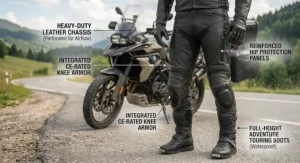
Buying by looks alone tops the list — a lot of riders choose leather pants based on style photos without checking the CE certification class printed on the tag, which is the actual measure of protection. Skipping the try-on-with-boots step is another frequent misstep; leather pants that fit fine over sneakers can bind or ride up when worn with tall touring boots, especially models without an adjustable calf zip. Ignoring armor placement causes real problems too — knee protectors positioned incorrectly out of the box need adjusting before the first ride, not after a fall reveals the gap.
Riders also commonly underestimate break-in time, expecting brand-new leather to feel as supple on day one as it will after a few hundred miles, which leads to premature returns of pants that would have fit great after normal wear-in. Finally, plenty of buyers skip checking whether hip armor is included standard or sold separately — as with the REV’IT! Gear 2 — and end up riding without hip protection for months before realizing the gap.
What to Expect: Real-World Performance on a Full Touring Day
Specs on a page translate into specific feelings once you’re actually riding. A perforated leather pant like the Dainese Pony 3 Perforated genuinely feels noticeably cooler by hour three of a hot-weather ride compared to solid leather — riders consistently describe it as the difference between “warm” and “uncomfortably warm.” Stretch panels at the knee and hip, present on most of the pants above, mean you can shift position in the saddle without the pant fighting back, which matters enormously on rides past the four-hour mark when subtle position changes prevent numbness.
Wind-blocking differences show up hardest at highway speed on cool mornings — solid leather pants like the standard Dainese Pony 3 noticeably outperform perforated or heavily meshed pants here, since open panels that feel great at 35 mph in traffic let a lot of cold air through at 75 mph on the interstate. Chaps perform differently again: riders report solid wind-blocking on the front and sides of the leg but noticeably less protection at the back, since the open-backed design simply doesn’t cover that area.
✨ Don’t Miss These Exclusive Deals!
🔍 Take your touring wardrobe to the next level with these carefully selected leather pants. Click on any highlighted item to check current pricing and availability. The right pair will keep you protected and comfortable on every mile of your next trip!
Long-Term Cost and Maintenance of Leather Touring Pants
Quality leather touring pants represent a genuine long-term investment rather than a disposable purchase, and the total cost of ownership reflects that. A well-maintained pair of full-grain leather pants, conditioned regularly and stored properly, commonly lasts 8-10 years of regular touring use before the leather itself needs replacing — armor inserts, which are the actual safety-critical component, are typically replaceable on their own well before the shell wears out. Chaps, with simpler construction and less structural stress from zippers and stretch panels, can last even longer, though they offer less protection to begin with.
Cost-per-use math favors the pricier options more than it first appears: a $450 pair of leather pants used for 100 touring days over five years works out to $4.50 per day of protection, compared to a $120 pair of chaps at the same usage rate working out to $1.20 per day but with meaningfully less coverage. Maintenance costs stay modest either way — leather conditioner runs $10-15 a bottle and lasts most riders a full season, and a periodic professional re-waterproofing treatment (roughly $30-50) extends the life of any leather garment exposed to regular touring-weather conditions.
Features That Actually Matter (And Those That Don’t)
Armor certification class, zip-together jacket compatibility, and calf-zip adjustability actually matter for touring — these directly affect protection and how the pant performs across a full riding day. Reflective detailing matters more than riders often assume too, since visibility at dawn or dusk on a multi-day tour genuinely reduces risk. What matters less than marketing suggests: cosmetic stitching patterns, matching a specific jacket’s exact styling, and cutting-edge slider systems built for track-day cornering, which add cost without meaningfully benefiting a touring rider who isn’t dragging a knee through corners.
Brand heritage is a mixed bag — it’s a reasonable proxy for build-quality consistency, but it shouldn’t override checking the actual certification tag and trying the pant on with your own boots and riding posture. The spec sheet won’t tell you this, but user reports suggest fit consistency varies more by individual body type than by brand reputation alone, which is exactly why several products above carry recurring sizing notes in aggregated reviews.
Safety, Regulations, and Compliance for Leather Touring Pants
Motorcycle protective clothing sold with CE certification in the leather touring pants category is generally tested against the EN 17092 standard, which a detailed technical breakdown from testing body SATRA describes as covering jackets, trousers, and full suits through a battery of abrasion, seam-strength, and impact tests. That standard sorts gear into classes from AAA (highest protection) down through lighter-duty categories, and understanding which class a given pant carries is more useful than any marketing claim on the box. In the United States, there’s no federal mandate requiring specific motorcycle apparel certification the way there is for DOT-compliant helmets, so the CE marking on European-designed gear remains the most reliable third-party benchmark American touring riders currently have access to.
Beyond certification, practical compliance considerations for touring riders include state-specific requirements (some states have minimum coverage guidance for organized rides or group tours) and manufacturer warranty terms, which often require documented proof of proper care to remain valid on premium leather pants. Riders touring across state lines should also note that visibility requirements for reflective gear vary, making the reflective detailing found on several pants above a practical compliance bonus, not just an aesthetic one.
FAQ
❓ What is the difference between leather motorcycle pants and leather chaps for touring?
❓ Are perforated leather pants safe for touring?
❓ How long does leather motorcycle gear typically last?
❓ Do leather touring pants need a break-in period?
❓ Can I wear leather touring pants in the rain?
Conclusion
Choosing leather motorcycle pants for touring comes down to matching real specs to your actual riding pattern rather than chasing the flashiest option on the shelf. Hot-climate, high-mileage riders get the most out of perforated leather like the Dainese Pony 3 Perforated Pants or airbag-ready sport-touring builds like the Alpinestars Missile V3 Leather Pants. Riders chasing all-weather versatility should look hardest at the REV’IT! Gear 2 Leather Pants, while a do-everything three-season pant like the Dainese Pony 3 Pants covers riders who don’t want two separate wardrobes. Budget-focused cruiser touring is well served by either the Street & Steel Richmond 2 Chaps or the Highway 21 Maverick Chaps, and sport-touring riders watching their spending should take a close look at the Alpinestars Track V2 Leather Pants.
Whichever pair you land on, prioritize the certification tag over the styling photos, try the pants on with the boots you’ll actually tour in, and budget time for a proper break-in before a big trip. Leather that fits right and breathes when it needs to disappears on a long ride — and that’s exactly the goal.
Recommended for You
- Motorcycle Racing Suit Leather: 7 Best CE-Certified Picks (2026)
- Motorcycle Knee Guards: 7 Best CE Level 2 Picks – 2026
- Motorcycle Shoulder Armor: 7 Best CE Picks for 2026 (Don’t Skip This)
Disclaimer: This article contains affiliate links. As an Amazon Associate, I earn from qualifying purchases. If you purchase products through these links, we may earn a small commission at no additional cost to you.
✨ Found this helpful? Share it with your friends! 💬🤗
