
In This Article
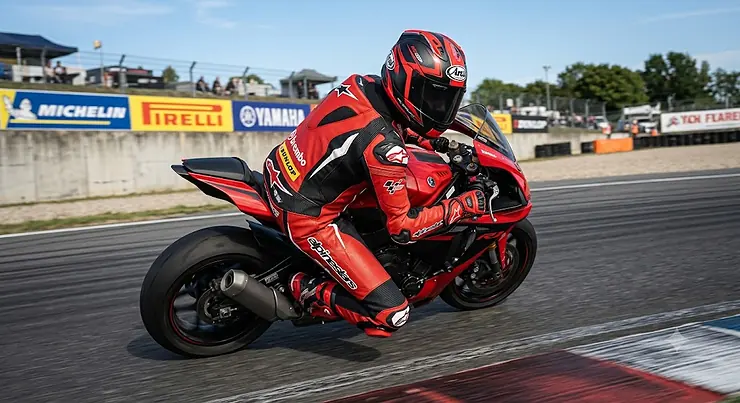
Sliding into your first motorcycle racing suit leather feels a little like putting on armor before a duel — stiff at first, then suddenly you understand why racers swear by it. A motorcycle racing suit leather is a one-piece or two-piece CE-certified garment made from cowhide or kangaroo leather, built with impact armor and abrasion-resistant panels to protect a rider’s full body during high-speed track riding or racing. That’s the textbook definition. The reality is messier and more interesting: fit, ventilation, armor placement, and airbag compatibility all pull against each other, and the “best” suit is really the one that matches your body, your budget, and how hard you actually push on track day.
This guide breaks down seven real, currently available suits — from budget-friendly one-piece options under $700 to premium airbag-equipped race leathers pushing past $2,500 — with honest analysis of what the spec sheets mean once you’re tucked in behind the windscreen at 130 mph. We’ll also dig into how CE certification for motorcycle clothing actually works, because “CE certified” gets slapped on marketing copy far more often than riders understand what it means. Whether you’re outfitting your first track day or replacing leathers that finally earned their road rash, you’ll walk away knowing exactly what to look for and why.
Quick Comparison Table
| Suit | Style | Best For | Price Range |
|---|---|---|---|
| Alpinestars Missile V2 | One-piece | Tech-Air airbag riders | $1,000-$1,300 range |
| Dainese Misano 3 Perforated D-Air | One-piece | Built-in airbag, premium track | Around $2,900 |
| RS Taichi GP-WRX R305 | One-piece | Best value race-quality leather | $1,500-$1,700 range |
| Spidi Track Wind Pro | One-piece | Hot-weather track days | $1,400-$1,700 range |
| REV’IT Quantum 2 | One-piece | Mid-tier AAA style and safety | $1,100-$1,300 range |
| Cortech Latigo 2.0 RR | One-piece | Budget first track suit | Under $650 |
| Joe Rocket Speedmaster 7.0 | Two-piece | Modular street-and-track use | $600-$700 range |
Looking at the spread above, the gap between the Cortech Latigo 2.0 RR and the Dainese Misano 3 Perforated D-Air isn’t just price — it’s the difference between foam padding and an electronically triggered airbag system. The RS Taichi GP-WRX R305 sits in a genuine sweet spot, delivering race-grade leather without the four-figure premium of the Italian flagships. Meanwhile, the Joe Rocket Speedmaster 7.0 proves that a two-piece suit can still be track-day legal if the zipper connection is built right, which matters a lot if you also commute on the same bike.
💬 Which suit matches your budget and riding style? Scroll down for the full breakdown below!😊
Top 7 Motorcycle Racing Suit Leather Options: Expert Analysis
1. Alpinestars Missile V2 — Tech-Air 5/10 airbag ready
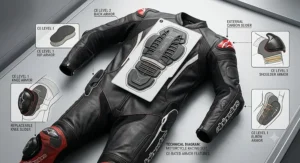
The standout here is simple: this is one of the most widely adopted Tech-Air-compatible suits on the market right now, and that compatibility alone changes the calculus for a lot of buyers. Constructed from 1.3mm genuine bovine leather, the Missile V2 is built for durability and abrasion resistance, and it ships with GP Lite CE Level 1 shoulder, elbow, and knee armor along with Bio-Flex hip armor. In practice, that armor spec means the suit meets the baseline for track-day admission at most organizations, but riders chasing maximum protection will still want to add the Tech-Air vest for airbag deployment. Based on the spec comparison against its siblings in the Alpinestars lineup, the Missile V2 is positioned as the accessible entry point into Tech-Air compatibility rather than the flagship — that’s exactly who it’s for: track-day riders and club racers who want airbag-readiness without paying GP-Pro pricing. Reviewers consistently note that the suit’s perforated leather and vented race hump help riders stay cool and focused through sessions, and sizing guides commonly flag that the fit is intentionally snug and shaped for an aggressive riding stance, so anyone between sizes typically sizes up rather than down.
Pros:
- ✅ Genuine Tech-Air 5 and Tech-Air 10 compatibility built in
- ✅ CE-certified GP Lite armor at shoulders, elbows, and knees
- ✅ Perforated panels keep hot-weather sessions bearable
Cons:
- ❌ Aggressive race fit runs snug for taller or broader riders
- ❌ Full airbag protection requires buying the Tech-Air vest separately
At around $1,000-$1,300 for the suit alone (before the airbag vest), the Missile V2 earns its price as a long-term platform you can build on rather than a suit you’ll outgrow after one season.
2. Dainese Misano 3 Perforated D-Air — built-in airbag system
What immediately sets this suit apart is that the airbag isn’t an add-on — it’s stitched into the architecture from day one. Constructed of high-quality D-Skin 2.0 full-grain cowhide, the Misano 3 is designed to offer maximum performance and safety on the track, and it comes equipped with a pentaxial elasticity system alongside the revolutionary triple-activation D-air Racing airbag. What most buyers overlook about this suit is the recharge system: the D-air Racing Shield 3X system provides reliable protection and can be easily recharged after deployment, which matters enormously for anyone racing a full season, since a single-use airbag that needs full replacement after every crash becomes a hidden ongoing cost. The Replaceable Slider System allows knee and elbow sliders to be swapped out without removing the base plate, which is a genuinely practical touch — track-day crashes chew through sliders far faster than leather, and not having to re-stitch a slider mount saves both time and money. This is squarely a suit for serious track riders and racers who’ve already decided airbag protection is non-negotiable and are willing to pay Italian-flagship pricing for it.
Pros:
- ✅ Airbag system fully integrated, not bolted on as an accessory
- ✅ Recharge-and-reuse gas cartridge system after deployment
- ✅ Replaceable slider system saves cost on crash repairs
Cons:
- ❌ Premium pricing puts it out of reach for casual track days
- ❌ Cannot be sold or shipped in certain US states due to airbag regulations
At around $2,900, this is a specialist’s investment — the right call for a dedicated racer, overkill for someone doing four track days a year.
3. RS Taichi GP-WRX R305 — best value race-quality leather
The standout advantage of the R305 is that it delivers genuine race-quality leather at a price point that undercuts most European flagships by hundreds of dollars. Based on the spec sheet, the suit uses race quality full grain leather with perforated flex panels on the waist, knees, elbows, and back shoulder, paired with CE protectors at the shoulder, elbow, and knee. Here’s what to weigh: the suit ships with just a foam pad in the back, so riders will need a proper back protector for full protection — that’s a detail easy to miss when comparing sticker prices, and it effectively adds $150-$250 to the real cost of getting track-ready. RS Taichi’s suits are also built to Japan’s own strict standard; each suit meets or exceeds the Motorcycle Federation of Japan standard, which is a genuinely rigorous benchmark that doesn’t get enough attention in the US market. What most buyers overlook is the T-AIR shoulder slider design, which lets the shoulder rotate and slide during a crash instead of catching and causing the rider to tumble — a subtle engineering choice that matters far more than it sounds on paper.
Pros:
- ✅ Race quality full-grain leather at a mid-tier price point
- ✅ Meets the rigorous Motorcycle Federation of Japan standard
- ✅ T-AIR shoulder sliders reduce tumbling risk in a crash
Cons:
- ❌ Back protector sold separately, adding to the real total cost
- ❌ US sizing runs on Japanese and European charts, so fitting takes extra care
Priced in the $1,500-$1,700 range, the R305 rewards buyers willing to do a little homework on sizing with genuinely excellent leather for the money.
4. Spidi Track Wind Pro — MotoGP-proven perforated build
What jumps out about the Track Wind Pro is its pedigree: this is leather refined through actual MotoGP and World Superbike paddock feedback rather than marketing copy. Built from 1.2/1.3mm cowhide with stretch materials, neoprene inserts, and Multitech, Biomechanic, and Forcetech protectors, the suit translates paddock-level engineering into something a track-day rider can actually buy. In practice, that spec sheet means the suit flexes with your body through hard lean angles instead of fighting you — accordion stretch gussets do a lot of unglamorous work here. Reviewers and retailers alike note the suit’s removable inner mesh lining, which enhances breathability and simplifies washing after a sweaty session, a small feature that matters enormously after your third consecutive track day in August heat. On paper, the armor checks every box: Biomechanic shoulder and elbow protectors plus Force-Tech elbow, hip, and knee protectors are all EN 1621-1:2012 certified, giving this suit a genuinely complete internal armor package rather than relying heavily on optional add-ons. This is the suit for riders who do most of their track time in warm climates and refuse to sacrifice safety for airflow.
Pros:
- ✅ MotoGP and WSBK-tested perforation and stretch panel design
- ✅ Full EN 1621-1:2012 certified armor at every major joint
- ✅ Removable mesh lining simplifies washing and airflow
Cons:
- ❌ Heavier lean-angle break-in period than some competitors
- ❌ Back protector arrangement still requires a separate purchase
In the $1,400-$1,700 range, the Track Wind Pro earns its keep for hot-climate trackday regulars who log serious mileage every season.
5. REV’IT Quantum 2 — mid-tier AAA-rated style and safety
The Quantum 2’s standout is hitting the top CE classification while still undercutting the true flagship suits on price. The suit uses Monaco performance cowhide leather and is prEN 17092 certified to Class AA, with some configurations reaching AAA depending on the exact build — the highest tier currently available under the standard. Here’s what the spec sheet won’t tell you outright, but reviewers note: the suit carries a full suite of Betac armor at the knees, shoulders, and elbows, with SEESMART protectors in the hips, plus internal pockets for optional SEESOFT chest and back protectors — a rare feature that lets riders scale up protection over time instead of buying a whole new suit. Based on the spec comparison against its siblings, the Quantum 2 is REV’IT’s mid-tier offering, positioned between the entry-level Triton and the range-topping Hyperspeed. Reviewers point out that the jacket has been certified to survive abrasion test speeds of at least 120 km/h in class 1 abrasion zones, a genuinely reassuring number for anyone who rides fast enough to worry about it. This is the suit for riders who want race-day style with room to add protection later without replacing the whole garment.
Pros:
- ✅ Certified up to AAA classification depending on configuration
- ✅ Modular pockets allow adding back and chest armor later
- ✅ Aluminum-backed sliders reduce tumbling risk in a fall
Cons:
- ❌ Base configuration ships with only CE Level 1 armor as standard
- ❌ Bold graphic styling won’t suit riders who prefer a plain look
Around $1,100-$1,300, the Quantum 2 is a smart middle path for riders outgrowing entry-level gear but not ready for four-figure Italian flagships.
6. Cortech Latigo 2.0 RR — budget-friendly first track suit
The Latigo 2.0 RR’s whole appeal is proving that a genuinely track-legal suit doesn’t have to break $1,000. Constructed of perforated and non-perforated top grain drum-dyed leather at 1.2-1.4mm, with an aerodynamic speed hump for ventilation and CE-approved shoulder, elbow, and knee protectors, this suit checks every mandatory box that most track organizations require for tech inspection. What most buyers overlook is the stitching quality relative to price: the suit uses double- and even triple-bonded nylon stitching at the important seams, which is exactly the detail that matters when you’re sliding down asphalt, and it’s not something entry-level suits always get right. On paper, the fit philosophy is different from the European brands too — the suit uses a more generous, American-style cut that offers comfort on and off the bike compared to snugger European suits. That’s a real trade-off: less aggressive tuck on the bike, but noticeably more livable in the paddock between sessions. Reviewers frequently describe it as a solid choice for a first track day, pairing well with rental leathers-grade expectations at a fraction of the cost.
Pros:
- ✅ CE-approved armor at a genuinely entry-level price
- ✅ Triple-stitched seams at high-stress crash zones
- ✅ Roomier American cut is comfortable off the bike too
Cons:
- ❌ Less aggressive tuck than race-fit European competitors
- ❌ Leather gauge is thinner than premium 1.3mm+ race suits
At under $650, this is the suit that gets first-timers onto the track without gatekeeping them by price.
7. Joe Rocket Speedmaster 7.0 Two-Piece — modular street-and-track option
The Speedmaster 7.0’s defining feature is the zip-together design that turns two separate garments into one track-legal suit when you need it. A 360-degree heavy-duty YKK Vision zipper connects the jacket and pants, with C.E.-rated protectors at the shoulders, knees, and elbows and removable spine armor. What that zipper spec means in practice is real versatility: wear the jacket alone commuting, zip in the pants for track day, and avoid owning two entirely separate wardrobes of gear. Built from 1.4 to 1.7mm top-grain cowhide with perforated sections at the chest, groin, and lower back for high-heat ventilation, the leather gauge here is actually thicker than several one-piece suits on this list, trading some flexibility for extra abrasion margin. Here’s what to weigh: two-piece suits inherently have a seam around the waist that a one-piece doesn’t, and while the wraparound zipper design is engineered to meet track-day tech inspection standards, purists still point to the one-piece as the gold standard for sustained high-lean racing. This is the suit for someone who rides to the track on the same bike they race, and doesn’t want to change in a parking lot twice.
Pros:
- ✅ Full 360-degree zipper makes it genuinely track-day legal
- ✅ Thicker 1.4-1.7mm cowhide adds abrasion margin
- ✅ Jacket and pants can be worn separately for commuting
Cons:
- ❌ Waist zipper seam is a structural compromise vs. true one-piece suits
- ❌ Non-perforated sections limit airflow compared to full-perf suits
At roughly $600-$700, the Speedmaster 7.0 remains one of the most practical two-piece values for riders splitting time between street and track.
Practical Usage Guide: Setting Up Your Track Day Suit Motorcycle Right
Getting a new track day suit motorcycle-ready takes more than just pulling it out of the box. First, break it in properly: leather typically stretches 3-5% within the first few wears, so a suit that feels aggressively snug on day one should loosen slightly with use — don’t panic and size up prematurely. Second, always try the suit on wearing your full kit: base layer, back protector, boots, and gloves all change how the suit fits in motion, and skipping this step is the single most common fitting mistake new track riders make.
Third, if you’re running an airbag system, confirm compatibility before you buy rather than after. Suits built for Tech-Air or D-air need internal routing channels and connector points; retrofitting an airbag into a suit that wasn’t designed for one rarely works cleanly. Fourth, inspect zippers, sliders, and stitching after every session — track crashes and even hard tucks put real stress on hardware, and catching a loose slider mount before your next session beats discovering it mid-slide. Finally, store your leathers hung up, not folded, in a cool dry space; folded leather creases at stress points and those creases become the first place the material fails under load.
💬 Ready to gear up properly? Compare full CE-certified suit specs before your next track day!😊
Real-World Scenarios: Which Race Suit Fits Your Riding Life
If you’re a college student doing your first two track days a season on a borrowed 600cc bike, the Cortech Latigo 2.0 RR makes the most sense — CE-approved protection without committing serious money to a hobby you’re still testing out. If you’re a weekend club racer logging fifteen-plus track days a year and slowly working toward your first amateur license, the RS Taichi GP-WRX R305 or REV’IT Quantum 2 hit the value-to-performance ratio that makes sense at that mileage, especially once you factor in a separate back protector purchase either way.
If you’re commuting on your sportbike during the week and racing it on weekends, the Joe Rocket Speedmaster 7.0 solves a real logistics problem — you’re not stuck owning a one-piece suit that only makes sense at the track. And if you’ve already crashed once in lesser gear and decided protection is worth paying for, the Alpinestars Missile V2 or Dainese Misano 3 Perforated D-Air represent the airbag-equipped tier that dedicated racers and safety-conscious enthusiasts gravitate toward once budget stops being the deciding factor.
Buyer’s Decision Framework
If your priority is airbag protection above everything else, choose the Dainese Misano 3 Perforated D-Air or Alpinestars Missile V2, because both offer genuine Tech-Air or D-air integration rather than a suit that’s merely “compatible” in name only. If your priority is stretching a limited budget as far as it goes, choose the Cortech Latigo 2.0 RR, because it clears CE certification requirements at the lowest real-world price on this list. If your priority is a race suit with back hump aerodynamics and hydration compatibility for endurance track days, choose the Spidi Track Wind Pro or Dainese Misano 3, since both suits build hydration bladder routing directly into the hump rather than treating it as an afterthought.
If sizing and a kangaroo pocket race suit fit matter to you specifically — some riders prefer kangaroo leather’s lighter weight and tighter grain for a closer, less bulky fit — note that most suits on this list, including the RS Taichi and Spidi options, are built from cowhide rather than kangaroo leather; true kangaroo-leather race suits exist mostly in premium custom and MotoGP-spec builds, so budget accordingly if that specific material is non-negotiable for you. And if you split time between street and track, choose the Joe Rocket Speedmaster 7.0, because the two-piece design solves the real-world problem one-piece suits create for daily riders.
How to Choose a Motorcycle Racing Suit Leather
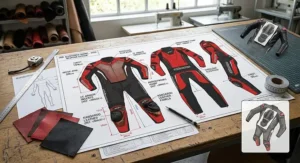
Choosing the right suit comes down to seven concrete criteria, each worth weighing on its own merits:
- CE certification class — confirm the suit is rated AA or AAA under EN 17092 rather than the lower A or B classes, since track organizations typically require the higher tiers for tech inspection.
- Leather thickness and type — 1.2mm to 1.7mm cowhide is standard; thicker leather adds abrasion resistance but reduces flexibility, so match the gauge to how aggressively you actually ride.
- Armor coverage — check whether shoulder, elbow, knee, and hip armor is included standard, and whether a back protector is bundled or sold separately, since that’s a frequently hidden cost.
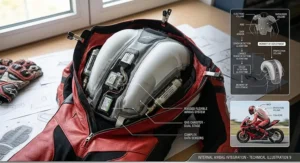
- Airbag compatibility — decide early if you want Tech-Air, D-air, or another airbag system, since retrofitting a non-compatible suit rarely works well.
- Perforation level — hot-climate riders benefit enormously from perforated leather, while cooler-climate riders may prioritize non-perforated durability instead.
- One-piece vs. two-piece construction — one-piece suits offer marginally better protection at the waist seam, while two-piece suits offer everyday versatility.
- Fit and sizing chart — European, Japanese, and American cuts differ meaningfully, so always cross-reference the manufacturer’s specific chart rather than assuming your usual jacket size applies.
A cross-sectional study following 212 crashed motorcyclists found riders were significantly less likely to be hospitalized when wearing motorcycle jackets and pants, which is a useful reminder that CE certification isn’t just a marketing checkbox — it’s tied to measurably better outcomes when things go wrong.
One-Piece vs Two-Piece Suit: The Real Safety Gap
The one-piece vs two-piece suit safety gap is smaller than race-day purists sometimes claim, but it’s not zero. A true one-piece suit has no seam around the waist, meaning there’s no structural joint that could theoretically separate or gap open during a high-speed slide. Two-piece suits close that gap with a heavy-duty zipper connection — the Joe Rocket Speedmaster 7.0, for instance, uses a 360-degree heavy-duty YKK Vision zipper specifically engineered to meet track-day tech inspection standards — but a zipper is still a mechanical connection point rather than continuous stitched leather.
In practice, for club-level track days and most amateur racing, a well-built two-piece suit with a proper wraparound zipper passes tech inspection at the vast majority of tracks and organizations. The gap becomes more relevant at the professional racing level, where the EN 17092 standard’s highest AAA classification is built around minimizing exactly this kind of structural weak point, and where sanctioning bodies increasingly mandate true one-piece construction for licensed competition. For everyday track-day riders, the practical trade-off is really about convenience versus that last few percentage points of structural certainty — both are legitimate choices depending on how you actually use the suit.
Perforated vs Textile Race Suits: What Actually Keeps You Cool and Safe
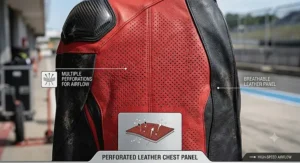
A perforated race suit motorcycle design punches small holes through the leather in non-structural zones to let air pass through while preserving abrasion resistance where it matters most — the Spidi Track Wind Pro and Cortech Latigo 2.0 RR both use this approach, localizing perforation away from seams so ventilation doesn’t come at the cost of durability. A textile race suit motorcycle option, by contrast, swaps leather for high-denier woven fabrics like Cordura or similar synthetics, trading some abrasion resistance for lighter weight, better inherent breathability, and often lower cost.
Here’s the honest trade-off: leather still outperforms textile in raw abrasion resistance at race-track speeds, which is exactly why virtually every professional racing suit on the grid remains leather rather than textile. Textile race suits exist mostly in the touring and sport-touring space rather than true racing, since most sanctioning bodies and track-day organizations require leather or leather-equivalent construction for competitive and high-speed track sessions. If you’re deciding between the two purely for track use, leather remains the safer and more widely accepted choice; textile only makes sense if you’re doing slower-paced sport-touring rather than genuine racing or aggressive track days.
Full Coverage Motorcycle Suit Features That Actually Matter
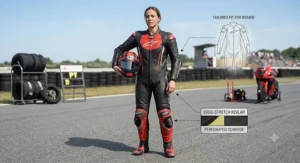
A genuinely full coverage motorcycle suit needs a few specific features, not just a head-to-ankle silhouette. First, a race suit with back hump matters more than most riders realize before their first session — the hump isn’t just aerodynamic styling, it houses back protector arrangements and often hydration bladder routing, and suits like the Dainese Misano 3 pair their hump with a Veloce Racing Neck system for reduced neck and throat pressure in a tucked position. Second, accordion stretch gussets at the shoulders, elbows, and knees matter enormously for full range of motion; without them, a “full coverage” suit can actually restrict the exact movements you need to control the bike through a corner.
Third, check whether the suit includes a kangaroo pocket race suit-style stash pocket — a small internal pocket, typically at the chest or lower back, meant for a transponder, key, or paddock pass rather than anything bulky. It’s a minor feature but a genuinely useful one on race weekends when you don’t want loose items rattling around inside your leathers. Features that don’t actually matter as much as marketing suggests: cosmetic perforation patterns purely for looks, oversized branding, and “premium” zipper pulls that add nothing functional. Filter for armor certification, seam construction, and stretch panel placement first; everything else is secondary.
Long-Term Cost & Maintenance: Building a Complete Leathers Set
A motorcycle leathers complete set extends well beyond the suit itself — race boots, gauntlet gloves, and a back protector (if not included) typically add $400-$800 on top of the suit price, and skipping any of these pieces undermines the protection the suit itself provides. Budget for re-waxing or conditioning leather every season if you ride in varied weather, since dried-out leather becomes noticeably less supple and more prone to cracking at stress points over time.
Sliders wear out faster than most riders expect — plan on replacing knee and elbow sliders after any hard tuck or minor get-off, even if the leather itself looks fine. Research on the injury-reduction benefits of protective clothing has found that a substantial share of motorcycle-specific gear shows signs of material failure after a genuine crash impact, which is a strong argument for inspecting your suit thoroughly — not just cosmetically — after any incident, rather than assuming it’s still track-ready because it looks intact. Total cost of ownership over a multi-season suit, including armor upgrades, slider replacements, and boots and gloves, often ends up rivaling the price of the suit itself — budget for the whole kit, not just the headline number.
Safety, Regulations, and CE Certified Racing Suit Compliance
Every CE certified racing suit sold for on-road or track use in Europe must comply with EU Regulation 2016/425 as Personal Protective Equipment, and as of April 2018, all motorcycle clothing sold needed proof that it’s genuinely protective under this regulation. The current benchmark is the EN 17092 standard, and it splits garments into five performance classes — AAA, AA, A, B, and C — reflecting intended use and protection level. For genuine racing and aggressive track-day use, look specifically for AAA or AA classification; A-class and below are built more for casual leisure riding than sustained high-speed abrasion scenarios.
In the US, there’s no federal mandate requiring CE certification for motorcycle apparel the way there is for helmets under FMVSS 218, which makes CE labeling a voluntary but meaningful signal of quality rather than a legal requirement. Most US track-day organizations and racing sanctioning bodies still require CE-rated armor and, in many cases, full leather one-piece or approved two-piece suits for tech inspection, so check your specific organization’s rulebook before assuming any CE-labeled suit automatically qualifies.
Common Mistakes When Buying a Leather Race Suit
The most common mistake is buying by street jacket size instead of the manufacturer’s specific race-fit chart — race suits run intentionally snug and sized differently from casual riding jackets, and guessing based on your usual size routinely leads to a suit that’s uncomfortably tight or, worse, one that’s returned and re-ordered, wasting weeks before a track season starts. The second mistake is assuming “CE certified” alone guarantees top-tier protection; always check the specific class (AAA, AA, or A) rather than trusting the label at face value.
Third, riders frequently forget that race suit sizing airbag compatible builds need extra room to accommodate the inflated volume of an airbag vest underneath — a suit sized perfectly for the leather alone can end up dangerously restrictive once an airbag system is layered underneath it, and stretch gussets built specifically for airbag inflation, like those on the Alpinestars Missile V2, exist precisely to solve this problem. Fourth, buyers often skip the back protector line item entirely, not realizing several suits on this list ship with only foam padding rather than certified armor. Finally, don’t ignore return policies — leather doesn’t always photograph accurately for fit and color, and a flexible return window matters enormously when ordering race leathers online.
✨ Don’t Miss These Exclusive Deals!
🔍 Take your track day kit to the next level with these carefully selected leather race suits. Click on any highlighted item to check current pricing and availability. The right suit gets you back on the grid with real confidence.
FAQ
❓ What's the difference between a leather race suit and a leather jacket?
❓ Do I need a back protector with a leather race suit?
❓ Is a two-piece suit legal for track days?
❓ How much does a CE certified racing suit typically cost?
❓ Can I wear an airbag vest under any race suit?
Conclusion
Choosing a motorcycle racing suit leather really comes down to being honest about how you actually ride. A rider doing two casual track days a year doesn’t need the same suit as someone chasing an amateur racing license, and pretending otherwise just wastes money in one direction or under-protects in the other. The Cortech Latigo 2.0 RR and Joe Rocket Speedmaster 7.0 prove that genuine CE-certified protection doesn’t require four-figure spending, while the Alpinestars Missile V2 and Dainese Misano 3 Perforated D-Air show what’s possible once airbag integration becomes the priority.
Whatever you choose, treat the suit as one piece of a complete system — back protector, boots, gloves, and proper fit all matter as much as the leather itself. Research following crash-injured riders has found that protective motorcycle clothing was specifically protective against soft-tissue injuries, and a suit that fits right, certified to the class your riding actually demands, is the single best investment you can make before your next session on track.
Affiliate Disclosure: This article contains affiliate links. As an Amazon Associate, I earn from qualifying purchases. If you purchase products through these links, we may earn a small commission at no additional cost to you.
Recommended for You
- Motorcycle Knee Guards: 7 Best CE Level 2 Picks – 2026
- Motorcycle Shoulder Armor: 7 Best CE Picks for 2026 (Don’t Skip This)
- Motorcycle Back Protector: 7 Best CE Level 2 Picks for 2026
✨ Found this helpful? Share it with your friends! 💬🤗
