
In This Article
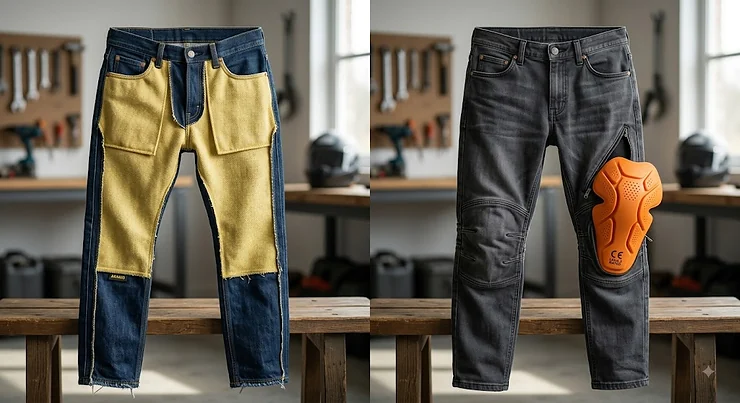
Here’s a confession most gear reviewers won’t make: the first time I dug into kevlar lined jeans vs armored jeans, I assumed the terms were basically interchangeable marketing fluff. They’re not. One describes a material — aramid fiber woven or stitched into the fabric. The other describes a system — CE-rated foam or D3O plates sitting in pockets at your knees and hips. Most of the best motorcycle jeans on the market actually combine both, but understanding where they diverge changes how you shop.
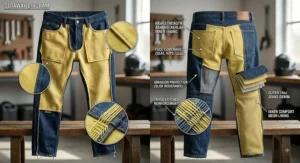
If you’ve ever squinted at a product listing wondering whether “reinforced denim” means you’re safe to lane-split at 45 mph or just safe from a sidewalk stumble, you’re not alone. This guide breaks down kevlar reinforced denim, armored riding jeans, and everything in between — using real products, real specs, and honest analysis instead of recycled marketing copy. We’ll also cover denim abrasion resistance, hidden armor pockets, and how casual motorcycle jeans protection actually stacks up against dedicated track gear, so you can pick jeans that match how you actually ride.
What Is the Difference Between Kevlar Lined Jeans and Armored Jeans?
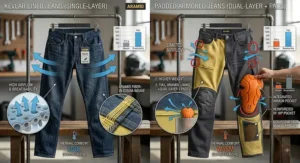
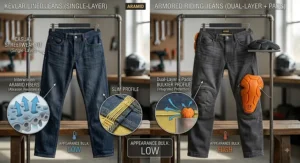
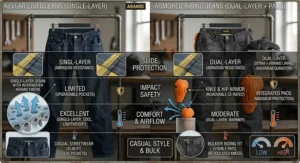
Kevlar lined jeans use aramid fiber (Kevlar, Twaron, or similar) woven into or laminated behind the denim to resist abrasion during a slide. Armored jeans add rigid or semi-rigid CE-certified pads at the knees and hips to absorb blunt-force impact. The strongest riding jeans do both — abrasion-resistant fabric plus removable armor — rather than picking one over the other, which lines up with NHTSA’s own guidance that riders cover arms and legs with heavy denim or leather as a baseline protective measure.
Quick Comparison Table
| Feature | Kevlar-Lined (Abrasion Focus) | Fully Armored (Impact Focus) | Best For |
|---|---|---|---|
| Primary job | Slows/stops road-rash during a slide | Absorbs blunt impact at joints | Combo of both ideally |
| Typical certification | EN 17092 Class A/AA (fabric only) | EN 1621-1/2 (armor inserts) | Look for both labels together |
| Comfort off the bike | Very close to normal denim | Slightly bulkier at knees | Daily commuters lean lighter armor |
| Price range | Around $60-$150 | Around $80-$300 | Budget-to-premium spread |
The table above makes something clear: these aren’t competing categories, they’re complementary layers of the same jacket-and-jeans philosophy. Milwaukee Leather MDM5000 and similar budget options lean on aramid thread for abrasion resistance with lighter armor, while Klim K Fifty 2 and Alpinestars Copper 2 stack heavier-duty Cordura denim with adjustable D3O or Bio Flex plates. If you’re commuting under 40 mph through city traffic, the abrasion side of the equation probably matters more than max-impact armor; if you’re doing highway miles, you want both working together.
💬 Already got a favorite in mind? Scroll down to compare it against our full lineup below.
Top 7 Kevlar and Armored Riding Jeans: Expert Analysis
1. Milwaukee Leather MDM5000 City Limit — best budget armored jeans for daily commuting
The Milwaukee Leather MDM5000 is the pair I’d point a first-time rider toward, mostly because it doesn’t ask you to sacrifice your grocery-run wardrobe for safety gear. Built from 14.5oz premium cotton denim reinforced with Kevlar aramid fiber thread in high-impact zones, it splits the difference between “looks like jeans” and “behaves like PPE” better than most sub-$100 options. In practice, that 14.5oz weight means the denim has enough body to resist a quick scuff at a stoplight tip-over without feeling like you’re wearing canvas overalls to brunch.
Specs-wise, the standout is that the armor is CE-approved and certified to EN1621-1 and EN1621-2 standards, positioned at both knees, which is the single most common impact point in a low-side crash. What most buyers overlook here is that the armor is removable — meaning you can wash the jeans without babying a hard plastic insert, a small detail that matters when you’re wearing them five days a week. Based on the spec comparison, this is squarely a “beginner or budget-conscious commuter” pick rather than a highway-mile tourer; the aramid thread is woven into panels rather than a full liner, so it’s optimized for scuffs, not extended slides.
Aggregated buyer sentiment on Amazon consistently praises the jean-like everyday fit and the YKK zipper durability, while a recurring theme in reviews is that sizing runs slightly generous through the waist — sizing down is a common suggestion.
Pros:
- ✅ Genuinely passes as normal denim off the bike
- ✅ CE Level 2 armor certified to EN1621-1/2
- ✅ Removable armor makes washing simple
Cons:
- ❌ Aramid coverage is zonal, not a full liner
- ❌ Sizing runs generous — order carefully
At around $70-$100, the Milwaukee Leather MDM5000 delivers strong value for anyone who wants visible, certified protection without committing to a $250 jean.
2. Milwaukee Leather MPM5592 Camo — most distinctive style for cruiser riders
If the classic blue-jean look isn’t your thing, the Milwaukee Leather MPM5592 swaps denim-blue for a camo colorway while keeping the same protective bones. It’s constructed from a rugged 14.5oz premium cotton denim outer shell (90%) reinforced with 10% genuine DuPont Kevlar aramid fiber thread in high-impact areas, which in real terms means the fiber ratio is intentionally light — enough to slow a slide without turning the jeans stiff and sauna-hot in July traffic.
The practical upside of that 90/10 blend is breathability; riders doing errands or short commutes in warm climates won’t feel like they’re wearing a wetsuit. What the spec sheet won’t tell you, but reviewers note, is that the camo pattern hides road grime and light scuffing far better than a plain wash, which matters if these are pulling double duty as work pants around a garage or shop. This one is a strong pick for cruiser and casual bike owners who want personality without giving up the 5-pocket layout and armor points that make it street-legal PPE.
Real customer feedback for this line skews positive on comfort and fit through the hip, with occasional notes that the camo print runs slightly bolder in person than in product photos — worth checking a size chart and a couple of customer photos before ordering.
Pros:
- ✅ Distinctive camo styling stands out from typical denim
- ✅ Lightweight 90/10 blend stays breathable in heat
- ✅ Classic 5-pocket layout for everyday carry
Cons:
- ❌ Lighter Kevlar ratio than heavier-duty options
- ❌ Print saturation varies from photos, per buyer notes
Priced in the same $70-$100 range as its City Limit sibling, this is a stylistic alternative more than a protection upgrade — pick it for the look, not for extra slide resistance.
3. ILM BJN01 Motorcycle Dirt Bike Jeans — best flexibility for mixed street and off-road use
The ILM BJN01 takes a slightly different construction path: instead of leaning entirely on aramid for abrasion resistance, it uses a 10.5oz stretch denim cloth made of 98% cotton and 2% spandex, with additional Kevlar lining specifically in the buttocks area to make the jeans wear- and scratch-resistant. That’s a deliberate trade-off — you get genuine stretch and mobility for standing on pegs or throwing a leg over a dual-sport, at the cost of less blanket aramid coverage than a dedicated street jean.
Where this pair earns its spot on the list is versatility: the detachable CE-armored knee pads and hip padding can be removed entirely so the jeans can be worn casually, and the elasticated knee and waist panels genuinely help on a dirt bike or ADV machine where you’re constantly shifting position. Based on the spec comparison, this is the pick for riders who split time between pavement commuting and light off-road trails, not someone chasing maximum highway-speed slide protection.
Because ILM is a newer entrant compared to legacy motorcycle brands, the review pool is smaller than established names — a pattern worth factoring in if you weight purchase decisions heavily on review volume.
Pros:
- ✅ Genuine 2% spandex stretch for off-road mobility
- ✅ Fully removable armor for casual daily wear
- ✅ Elasticated knee panels aid dirt-bike positioning
Cons:
- ❌ Kevlar lining concentrated in buttocks area only
- ❌ Smaller review history than legacy brands
At a budget-friendly $50-$80, the ILM BJN01 is the value pick for anyone whose riding isn’t strictly street-only.
4. WICKED STOCK Riding Pants with CE Level 2 Armor — most complete aramid lining in this lineup
Most motorcycle kevlar jeans only reinforce the seat, hips, and knees. The WICKED STOCK pair breaks that pattern with a 100% interlock-knit aramid lining running throughout the entire garment rather than in isolated panels. In practice, that full-coverage approach matters most in unpredictable low-sides, where a slide doesn’t always land exactly where a manufacturer expected to place a reinforcement patch.
This is where hidden armor pockets genuinely earn their name — the CE Level 2 knee and hip inserts sit in fully concealed internal sleeves, so from the outside these read as plain dark denim with zero tactical or “motorcycle gear” visual cues. Honestly, that’s the whole appeal: riders who commute into offices or don’t want to broadcast “I ride a motorcycle” through their pants get full PPE without the look. Based on the spec comparison, the trade-off for full-lining coverage is a touch less breathability than zonal-Kevlar jeans, so hot-climate summer commuters should weigh that against the extra slide protection.
Aggregated review sentiment highlights the sleeper aesthetic and complete lining as the top draws, with a recurring note that the cut runs closer to athletic/tapered than a traditional relaxed jean — worth checking the size guide against your usual denim fit.
Pros:
- ✅ Full aramid lining, not just knee/hip panels
- ✅ Hidden armor pockets keep the look civilian
- ✅ CE Level 2 armor at both knees and hips
Cons:
- ❌ Less breathable than zonal-Kevlar alternatives
- ❌ Tapered cut runs narrower than classic denim
In the $80-$120 range, this is the strongest pick specifically for riders prioritizing casual motorcycle jeans protection that doesn’t look like gear.
5. EndoGear San Marino Noir Kevlar Cargo — best cargo-style utility with CE certification
The EndoGear San Marino Noir swaps the classic 5-pocket cut for a cargo silhouette, which immediately changes who this jean is for: riders who use their bike for errands, work, or touring and want actual usable pocket real estate beyond a phone-sized front slit. EndoGear employs Kevlar throughout its motorcycle protective gear, and this cargo pair carries a Class AA CE certification alongside knee and hip armor points.
What most buyers overlook about cargo-cut riding jeans is airflow — the looser cargo fit generally breathes better than a slim straight-leg jean, which is a genuine advantage on longer rides in warm weather, though it does mean slightly less contact area between fabric and skin during a slide compared to a snug-fitting pair. Reviewers consistently note the jeans shrug off mud stains and light rain reasonably well for daily use, and the pocket count is a repeated point of praise for anyone carrying tools, a wallet, and a phone without a backpack. This is a strong match for the “casual motorcycle jeans protection” search intent — riders who want CE-rated safety in a garment that also functions as genuine daily workwear.
Because EndoGear is a smaller, gear-focused brand rather than a mainstream denim label, the review base skews toward dedicated riders rather than casual browsers — worth reading a handful of reviews closely rather than skimming star ratings alone.
Pros:
- ✅ Cargo cut adds real usable pocket storage
- ✅ Class AA CE certification with knee/hip armor
- ✅ Looser fit improves airflow on longer rides
Cons:
- ❌ Looser fit means slightly less skin coverage in a slide
- ❌ Smaller, less mainstream review base
Priced around $90-$130, this is the pick for riders who think of their bike as transportation first, not just weekend recreation.
6. Alpinestars Copper 2 Denim — best mid-premium balance of style and certified armor
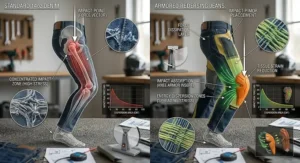
Alpinestars doesn’t need much introduction in the gear world, and the Copper 2 Denim shows why the brand’s jeans line punches above casual competitors. Construction pairs a stretch denim layer with Kevlar panels, and critically, the whole garment is CE-certified to CE Category II under PPE Regulation (EU) 2016/425 — meaning the jean itself, not just the inserted armor, has passed independent third-party testing rather than relying on manufacturer claims alone.
The knee armor here uses Alpinestars’ Bio Flex system, designed to allow high levels of movement while staying slim and discreet off the bike. Based on the spec comparison, that slim-profile armor is the real differentiator versus budget competitors — cheaper knee pads tend to be bulkier and more obviously “gear-shaped” under the denim, while Bio Flex tucks in closer to a normal jean silhouette. Reviewers also call out the reflective turn-up hem as a smart, easy-to-miss safety touch for anyone riding at dusk.
Aggregated customer sentiment is generally strong on build quality and the CE Category II certification specifically, since it removes ambiguity about whether the whole garment (not just the armor insert) has been independently tested. A repeated theme in reviews is that the regular fit runs true to size but sits slightly higher-waisted than some expect from a “street” jean.
Pros:
- ✅ Whole garment CE Category II certified, not just armor
- ✅ Bio Flex knee armor stays slim and discreet
- ✅ Reflective hem adds low-light visibility
Cons:
- ❌ Higher-waisted fit than some street-jean expectations
- ❌ Priced above most budget competitors
At roughly $180-$230, the Alpinestars Copper 2 Denim is the mid-premium pick for riders who want documented, whole-garment certification rather than armor-only claims.
7. Klim K Fifty 2 Riding Jeans — best premium option for serious mileage
If there’s a “top of the class” entry here, it’s the Klim K Fifty 2. Built from Cordura Denim — a nylon-cotton blend — rather than standard cotton, the fabric itself starts from a tougher base before any aramid reinforcement even enters the picture. Layered on top, reinforced Kevlar panels sit on the interior of the knees and back of the thighs, addressing the two zones most likely to contact pavement in a low-side slide.
What separates this from nearly everything else on this list is the armor package: D3O Evo CE Level 1 protectors at the hips and knees, both removable, with the knee protector position adjustable, plus a Poron XRD tailbone impact-absorbing pad — a piece of protection most riding jeans skip entirely. Based on the spec comparison, that tailbone pad alone justifies a meaningful chunk of the price premium for anyone who’s ever landed on their backside during a slow-speed drop; it’s a body zone that generic “knee and hip” marketing consistently ignores. The jeans are certified to prEN 17092-3 CE AA, putting whole-garment certification on par with — and in some respects ahead of — competitors at this price point.
Reviewers on Klim’s own product page and third-party retailers describe the fit as rugged and durable with a full range of quality armor, while a consistent critique across aggregated reviews is that the cut runs roomier through the waist and hip than expected, and the added Cordura weight means noticeably warmer wear in summer heat compared to lighter competitors.
Pros:
- ✅ Cordura denim base outperforms standard cotton denim
- ✅ Rare tailbone pad most competitors skip entirely
- ✅ Whole-garment CE AA certification under prEN 17092-3
Cons:
- ❌ Runs warm in summer due to Cordura weight
- ❌ Fit is roomier than expected — size down consideration
Sitting in the $290-$370 range, the Klim K Fifty 2 is the pick for riders logging serious weekly mileage who treat jeans as genuine gear, not a fashion statement with a safety bonus.
💬 Found the pair that fits your riding style? Compare specs one more time before you commit.
Top 7 Products: Full Comparison Table
| Product | Material | Armor | CE Rating | Price Range | Best For |
|---|---|---|---|---|---|
| Milwaukee Leather MDM5000 | Kevlar-thread denim | Knee, EN1621-1/2 | Armor-certified | $70-$100 | Budget daily commuting |
| Milwaukee Leather MPM5592 | Kevlar-thread denim | Knee, EN1621-1/2 | Armor-certified | $70-$100 | Style-focused cruiser riders |
| ILM BJN01 | Stretch denim + Kevlar seat lining | Removable knee/hip | Armor-certified | $50-$80 | Mixed street/off-road |
| WICKED STOCK | Full aramid lining | CE Level 2 knee/hip | Armor-certified | $80-$120 | Discreet everyday protection |
| EndoGear San Marino Noir | Kevlar cargo denim | Knee/hip | Class AA | $90-$130 | Utility/touring riders |
| Alpinestars Copper 2 | Stretch denim + Kevlar panels | Bio Flex knee | CE Category II | $180-$230 | Mid-premium style + certification |
| Klim K Fifty 2 | Cordura denim + Kevlar panels | D3O Evo + tailbone pad | prEN 17092-3 CE AA | $290-$370 | Serious high-mileage riders |
Scanning this table, the pattern is clear: whole-garment CE certification (not just armor certification) climbs steadily with price, and so does the sophistication of the armor system itself — from simple foam inserts to adjustable D3O with a dedicated tailbone pad. If your budget caps around $100, prioritize the Milwaukee Leather MDM5000 or WICKED STOCK for certified armor with solid Kevlar coverage; if you’re commuting daily through varied weather and mileage, the jump to Alpinestars Copper 2 or Klim K Fifty 2 buys you whole-garment testing and noticeably better armor engineering.
✨ Ready to gear up? Check current pricing and availability on any pair above before your next ride.
How to Choose Between Kevlar Lined Jeans and Armored Jeans
- Identify your typical riding speed. Urban commuting under 40 mph leans more on abrasion resistance than heavy impact armor; highway riding demands both, at a higher certification class.
- Check for whole-garment CE certification, not just armor certification. A jean can advertise “CE armor” while the denim itself was never independently tested for abrasion — look for EN 17092 class labeling on the garment itself.
- Match fabric weight to your climate. Heavier Cordura-denim blends like the Klim K Fifty 2 run warmer; lighter aramid-thread denim like the Milwaukee Leather line breathes better in heat.
- Prioritize removable armor. Washable, removable inserts extend the life of both the armor and the jeans — a detail nearly every product on this list gets right.
- Consider coverage pattern. Full-lining jeans like WICKED STOCK protect against unpredictable slide direction; zonal-Kevlar jeans protect the statistically most common impact points at a lower cost.
- Factor in fit style. Cargo cuts like the EndoGear breathe better but cover less skin in a slide than a snug straight-leg cut.
- Weigh price against mileage. Occasional weekend riders rarely need a $300 jean; daily commuters logging serious miles get real long-term value from premium armor engineering.
Practical Usage Guide: Getting the Most From Your Riding Jeans
Breaking in a new pair of armored riding jeans is different from breaking in regular denim, mostly because of the armor. For the first few rides, spend ten minutes walking around and sitting on the bike before you actually ride — this lets you feel where the knee armor sits when your leg is bent at riding angle, and most jeans (including the Klim K Fifty 2 and Alpinestars Copper 2) have adjustable armor pockets specifically so you can shift the pad up or down until it lines up with your actual kneecap, not just the factory default position.
Maintenance is simpler than people expect: remove the armor before washing (nearly every pair on this list uses hook-and-loop or pocket-insert armor specifically for this reason), wash the denim shell on a normal cycle, and let it air dry — high heat can degrade both the aramid fiber’s structure over time and the stretch elastane in blended fabrics. A common first-30-days mistake is leaving armor in during a wash cycle, which can warp foam inserts or crack rigid plastic shells. Another frequent error: assuming Kevlar-lined denim needs zero care because “it’s tough” — aramid fiber loses effectiveness when heavily abraded even without a crash, so treat visible fraying or thinning at the knees as a signal to inspect (and eventually replace) the garment, the same way you’d retire a worn bike tire.
Real-World Scenarios: Which Jeans Fit Your Riding Life?
The daily office commuter — Rides 8-12 miles each way through city traffic, wants to walk into a meeting without changing pants. The WICKED STOCK pair is built for exactly this: hidden armor pockets and a full aramid lining mean nobody at the office clocks these as motorcycle gear, while the CE Level 2 armor stays on for the entire ride.
The weekend cruiser rider — Puts on 60-100 miles most Saturdays, values style as much as protection, and doesn’t want to look like they’re wearing safety equipment at a coffee stop. The Milwaukee Leather MPM5592 camo or the Alpinestars Copper 2 both land well here — enough certified protection for moderate speeds, styled to look intentional off the bike.
The high-mileage tourer — Logs 200+ miles weekly across varied weather and road conditions, and treats gear as a genuine investment rather than an afterthought. The Klim K Fifty 2 is the clear fit: Cordura denim, adjustable D3O armor, and a tailbone pad most competitors skip entirely make it worth the higher price for someone spending that much time in the saddle.
Kevlar Denim vs Traditional Riding Leathers
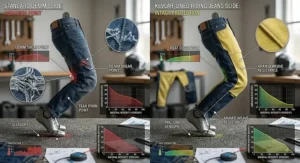
Leather has been the default “real” motorcycle protection for decades, and for outright abrasion resistance in a worst-case slide, quality leather still generally wins — a single layer of 1.3mm-thick leather lasted roughly the same or slightly better than top-tier AAA-rated lined denim jeans in Cambridge machine abrasion testing. But that comparison misses why kevlar reinforced denim has become the default choice for a huge share of riders: leathers are hot, stiff off the bike, and impractical for anyone who wears their riding pants into a grocery store or an office.
The honest trade-off is this: leather wins on raw slide-time in a worst-case scenario, but kevlar lined and armored jeans win decisively on wearability, versatility, and the simple fact that riders are far more likely to actually wear jeans every single ride, including the short five-minute trips where a rider might otherwise skip protective gear entirely. Testing from Bennetts BikeSocial found AAA-rated lined jeans survived more than double the abrasion time of AAA-rated single-layer jeans in the same Cambridge machine test — 4.34 seconds versus 2.03 seconds — which underscores that not all “AAA” denim is equal, and lined construction meaningfully outperforms single-layer denim even within the jean category itself.
Benefits vs Traditional Riding Pants (Textile Overpants)
| Factor | Kevlar/Armored Jeans | Traditional Textile Overpants |
|---|---|---|
| Everyday wearability | High — pass as normal clothing | Low — bulky, gear-only look |
| Weather protection | Moderate | High (often waterproof) |
| Ease of quick trips | Excellent, no changing required | Poor, requires full gear-up |
| Best For | Commuters, casual riders | Long-distance touring in variable weather |
The analysis here is straightforward: textile overpants generally out-perform denim on pure weatherproofing and abrasion coverage for long tours, but jeans win decisively on the “will you actually have them on” factor. A rider who skips gearing up for a 10-minute errand run because overpants feel like too much hassle gets zero protection that day — a rider wearing the EndoGear San Marino Noir or Milwaukee Leather MDM5000 as their default pants gets real, certified protection on every single ride without thinking about it.
Common Mistakes When Buying Motorcycle Jeans
Riders new to armored riding jeans tend to make a handful of predictable mistakes. First, judging protection purely by the word “Kevlar” on a listing without checking coverage area — as we’ve seen across this list, some jeans use aramid thread in isolated panels while others use full interlock-knit lining, and those are meaningfully different levels of protection despite both technically qualifying for the phrase. Second, ignoring whole-garment CE certification and assuming “comes with CE armor” means the jean itself passed abrasion testing — it doesn’t automatically follow, and only products carrying an EN 17092 class label on the denim itself have been independently verified as a complete garment.
Third, buying based on looks alone and skipping fit — armor that doesn’t sit over the actual kneecap because the jean runs long or short in the rise provides dramatically less real-world protection than the CE rating suggests, regardless of how good the fabric is. Fourth, treating riding jeans as a permanent, maintenance-free purchase; aramid fiber and foam armor both degrade with UV exposure, repeated washing, and general wear, so a five-year-old pair of “CE-rated” jeans may no longer perform to the original spec.
Long-Term Cost and Maintenance
Thinking in terms of cost-per-ride rather than sticker price changes the calculus considerably. A $90 pair of Milwaukee Leather jeans worn three times a week for two years works out to roughly $0.29 per wear before factoring in any protective benefit at all — cheaper than most riders’ daily coffee. A $320 Klim K Fifty 2, worn at the same frequency, comes out closer to $1.03 per wear, but the more durable Cordura construction and superior armor system generally mean a longer usable lifespan before the fabric or foam needs replacing, partially closing that per-wear gap over a five-year span.
Maintenance costs stay modest across the board — replacement armor inserts typically run $20-$50 per pair if foam degrades, and most manufacturers sell compatible replacement pads rather than requiring a whole new garment. The real long-term cost consideration isn’t the jeans themselves; it’s the cost of not wearing them. A single ER visit for road rash from an unprotected slide dwarfs even the premium end of this list many times over, which is really the core argument for buying jeans you’ll actually wear on every ride rather than saving the “good gear” for long trips only.
Features That Actually Matter (And Those That Don’t)
Marketing copy on riding jeans loves to lean on the word “Kevlar” as a catch-all safety signal, but a few specific features matter far more in practice than brand-name fiber alone. Whole-garment CE classification (EN 17092 Class A/AA/AAA) matters more than raw fiber content, because it reflects independently tested real-world abrasion performance rather than a marketing claim. Removable, adjustable armor matters more than fixed foam pads, because armor that doesn’t sit correctly over your knee or hip provides meaningfully less protection no matter how advanced the material. Stitching and seam strength — genuinely hard to evaluate from a product photo — matters enormously in a slide, since a garment that abrades intact protects better than one that tears open and exposes skin, regardless of fiber content.
What matters comparatively less: exact denier count of the outer fabric in isolation (context and construction matter more than a single number), designer branding without an accompanying CE label, and marketing terms like “military grade” or “tactical” that carry no standardized testing behind them in the motorcycle-gear context. Reviewers consistently note that fit and armor placement affect real-world confidence more than any single spec on a listing — a finding echoed by peer-reviewed research on motorcycle crash injuries, which found protective clothing meaningfully reduced soft-tissue injuries like abrasion and lacerations even when it couldn’t prevent every type of trauma.
Safety, Regulations, and Compliance Guide
In the United States, motorcycle riding apparel isn’t subject to a mandatory federal certification requirement the way helmets are under DOT standards, which means riders are largely on their own to interpret voluntary safety labeling. The most reliable signal to look for remains the EN 17092 CE certification that originated in Europe but has become the de facto global benchmark most reputable brands — including several on this list — voluntarily test against, since EN 17092 testing must be conducted by an independent third party rather than in-house, unlike unverified brand claims. For a deeper technical breakdown of how these classifications are actually tested, the Federal Highway Administration’s motorcycle safety resources offer useful context on rider protective equipment more broadly, even though jeans specifically fall outside DOT’s direct regulatory scope.
Within the EN 17092 framework, Class A garments are rated for urban riding, Class AA covers most riding up to roughly 75 mph, and Class AAA is intended for speeds beyond that threshold. Riders logging serious highway mileage should treat Class AA as close to a practical minimum rather than treating any “reinforced denim” label as automatically sufficient, since the gap in tested abrasion performance between unrated and certified denim is substantial. For a broader technical primer on aramid fiber itself and how it behaves under stress, Wikipedia’s overview of aramid fibers is a solid, neutral starting point if you want to understand what’s actually happening at the material level before a slide even starts.
Problem → Solution: Fixing Common Riding-Jean Pain Points
Problem: Armor bunches or shifts while riding. Most modern jeans, including the Klim K Fifty 2 and Alpinestars Copper 2, include hook-and-loop adjustment inside the armor pocket — take five minutes off the bike to reposition the pad directly over your kneecap before your first ride, rather than assuming factory placement fits your leg length.
Problem: Jeans feel unbearably hot in summer. Lighter zonal-Kevlar options like the Milwaukee Leather MPM5592 breathe noticeably better than Cordura-heavy jeans like the Klim — if heat is a dealbreaker, prioritize fabric weight over maximum coverage.
Problem: Uncertainty about whether a “CE” label means anything. Look specifically for an EN 17092 class letter (A, AA, or AAA) alongside the CE mark — a bare “CE” logo without a class designation, as noted in aggregated buyer discussions, is a weaker signal than a fully classified garment.
Problem: Jeans look too “gear-like” for office wear. The WICKED STOCK pair with fully hidden armor pockets solves this directly, as does most straight-leg denim from Milwaukee Leather — cargo-cut jeans like the EndoGear read more overtly “riding gear” by comparison.
Problem: Armor degrades faster than expected. UV exposure and machine drying both accelerate foam breakdown — air-dry the shell, store jeans out of direct sunlight when not in use, and replace armor inserts every few years even without a crash.
Kevlar Lined Jeans for Beginner Riders
Quick decision shortcut: ride under 40 mph in city traffic → lighter Kevlar-panel jean like the Milwaukee Leather MDM5000, since abrasion risk is lower and comfort matters more day-to-day. Mixed street and light off-road → the ILM BJN01, since stretch construction and removable armor suit varied body positions. Need maximum discretion for office settings → the WICKED STOCK, since hidden armor pockets and full lining keep the look civilian. Logging serious weekly highway mileage → the Klim K Fifty 2, since whole-garment CE AA certification and a tailbone pad address risks lighter jeans don’t cover.
New riders often default to whatever jeans they already own, reasoning that “real” gear can wait until they’ve logged more miles — this is backwards, since new riders statistically drop bikes more often during the learning curve, not less. A budget-friendly, certified option like the Milwaukee Leather MDM5000 or the ILM BJN01 removes the cost barrier while still delivering EN1621-rated armor and genuine aramid reinforcement, meaning a low-speed parking-lot tip-over — extremely common in the first few months of riding — is far less likely to result in road rash or a knee injury. Beginners should prioritize fit and armor placement over brand prestige at this stage; an ill-fitting premium jean protects worse than a well-fitted budget one.
Frequently Asked Questions
❓ Do kevlar lined jeans actually work in a motorcycle crash?
❓ Are armored motorcycle jeans legal to wear without additional gear?
❓ How often should I replace my riding jeans' armor?
❓ Can I wash kevlar lined jeans in a regular washing machine?
❓ What's the difference between Kevlar and Cordura in riding jeans?
Conclusion
Kevlar lined jeans vs armored jeans isn’t really an either/or decision once you dig into how these garments are actually built — the strongest options on the market, from the budget-friendly Milwaukee Leather MDM5000 to the premium Klim K Fifty 2, layer aramid fiber abrasion resistance with certified impact armor rather than picking one approach. What should guide your choice is honest self-assessment: your typical speed, climate, budget, and how much you value looking like you’re not wearing gear at all.
Whichever pair you land on, the single biggest factor in real-world protection isn’t brand prestige or price — it’s whether you actually wear them on every ride, including the short five-minute ones where skipping gear feels tempting. A well-fitted, honestly-rated pair of everyday riding jeans beats premium gear left in the closet every single time.
Recommended for You
- Armored Motorcycle Pants vs Leather Pants: 7 Real Picks (2026)
- Men’s Riding Overpants for Rain Protection: 7 Best Picks (2026)
- Rain pants for motorcycle commuting: 7 Picks That Won’t Let You Down (2026)
Disclaimer: This article contains affiliate links. As an Amazon Associate, I earn from qualifying purchases. If you purchase products through these links, we may earn a small commission at no additional cost to you.
✨ Found this helpful? Share it with your friends! 💬🤗
