
In This Article
Let’s be honest about something the gear industry doesn’t love to admit: for years, “women’s motorcycle pants” mostly meant men’s pants in a smaller waist size, slapped with a pink zipper pull and called a day. That era is mercifully dying. Today’s women’s armored motorcycle pants are cut for actual female hips, thighs, and inseams, built around real CE-rated armor, and priced anywhere from “grad-student budget” to “I just got a bonus.” If you’ve ever ridden in regular jeans and felt your stomach drop imagining a low-side at 30 mph, you already know why this matters.
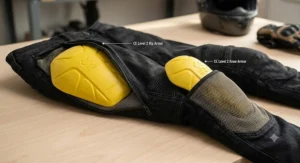
So, what is a women’s armored motorcycle pant? It’s a riding-specific garment — denim, textile, or mesh — built with reinforced or abrasion-resistant fabric and pockets for hard or soft CE-certified armor at the hips and knees, engineered to reduce road rash and impact injury in a fall while fitting a woman’s body shape rather than a unisex block pattern. This category falls under the broader umbrella of motorcycle personal protective equipment, which covers everything from helmets to boots.
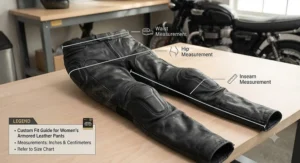
This guide isn’t a repackaged Amazon listing. We dug into real specs from seven current products, cross-referenced armor certification standards, and pulled in aggregated customer sentiment so you’re not just trusting marketing copy. We’ll walk through budget, mid-range, and premium options, explain hip and knee armor in plain English, and cover fit — including plus-size riding gear — because “just size up” is not a sizing strategy. By the end, you’ll know exactly which pair matches your budget, your body, and the way you actually ride. The three measurements worth having ready before you buy anything on this list: waist at the navel, hips at their widest point, and inseam from groin to ankle bone.
Quick Comparison Table
| Product | Armor | Best For | Price Range |
|---|---|---|---|
| Bohn Body Armor BodyGuard Mesh Pants | CE Level 2 hip/knee/tailbone | Layering under jeans | Under $200 |
| BILT Iron Workers Women’s Steel Jeans | CE Level 1 knee | Budget denim, sizes 4–16 | Around $80–$100 |
| Wicked Stock Women’s CE Mesh Pants | CE Level 1 hip/knee | Matching jacket-and-pant kits | $100–$150 range |
| Oxford Super Jeggings 2.0 | CE Level 2 knee, hip-ready | Slim everyday commuting | $130–$170 range |
| Sedici Alexi 2 Mesh Pants | CE-rated hip/knee | Hot-weather riding | $150–$200 range |
| REV’IT! Eclipse 2 Pants | CE-rated hip/knee | Relaxed touring fit | $200–$250 range |
| KLIM Women’s Artemis Pants | KLIM Rogue CE Level 2 hip/knee | Premium adventure riding | Mid-$400s and up |
Scanning this table, the spread tells its own story: armor coverage is fairly consistent across the board (nearly every serious option here hits CE Level 1 or 2), but what changes dramatically is fit philosophy and use case. The Bohn Body Armor BodyGuard Mesh Pants and BILT Iron Workers Women’s Steel Jeans solve the “I need protection now, on a budget” problem, while the KLIM Women’s Artemis Pants target riders who want dedicated adventure-touring architecture and don’t mind paying premium dollars for it. Notice, too, that price doesn’t map directly to protection level — the Oxford Super Jeggings 2.0 carry CE Level 2 knee armor at a fraction of the KLIM price, which is exactly the kind of nuance a spec sheet alone won’t tell you.
💬 Just one click — help others make better buying decisions too!😊
Top 7 Women’s Armored Motorcycle Pants: Expert Analysis
Here’s where we get into the weeds. Every pick below earns its spot for a specific reason — budget, fit, armor coverage, or all three — and none of them are filler. We looked at real specs, real construction details, and real aggregated review themes to get here.
1. Bohn Body Armor BodyGuard Mesh Pants — most affordable way to add real CE-2 armor under any pants
The pitch is simple: instead of buying a whole new pair of riding pants, you slide these body-hugging mesh-and-Lycra pants on underneath your regular jeans, khakis, or work trousers. Armor sits at the hips, knees, and tailbone, rated to CE Level 2 — the higher of the two common impact-absorption tiers — and the viscoelastic pads are multi-impact rated, meaning they’re designed to stay effective even after they’ve already absorbed one crash. The close, second-skin fit is the whole engineering thesis here: loose armor shifts out of position exactly when you need it most, so a snug base layer keeps the pads locked over your hip rotator and kneecap through a slide instead of riding up your thigh. This is the pick for commuters who refuse to own “motorcycle clothes” as a separate wardrobe, or anyone who rides in work attire and just wants a hidden safety net. Aggregated reviewer sentiment consistently praises the breathability of the mesh panels and the fact that the armor genuinely disappears under normal pants — a common complaint about bulkier armored jeans is that they look obviously “motorcycle-y,” and this sidesteps that entirely. The main criticism that surfaces repeatedly is that Lycra-based garments like this are abrasion-neutral by themselves; the pants underneath still need to survive the slide.
Pros:
- ✅ CE Level 2 armor at hips, knees, and tailbone
- ✅ Disappears invisibly under any regular pants
- ✅ Multi-impact viscoelastic pads rated to last years
Cons:
- ❌ Provides zero abrasion resistance on its own
- ❌ Requires pairing with durable outer pants to work
Priced under $200, this is one of the cheapest ways to add genuine CE-2 protection to your existing wardrobe, and the value case is hard to argue with if your outer layer is already tough enough to handle a slide.
2. BILT Iron Workers Women’s Steel Motorcycle Jeans — best budget denim with plus-size range up to a 16
This is the pants version of “looks like jeans, rides like armor.” The chassis is 100% denim on the outside with aramid fiber (the DuPont Kevlar-family material used for its cut and heat resistance) reinforcing the knees, hips, and seat, plus removable CE-approved soft knee armor. In practice, that aramid lining does the heavy lifting: it’s the layer standing between your skin and the pavement if you go down, and it’s noticeably tougher than the denim alone would be. Aggregated customer feedback on this Kevlar-lined denim line is mixed but instructive — riders consistently note the pants feel like ordinary jeans off the bike, wash well over time, and the removable armor pads are easy to pull for laundering, while a recurring critique is that inseam length runs short relative to the labeled size, so double-check the actual measurement against your own before buying. Available in women’s sizes 4 through 16, this is a genuinely inclusive budget option in a category where “budget” and “size range” don’t always overlap. Who’s it for? Riders who want jeans they’d wear off the bike too, and who prioritize looking normal at the coffee shop over maximum abrasion coverage.
Pros:
- ✅ Real aramid-lined denim, not just a marketing label
- ✅ Sizes 4–16 cover a wider range than most budget denim
- ✅ Removable knee armor simplifies washing
Cons:
- ❌ Inseam commonly runs shorter than labeled size
- ❌ Kevlar lining reads noticeably hot in warm weather
At around $80–$100, this pair delivers a genuinely rare combination in the budget tier: real reinforcement fiber, real removable armor, and a size range that doesn’t stop at a 12.
3. Wicked Stock Women’s Motorcycle Pants CE Level Armor Mesh — matching jacket-to-pant kit for a coordinated look
If you already own (or plan to buy) the matching Wicked Stock women’s jacket, these pants are designed to zip directly to it, creating one continuous protective shell instead of two separate garments that gap at the waist in a slide. CE Level 1 armor sits at both knees and hips, and — this is the detail that actually matters day to day — a zipper positioned above each knee lets you pull the armor pad out for washing or refitting without disassembling the whole garment. Stretch panels at the rear and double-knee construction keep the pads seated through normal riding motion rather than sliding toward your shin every time you shift gear at a stoplight. Reviewers consistently highlight the adjustable waistband and boot-cuff zippers as genuinely useful, practical touches rather than gimmicks, since they let you fine-tune fit without hemming or tailoring. The honest caveat: because this is a newer, smaller brand relative to legacy names like REV’IT! or Klim, the pool of verified long-term reviews is thinner, so treat the durability picture as promising but not yet as proven as some older competitors.
Pros:
- ✅ Zips directly to matching jacket for full-shell coverage
- ✅ CE Level 1 hip and knee armor with easy access
- ✅ Adjustable waist and boot-cuff zippers for custom fit
Cons:
- ❌ Smaller brand means fewer long-term durability reviews
- ❌ CE Level 1 offers less impact absorption than Level 2
In the $100–$150 range, these fill a specific niche well: riders who want a matched, integrated look without paying premium-brand prices for it.
4. Oxford Super Jeggings 2.0 — closest thing to yoga pants with genuine knee armor
These solve a real complaint: a lot of riders, especially anyone commuting straight into work clothes, don’t want to own a separate pair of stiff riding jeans. The Super Jeggings 2.0 use a 4-way stretch outer material lined with aramid fiber thread and elastane, so the silhouette reads slim and casual rather than “motorcycle gear,” while the lining underneath is doing genuine abrasion-resistance work. They ship with removable CE Level 2 knee armor already installed, plus pockets sewn in to accept optional hip armor if you want to add it — a smart middle-ground for riders who aren’t ready to commit to full hip protection but want the option open. What most buyers overlook about this style is that the stretch fit, while comfortable, means it runs closer to the body than traditional riding jeans, and aggregated reviews consistently recommend sizing up because the fabric hugs tighter than the size chart implies. This is the pick for someone who rides to run errands, grab coffee, or commute and refuses to change pants at either end of the trip.
Pros:
- ✅ CE Level 2 knee armor included, hip-armor pocket ready
- ✅ Slim, casual silhouette wears like everyday leggings
- ✅ Aramid lining hidden inside a genuinely stretchy fabric
Cons:
- ❌ Reviewers consistently say to size up one full size
- ❌ Hip armor sold separately, not included standard
At a $130–$170 range, this is arguably the best “gateway” pair on this list for someone who’s never owned real riding pants and is intimidated by stiff denim or bulky textile.
5. Sedici Alexi 2 Mesh Women’s Pants — coolest option for triple-digit summer commutes
Built specifically for female riders rather than a unisex mesh pant with a smaller waist option, the Alexi 2 uses a 600D dobby textile chassis with hard mesh panel inserts placed exactly where airflow matters most: front thighs and rear. Stretch accordion panels at the crotch, knees, and rear yoke are a small detail with outsized real-world impact — they’re what let you actually bend your knee to shift or plant a foot at a stoplight without the fabric fighting you the whole time. CE-rated armor covers the hip and knee zones, and the fully adjustable waist means the fit can be dialed in rather than accepted as-is. On paper, this reads like a hot-weather-only pant, and honestly, that’s a fair read; reviewers consistently cite the ventilation as the standout feature, with fewer comments about cold-weather versatility since mesh, by definition, isn’t wind-blocking. If you live somewhere with a real summer — the kind where regular riding jeans turn into a sauna at every red light — this is built for exactly that problem.
Pros:
- ✅ Purpose-built women’s cut, not a resized unisex pattern
- ✅ Hard mesh panels placed for maximum summer airflow
- ✅ Stretch accordion panels improve knee mobility significantly
Cons:
- ❌ Minimal wind or cold protection outside of summer
- ❌ Mesh construction generally trades some abrasion margin
In the $150–$200 range, this pair earns its keep specifically as a seasonal specialist rather than a do-everything pant, and that’s a fair trade if you already own something warmer for the rest of the year.
6. REV’IT! Eclipse 2 Women’s Pants — most versatile relaxed-fit touring pant
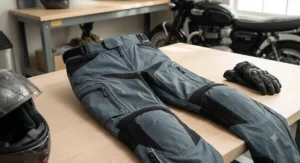
REV’IT! has built a reputation on European CE-certification rigor, and the Eclipse 2 reflects that: a relaxed, touring-oriented cut with heavy ventilation designed to keep you comfortable across a wider range of temperatures than a pure summer mesh pant. The relaxed fit is a deliberate design choice rather than a limitation — it accommodates layering for cooler mornings, sits comfortably over the hip for longer rides, and doesn’t restrict movement when you’re on the bike for three or four hours instead of a twenty-minute commute. Based on the spec comparison with tighter-cut competitors on this list, the trade-off is exactly what you’d expect: less of a “sleek” silhouette in exchange for genuine touring comfort. Aggregated reviewer sentiment frames these as a strong middle-ground pick — protective enough for serious riders, comfortable enough for full-day trips, without the premium-tier price tag of adventure-specific gear. What most buyers overlook is that the mesh ventilation zones, while excellent for airflow, mean this pant leans warm-weather-to-mild rather than genuine four-season, so riders in colder climates will still want a base layer or liner for anything below room temperature.
Pros:
- ✅ Relaxed touring fit stays comfortable on long rides
- ✅ Strong ventilation without sacrificing CE-rated protection
- ✅ European build quality at a mid-range price point
Cons:
- ❌ Relaxed cut trades some of the slim, sporty look
- ❌ Not genuinely built for cold-weather riding alone
At $200–$250, the REV’IT! Eclipse 2 sits at the point where mid-range value and genuine touring capability meet, which is exactly why it shows up on so many “best of” lists across the industry.
7. KLIM Women’s Artemis Adventure Pants — most complete premium ADV pant built by women, for women
This is the splurge pick, and the spec sheet explains why. The current generation uses KLIM’s proprietary Rogue armor system at the hips and adjustable knees, engineered specifically to improve weight, breathability, and flexibility over older armor generations while still meeting KLIM’s internal impact requirements, which the brand states exceed the baseline needed for CE Class AA certification. Two thigh intake vents and two thigh exhaust vents manage airflow on long adventure days, dual cargo pockets (including an internal organizer) replace the awkward “where do I put my phone” problem most riding pants ignore, and — critically — this isn’t a men’s pattern resized down. It’s cut with a dedicated mobility gusset, moisture-wicking anti-odor liner, and adjustment points at the waist, knee, and calf built around an actual female range of motion. It’s designed to layer over off-road boots and connects to a matching jacket for a full adventure-touring shell. Reviewers who’ve put serious mileage on the Artemis line consistently describe the fit as noticeably more dialed-in than competitor ADV pants adapted from men’s patterns, and note the armor coverage feels substantial without turning into a sauna on hot trail days. The honest trade-off: this is adventure-specific gear, over-built for someone who only rides pavement to the grocery store.
Pros:
- ✅ KLIM Rogue armor exceeds baseline CE AA requirements
- ✅ Ground-up women’s pattern, not a resized men’s cut
- ✅ Four-vent thigh airflow system for long adventure days
Cons:
- ❌ Premium price puts it out of reach for casual riders
- ❌ Off-road-oriented cut is overkill for pure street commuting
Priced in the mid-$400s and up, the KLIM Women’s Artemis Pants are squarely for the rider who’s serious about adventure touring and wants gear built for her body from the ground up, not adapted from someone else’s.
✨ Don’t Miss These Exclusive Deals!
🔍 Take your riding wardrobe to the next level with these carefully selected picks. Click on any highlighted item to check current pricing and availability. The right pair of armored pants turns “someday I’ll get real gear” into a decision you make once and stop worrying about.
Practical Usage Guide: Breaking In and Maintaining Armored Riding Pants
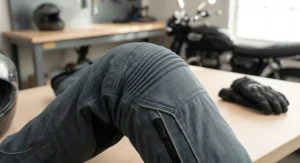
New armored pants rarely feel perfect on day one, and that’s normal — most CE armor, especially the hard-shell or dual-density foam variety, needs a break-in period where it softens slightly and molds closer to your knee and hip shape. For the first few rides, expect the knee armor to feel a little high or a little stiff; this typically settles within 100–200 miles as the fabric relaxes and you naturally adjust your riding position around it. A common first-30-days mistake is assuming loose armor placement will “work itself out” — it won’t, and armor that sits even an inch off your actual kneecap or hip bone loses a meaningful chunk of its protective value in a real impact. Check placement every few rides until the fit feels locked in, not just at initial purchase. For a deeper walkthrough on getting sizing right the first time, this women’s motorcycle pants buying guide covers measurement technique in more detail than most product listings bother to.
Maintenance matters more than most riders realize. Armor pads should be removed before washing whenever the garment allows it — tossing viscoelastic or D3O-style armor through a washing machine can degrade the impact-absorbing gel over time. Most CE pads are rated for years of use, but should be inspected periodically for cracking, compression, or delamination, especially after any fall, even a minor one; soft armor in particular can compress permanently after absorbing an impact and needs replacing even if it looks fine. For the outer shell — denim, textile, or mesh — follow the manufacturer’s wash guidance closely, since aramid and Kevlar-blend fabrics can lose some of their tear resistance if washed too hot or dried on high heat repeatedly. A quick optimization trick: store armored pants flat or hung rather than balled up in a gear bag, since constant creasing at the knee can eventually create weak points in both fabric and pad shape.
Real-World Scenarios: Which Rider Are You?
The daily commuter. She’s riding 5–15 miles each way, in regular clothes, and doesn’t want a wardrobe change twice a day. The Bohn Body Armor BodyGuard Mesh Pants or Oxford Super Jeggings 2.0 solve this directly — one layers invisibly under existing pants, the other simply is her existing pants, minus the risk.
The weekend tourer. Longer rides, multiple hours in the saddle, variable weather across a single day. The REV’IT! Eclipse 2 or Sedici Alexi 2 Mesh Pants fit this profile well, prioritizing comfort and airflow over multiple hours without sacrificing CE-rated protection at the joints that matter most.
The budget-conscious new rider. Just got licensed, gear budget is tight, doesn’t want to compromise on real protection to save money. The BILT Iron Workers Women’s Steel Jeans hit this need directly — real aramid lining, real removable armor, and a price point that doesn’t require choosing between a helmet upgrade and pants that protect her.
The adventure rider. Mixed pavement and dirt, longer expeditions, needs gear engineered for a wider range of motion and off-road boot compatibility. The KLIM Women’s Artemis Pants are purpose-built for exactly this rider, and honestly, for nobody else — buying them for a five-mile city commute would be like bringing an expedition tent camping in your backyard.
How to Choose Women’s Armored Motorcycle Pants: 7-Step Framework
- Start with armor level, not fabric. Confirm CE Level 1 or Level 2 (or CE Class A/AA/AAA under the EN 17092 standard) at minimum the hips and knees — this is non-negotiable before you even think about style.
- Measure yourself, not your regular pants size. Waist at the navel, hips at their widest point, and inseam from groin to ankle bone are the three numbers that actually predict fit accuracy.
- Match the fabric to your climate. Mesh for genuine summer heat, textile for three-season versatility, reinforced denim for year-round wear with moderate temperature swings.
- Decide how much abrasion resistance you actually need. A five-mile city commute at 30 mph has different real-world risk than a 400-mile highway tour at 75 mph — gear appropriately.
- Check armor placement adjustability. Fixed-position armor rarely lands correctly on every body; adjustable straps or multiple pocket positions matter more than they sound like they would.
- Consider what it connects to. Jacket-to-pant zip connections close the gap at your waist in a slide — worth prioritizing if you already own or plan to buy a matching jacket.
- Budget for the whole system, not just the pants. A great pair of armored pants paired with unarmored regular jeans underneath a mesh layer defeats half the purpose — plan your gear budget holistically.
Affordable Women’s Riding Pants: Finding Budget Protective Riding Gear That Doesn’t Skimp on Safety
Here’s the myth worth killing early: cheap doesn’t automatically mean unsafe, and expensive doesn’t automatically mean better-protected. Among affordable women’s riding pants, the meaningful variable isn’t price — it’s whether the armor is actually CE-certified versus a generic foam pad marketed as “protective.” The BILT Iron Workers Women’s Steel Jeans and Bohn Body Armor BodyGuard Mesh Pants both prove this point at very different price tiers, delivering genuine CE-rated hip, knee, or tailbone armor well under $200.
The smartest budget strategy is layering strategically instead of buying one expensive garment that tries to do everything. A base-layer armor system like Bohn’s under a pair of sturdy jeans, or a single well-built armored jean like BILT’s, both outperform an unarmored “moto-style” pant that only looks protective. Budget protective riding gear for women has genuinely improved over the last few years — the gap between a $90 pair and a $250 pair is increasingly about comfort, ventilation, and styling rather than raw impact protection, which is good news if your gear budget is tight this season.
Women’s CE Armor Motorcycle Pants Explained: Hip and Knee Armor Levels That Matter
CE armor certification is the single most important spec on any label, and it’s worth understanding rather than just glancing past. The EN 17092 standard that governs modern leisure motorcycle clothing classifies garments into five protection classes — AAA, AA, A, B, and C — with AAA representing the highest abrasion resistance, typically seen in one- or two-piece race-oriented leather suits, and AA striking a balance suited to touring riders with slightly more ergonomic flexibility built in. Separately, armor pads themselves — the actual hip and knee inserts — carry their own CE Level 1 or Level 2 rating under a different testing protocol, measuring how much force gets transmitted through the pad in an impact. CE Level 1 armor allows a maximum transmitted force of roughly 18 to 24 kilonewtons and tends to run thinner and more flexible, a reasonable choice for casual or urban riding. CE Level 2 armor transmits meaningfully less force in testing, offering a higher protection ceiling, generally at the cost of slightly more bulk.
| Armor Type | Max Force Transmitted | Typical Feel | Best For |
|---|---|---|---|
| CE Level 1 | Up to ~18–24 kN | Thin, flexible | Urban/casual riding |
| CE Level 2 | Lower than Level 1 | Slightly bulkier | Higher-speed or touring riding |
| EN 17092 Class AA | Balanced abrasion/comfort | Textile-friendly | Touring gear like REV’IT! Eclipse 2 |
| EN 17092 Class AAA | Highest abrasion resistance | Least flexible | Track-oriented leather suits |
Reading this table, the practical takeaway is that “CE certified” alone doesn’t tell you everything — Level 1 versus Level 2 hip and knee armor is a genuinely different protection tier, and it’s worth checking which one sits inside the pants you’re buying rather than assuming all “CE armor” pants are equal. Products on this list like the Bohn Body Armor BodyGuard Mesh Pants, Oxford Super Jeggings 2.0, and KLIM Women’s Artemis Pants all specify CE Level 2, which is meaningfully more protective than the Level 1 armor found in more budget-oriented options.
Getting the Right Women’s Motorcycle Fit: Sizing Up for Plus-Size Riding Gear
Fit is where the “just take a men’s medium” era of women’s motorcycle gear did the most damage, and it’s still the biggest source of buyer frustration. A proper women’s motorcycle fit accounts for a higher hip-to-waist ratio, a shorter rise in many cases, and armor pockets positioned for a female knee and hip rather than assumed from a men’s block pattern. Brands like KLIM, with the Women’s Artemis Pants, and Sedici, with the Alexi 2 Mesh Pants, build from women’s-specific patterns rather than resizing men’s cuts — and it shows in how the armor actually sits once you’re seated on a bike rather than standing in a fitting room.
Plus-size riding gear has historically been the weakest link in this category, with many brands stopping their size range at a 12 or 14. This is changing, but unevenly. The BILT Iron Workers Women’s Steel Jeans, sized 4 through 16, represent one of the more inclusive budget options here, while other manufacturers have started building dedicated plus-size lines using the same CE-certified materials as their standard sizing rather than a scaled-down, lower-protection version. When shopping plus-size specifically, prioritize brands that explicitly state their plus-size gear uses identical armor and fabric to standard sizing — some cheaper brands quietly reduce armor coverage or swap fabric in extended sizes, which defeats the entire purpose of buying protective gear in the first place.
Common Mistakes When Buying Armored Motorcycle Pants
The most common mistake, by a wide margin, is buying based on waist size alone and ignoring hip and inseam measurements — riding pants fit fundamentally differently than street pants because of the seated riding position and armor pocket placement. A close second is assuming “armored” means CE-certified; some budget listings use foam padding that offers cushioning but hasn’t passed any recognized impact-force testing, which is a meaningfully different product than true CE Level 1 or 2 armor. Riders also frequently skip trying pants on while seated in a riding position (even just straddling a chair at home), which is the only way to catch armor that rides up or bunches at the exact angle your knee bends on a bike. Another overlooked error: buying mesh-only pants as a first and only pair, then discovering they offer minimal wind protection or warmth outside of peak summer — great as a specialist piece, poor as someone’s entire riding wardrobe. Finally, riders sometimes buy based on brand reputation from men’s gear reviews without confirming the women’s-specific version uses the same armor and materials, which isn’t always guaranteed.
Armored Motorcycle Pants vs Regular Riding Jeans: What’s the Real Difference
“Riding jeans” and “armored motorcycle pants” get used almost interchangeably in casual conversation, but they’re not the same category, and the difference genuinely matters in a crash. Regular jeans — even sturdy denim — are made from cotton woven for durability against everyday wear, not high-speed abrasion. Motorcycle-specific gear is built around a completely different design brief: garments engineered with reinforced or abrasion-resistant fabric and armor pockets specifically positioned for the hips and knees, the two impact points most commonly injured in a low-side or slide.
| Factor | Regular Jeans | Armored Motorcycle Pants |
|---|---|---|
| Abrasion resistance | Minutes at most under sliding friction | Rated fabric, often aramid/Kevlar-reinforced |
| Impact armor | None | CE Level 1 or 2 at hip/knee |
| Fit for riding position | Not optimized | Articulated for seated riding posture |
| Best For | Off-bike, casual wear | Actual riding, any distance |
The analysis here is straightforward: the entire point of a certification standard is to guarantee that clothing which looks protective actually is protective under testing, and regular denim was simply never engineered or evaluated against that bar. Riders sometimes push back with “I’ve ridden in jeans for years and never fallen,” which is true for a lot of people right up until the day it isn’t. According to federal motorcycle safety data, motorcyclists face significantly higher injury and fatality risk per mile traveled than occupants of passenger vehicles, which is exactly the gap that proper protective gear is designed to narrow. If budget is the actual barrier rather than awareness, options like the BILT Iron Workers Women’s Steel Jeans close that gap without requiring a huge spend.
Long-Term Cost & Maintenance: What Armored Riding Pants Really Cost Over Time
The sticker price is only part of the real cost picture. CE armor pads generally have a usable lifespan measured in years rather than months under normal wear, but that lifespan assumes proper care — avoiding machine-washing the armor itself, storing pants flat rather than crushed, and replacing any pad involved in even a minor fall regardless of visible damage. Factor in that outer shells (denim, textile, or mesh) typically outlast the armor inside them if maintained well, meaning some riders extend the life of a favorite pair by simply replacing worn armor pads rather than the whole garment, where the design allows it.
Cost-per-wear tells a more useful story than sticker price alone. A $90 pair of BILT Iron Workers Women’s Steel Jeans worn twice a week for three years works out to a strikingly small per-ride cost, while a $450 pair of KLIM Women’s Artemis Pants used primarily for a few long annual adventure trips may cost more per actual wear despite the premium construction — context matters more than the number on the price tag. The genuinely expensive mistake isn’t overspending on gear; it’s underspending on gear you skip wearing because it’s uncomfortable, which is a real and common outcome when riders buy the wrong fit purely to save money upfront.
Frequently Asked Questions
❓ Do women's armored motorcycle pants really need CE armor, or is any padding fine?
❓ Can I wear armored leggings instead of full riding pants?
❓ How do I find plus-size women's armored motorcycle pants?
❓ What's the difference between CE Level 1 and Level 2 armor?
❓ Are affordable women's riding pants actually safe, or just cheap?
Conclusion
If there’s one takeaway from all this, it’s that “women’s armored motorcycle pants” stopped being a compromise category a while ago — you genuinely don’t have to choose between fit, protection, and budget anymore, even if you have to be a slightly more informed shopper to find the sweet spot. Riders on a tight budget have real, CE-certified options in the BILT Iron Workers Women’s Steel Jeans and Bohn Body Armor BodyGuard Mesh Pants. Riders who want an everyday, low-friction option that doesn’t scream “motorcycle gear” have the Oxford Super Jeggings 2.0. Summer riders have the Sedici Alexi 2 Mesh Pants, tourers have the REV’IT! Eclipse 2, and adventure riders who want gear built specifically for a woman’s body from the ground up have the KLIM Women’s Artemis Pants. Whatever you choose, the underlying rule doesn’t change: check the CE rating, measure your actual hips and inseam instead of guessing, and try the fit in a seated position before you commit. Your knees and hips only get one shot at being protected correctly — make it count.
Recommended for You
- Heated Motorcycle Pants for Winter Riding: 7 Best Picks (2026)
- 7 Best Leather Motorcycle Pants for Touring in 2026
- Motorcycle Racing Suit Leather: 7 Best CE-Certified Picks (2026)
Disclaimer: This article contains affiliate links. As an Amazon Associate, I earn from qualifying purchases. If you purchase products through these links, we may earn a small commission at no additional cost to you.
✨ Found this helpful? Share it with your friends! 💬🤗
