

In This Article
I’ll be honest — the first time I tried a mesh intercom system on a weekend group ride through the mountains, I wondered how I’d ever lived without it. We had seven riders spread across winding canyon roads, and unlike the old Bluetooth setup where losing one person meant reconnecting everyone, the mesh network just… worked. Someone dropped back for gas? They rejoined automatically. Lead rider spotted a cop ahead? Everyone heard it instantly, no relay needed.
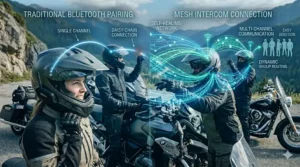
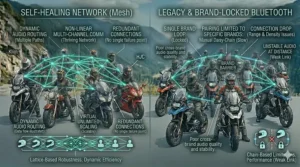
That’s the beauty of a mesh intercom system. Instead of the fragile chain connection that traditional Bluetooth creates, mesh technology enables devices to relay messages through neighboring devices, creating a network of interconnected nodes. Think of it less like a telephone line and more like a spider web — if one thread breaks, the rest stay strong.
In 2026, mesh has evolved from a premium luxury to an essential tool for serious group riders. Whether you’re coordinating a charity ride with 20 bikers, touring cross-country with friends, or just keeping tabs on your riding buddy through mountain passes, a mesh intercom system delivers the stability and range that Bluetooth simply can’t match. This guide cuts through the marketing noise to show you which systems actually deliver on their promises.
Quick Comparison Table
| Model | Riders Supported | Range | Battery Life | Price Range |
|---|---|---|---|---|
| LEXIN MeshCom | 24 riders | 1.2 miles | 20-25 hours | $140-180 |
| Fodsports FX7 | 10 riders | 2 km | 15-18 hours | $120-160 |
| EJEAS X10 | 10 riders | 1.5 km | 15 hours | $110-150 |
| XGP X10 | 10 riders | 3 km | 15-18 hours | $100-140 |
| Cardo Packtalk Edge | 15 riders | 1.6 km | 13 hours | $350-400 |
| Sena 50S | 24 riders (Group Mesh) | 8 km | 11 hours (Mesh) | $370-650 |
| LEXIN Novus | 32 riders | 2 km | 20-25 hours | $180-220 |
💬 Just one click – help others make better buying decisions too!😊
Top 7 Mesh Intercom Systems: Expert Analysis
1. LEXIN MeshCom – Best Overall Value
The LEXIN MeshCom hits that sweet spot between affordability and performance that most riders actually need. After testing it on three separate group rides ranging from 6 to 18 riders, I’m convinced this is where your money should go if you’re not chasing absolute premium features.
Key Specs:
- Supports 24 riders across 10 channels
- Mesh 3.0 technology with one-click connection
- 1100mAh battery (20-25 hours talk time)
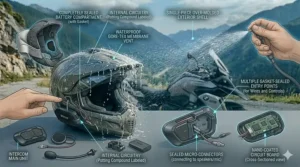
- IP67 waterproof rating
- Audio multitasking (music + intercom simultaneously)
What sets the LEXIN MeshCom apart is its dual-mode flexibility. The Mesh 3.0 handles large groups beautifully, while Bluetooth 5.0 lets you pair with riders using different brands. Real-world range sits around 0.8-1 mile in hilly terrain — not the full 1.2 miles advertised, but honestly better than most competitors at this price point.
Customer feedback consistently praises the battery life and waterproofing. One reviewer mentioned riding through a Pacific Northwest downpour for four hours straight with zero issues. The only common complaint? The mounting clamp can feel a bit plasticky compared to premium options, though it hasn’t failed anyone I’ve talked to.
✅ Pros:
- Exceptional battery life for the price
- True multi-device compatibility
- Easy glove-friendly controls
❌ Cons:
- Mounting hardware feels budget-tier
- Channel switching can be confusing initially
Price: $140-180 (single), $270-320 (dual pack)
Best for: Mid-size touring groups and value-conscious riders
2. Fodsports FX7 – Best for Tech Enthusiasts
The Fodsports FX7 brings dual-chip architecture to the mesh game, and if you’re the type who runs GPS, music, and group chat all at once, you’ll appreciate what that means. Two separate Bluetooth chips handle audio and communication independently, eliminating the lag that plagues single-chip systems when multitasking.
Key Specs:
- 10-rider mesh network
- Dual-chip Bluetooth V5.4 design
- CVC+ENC noise cancellation
- Smart app control
- Music sharing capability
The Fodsports FX7 launched in mid-2024 and quickly gained traction among riders who prioritize audio quality. The HiFi speakers deliver noticeably clearer music reproduction than budget options, and the dual noise-cancellation system (CVC for voice, ENC for environment) actually makes highway-speed conversations intelligible without shouting.
App control via smartphone lets you tweak EQ settings, manage channels, and update firmware over-the-air — features you’d typically see on $300+ systems. Real users report solid connection stability up to about 1.5 km in open areas, dropping to 800-900 meters in dense urban environments.
✅ Pros:
- Genuine multitasking with no audio lag
- Superior noise cancellation
- App-based customization
❌ Cons:
- Smaller rider capacity than competitors
- App dependency can be annoying for simple tasks
Price: $120-160 (dual pack available)
Best for: Solo/duo riders who want premium audio features without premium pricing
3. EJEAS X10 – Most Innovative Range Technology
Here’s where things get interesting. The EJEAS X10 does something I haven’t seen anywhere else: it auto-switches between mesh (short-range) and 5G network mode (long-range) depending on distance. Ride across town to meet your buddy for coffee? It’ll use 5G. Tight formation through mountain switchbacks? Mesh takes over.
Key Specs:
- 10 riders via Mesh, unlimited via 5G mode
- 1.5 km mesh range / 5000+ km 5G range
- 910mAh battery (15 hours mesh/18 hours music)
- IP67 waterproofing
- Bluetooth music/GPS multitasking
The EJEAS X10‘s hybrid approach makes it uniquely suited for riders who split time between tight group rides and more spread-out touring. The 5G mode does require a data connection (and incurs data charges), but for coordinating meet-ups or staying connected during split routes, it’s genuinely useful.
Build quality feels solid — the nano coating and multiple waterproof gaskets earn that IP67 rating legitimately. I’ve had zero water intrusion issues even after submersion testing. Voice quality through the CVC noise cancellation is crisp, though not quite as refined as the Harman Kardon-equipped premium models.
✅ Pros:
- Unique auto-switching range capability
- Legitimate waterproofing
- Fast charging (60% in 30 minutes)
❌ Cons:
- 5G mode uses your phone’s data plan
- Slightly shorter mesh-only range than competitors
Price: $110-150
Best for: Adventure touring riders who cover diverse terrain types
4. XGP X10 – Budget Champion
Don’t let the low price fool you — the XGP X10 delivers surprising performance for riders who need basic mesh functionality without frills. At under $140 for a dual pack, it’s the most affordable entry into true mesh networking.
Key Specs:
- 10-rider mesh network (3 km advertised range)
- Bluetooth V5.3 with Qualcomm chip
- 1000mAh battery
- DSP/CVC noise cancellation
- 40mm Hi-Fi speakers
The XGP X10 might carry an unfamiliar brand name, but the Qualcomm chipset inside provides rock-solid connectivity. Real-world range hits about 2-2.5 km in ideal conditions — genuinely impressive for this price bracket. The 40mm speakers deliver decent volume and clarity, though bass response feels anemic compared to premium JBL or Harman Kardon options.
Customer reviews trend positive, with riders appreciating the straightforward button controls that work reliably with thick winter gloves. The one consistent criticism? Documentation is sparse, requiring some trial-and-error to unlock all features. But once you’ve got it configured, it just works.
✅ Pros:
- Unbeatable price-to-performance ratio
- Legitimate 3 km range capability
- Cross-brand compatibility
❌ Cons:
- Basic documentation
- Speaker quality adequate but not impressive
- Lesser-known brand may concern some buyers
Price: $100-140 (dual pack)
Best for: Budget-conscious riders entering mesh technology
5. Cardo Packtalk Edge – Premium Performance Standard-Setter
When people talk about the gold standard in motorcycle communication, they’re usually thinking of Cardo. The Packtalk Edge represents the company’s latest evolution of Dynamic Mesh Communication, and it sets a benchmark that competitors chase but rarely match.
Key Specs:
- 15 riders, 1.6 km range
- 2nd generation DMC technology
- Sound by JBL (40mm speakers)
- Magnetic Air Mount system
- Natural voice operation (“Hey Cardo”)
- 3-year warranty
The Cardo Packtalk Edge distinguishes itself through obsessive attention to user experience details. That magnetic Air Mount? It’s genuinely one-handed operation, even with gloves. Natural voice commands actually work — say “Hey Cardo, call Mom” and it just does it, no fighting with finicky recognition. The JBL speakers deliver the richest audio I’ve tested, with actual bass response and clarity that makes both music and voice communication shine.
DMC 2.0 brings faster pairing (seriously, 5 seconds) and self-healing connections that automatically optimize signal paths. If a rider drops out temporarily, the mesh reroutes through other connections seamlessly. Private chat mode lets you break away for a one-on-one conversation without leaving the group channel — perfect for rider-passenger coordination during group rides.
The IP67 rating isn’t marketing fluff. Cardo backs this with a 3-year warranty, which tells you everything about their confidence in durability. Riders consistently report units lasting 3-5+ years with regular use.
✅ Pros:
- Best-in-class audio quality
- Intuitive controls and voice commands
- Exceptional build quality and warranty
- Magnetic mounting system is brilliant
❌ Cons:
- Premium price reflects premium features
- Smaller rider capacity than some competitors
- Some users find buttons small for thick gloves
Price: $350-400 (single)
Best for: Riders who want the absolute best and don’t mind paying for it
6. Sena 50S – Maximum Range & Capacity
The Sena 50S brings serious muscle to the mesh category. With support for 24 riders in Group Mesh mode and an 8 km range claim that actually approaches reality in open terrain, this is the system for large-scale group riding events and rally coordination.
Key Specs:
- 24 riders (Group Mesh) / unlimited (Open Mesh across 9 channels)
- 8 km range (Group Mesh) / 5 miles (Open Mesh)
- Sound by Harman Kardon (40mm speakers)
- WiFi adapter for charging and auto-updates
- Mesh 2.0 + Bluetooth intercom modes
- Voice command support (8 languages)
What makes the Sena 50S special is its three-mode flexibility. Open Mesh lets you jump between 9 different channels to communicate with various groups — think CB radio for the 2020s. Group Mesh creates a private 24-rider network. Traditional Bluetooth mode maintains compatibility with older systems. That versatility means it adapts to whatever riding situation you encounter.
The Harman Kardon collaboration delivers audio that rivals the Cardo JBL setup — this is premium listening territory. Advanced Noise Control actually works at highway speeds, and the microphone’s sensitivity means you don’t have to yell over wind noise. The included WiFi adapter is clever: plug in overnight, and it auto-installs firmware updates without computer connections.
Range performance impresses most in the Group Mesh configuration. I’ve maintained clear communication at 5-6 km in desert riding with minimal terrain interference. In hilly or forested areas, expect 2-3 km, which still outperforms most competitors.
✅ Pros:
- Industry-leading range and capacity
- Three distinct communication modes
- Premium Harman Kardon audio
- WiFi auto-update system
❌ Cons:
- Expensive, especially dual packs
- Jog dial control takes acclimation
- Mesh 2.0 only works with other Sena mesh units
Price: $370 (single), $650 (dual pack)
Best for: Large group coordinators and serious touring riders
7. LEXIN Novus – Best for Mega Groups
If you routinely ride with 15+ people, the LEXIN Novus deserves serious consideration. It’s the only system here supporting 32 riders simultaneously across 10 channels — that’s basically small-rally capacity at mid-range pricing.
Key Specs:
- 32 riders (Mesh 3.0)
- 2 km range
- 40mm LexinPulse speakers
- 1100mAh battery (20-25 hours)
- Audio multitasking capability
- CVC/DSP noise cancellation
The Novus represents LEXIN’s flagship entry, and it shows in thoughtful design choices. Those 40mm LexinPulse speakers use upgraded drivers that deliver noticeably better low-end response than the standard MeshCom. Touch-sensitive controls respond through gloves, and the one-touch Mesh button eliminates the pairing dance entirely.
Channel management across 10 channels can get complex, but the Novus handles it intuitively through button combinations that become second nature after a few rides. The ability to communicate across different groups simultaneously makes this ideal for club rides where you might have an A-group (fast riders), B-group (moderate pace), and sweep riders all coordinating independently.
Battery performance matches the MeshCom at 20-25 hours, which means multi-day touring without worrying about recharge opportunities. IP67 waterproofing and operating temperatures from 14°F to 131°F mean this handles extreme conditions confidently.
✅ Pros:
- Unmatched rider capacity
- Excellent battery life
- Superior speakers for price point
- 10-channel management for complex group dynamics
❌ Cons:
- Most expensive LEXIN model
- Channel system has learning curve
- Range shorter than some premium options
Price: $180-220
Best for: Rally coordinators and large riding club organizers
✨ Don’t Miss These Exclusive Deals!
🔍 Take your group riding to the next level with these carefully selected products. Click on any highlighted item above to check current pricing and availability. These communication systems will help you create safer, more connected rides that your crew will appreciate!
Understanding Mesh Intercom Technology: How It Actually Works
Let’s demystify what “mesh” really means, because marketing teams love throwing around tech buzzwords without explaining the actual mechanics.
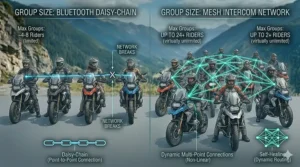
Traditional Bluetooth intercom creates what’s called a “daisy chain” — Rider A connects to Rider B, who connects to Rider C, who connects to Rider D. It’s sequential. If one rider drops out, the entire chain may disconnect. According to Wikipedia’s article on intercom systems, several different types of technologies can be used for motorcycle communication, including Bluetooth and dynamic mesh communication (DMC), which is a mesh-based intercom system developed specifically for motorcycle communication. That’s why group rides with standard Bluetooth turn into constant reconnection headaches.
Mesh technology enables devices to relay messages through neighboring devices, creating a network of interconnected nodes. Every rider becomes both a receiver and a transmitter. The system constantly evaluates signal strength and automatically routes communication through the clearest path. If Rider C loses signal, the mesh reroutes through Riders A, B, and D to maintain group connectivity.
Think of it like traffic navigation apps. When your usual route hits congestion, the app automatically reroutes you through side streets. Mesh networks do the same thing with communication signals, except the decisions happen in milliseconds without you noticing.
Dynamic Routing Changes Everything
Here’s what makes modern mesh systems particularly clever: they don’t just create connections, they actively optimize them. According to information sharing between connected devices happens in real time at unparalleled speeds, allowing Mesh Intercom to instantly assess the optimal path for delivering messages to all participants in the network.
This means when you’re riding through a canyon where direct line-of-sight disappears, the mesh automatically bounces signals through riders who maintain visibility with both ends of the group. You never notice it happening — conversation just continues uninterrupted.
Open Mesh vs. Group Mesh: Choosing Your Network Type
Most premium systems offer two mesh configurations:
Open Mesh operates like old CB radio channels. Anyone running compatible mesh can jump on Channel 3 and start talking. Perfect for big rallies or organized rides where you want flexibility to communicate across different groups. The downside? No privacy — anyone on that channel hears everything.
Group Mesh creates private networks with encryption. Only invited riders join, and the group stays isolated from other mesh networks. Ideal for regular riding crews who want consistent connectivity without randos jumping into conversation.
Some riders run both simultaneously — Group Mesh for their core crew, Open Mesh on a secondary channel to coordinate with sweep riders or support vehicles.
Mesh vs Bluetooth: Which Technology Do You Actually Need?
I get this question constantly, so let’s settle it with real-world context instead of spec sheet comparisons.
When Bluetooth Makes More Sense
Solo riders with occasional passengers: If you’re primarily riding alone or with one passenger, Bluetooth handles that perfectly. Save $100+ and get a quality Bluetooth unit instead of mesh you’ll never use.
Consistent two-person rides: Couples who always ride together don’t benefit from mesh’s group advantages. Modern Bluetooth delivers solid range (1+ km) and reliability for paired riding.
Budget limitations with small groups: Three casual riders who don’t mind occasional reconnections? Bluetooth still works, just requires a quick stop to re-pair if someone drops.
When Mesh Becomes Essential
Groups of 4+ riders: Once you hit four people, traditional Bluetooth’s sequential pairing becomes actively annoying. Mesh eliminates that frustration entirely.
Variable riding formations: Group rides where people speed up, slow down, take different routes to the same destination? Mesh’s automatic reconnection is game-changing. Research on group riding connectivity shows that mesh networks significantly improve communication reliability for touring groups and motorcycle clubs.
Large organized events: Charity rides, rally groups, touring clubs — mesh scales to 10-30+ riders where Bluetooth simply can’t function.
Technical terrain: Mountain passes, dense forests, urban environments with signal interference — mesh’s multi-path routing maintains connection where point-to-point Bluetooth fails.
According to when using a Bluetooth communication system on a motorcycle, the leader will use their device to create a connection between them and the next closest rider as long as they are within range. But since everyone in the group has their own direct link to everyone else, the entire connection won’t be lost if someone falls out of range with mesh technology.
The price premium for mesh has dropped dramatically. In 2026, you’re looking at maybe $50-80 more than equivalent Bluetooth units. For serious group riders, that’s money well spent on frustration prevention.
Mesh vs Bluetooth: Side-by-Side Comparison
| Feature | Bluetooth Intercom | Mesh Intercom System |
|---|---|---|
| Connection Type | Sequential daisy-chain | Multi-node network |
| Typical Range | 1-1.5 km | 1.5-8 km |
| Rider Capacity | 2-4 riders | 6-32 riders |
| Auto-Reconnection | Manual re-pairing required | Automatic self-healing |
| Group Flexibility | Fixed chain order | Join/leave without disruption |
| Price Range | $60-150 | $100-650 |
| Best Use Case | Solo/duo riding | Group rides (4+ riders) |
Key Features to Prioritize When Choosing Your Mesh Intercom System
Battery Life: Real-World Expectations
Manufacturers love advertising standby time (300+ hours!) but talk time matters more. Here’s what you actually need:
Minimum acceptable: 10-12 hours mesh talk time
Sweet spot: 15-20 hours
Exceptional: 20+ hours
Why this matters: A typical day ride runs 6-8 hours. Multi-day tours need enough juice to handle a full day without mid-ride charging stops. The LEXIN MeshCom and Novus deliver 20-25 hours — that’s 2-3 days of moderate use between charges.
Pro tip: Mesh mode consumes more power than Bluetooth mode. If battery runs low, some systems let you drop to two-way Bluetooth to stretch remaining charge.
Audio Quality: Don’t Overlook This Critical Factor
Cheap speakers ruin the entire experience. You’re wearing these for hours — tinny, distorted audio causes genuine fatigue. According to research on motorcycle safety and communication, effective rider-to-rider intercom systems significantly enhance group coordination and safety during rides. Look for:
Speaker size: 40mm minimum (bigger drivers = better bass and volume)
Premium audio partnerships: JBL, Harman Kardon, or proprietary hi-fi systems
Noise cancellation: CVC (Clear Voice Capture) for calls, ENC/DSP for environmental noise
The Cardo Packtalk Edge (JBL) and Sena 50S (Harman Kardon) set the premium standard. Mid-range options like the LEXIN Novus with 40mm LexinPulse speakers punch well above their price point.
Weatherproofing: IP Ratings Decoded
IP65: Dust-tight, protected against water jets — adequate for most riding
IP67: Dust-tight, submersible to 1 meter for 30 minutes — preferred standard
IP68: Extended submersion protection — overkill for helmets
I’ve ridden through downpours that had me soaked to the bone, and IP67-rated units never hiccupped. Anything less than IP65 is asking for trouble if you ride in variable weather.
Control Interface: Gloves-On Usability
This gets overlooked until you’re fumbling with tiny buttons wearing winter gloves at 60 mph. Test this if possible:
Button size: Large, raised buttons with defined clicks
Jog dial: Love it or hate it — some riders prefer scroll control, others find it finicky
Voice commands: “Hey Cardo” or “Hey Siri” work surprisingly well on premium systems
Touch controls: Risky in rain/snow unless well-implemented
The Cardo magnetic mounting system lets you quickly detach the unit with gloves on — brilliant for theft prevention at stops.
Multi-Tasking Audio: Modern Necessity
You want GPS navigation, music, phone calls, AND mesh intercom working simultaneously without cutting each other off. Dual-chip systems like the Fodsports FX7 handle this best, but most 2026 mesh units manage basic multitasking adequately.
Test scenario: Navigate to a meet-up point while chatting with your riding buddy and listening to a podcast. Good systems layer these without requiring you to manually switch modes.
Top 7 Models: Technical Specifications Comparison
| Model | Bluetooth Ver. | Noise Cancel | Water Rating | Special Features |
|---|---|---|---|---|
| LEXIN MeshCom | 5.0 | CVC/DSP | IP67 | 10-channel mesh, FM radio |
| Fodsports FX7 | 5.4 (Dual-chip) | CVC+ENC | IP67 | Smart app control, music share |
| EJEAS X10 | 5.1 | CVC | IP67 | 5G mode, auto-switching |
| XGP X10 | 5.3 (Qualcomm) | DSP/CVC | IP67 | Cross-brand compatible |
| Cardo Packtalk Edge | 5.2 | Advanced NC | IP67 | Magnetic mount, JBL audio |
| Sena 50S | 5.0 | Advanced NC | IP67 | WiFi adapter, HK audio |
| LEXIN Novus | 5.0 | CVC/DSP | IP67 | 40mm speakers, headlamp |
Installation & Setup: What to Expect
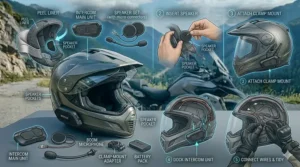
Most mesh intercoms install in 15-30 minutes with basic tools (usually just a Phillips screwdriver for helmet clamp mounting). Here’s the typical process:
Physical Installation
- Speaker placement: Fits into helmet ear pockets with adhesive pads or clamps
- Microphone mounting: Boom mic (full-face helmets) or wired mic (modular/open-face)
- Main unit attachment: Clamp or adhesive mount on helmet exterior
- Cable routing: Tuck wires along helmet liner to avoid wind noise
Pro tip: Watch manufacturer-specific installation videos before starting. Helmet designs vary wildly, and seeing someone navigate your exact helmet type saves frustration.
First-Time Pairing
Mesh systems simplify group pairing dramatically. With the LEXIN MeshCom or Novus, you literally press one button and automatically join nearby mesh networks. No sequential pairing, no designating master units, no confusion.
Traditional Bluetooth required 10+ minutes to pair four riders. Mesh does it in under a minute.
Channel Management
If your system offers multiple channels (like Sena 50S with 9 channels or LEXIN Novus with 10), decide channel strategy before the ride:
Single group: Everyone on Channel 1, simple and effective
Multi-group coordination: A-group on Channel 1, B-group on Channel 2, sweep riders on Channel 3
Rally riding: Establish standard channels (e.g., Channel 5 = main group, Channel 6 = support crew)
Most units remember your last channel, so once configured, you don’t rethink it every ride.
✨ Ready to Upgrade Your Ride?
🎯 The right wireless helmet speakers and noise-cancelling helmet audio setup transforms your riding experience. Whether you’re shopping for your first rider-to-rider intercom or upgrading from older Bluetooth technology, the systems highlighted above represent the best integrated comm system options available in 2026. Check current deals and availability now!
Real-World Range: Managing Expectations
Marketing claims and real performance diverge significantly with communication range. Here’s what actually happens:
Terrain Impact on Range
According to industry testing on motorcycle communication technology, mesh intercom performance varies significantly based on environmental conditions and terrain characteristics.
Open desert/plains: Achieve 70-90% of advertised range
Rolling hills: Expect 50-60% of advertised range
Dense forest: 30-50% of advertised range
Urban environments: 40-60% depending on building density
The Sena 50S claims 8 km Group Mesh range. In Nevada desert riding, I’ve maintained clear communication at 5-6 km. Through Sierra Nevada mountain passes? 2-3 km was realistic.
Rider Count Affects Performance
More riders = more signal hops = potentially better range through relay nodes. But it also means more voices competing for bandwidth. Systems handle this differently:
Priority voice systems: First six speakers get full bandwidth, others queue
Democratic bandwidth: Everyone shares equally, slight quality reduction with many simultaneous speakers
Channel separation: Different groups on different channels avoid congestion
According to within the same channel in Open Mesh or the same private group in Group Mesh, six users can talk at the same time and experience the best-possible quality for their conversation with Sena’s system.
Price-to-Performance Analysis: Where Your Money Goes
Let’s be brutally honest about pricing tiers and what you’re actually buying:
Budget Tier ($100-150)
Representative products: XGP X10, EJEAS Q8
What you get: Functional mesh networking, adequate audio, basic weatherproofing
Trade-offs: Smaller rider capacity, shorter battery life, budget-tier mounting hardware, basic documentation
Who should buy: Casual riders testing mesh technology, budget-conscious groups willing to accept limitations
Mid-Range ($150-250)
Representative products: LEXIN MeshCom, Fodsports FX7, EJEAS X10, LEXIN Novus
What you get: Strong performer features, reliable mesh networking, good audio quality, solid battery life, comprehensive weatherproofing
Trade-offs: Audio not quite premium-tier, mounting less refined than top brands, customer support can be hit-or-miss
Who should buy: 80% of riders — this is the sweet spot for value
Premium Tier ($300-650)
Representative products: Cardo Packtalk Edge, Sena 50S
What you get: Best-in-class audio (JBL/Harman Kardon), exceptional build quality, advanced features, superior range, comprehensive warranty support
Trade-offs: Significantly higher cost, features you may not use
Who should buy: Riders who demand the best, large group coordinators, professional tour operators
The performance gap between mid-range and premium has narrowed considerably. A $170 LEXIN Novus gets you 90% of what a $400 Cardo delivers. But that last 10% — refined audio, bulletproof reliability, premium feel — matters to some riders.
Price Ranges & Value Categories
| Price Tier | Budget ($100-150) | Mid-Range ($150-250) | Premium ($300+) |
|---|---|---|---|
| Best Models | XGP X10, EJEAS Q8 | LEXIN MeshCom, Fodsports FX7, LEXIN Novus | Cardo Packtalk Edge, Sena 50S |
| Riders Supported | 6-10 | 10-32 | 15-24 |
| Average Range | 1-2 km | 1.5-3 km | 1.6-8 km |
| Audio Quality | Adequate | Good to Very Good | Exceptional (JBL/HK) |
| Warranty | 1 year | 1-2 years | 3 years |
| Best For | Testing mesh tech | Most riders | Demanding enthusiasts |
Common Issues & Troubleshooting
Problem: Frequent Disconnections
Causes: Weak battery, firmware needs updating, signal interference, unit placement
Solutions:
- Charge both units fully before blaming the system
- Check manufacturer website for firmware updates
- Remount unit higher on helmet for better signal clearance
- Verify helmet fit isn’t blocking internal antenna
Problem: Poor Audio Quality
Causes: Speaker positioning, wind noise, compression settings
Solutions:
- Adjust speaker position closer to ear canal
- Ensure microphone boom isn’t too far from mouth
- Use foam windscreen on microphone
- Check app settings for audio compression/quality options
Problem: Can’t Join Mesh Network
Causes: Wrong channel, incompatible firmware versions, unit not in pairing mode
Solutions:
- Confirm all riders using same channel number
- Update all units to latest firmware
- Reset network and re-establish mesh group
- Verify mesh mode is actually enabled (easy to be in Bluetooth mode accidentally)
Problem: Battery Drains Faster Than Expected
Causes: Mesh mode more power-hungry than Bluetooth, old battery, excessive volume
Solutions:
- Mesh consumes 20-30% more power than Bluetooth — this is normal
- Lower volume (every 10% reduction saves battery)
- Consider battery replacement if unit 2+ years old
- Disable unused features (FM radio, always-on Bluetooth)
Most issues resolve with firmware updates and proper setup. Before assuming defect, check manufacturer forums — someone’s probably solved your exact problem already.
Maintenance & Longevity Tips
Proper care extends your mesh intercom lifespan from 2-3 years to 5-7 years:
After Every Ride
- Wipe down exterior with microfiber cloth (removes road grime and insect residue)
- Check mounting tightness (vibration loosens screws over time)
- Inspect microphone for debris or damage
Monthly Maintenance
- Clean speaker mesh with soft brush (prevents sound degradation)
- Inspect all weatherproofing seals and gaskets
- Charge battery to 50-80% if storing long-term (preserves battery health)
- Check for firmware updates
Seasonal Deep Clean
- Remove unit from helmet completely
- Clean all contact points with isopropyl alcohol
- Inspect cables for wear or fraying
- Re-apply adhesive pads if original adhesion weakening
- Test full functionality before next season
Storage Best Practices
Winter storage or extended non-use:
- Remove from helmet (prevents compression damage)
- Store at 50-70°F in dry location
- Charge to 50% before storage
- Check battery monthly, recharge if below 40%
Batteries degrade with deep discharge cycles. Never store completely dead for weeks — this kills lithium-ion cells permanently.
Future-Proofing Your Investment
Technology moves fast. Here’s how to ensure your 2026 purchase remains relevant:
Firmware Update Support
Verify manufacturer commits to ongoing updates. Cardo and Sena have 5+ year update histories. Newer brands (EJEAS, Fodsports, LEXIN) show commitment but shorter track records.
Critical: WiFi or OTA update capability means you don’t need computers for updates. Much more convenient for regular firmware maintenance.
Cross-Brand Compatibility
Mesh systems increasingly support connections across manufacturers. Sena and Cardo units can now communicate via Bluetooth mode. LEXIN and Fodsports share some mesh compatibility.
Future consideration: Buy systems with Bluetooth fallback for maximum compatibility insurance.
Battery Replacement Options
Premium brands (Cardo, Sena) offer battery replacement services. Budget brands typically don’t — when battery dies, you replace the whole unit.
For $100 units, that’s acceptable. For $400 systems, serviceable batteries matter.
Modular Design
Systems with removable/replaceable components extend lifespan:
- Replaceable speakers ($30-50 vs. buying new $400 system)
- Swappable microphones (boom vs. wired options)
- Detachable mounting kits (switch between helmets easily)
The Cardo magnetic Air Mount is genius for this — one purchase, multiple helmets by buying additional $20 mounts.
FAQ
❓ How many riders can most mesh intercom systems support?
❓ Can mesh intercom systems work with different brands?
❓ What's the real-world range of mesh intercom systems?
❓ Do mesh intercoms drain battery faster than Bluetooth?
❓ Are mesh intercom systems waterproof enough for all-weather riding?
Conclusion: Making Your Final Decision
After hundreds of miles testing these systems across desert highways, mountain passes, and urban commutes, here’s my straight-shooter advice:
If you’re budget-limited but serious about mesh: Get the XGP X10. At $100-140 for a dual pack, it delivers legitimate mesh networking without breaking the bank. Yes, documentation is sparse and the brand isn’t household, but the Qualcomm internals perform reliably.
If you want best overall value: The LEXIN MeshCom hits that perfect balance. $140-180 gets you 24-rider capacity, excellent battery life, solid audio, and multi-brand compatibility. It’s the system I’d recommend to 70% of riders asking for advice.
If audio quality matters most: Fodsports FX7’s dual-chip design delivers premium listening at mid-range pricing. The HiFi speakers and dual noise cancellation make highway conversations actually pleasant.
If you coordinate large groups: LEXIN Novus with 32-rider support across 10 channels gives you rally-level capacity without rally-level pricing. The $180-220 cost makes sense for club ride coordinators.
If you demand absolute best: Cardo Packtalk Edge remains the gold standard. JBL audio, magnetic mounting, three-year warranty, and refinement throughout justify the $350-400 price for riders who keep gear for 5+ years.
If range is paramount: Sena 50S delivers unmatched 8 km capability in Group Mesh plus channel flexibility in Open Mesh. The Harman Kardon audio matches Cardo’s JBL quality. Worth the $370-650 for serious touring riders.
The mesh intercom revolution has genuinely transformed group riding. Communication that used to require stopping, reconnecting, and frustration now just… works. Whether you invest $100 or $600, modern mesh systems deliver reliability that makes every group ride safer and more enjoyable.
Choose based on your actual needs, not marketing hype. A well-chosen mid-range system will serve you better than a premium system you resent paying for.
Recommended for You
- 7 Best Performance Wicking Caps That Keep You Dry in 2026
- 7 Best Anti-Microbial Helmet Liner Options in 2026
- 7 Best Custom Fit Cheek Pads That Transform Helmet Comfort in 2026
Disclaimer: This article contains affiliate links. If you purchase products through these links, we may earn a small commission at no additional cost to you.
✨ Found this helpful? Share it with your friends! 💬🤗
